Ethiopian MonkBiblio.com
3.275 Ergebnisse
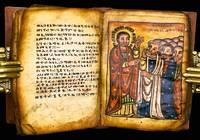
1890Best.-Nr. 518Ethiopia: Unknown 1890. First edition. Hand-tooled full red morocco over wood boards. `. Ethiopian Monk. ANTIQUE ETHIOPIAN-HANDMADE HANDWRITTEN AND HAND-PAINTED- COPTIC CHRISTIAN MANUSCRIPT PRIEST MISSAL ON PARCHMENT. This is a small monastic handmade Christian missal Maṣḥafa Qeddase made for a priest of the Ethiopian Orthodox Tewahedo Church when leading masses/religious ceremonies. It contains the divine liturgy of the church and is comprised of prayers and psalms handwritten at an Ethiopian monastery by a talented scribe circa 1890 - 1920 during the imperialistic revival period ushered in during the reign of Emperor Menelik II 1844-1913 of Ethiopia or his successor. This is evident through careful analysis of paint pigments used artistic style natural aging of the vellum signs of antiquarian wear and the distinct paleography of the period. Its four hand-painted full-page miniatures show an exceptional artistry influenced by European schools of art typical of the period. They show greater technical achievement and refinement than typically seen showing more proficient training in color balance perspective and proportionalism aside from curious uneven eye placement at times. The beautiful red morocco is later circa latter part of the 20th century and is exceptionally well-crafted and tooled in blind using traditional Ethiopian religious iconography. Most examples of Ethiopian Coptic manuscripts are quite small usually ranging between 3" x 5" to 7" x 5" or pocket-sized for personal use and often lack illustrations or sparsely and crudely have a page or two illustrated. This example is of a typical size used for an Ethiopian Coptic manuscript: 5.5 in. x 4.25 in. and features 116 total unnumbered pages written in Ge'ez - the ancient liturgical language of the Ethiopian Orthodox Tewahedo Church. Unlike most examples this missal was designed for use by a priest: there are rubrics in red ink-instructions and also horizontal red-and-black cross-shaped marks indicating when the priest should perform a specific action cantillation marks called melekket. Melekket guide the priest's movements gestures and timing and his leading of the congregation throughout the ceremony. The Ge'ez script is written in a confident highly practiced monastic hand. The letters are bold sharp and tightly spaced which is characteristic of the late- to post-Gondarine literary renaissance. The alternating black and red ink red being used for sacred names section headers or priest instructions utilizes traditional organic soot for the black ink and an imported material like cinnabar or vermillion for the red pigment. There are also harags rectangular horizontal headers with geometric patterns which signal the opening page of a new chapter or major liturgical section within the Maṣḥafa Qeddas. Some are contemporary to the text and others are more modern using ballpoint ink. The missal is bound in a later 20th century luxurious red morocco karta stretched tightly over wooden boards with exceptional tooling in blind comprised of traditional Ethiopian Christian religious symbols and motifs framing a large centralized cross. There is uniform precision in the blind-tooled geometric stamps crisp overlapping corner turn-ins and tight structural integrity of the binding. The boards and binding cords are original to the work. Interlaced within the text are four full-page miniatures in the imperialistic revival style at its height between 1890-1929. The paintings use more modern pigments made accessible through the burgeoning trade with Europe at this time. The four paintings showcase famous healing miracles performed by Jesus: 1. The Healing of the Man Born Blind from the Gospel of John Chapter 9. Jesus stands on the left adorned with a cruciform halo. He is extending his hand to touch the eyes of a blind man who is leaning forward respectfully with closed eyes. A disciple stands closely behind the blind man looking on to witness the miracle. The Ge'ez script in the top-right corner explicitly labels the scene: Wa-aḥyawo əgzi əna la- əwur which translates directly to 'And our Lord healed the blind man. 2. The Commissioning or Healing of the Apostles. Christ stands with a radiant cruciform halo raising His right hand in a classic gesture of blessing and instruction. He extends His left hand angles toward Saint Peter who stands directly at the front of the group of disciples touching his face or gesturing toward him in dialogue. Behind Saint Peter a dense layered cluster of disciples looks onward. Their highly structured stacked halo-like head shapes behind them represent the larger group of the Twelve Apostles. The Ge'ez script in the top-right corner translates to 'And our Lord taught the Apostles' - a symbolic healing of their minds and spirits. 3. The Healing of the Paralytic Man from the Gospel of Mark 2:1-12 or John 5:1-9. Jesus stands with a golden cruciform halo dressed in red and green vestments. He extends His right hand to touch the shoulder of a man dressed in a patterned dark blue robe. The healed man is walking away while carrying his bed/cot strapped to his back directly illustrating Jesus's famous scriptural command: 'Rise take up your bed and walk.' Behind Jesus Saint Peter distinguished by his white hair and beard watches the miracle with a hand extended in reverence. The Ge'ez script in the top-right corner translates directly to 'And our Lord healed the paralytic.' 4. The Raising of Lazarus from the Gospel of John Chapter 11. Jesus has His right hand raised in a gesture of divine authority and blessing commanding the dead man to arise. On the left Lazarus is shown wrapped tightly in white burial shrouds mummy-like bindings standard for Orthodox icons of this scene. He is rising vertically directly out of his open block-like wooden tomb box. Behind Jesus Saint Peter looks on closely witnessing the miraculous return to life. The painting inscription translation: 'And our Lord raised Lazarus.' HOW THIS MANUSCRIPT WAS MADE Ge'ez calligraphy executed in natural red and black inks with a reed pen in single column a format unique to psalters and missals for where many lines end in verse; otherwise two or three columns were used to maximize the use of expensive parchment and rubricated throughout adorns hand-made parchment made from goatskin or sheepskin. The parchment sheets are folded and then bound together using reed with a link chain stitch for the quires and housed in wooden boards made from local trees. Goatskin was tanned dyed and treated and stretched tightly over the wooden boards and tooled in blind. These same techniques have been consistently used for more than 1000 years and it is this consistency of technique that makes Ethiopian Coptic texts notoriously difficult to exactly date without carbon dating methods. Time periods of construction can be narrowed down with knowledge of period artistic styles pigments and materials used analysis of vellum aging and wear and the distinct changes in Ethiopian paleography over time and setting. HISTORY OF ETHIOPIAN COPTIC MANUSCRIPTS IN GE'EZ Ethiopian Handwritten Coptic Ge'ez Bibles and liturgical texts were produced as early as the fourteenth century until the early 20th century throughout Ethiopia the first country to become an independent African nation. Christianity was introduced to Ethiopia in the 4th century when Syrian missionaries first translated the Bible into Ge'ez the language of the Ethiopian Orthodox Tewahedo Church. The surviving body of Ge'ez literature is composed almost entirely of Christian liturgy as education was exclusively the responsibility of priests and monks. The bibles produced typically contain the gospels of the New Testament recounting the life of Jesus of Nazareth and the foundation of the Christian. The Ethiopian Bible contains a significantly larger canon of books than Western Bibles including texts like the Book of Enoch and the Book of Jubilees which are often found in its broader canon. It is considered one of the oldest and most complete Bibles containing more than 80 books compared to the 66 in the Protestant canon. The world's earliest illustrated Christian book is the Garima Gospels written in Ge'ez found in a remote Ethiopian monastery. It is named after a monk who arrived in Ethiopia in the 5th century and is beautifully illustrated. For perspective it predates the first King James Bible by about 1200 years. CONDITION REPORT Exterior and binding are NEAR FINE. Interior is Poor. The missal has been subjected to severe natural weathering. The sacred manuscript was salvaged and rebound in its current beautiful modern fine goatskin binding over its original wooden boards. Exterior and binding: Firmly bound. Minimal wear beautifully preserved. Some light scratches and areas of light rubbing. Vellum page edges heavily darkened with soot sun and natural aging. Interior: The vellum leaves show significant wear soiling warping and water damage. It appears as if the entire manuscript was water-logged at some point perhaps caught up a torrential East-African downpour during the rainy season. Many of the leaves are heavily water-browned and there are many areas where the text is obscured. There are also multiple areas of text loss from rips tears fading holes and heavy soiling/vellum darkening. Fortunately the exceptional paintings avoided most of the condition issues and are still colorful though darkened with age and a thin film of dust. The first painting has a large area of loss to the gutter margin fortunately only affecting the border and not the painted figural scene. There are multiple instances of modern ink marginalia and a few text corrections and insertions of harags divisional borders. All in all a scarce heavily weathered surviving example of a priest's missal rebound in modern fine goatskin leather over its original wood boards with four high-quality hand-painted miniatures. Most of the value is retained in the beautiful art fine binding and scarcity as a priest missal. Unknown unknown
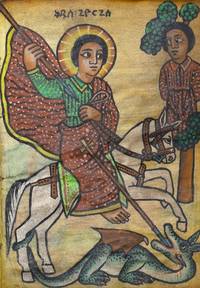
1890Best.-Nr. 529Ethiopia: Ethiopian monastery 1890. Ethiopian monastic cross-stich four-hold wood boards. ANTIQUE ETHIOPIAN-HANDMADE HANDWRITTEN AND HAND-PAINTED- COPTIC CHRISTIAN MANUSCRIPT PRIEST'S MISSAL ON PARCHMENT. This is a medium-sized monastic handmade Christian missal Mäṣḥafä Qəddase appended with two smaller works Haza Mesqel Book of the Cross and the Gadl Acts of the Archangels. It is a fantastic and scarce example of a First Gondarine revival work made circa 1890-1920. This is a pocket-sized missal made for a likely traveling priest of the Ethiopian Orthodox Tewahedo Church when leading religious ceremonies with chants and songs. Interestingly the missal omits liturgic text that was exclusively used for baptized congregation members meaning all people were welcome baptized church member or not to participate in ceremonies using this missal. The Ethiopian Christian missal contains the divine liturgy of the church and contains specific directions and cues for the priest that are synchronized with the spoken prayers and sung liturgy. Meticulously included by the original scribe are tiny interlinear musical notations called melekket between the lines of the Ge'ez liturgical text. The melekket guide the priest or liturgical singer a dabtaraon on what pitch and rhythm to use with the corresponding liturgy. Throughout the text rectangular purple marks are used to obfuscate some of the melekket. On the final blank page there is a brief ecclesiastical ownership record written in pencil by a contemporary hand which translates to 'This is the book of the Church of Saint Mary'. Most Ethiopian Coptic manuscripts are quite small usually ranging between 3" x 5" to 7" x 5" or pocket-sized for personal use and often lack illustrations or sparsely and crudely have a page or two illustrated. This manuscript is 6.75" x 5" and features 222 total unnumbered pages written in Ge'ez - the ancient liturgical language of the Ethiopian Orthodox Tewahedo Church. It is richly illustrated with 11 hand-painted pages an expensive and time-consuming proposition. There are rubrics in red ink and also special marks indicating when the priest should perform a specific action. The codex was hand-written and hand-painted at an Ethiopian monastery by a scribe circa 1890 - 1920 during the imperialistic revival period of Emperor Menelik II 1844-1913 or his successor. Its 11 striking illuminations were painted in a First Gondarine style early 17th to early 18th century incorporating the following compositional hallmarks of the period: 1 neutral backgrounds for colorful figures typically the naked vellum itself the chief distinction of this era; 2 art comprised of solid vivid colors with minimal blending or color gradients; 3 strikingly vivid color pigments used; 4 deep perspective avoided an emphasis on delicate facial shading and thick black outlines. While the sammelband contains many First Gondarine elements it still retains distinct characteristics of high-end imperialistic Gondarine revival craftsmanship ushered under the rule of Manelik II. The writing is more rounded fluid and quickly executed rather than the consistently neat uniform and methodically executed First Gondarine calligraphy. The figures are painted in 3/4 profile rather than the First Gondarine style in which full faces are shown for the righteous and one-eyed profiles for the villainous like Judas and Roman guards. The definitive tell-tale indicator is the use of paint pigments that were simply not available until the late 19th century including the striking purple hues and vibrant fluorescent-like light greens. Following are eleven paintings painted in the manuscript in order featured: 1 Saint Yared and the Three Heavenly Birds. The 6th-century Aksumite father of Ethiopian music is depicted holding a golden Sistrum and a prayer staff with a polished golden pommel. Three divine birds from Paradise are nested beside him in a stylized round-canopy tree imparting the heavenly melodies of the church. 2 The Betrayal in the Garden / The Arrest of Christ: Shows Judas leaning in close to deliver the signal the infamous kiss of Judas kissing while surrounded by a tightly packed group of temple guards. Christ is depicted with a finely detailed red-and-gold striped halo while a central guard behind Him holds a drawn weapon. 3 The Madonna and Child. A magnificent double-bordered iconographic centerpiece showing the Virgin Mary holding the Christ Child. They are flanked by the protective wings and drawn swords of the Archangels Michael and Gabriel. 4 Saint George Slaying the Dragon. This painting is a classic representation of Saint George. In the Ethiopian tradition he is deeply venerated as the patron saint of the nation a protector of the faithful and a symbol of unwavering courage. In the upper right corner is Birutawit the maiden of Beirut whom Saint George saved from being sacrificed to the dragon. 5 Christ Teaching His Disciples and Followers. Christ acts as the tall anchor on the left with his hand raised in instruction while the stacked crowd listens attentively. 6 The Crucifixion. Jesus is depicted nailed to the cross wearing a crown of thorns and blood flowing from his wounds. His frame is long and thin and his ribs are exposed. His head leans gently to the side with his eyes closed representing his death. Jesus is flanked by the two traditional figures from the Gospels. On the left stands the Virgin Mary Maryam and on the right stands Saint John the Evangelist Yohannes offering a blessing with the other. Tears stream down their faces which are filled with grief. 7 The Via Dolorosa Christ Carrying the Cross: Depicts Christ physically bearing the massive wooden beam of the cross on his shoulders pushed forward by a tightly packed column of guards and onlookers. To the right stands Simon of Cyrene who was compelled by the Roman soldiers to help carry the cross. 8 The Deliverance of the Three Holy Children: Archangel Gabriel descends from heaven with a drawn sword and a cross-topped staff to shield Shadrach Meshach and Abednego as they stand in the middle of a blazing bright red fiery furnace with their arms crossed in prayer profound reference and humility before God. They are unharmed through this divine intervention. 9 The Entombment of Christ. Shows the shrouded body of Christ being bound tightly with cords and laid to rest. A teary-eyed Virgin Mary and disciples are in the foreground of a massive multi-row stacked background of mourning followers of Christ. 10 The Raising of Lazarus. Christ extends his hand in a gesture of blessing toward a completely swaddled Lazarus rising vertically from his tomb. Martha the sister of Lazarus lifts a hand to her face in profound emotion. Surrounding them is a dense crowd of onlookers. 11 The Assembly of the Holy Fathers / Monastic Saints: A powerful liturgical gathering depicting nine high-ranking church fathers clad in traditional monastic caps and decorative capes kaba each tightly clutching a hand-cross Masqal and gospel codex. The nine saints were a group of missionaries who arrived in Axum Ethiopia during the late 5th century. They are credited with significantly expanding and cementing Christianity across the region. They were also responsible for translating the Bible and liturgical texts from Greek into Classical Ge'ez. HOW THIS MANUSCRIPT WAS MADE Ge'ez calligraphy executed in natural red and black inks with a reed pen in double columns and rubricated throughout adorns hand-made parchment made from goatskin or sheepskin. The parchment sheets are folded and then bound together using reed with a link chain stitch for the quires and housed in wooden boards made from local trees. These same techniques have been consistently used for more than 1000 years and it is this consistency of technique that makes Ethiopian Coptic texts notoriously difficult to exactly date without carbon dating and other advanced scientific methods. HISTORY OF ETHIOPIAN COPTIC MANUSCRIPTS IN GE'EZ Ethiopian Handwritten Coptic Ge'ez Bibles and liturgical texts were produced as early as the fourteenth century until the early 20th century throughout Ethiopia the first country to become an independent African nation. Christianity was introduced to Ethiopia in the 4th century when Syrian missionaries first translated the Bible into Ge'ez the language of the Ethiopian Orthodox Tewahedo Church. The surviving body of Ge'ez literature is composed almost entirely of Christian liturgy as education was exclusively the responsibility of priests and monks. The bibles produced typically contain the gospels of the New Testament recounting the life of Jesus of Nazareth and the foundation of the Christian. The Ethiopian Bible contains a significantly larger canon of books than Western Bibles including texts like the Book of Enoch and the Book of Jubilees which are often found in its broader canon. It is considered one of the oldest and most complete Bibles containing more than 80 books compared to the 66 in the Protestant canon. The world's earliest illustrated Christian book is the Garima Gospels written in Ge'ez found in a remote Ethiopian monastery. It is named after a monk who arrived in Ethiopia in the 5th century and is beautifully illustrated. For perspective it predates the first King James Bible by about 1200 years. CONDITION REPORT Exterior and binding: The uneven hand-carved boards have been worn smooth with a natural patina from over a century of use within a church by a priest. The boards have been darkened by soot smoke and the natural oils from hands. All page edges are heavily darkened. The last quartile of the codex is loose with several signatures detached and the rear board hanging on by a single cord. This takes place where the appended works were added within the missal likely creating a structural weak point when rebound. Interior: The vellum has mostly darkened to a yellowish to golden amber. with the leaves most preserved toward the center of the manuscript. The page margins are darkened and toned with hand-soiling and hand oils. The miniatures and initial dozen or so leaves and last dozen or so leaves are particularly infused with smoke and have layers of soot and residue from wax candles and frankincense censers which burned continuously in monastic buildings where this missal resided. This airborne resin and carbon settle directly onto the exposed outer page edges and the terminal pages of a book left on a lectern on its side and on certain internal pages left open for an extended period of time. This created the classic gray-black 'church dust' film visible on all the miniatures which have all been darkened. The first miniature is the least impacted and the final miniature of the nine holy fathers is heavily darkened. There are a few spots of more modern blue ink runs and writing. Other signs of use like stains soiling and water dampening spots. Evidence of bio-predation from insects on multiple leaves with holes or areas of loss with some words/letters and the bottom of one miniature impacted. One leaf has an antique repair using animal sinew stitching. All in all a scarce example of a well-loved and authentically used and aged priest's Coptic manuscript missal sammelband in Ge'ez with Ethiopian ecclesiastical provenance and 11 beautiful First Gondarine Revival paintings. . Ethiopian monastery unknown
1718Best.-Nr. 238501718 A Paris, chez Joseph Mongé ... M.DCC.XVIII., 1718. in-12 (9,5x16,5cm),[6], 72, 83, [12], 339, [12] p, [1] pl.-bl pp., 3 parties reliées en un volume.: "L'histoire abrégée de la Moscovie, des Czars ou Empereurs qui y ont regne, jusques a present", "La relation de ce que Pierre Alexeowitz, a present regnant, a fait de plus remarquable dans ses Etats" - Nouvelle édition française, rare. Illustrée d'un portrait au frontispice de Pierre 1er et d'une grande carte dépliante. Réimpression de l'originale française parue en 1717 chez Jean Boudot. Reliure en pleine basane brune d'époque. Dos à nerfs orné. Coiffes de tête et queue en partie élimées. Epidermures sur les plats. Frottements au coiffes et bordures,tranches rouges.Texte et ill.fraiches.
2017Best.-Nr. 1-3639537378Editorial Académica Española 2017. Paperback. New. 68 pages. Spanish language. 8.66x5.91x0.16 inches. Editorial Académica Española paperback
2014Best.-Nr. 1386523NASA. New. 2014. Soft Cover. Reprint Edition . NASA paperback
Best.-Nr. 0077701402.Ghardcover. Good. Access codes and supplements are not guaranteed with used items. May be an ex-library book. hardcover
Best.-Nr. 28112647-nnew. unknown
Best.-Nr. 28112647like new. unknown
2013Best.-Nr. SKU0201090McGraw-Hill Education 2013-01-14. Hardcover. Good. Textbook May Have Highlights Notes and/or Underlining BOOK ONLY-NO ACCESS CODE NO CD Ships with Tracking McGraw-Hill Education hardcover
Best.-Nr. UJan2018--1797McGraw-Hill Education 2017-02-02. Hardcover. Good. 8x1x10. US Edition Textbook May Have Highlights Notes and/or Underlining BOOK ONLY-NO ACCESS CODE NO CD Ships with Emailed Tracking from USA McGraw-Hill Education hardcover
2017Best.-Nr. G1259869571I5N00McGraw Hill 2017. Hardcover. Acceptable. Readable copy. Pages may have considerable notes/highlighting. ~ ThriftBooks: Read More Spend Less.Dust jacket quality is not guaranteed. McGraw Hill hardcover
Best.-Nr. 53308105like new. unknown
Best.-Nr. 53308105-nnew. unknown
Best.-Nr. 6417371Edition: Second . Good Condition. No Hassle 30 Day Returns Ships Daily Underlining/Highlighting: NONE Writing: NONE Publisher: McGraw Hill Education Pub Date: 1/1/2014 Binding: Loose Leaf Pages: 532 unknown
Best.-Nr. 17728Paris, Bachelier, 1819. In-8, VIII-200 pp. 5 pl., basane blonde de l'époque, dos lisse orné de filets dorés, pièces de titre rouge et verte, tranches mouchetées (épidermures, quelques petites rousseurs ou taches, petit manque marginal à la dernière planche sans atteinte à l'image).
Best.-Nr. 2932240Madrid.: Fernando Fe. Hardcover. Cubierta deslucida. Good. 21 cm. 468 p. Encuadernación en tapa dura artesanal con lomo en piel. Cubierta deslucida. Literatura.82 82 Fernando Fe. hardcover
Best.-Nr. 12698568-nnew. unknown
Best.-Nr. 12698568like new. unknown
Best.-Nr. 1463300131.Ghardcover. Good. Access codes and supplements are not guaranteed with used items. May be an ex-library book. hardcover
2017Best.-Nr. 2-6202266546Éditions universitaires européennes 2017. Paperback. New. 88 pages. French language. 8.66x5.91x0.20 inches. Éditions universitaires européennes paperback
Best.-Nr. 1904052177.Gpaperback. Good. Access codes and supplements are not guaranteed with used items. May be an ex-library book. paperback
Best.-Nr. 0R-X9PB-N921Publifolha. New. Publifolha unknown
Best.-Nr. SPN-530Metz : Éditions Le Lorrain, s.d. Fascicule agrafé, 24 pages, 3 documents en noir (aquarelle de l'ermitage et la chapelle Ste-Vérène d'Enchenberg + photo de l'ermitage et la chapelle St Jacques de Mussy-l'Evêque + plan de la chapelle et de l'ermitage St Roch de Koenigsmacker). Hommage de l'auteur en première page. [BEG, petite étiquette apposée sur le premier plat, 2 cachets anciens de bibliothèque en début et fin d'ouvrage. Cf.photos] Ouvrage peu courant.
Best.-Nr. 19947ABo.J. Handkolorierter Kupferstich. 25, 8 x 19,8 cm.
Best.-Nr. 19948ABo.J. Handkolorierter Kupferstich. 25, 8 x 19,8 cm.