MONGE, GaspardLivre Rare Book

3332 resultados
ref. 16924Paris, Impr. du Comité de Salut public, 1794 - An 2.
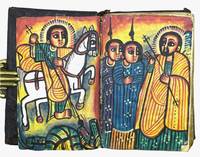
1890ref. 513Ethiopia: Unknown 1890. First edition. Hand-made: Hand-tooled red-brown morocco over wood boards. Very Good/`. Ethiopian Monk. BEAUTIFUL ANTIQUE ETHIOPIAN-HANDMADE HANDWRITTEN AND HAND-PAINTED RELIGIOUS MANUSCRIPT ON VELLUM. WITHIN THIS LITURGIC WORK IN ADDITION TO THE MANY PRAYERS AND INVOCATIONS INVOLVING JESUS AND THE VIRGIN MARY THE MANUSCRIPT IS BLESSED AND SANCTIFIED TO PROTECT THE OWNER AND HIS ENTIRE BLOODLINE FROM EVIL AND HARM INCLUDING DARK SPIRITS PHANTOM ILLUSIONS DEMONS DISEASE WAR AND SORCERY. This is a medium pocket-sized 6 3/8 inches x 4 1/4 inches 92-page collection of Christian liturgical prayers and blessings found in the sacred Ethiopian religious works Sene Golgotha and the Miracles of Mary. It was hand-made and personalized for an individual and his family by an Ethiopian monk circa 1890s to 1920s. It is handwritten entirely in the classical Semitic liturgical language Ge'ez on vellum and bound in blind-tooled morocco tightly stretched over wooden boards. The manuscript serves a dual purpose: 1 it functions as an active liturgical devotional script used by a priest during family or church gatherings and 2 it acts as an apotropaic evil-averting physical shield meant to safeguard an individual and his entire multi-generational bloodline. A hand-made prayer manual of this quality with six miniatures and finely bound in morocco would have been a luxurious and expensive item of importance made for a more affluent family. ABOUT THE WORK The original recipient's personal info has been painted over and replaced with that of a new recipient throughout the manuscript. The final page of the manuscript is a colophon page written by a prior owner not the scribe. It is dated 1914 Ethiopian 1921-1922 in Western years in both purple and blue ink and lists personal and family tree information. In traditional Ethiopian manuscripts a page like this located at the very end of a prayer book was frequently used as a family register or a commemorative prayer list. The owner would write down the baptismal names of their family members so that a priest could read them aloud during services asking for a blessing over their household. It is quite lovely to find provenance of ownership and specific dates as they are often lacking in Ethiopian Coptic manuscripts. The original owner of the manuscript is unknown 'whited out' but the subsequent owner is identified as Walda Yared throughout the manuscript. In 1921-1922 ownership passed on to Wongelawi Wolde Rufael whose name and family tree is identified on the last page colophon. The Ge'ez script is written in strokes executed with a thick heavy rounded hand using a split-nib reed pen bila. The scribe is writing efficiently and smoothly in a style typical of the late 19th century to turn-of-the-century expansion of book production rather than using the strict elongated razor-sharp geometric strokes demanded by early to mid-18th-century imperial scriptoriums. The alternating black and red ink red being used for sacred names the recipient's and his family member's names or section headers utilizes traditional organic soot or another local carbon source for the black ink and imported vermillion or another source like cinnabar introduced via trade for the red ink. Subject matters include the following prayers and blessings: For and from the Virgin Mary and Jesus for the man and his bloodline for whom this prayer manual was made from passages found in the New Testament - birth of Jesus Jesus's teachings the Crucifixion and Annunciation the archangels and more and specific prayers and blessings to ward off evil and offer protection to the family who possessed this holy prayer book. Some examples of striking content: 1. The manuscript opens with hand paintings and opening prayers for the owner and transitions into the protective amulet-style properties of the manuscript page 6 declaring how its physical presence shields against natural disasters sickness and attacks while prominently inserting a personal blessing for the manuscript's owner Walda Yared. 2 There is a section emphasizing Christ's absolute dominion over death and the underworld. It states that by binding the names that command Sheol subdue the primeval serpent and govern cosmic borders like Jordan Mary guarantees that the Covenant of Mercy she is securing reaches into the deepest abyss to rescue souls from damnation Miracles of Mary. 3 There is a vivid passage that functions as a powerful exorcism and protective shield explicitly listing various categories of dark spirits phantom illusions and sorceries that are completely paralyzed and banished by the presence of this prayer manuscript. 4 The manuscript owner's name is written in red text by a scribe and included throughout the work; it is the ultimate fulfillment of the manuscript's purpose. By writing the name directly into the climax of Sene Golgotha for example the scribe structurally links his soul and those of his loved ones to Christ's promise: that anyone who commissions or possesses this text is guaranteed safety from the powers of darkness and absolute remission of sins. 5 Page 44 Jesus speaking Sene Golgotha: 'Whether they are tested by a sudden affliction or by evil spirits or by a snake's bite; whether by a burning fire or by deep water. They shall be saved when they enter or when they go out. All of these shall not be able to draw near to anyone who carries this prayer. And the power of human curses and sorcery and the evil eye of man or woman shall not be able to draw near to anyone who carries this prayer. The power of evil spirits and demons shall find no place against anyone who carries this prayer. And inside their fields if they read this prayer the pests that destroy the harvest shall not be able to draw near. And all their crops shall be blessed and multiply up to thirtyfold and sixtyfold and an hundredfold and all the fruits of the earth. And no destruction or plague shall come upon them.' ELEMENTS OF THE MANUSCRIPT The prayer book is bound in luxurious and dark red-brown morocco Beranna stretched tightly over wooden boards with intricate tooling in blind framing a large centralized cross. Interlaced within the text are six full-page miniatures in groupings of two that are painted in the artistic revival style prominent during the reign of Emperor Menelik II 1889 - 1913 style. The paintings are themes commonly featured in Ethiopian Christian liturgical texts. In order of appearance: 1. Saint George Slaying the Dragon. This painting is a classic representation of Saint George. In the Ethiopian tradition he is deeply venerated as the patron saint of the nation a protector of the faithful and a symbol of unwavering courage. The very large expressive almond-shaped eyes and vividly colorful robes are characteristic of the late 19th century to early 20th century period in Ethiopian manuscript painting. 2. A Saint Blessing Disciples. The scene features a saint as designated by the halo and cross-staff possibly Saint Philip the Evangelist or Saint Peter or Saint Paul all who are often depicted in similar fashion. The saint is scene offering a blessing with his right hand to the people in attendance. 3. Nativity Scene. The Virgin Mary is with the swaddled Christ Child; they have matching radiant halos. Mary is wearing a deep indigo or charcoal-colored maphorion cloak with distinct fold lines a Gondarine art form first developed in the late 1700s. 4. & 5. Jesus & Disciples. Jesus is depicted offering prayer and guidance to his disciples. 6. Virgin Mary. Mary is shown offering blessings or intercessory prayer to two holy attendants with hands reverently crossed. HOW THIS MANUSCRIPT WAS MADE Ge'ez calligraphy executed in natural carbon-based black ink and imported vermillion- or cinnabar-based red inks with a reed pen in double columns and rubricated throughout adorns hand-made parchment made from goatskin or sheepskin. The vellum sheets are folded and then bound together using reed with a link chain stitch for the quires and housed in wooden boards made from local trees typically olive or wanza. Goatskin was tanned dyed and treated and stretched tightly over the wooden boards and then intricately tooled in blind. These same techniques have been consistently used for more than 1000 years and it is this consistency of technique that makes Ethiopian Coptic texts notoriously difficult to exactly date without carbon dating methods or in this case distinct paleography artistic style paint sources used and most importantly provided dates of ownership. HISTORY OF ETHIOPIAN COPTIC MANUSCRIPTS IN GE'EZ Ethiopian Handwritten Coptic Ge'ez Bibles and liturgical texts were produced as early as the fourteenth century until the early 20th century throughout Ethiopia the first country to become an independent African nation. Christianity was introduced to Ethiopia in the 4th century when Syrian missionaries first translated the Bible into Ge'ez the language of the Ethiopian Orthodox Tewahedo Church. The surviving body of Ge'ez literature is composed almost entirely of Christian liturgy as education was exclusively the responsibility of priests and monks. The bibles produced typically contain the gospels of the New Testament recounting the life of Jesus of Nazareth and the foundation of the Christian. The Ethiopian Bible contains a significantly larger canon of books than Western Bibles including texts like the Book of Enoch and the Book of Jubilees which are often found in its broader canon. It is considered one of the oldest and most complete Bibles containing more than 80 books compared to the 66 in the Protestant canon. The world's earliest illustrated Christian book is the Garima Gospels written in Ge'ez found in a remote Ethiopian monastery. It is named after a monk who arrived in Ethiopia in the 5th century and is beautifully illustrated. For perspective it predates the first King James Bible by about 1200 years. CONDITION REPORT Very Good for a hand-made Ethiopian prayer manual used in religious ceremonies and rites of protection for over a century. Exterior and binding: Firmly bound with some spine twist. Boards and spine are naturally worn by generations of handling and rubbing. Some scrapes and spots of soiling. Interior: The vellum pages show light natural aging - mostly light toning more yellowed and browned on occasion. Marginal finger soiling particularly the bottom margin which was intentionally made wide for handling purposes. Quite a few pages soiled in a thin layer of dust that the vellum has soaked up. The first and last pages are quite grubby. The colophon hand-written 1921-22 is faded. The paintings are well-preserved colorful and bright and nicely executed. Signs of handling like stains some creases smudges dust soiling 'whited out names replaced with family names of a new owner. A few small areas of marginal vellum loss. All in all a lovely medium-sized example of a late 19th century to early 1920s Ethiopian hand-made prayer manuscript and protective ward from physical and spiritual harm used by multiple families over the past 100 years. Please view pictures as they are an important part of the condition description and book information. As a fellow book collector I know how frustrating it can be when items aren't accurately described or poorly packaged for shipping. That is why I 1 take a lot of pictures and try to describe condition issues as accurately as possible and 2 pack your book purchases with the utmost care before shipping. . Unknown unknown
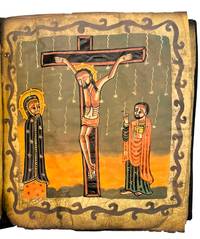
1780ref. 507Ethiopia: Unknown 1780. First edition. Hand-made: Hand-tooled full red morocco over wood boards. Very Good/`. Ethiopian Monk. MAGNIFICENT EXAMPLE OF AN ANTIQUE ETHIOPIAN-HANDMADE HANDWRITTEN AND HAND-PAINTED- COPTIC MANUSCRIPT ON PARCHMENT. This is a large luxurious monastic psalter comprised of about 75 psalms of 151 total handwritten and handmade at an Ethiopian monastery by a talented scribe at the height of the Second Gondarine period in Ethiopia or shortly thereafter circa 1780s to 1830s judging by the aging of the vellum signs of centuries-old wear and the distinct paleography. Its four hand-painted miniatures were added later by a skilled artist over existing text circa mid-19th to early 20th century. The beautifully preserved leather wrap-around binding over heavy wood boards is later with remnants of unremoved goat hair still intact. Most examples of Ethiopian Coptic manuscripts are quite small usually ranging between 3" x 5" to 7" x 5" or pocket-sized for personal use and often lack illustrations or sparsely and crudely have a page or two illustrated. This example is quite large for an Ethiopian Coptic manuscript: 9" x 8" 2 to 5 times larger than a typical example and features 122 total unnumbered pages written in Ge'ez - the ancient liturgical language of the Ethiopian Orthodox Tewahedo Church. This lovely lectern copy was designed to be used during religious ceremonies. The Ge'ez script is written in a confident highly practiced monastic hand. The letters are bold sharp neat and evenly spaced which is characteristic of the late Gondarine literary renaissance. The alternating black and red ink red being used to rubricate sacred names or section headers utilizes traditional organic soot and mineral pigments. The symbol composed of red and black dots at the end of each text line is a traditional scribal verse separator called a Geʽez misraf. The prayer book is bound in luxurious red-brown morocco Beranna stretched tightly over wooden boards with intricate tooling in blind framing a large centralized cross. Interlaced within the text are four full-page miniatures that were added later and painted over existing text in a Gondarine style using more modern pigments. The paintings are themes commonly featured in psalters from the late 18th century to early 20th century. 1. Saint George Slaying the Dragon. This painting is a classic representation of Saint George. In the Ethiopian tradition he is deeply venerated as the patron saint of the nation a protector of the faithful and a symbol of unwavering courage. The large expressive almond-shaped eyes of St. George the three-quarter turn of the head the specific layout of the horse's tack and the warm earth-and-mineral pigments reds yellows and deep charcoals are highly characteristic of Second Gondarine and post-Gondarine art styles. In the upper right corner is Birutawit the maiden of Beirut whom Saint George saved from being sacrificed to the dragon. 2. The Masqalaor the Image of the Virgin and Child with Her Guardians. A foundational piece of art frequently included in highly sacred texts like the Psalter Dawit. The Virgin Mary is holding the Christ Child Maryam and Iyasus flanked by the Archangels Michael and Gabriel wielding drawn swords. Mary is wearing a deep indigo or charcoal-colored maphorion cloak with distinct fold lines a Gondarine art form not developed until the late 1700s adorned with small golden stars. The decorative red and gold borders on her clothing are highly characteristic of styles used late18th century to early 20th century. The inscription written in Ge'ez above Mary's shoulder translates to 'With Her Beloved Son.' 3. The Crucifixion. Jesus is depicted on a dark T-shaped or Latin cross wearing a traditional striped loincloth. His frame is long and thin and his ribs are prominently exposed. His head leans gently to the side representing his death. Jesus is flanked by the two traditional figures from the Gospels. On the left stands the Virgin Mary Maryam and on the right stands Saint John the Evangelist Yohannes holding a book in one hand and offering a blessing with the other. 4. The Resurrection. Rather than showing Christ emerging from a stone tomb like in Western European art Ethiopian icons depict Jesus standing victoriously upon a stylized pedestal platform which represents Hades or the broken gates of Death. He holds a long slender staff capped with a cross Qewami Meskel that serves as a sign of victory over death showing that the tool of his execution has become his instrument of triumph. His multi-layered radiant golden halo indicates his divinity. He is accompanied by witnesses bottom and angels in the sky. HOW THIS MANUSCRIPT WAS MADE Ge'ez calligraphy executed in natural red and black inks with a reed pen in single columns a format unique to psalters for religious texts otherwise two or three columns were used to maximize the use of expensive parchment and rubricated throughout adorns hand-made parchment made from goatskin or sheepskin. The parchment sheets are folded and then bound together using reed with a link chain stitch for the quires and housed in wooden boards made from local trees. Goatskin was tanned dyed and treated and stretched tightly over the wooden boards and then intricately tooled in blind. These same techniques have been consistently used for more than 1000 years and it is this consistency of technique that makes Ethiopian Coptic texts notoriously difficult to exactly date without carbon dating methods. HISTORY OF ETHIOPIAN COPTIC MANUSCRIPTS IN GE'EZ Ethiopian Handwritten Coptic Ge'ez Bibles and liturgical texts were produced as early as the fourteenth century until the early 20th century throughout Ethiopia the first country to become an independent African nation. Christianity was introduced to Ethiopia in the 4th century when Syrian missionaries first translated the Bible into Ge'ez the language of the Ethiopian Orthodox Tewahedo Church. The surviving body of Ge'ez literature is composed almost entirely of Christian liturgy as education was exclusively the responsibility of priests and monks. The bibles produced typically contain the gospels of the New Testament recounting the life of Jesus of Nazareth and the foundation of the Christian. The Ethiopian Bible contains a significantly larger canon of books than Western Bibles including texts like the Book of Enoch and the Book of Jubilees which are often found in its broader canon. It is considered one of the oldest and most complete Bibles containing more than 80 books compared to the 66 in the Protestant canon. The world's earliest illustrated Christian book is the Garima Gospels written in Ge'ez found in a remote Ethiopian monastery. It is named after a monk who arrived in Ethiopia in the 5th century and is beautifully illustrated. For perspective it predates the first King James Bible by about 1200 years. CONDITION REPORT Very Good for a hand-made Ethiopian psalter used in religious ceremonies for centuries. 'Good' by antiquarian book standards. Exterior and binding: Firmly bound. Minimal wear beautifully preserved. Some light scratches and areas of light rubbing. Interior: The vellum pages show significant natural aging - internal cracking within the parchment caused by the breakdown of collagen over the centuries and shrinking and yellowing of the vellum - all caused by fluctuating changes in heat and humidity over long periods of time. The page margins are layered in hand-soiling and hand oils as well as soot and residue from wax candles and frankincense censers which burn continuously in monastic buildings. Over decades and centuries this airborne resin and carbon settle directly onto the exposed outer page edges and the first few pages of a book left on a lectern or internally if a book is left open as is the case in several spots in this manuscript. This created the classic gray-black 'church dust' film visible on the first two miniatures while the other two are in FINE condition and exceptionally preserved. The edges of the pages are brittle with age and there are numerous cracks chips creases and marginal tears. There are a few spots of immature marginal art in a child's hand added in more modern times and some examples of later added Ethiopian writing in pen. Other signs of use like stains soiling and water dampening spots. All in all a lovely large example of a late 18th century to early 19th century Ethiopian hand-made psalter used in religious ceremonies for generations with later added masterfully painted religious scenes and bound in luxurious red-brown morocco hand-tooled in blind. Unknown unknown
1953ref. 819991953-54. From the collection of Jazz Hall-of-Famer Junior Mance from his time as house pianist at the Bee Hive in Chicago. None of the leaves are personalized apart from that of Coltrane who has inscribed "Best to Junior John Coltrane." The Coltrane leaf is mounted with a studio printed photograph by Francis Wolff a portrait of 'Trane taken in 1956 at bassist Paul Chambers's Blue Note recording sessions for Whims Of Chambers; Pres with an image by the Dutch jazz photographer Gerrit Schilp; Monk the leaf inscribed "Good luck always" with an original photograph of Monk by Duncan Schiedt; and Bird mounted with a high quality reproduction of the famous James Kriegsmann studio portrait of the young Bird. Junior Mance began playing the piano at the age of five not receiving formal training until the age of eight and starting to play professionally during his early teens. He attended Roosevelt College in Chicago as a music major. In 1947 Mance left Roosevelt College to join Gene Ammons' band and began his recording career with Gene. He joined Lester Young in 1949 for almost two years and rejoined Ammons several months in 1951 before being drafted into the U. S. Army serving in the 36th Army Band at Fort Knox Kentucky along with Julian "Cannonball" Adderley. After his discharge from the Army in 1953 he became part of the house rhythm section at the Bee Hive Jazz Club in Chicago for a year accompanying musicians such as Charlie Parker Coleman Hawkins Eddie "Lockjaw" Davis and Sonny Stitt. In 1954 Mance joined and toured with Dinah Washington later working with Dizzy Gillespie before forming his own trio. Junior Mance was inducted into the International Jazz Hall of Fame in 1997 he continues to work in NYC and Japan. A really lovely group of important and uncommon signatures with a most excellent provenance. Four individual autograph album leaves from an album kept by pianist Junior Mance each archivally mounted framed and glazed together with a photographic portrait of subject accompanied by a similarly presented image of Mance himself with signature. Very good condition. unknown
2021ref. SBBIH-NQWMQB4JPTLOAACHE Ediciones 2021. paperback. Good. Our good condition books are generally good for reading but not for gifting or collecting. They could have imperfections such as creasing fanning inscriptions margin notes yellowing staining on edge or cover or pages bumps scuffs etc etc sometimes multiple of these. It's a wide category that encompasses anything that isn't almost-new down to anything that is slightly better than poor. We would NOT recommend gifting Good books - these should be considered reading copies. Our books are dispatched from a Yorkshire former cotton mill. We list via barcode/ISBN so please note that the images are stock images and may not be the exact copy you receive furthermore the details about edition and year might not be accurate as many publishers reuse the same ISBN for multiple editions and as we simply scan a barcode or enter an ISBN we do not check the validity of the edition data when listing. If you're looking for an exact edition please don't order at least not without checking with us first although we don't always have time to check. We aim to dispatch prompty the service used will depend on order value and book size. We can ship to most countries see our shipping policies. Payment is via Abe only. AACHE Ediciones paperback
ref. 67180A Paris, chez L. Reynier [et de l'Imprimerie du cercle social], an IV [1795], , 7 volumes in-8, 28 [+ 2] planches gravées en taille-douce, 6 volumes reliés veau havane de l'époque, dos à nerfs et fleuronnés, pièces de titre et de tomaison fauve ; et 1 volume broché sous couverture d'attente bleue, TRÈS RARE COLLECTION COMPLÈTE, EN ÉDITION ORIGINALE, DES COURS DONNÉS DANS LES ÉPHÉMÈRES ÉCOLES NORMALES ; bien complète du 7e volume de Débats, et des 28 planches gravées sur cuivre, dont 2 (planches 1 et 2 de l'histoire naturelle) sont répétées et reliées à la fin du volume 6. L'ensemble comprend donc : 24 planches de Géométrie descriptive, 2 planches de mathématiques et 2 planches d'histoire naturelle. Créées le 9 brumaire an III par décret de la Convention Nationale afin de former les instituteurs de langue française, les Écoles normales ont eu une durée de vie très courte ; 4 mois, du 1er pluviôse au 30 floréal de l'an III (20 janvier - 19 mai 1795). MONGE Y EXPOSA SA GÉOMÉTRIE DESCRIPTIVE ET LAPLACE SON HYPOTHÈSE COSMOGONIQUE. Les leçons qui étaient professées, par les savants les plus illustres, devaient être toutes improvisées, recueillies par la sténographie et publiées dans le journal de l'école créé à cet effet, de même que les débats ayant lieu une fois par décade, à l'occasion desquels les élèves discutaient avec les professeurs. Plus de 180 cours furent ainsi donnés, par 14 professeurs nommés par décrets : Lagrange et Laplace pour les mathématiques, Monge pour la géométrie descriptive, Haüy pour la physique, Daubenton pour l'histoire naturelle, Berthollet pour la chimie, Buache et Mentelle pour la géographie, Volney pour l'histoire, Bernardin de Saint-Pierre à la morale, Sicard à la grammaire, Garat à l'analyse de l'entendement, La Harpe pour la littérature et Vandermonde pour l'économie politique (Thouin, nommé pour l'agriculture, ne put jamais donner de cours). Ex-libris manuscrit de l'époque aux titres des 6 premiers tomes. Très bon exemplaire en reliure uniforme, sauf pour le tome 7, non rogné, sous couverture d'attente de l'époque (usagée). Petits accrocs au plat supérieur du tome 6 et à la coiffe inférieure du tome 5. Une lacune de 2 cm environ à un feuillet du tome II, avec perte de texte. Quelques annotations anciennes. Rares rousseurs. Ferdinand Buisson, Nouveau Dictionnaire de Pédagogie et d'Instruction primaire. Couverture rigide
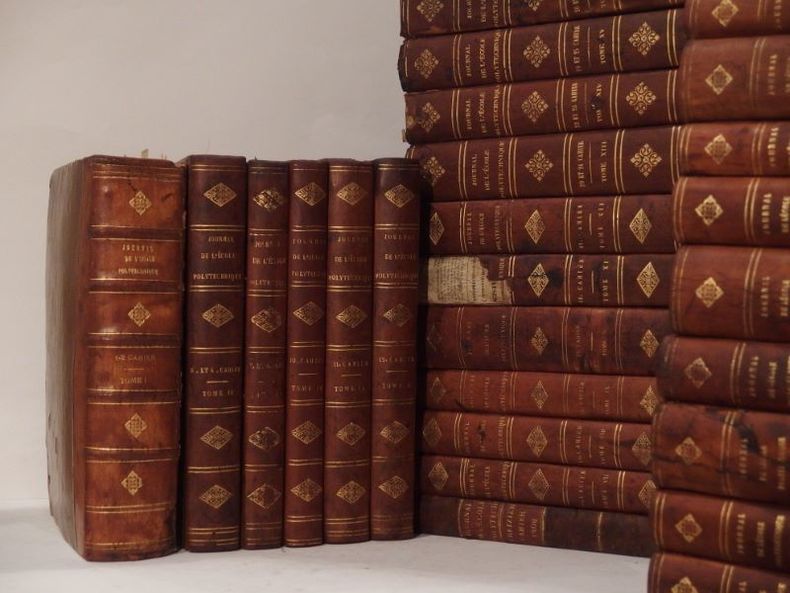
ref. 13594Paris, De l'Imprimerie de la République, Régent et Bernard, Bachelier, Mallet-Bachelier, Gauthier-Villars, An III (1794) - 1881. 48 tomes (1 à 8 et 10 à 49) in-4 reliés en 27 volumes, 160 planches hors-texte, quelques figures dans le texte, reliure demi-basane ou veau à coins (reliure frottée, manques à quelques coiffes, quelques mors fendillés, manque la moitié du dos au tome 11, dos du tome 20 tabîmé, mors supérieur du tome 1 fendu, rousseurs éparses). Tampons humides ("Bibliothèque de l'Université de France", "Echange autorisé", "Dons n° 12961", "Ecole Polytechnique") et ex-libris : Citoyen Messier (manuscrit), Lefebure de Fourcy 1869 (impr.) et "Monsieur Lefebvre" (manuscrit), Paul Serret (d'après un certificat de la Librairie scientifique A. Hermann, daté 1884 et signé par le libraire, qui confirme qu'il s'agit d'une collection ayant fait l'objet d'un échange autorisé avec la Bibliothèque de l'Université - cf. cachets, et par exemple l'ex-dono manuscrit suivant, répété : "à Mr. Lefebvre, Elève de l 'Ecole Polytechnique, De la part du Conseil de la dite Ecole").