933 résultats
1930réf. 263869London: Chatto and Windus 1930. pocket size 12mo. Various colours of cloth. Many in red decorated dustjackets with phoenixs repeated priced 3s 6d net or later 4s net. Some signed R.F. Ashley-Montagu London. VG generally. pocket size 12mo. Including Julian Huxley Aldous Huxley Richard Aldington Jane Austen Marcel Proust. Chatto and Windus unknown books
1930réf. 263869London: Chatto and Windus 1930. pocket size 12mo. Various colours of cloth. Many in red decorated dustjackets with phoenixs repeated priced 3s 6d net or later 4s net. Some signed R.F. Ashley-Montagu London. VG generally. pocket size 12mo. Including Julian Huxley Aldous Huxley Richard Aldington Jane Austen Marcel Proust etc. Chatto and Windus unknown
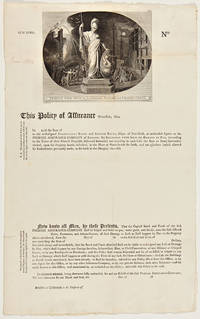
1804réf. WRCAM37730London 1804. Bifolium consisting of one unaccomplished broadside form and one broadside advertisement 19 1/2 x 12 inches. Copper- engraved scene 5 3/4 x 7 inches at head of form. Woodcut emblem 3 x 4 1/2 inches at head of advertisement. Two vertical and three horizontal folds. Contemporary manuscript inscription "June 1804" in left margin beside engraving in first leaf; contemporary manuscript inscriptions dated November 8 1804 on blank verso of first leaf referring to policy rates in Charleston. Half-inch tear at gutter of first leaf repaired with tape on verso. Portion of upper corner at fore-edge and portion of margin at gutter lacking from second leaf supplied in later paper. Second leaf somewhat faded. Else near fine. Bifolium of two broadsides for the Phoenix fire insurance company of London at the time of the opening of its first agency in New York. The Phoenix Assurance Company still operating today as Phoenix Life Ltd. was founded in 1782 by a consortium of sugar refiners in London seeking more reasonable rates for the insurance of their risky holdings against fire. By the mid-1780s Phoenix had established itself as a successful fire insurer across the whole of Great Britain for a wide array of businesses and homes. In 1785 the Phoenix Company sold its first North American policy at Charleston and the first policy in New York was accepted two years later. It was not until 1804 however that Phoenix began establishing actual agencies in the New World breaking ground in New York with the appointment of Theophylact and Andrew Bache as agents there. The first leaf is a printed policy form for the Phoenix Company in New York never filled in. The second leaf is an advertising broadside for the company containing a table of rates for New York subscribers and a detailed list of conditions for new policies. The handsome copper engraving at the top of the form leaf depicts a helmeted goddess presumably Athena on a pedestal bearing a shield stamped with the word "PROTECTION" and the image of a phoenix rising from ashes. Behind the figure is a nighttime scene of the burning remains of a building and a family of victims spilling onto the street. A team of firefighters is extinguishing the flames with a pump-operated hose and behind them is a scaffolded building under repair. The engraved caption reads: "PHOENIX FIRE OFFICE LOMBARD STREET and CHARING CROSS." A similar illustration in woodcut is included at the head of the "Proposals" broadside. Here the goddess is the only figure depicted. On her left are both the burning building and the new construction; on her right is a ship at sea engulfed in flames. The hooks and axes of the firefighter adorn the sides of the cut. The Goldsmiths'-Kress Library of Economic Literature at Harvard lists a copy of the Boston variant of the advertising broadside. The only located institutional holding of this New York issue however is at the Connecticut Historical Society. No records of the printed form in any issue have been located. A rare and interesting pair of documents from the early history of international insurance. KRESS B4839 variant. Clive Trebilcock PHOENIX ASSURANCE AND THE DEVELOPMENT OF BRITISH INSURANCE VOLUME I 1782-1870 Cambridge University Press 1985 pp.184-201. unknown books
1804réf. 37730London. 1804. Illustrated Fire Insurance Policy Bifolium of two broadsides for the Phoenix fire insurance company of London at the time of the opening of its first agency in New York. The Phoenix Assurance Company still operating today as Phoenix Life Ltd. was founded in 1782 by a consortium of sugar refiners in London seeking more reasonable rates for the insurance of their risky holdings against fire. By the mid-1780s Phoenix had established itself as a successful fire insurer across the whole of Great Britain for a wide array of businesses and homes. In 1785 the Phoenix Company sold its first North American policy at Charleston and the first policy in New York was accepted two years later. It was not until 1804 however that Phoenix began establishing actual agencies in the New World breaking ground in New York with the appointment of Theophylact and Andrew Bache as agents there. The first leaf is a printed policy form for the Phoenix Company in New York never filled in. The second leaf is an advertising broadside for the company containing a table of rates for New York subscribers and a detailed list of conditions for new policies. The handsome copper engraving at the top of the form leaf depicts a helmeted goddess presumably Athena on a pedestal bearing a shield stamped with the word "PROTECTION" and the image of a phoenix rising from ashes. Behind the figure is a nighttime scene of the burning remains of a building and a family of victims spilling onto the street. A team of firefighters is extinguishing the flames with a pump-operated hose and behind them is a scaffolded building under repair. The engraved caption reads: "PHOENIX FIRE OFFICE LOMBARD STREET and CHARING CROSS." A similar illustration in woodcut is included at the head of the "Proposals" broadside. Here the goddess is the only figure depicted. On her left are both the burning building and the new construction; on her right is a ship at sea engulfed in flames. The hooks and axes of the firefighter adorn the sides of the cut. The Goldsmiths'-Kress Library of Economic Literature at Harvard lists a copy of the Boston variant of the advertising broadside. The only located institutional holding of this New York issue however is at the Connecticut Historical Society. No records of the printed form in any issue have been located. A rare and interesting pair of documents from the early history of international insurance. Bifolium consisting of one unaccomplished broadside form and one broadside advertisement 19½ x 12 inches. Copper-engraved scene 5¾ x 7 inches at head of form. Woodcut emblem 3 x 4½ inches at head of advertisement. Two vertical and three horizontal folds. Contemporary manuscript inscription "June 1804" in left margin beside engraving in first leaf; contemporary manuscript inscriptions dated November 8 1804 on blank verso of first leaf referring to policy rates in Charleston. Half-inch tear at gutter of first leaf repaired with tape on verso. Portion of upper corner at fore-edge and portion of margin at gutter lacking from second leaf supplied in later paper. Second leaf somewhat faded. Else near fine. KRESS B4839 variant. Clive Trebilcock PHOENIX ASSURANCE AND THE DEVELOPMENT OF BRITISH INSURANCE VOLUME I 1782-1870 Cambridge University Press 1985 pp.184-201. unknown
1999réf. 101588Oxford University Press USA. New. Paperback. FREE UPGRADE to Courier/Priority Shipping Upon Request - IN STOCK AND IMMEDIATELY AVAILABLE FOR SHIPMENT - Flawless copy brand new pristine never opened -- 346 pages. -- with a bonus offer--; Later this year approximately 100 of the most important and best-preserved examples of paintings on copper from collections in the U.S. Europe and South America along with displays of copper mining and copper ores and copper objects and printing plates from the period will be exhibited at the Phoenix Art Museum travelling next to the Nelson-Atkins Museum of Art in Kansas City and then to the Royal Cabinet of Paintings Mauritshuis in The Hague. The artform of painting on copper dates back to the mid-sixteenth century when European artists found that the smooth surfaces of thin sheets of copper lent themselves to fine workmanship were easy to handle and even gave a luminous shine to the paint. Masters including Jan Breughel the Elder Claude El Greco Reni Guercino Rembrandt and Vernet are among those who produced fine works on copper. Copper as Canvas brings together 100 full-color and sixty-five black and white reproductions of these paintings each accompanied by a detailed entry as well an interdisciplinary range of essays covering the history of painting on copper. From the history of the copper industry in Europe circa 1500-1700 to the technique's emergence in the New World colonies particularly Mexico and Peru to technical studies of the technique the essays provide illuminating background information for the museum-goer. A combination of beautifully produced illustrations and fascinating reading Copper as Canvas brings these stunning paintings to art-lovers in an impressive volume sure to have a long afterlife beyond the exhibition. . 1999. 0195123972 . Oxford University Press, USA paperback
1998réf. 13151Phoenix AZ: Phoenix Art Musuem. New. Paperback. FREE UPGRADE to Courier/Priority Shipping Upon Request - IN STOCK AND IMMEDIATELY AVAILABLE FOR SHIPMENT - FLAWLESS COPY BRAND NEW PRISTINE NEVER OPENED- 4 pages. -- with a bonus offer--; 013151; Elephant Folio-over 15" - 23" tall Folded in Half; Phoenix Art Musuem The Splendors of Ancient Egypt - October 4 1998 - March 28 1999 - Special Members Calendar - Fall 1998 . 1998. Phoenix Art Musuem paperback
2014réf. 107397Museum. New. Hardcover. FREE UPGRADE to Courier/Priority Shipping Upon Request - IN STOCK AND IMMEDIATELY AVAILABLE FOR SHIPMENT - Flawless copy brand new pristine never opened - -- with a bonus offer-- . 2014. 1606063235 . Museum hardcover
2012réf. 100271Museum. New. Paperback. FREE UPGRADE to Courier/Priority Shipping Upon Request - IN STOCK AND IMMEDIATELY AVAILABLE FOR SHIPMENT - Flawless copy brand new pristine never opened -- 112 pp. ; 89 illus. 68 in color. -- with a bonus offer--; Maerten van Heemskerck 1498–1574 was one of the most active and inventive Dutch painters of the sixteenth century. Over the course of his long career he created lively mythological scenes dramatic altarpieces for guilds and smaller works for wealthy individuals. Several of his religious paintings were destroyed by Protestant iconoclasts in 1566. One of his extant masterpieces the Ecce Homo triptych of 1544 once graced the family chapel of Jan van Drenckwaerdt a wealthy merchant and sheriff in Dordrecht’s Augustinian church. This unusually complete triptych with its original decorated frame was brought from the National Museum in Warsaw Poland for treatment and study at the J. Paul Getty Museum as part of the Conservation Partnership program. Richly illustrated the book documents the dramatic process of revealing the brilliance of a sixteenth-century masterpiece and it sheds light on the artist’s technique iconography and the role of the altarpiece in the turbulent history of the era. Drama and Devotion accompanies an exhibition at the J. Paul Getty Museum that opens June 5 2012. . 2012. 1606061127 . Museum paperback