QUADRI Antonio; MORETTI Dionisio:Livre Rare Book
634 résultats
réf. 19594Venezia, dalla tipografia Andreola [et] dalla tipografia di commercio, 1828 [et] 1831. Deux volumes reliés en un, pleine percaline verte. 12 pages de texte, 48 pl. et [4]-33-[3] pages, 16 pl.
1741réf. 6390Madrid: Miguel Fernández 1741. First Edition Primera edición. Hardcover Tapa dura. 207x149mm. 8¼x5¾". Madrid Miguel Fernández 1741. En 4º 207 x 149mm. 16 h. 99 pp. 1 lámina plegada y grabada por Minguet con la representación del puerto y dos ciudades de Guayaquil. Encuadernación de la época en piel. Primera edición escasa en comercio y de mucho aprecio especialmente cuando contiene su famoso Plano de Alcedo. Esta obra se sacó de un manuscrito del P. Jacinto Basilio Morán de Butrón verdadero autor del texto y fue editada y preparada para la imprenta por Dionisio Alcedo y Herrera uno de los grandes burócratas españoles y de los mayores conocedores de la América española en el siglo XVIII. El hecho de que Alcedo se atribuyera la autoría de la obra le hizo merecedor de ciertos reproches de plagio. Este Compendio es una de las fuentes más tempranas que tenemos acerca de la historia geografía y etnografía de Guayaquil la segunda ciudad más grande y poblada de Ecuador e incluye además diversas noticias acerca de los ataques de los piratas Drake y Morgan a sus costas. Se describe aquí por primera vez la flora la fauna el comercio y la arquitectura de la región así como el primer estudio topográfico de su área. En la introducción el autor describe las causas de la importancia de Guayaquil como uno de los puertos más importantes de las colonias españolas en América de ahí los ataques sufridos por diversos piratas a lo largo de la historia que quedan narrados en las pp. 82-90. De especial interés son los capítulos 10 y 11 que tratan acerca de los indios Mangache y Colorado. La importantísima lámina grabada y plegada que representa el plano de Guayaquil comúnmente llamado Plano de Alcedo es el primer plano que se conoce de la región fue elaborado y grabado por el dibujante Pablo Minguet en 1740 por encargo del jesuita Jacinto Morán de Butrón verdadero autor del libro como hemos apuntado antes. El plano muestra el puerto con las dos ciudades los esteros la navegación embarcaciones y un cuadro con la explicación de más de 70 puntos topográficos. Dionisio de Alcedo y Herrera 1690-1777 desarrolló una importante carrera administrativa en América ocupando altos cargos en la administración de México y Perú. Primero como Secretario de Cartas en el Virreinato de Perú para pasar después a Ordenador del Tribunal Mayor de Cuentas de la Ciudad de los Reyes. En 1723 es nombrado diputado del Comercio en el Perú y es en esas fechas cuando viaja a Madrid a informar al rey del estado del comercio en América. En Madrid Alcedo expuso al Monarca el objeto de su comisión y Felipe V dispuso que se celebrase una Junta que había de presidir el ministro José Patiño compuesta por cuatro ministros del Consejo de Castilla cuatro del de Indias cuatro del de Hacienda y el propio Alcedo y Herrera donde se discutió sobre diferentes puntos tocantes al estado de la Real Hacienda y del Comercio adoptándose las medidas necesarias para el beneficio de los mercaderes de Indias y el incremento del Patrimonio Real. Además una vez terminada la guerra con Inglaterra Alcedo consiguió que se diera por bueno el ajuste hecho por el Consulado de Lima referente a los asientos de avería. En recompensa de sus servicios en 1728 regresa a Perú y es elevado a presidente de la Audiencia de Quito. En el tiempo que se mantuvo en el cargo tuvo la oportunidad de colaborar con la famosa expedición científica dirigida por Le Condamine y en la que participaban Antonio de Ulloa y Jorge Juan. Abandonó su cargo en 1736 y cuatro años más tarde fue nombrado Gobernante y Capitán General de Tierra Firme. No tuvo mucha suerte en su nuevo nombramiento ya que sería acusado y procesado en varias ocasiones por irregularidades administrativas y asuntos relacionados con la tolerancia con el contrabando lo que le obligó a regresar a España en 1752. Alcedo a causa de los diferentes cargos que ocupó y de los asuntos para los que fue requerido adquirió vastos conocimientos y sobre todo una gran experiencia en todo lo relativo al comercio con América y muy especialmente de nuestras relaciones comerciales con los ingleses. En 1725 escribió el Memorial informativo sobre diferentes puntos tocantes al estado de la Real Hacienda y del Comercio entre España y las Indias. Varios años más tarde en 1740 publica en Madrid su Aviso historico politico geographico con las noticias mas particulares del Peru Tierra-Firme Chile y Nuevo Reyno de Granada. Al año siguiente en 1741 apareció su última obra publicada el presente Compendio histórico de Guayaquil. Todas sus obras son raras y de mucho aprecio. Obra poco frecuente en comercio y que tampoco abunda en bibliotecas públicas sólo hemos encontrado 6 ejemplares en España 2 ejemplares en BN Universidad de Sevilla Biblioteca de Castilla-La Mancha RAH y Universidad Complutense Mancha de humedad en la portada por lo demás en excelente estado. Miguel Fernández hardcover
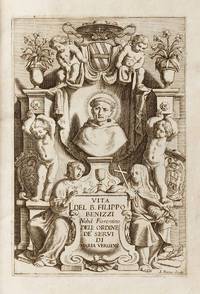
réf. 54778Bologna: Giacomo Monti 1668. Small quarto 23 × 17 cm. Contemporary elaborately decorated and richly gilt morocco binding with the armorial supralibros of Pope Clement X. on the front and back covers from the orbit of the Andreoli/Rospigliosi bindery with gilt edges; 16 148 pp. with engraved title page 14 copper-engraved plates by Lorenzo Tinti and numerous initials. Inner lid with ex-libris from the notable collection of the London bookseller W. A. Foyle Beeleigh Abbey; binding showing traces of former ties; joints headcaps edges and corners lightly rubbed the joints slightly more so; spine with a few minute almost imperceptible restorations and a few tiny wormholes; slightly toned and faintly fox-stained in places along the edges; else very good. First edition with the copperplate engravings by Lorenzo Tinti and the second edition of the text first published in Florence in 1626 under the equally fictitious authorship of Pandolfo Ricasoli Baroni see Melzi and Moreni. This Vita replaced Arcangelo Giani's "Della historia del b. Filippo Benizii nobile fiorentino" published in 1604 as the authoritative hagiography updating Giani's account in light of the Processi informativi completed in 1621 in preparation for the canonization proceedings. During this process the commissions in Florence Philip's birthplace and Todi the place of his death interviewed more than fifty witnesses and inspected the principal sites of veneration see the Preface and Sabine Hoffmann Ein heiliger und sieben Gründer . Munich 2013 p. 47. The occasion for this second edition of the Vita enriched with copperplate engravings was the renewed - and this time successful - effort undertaken in Rome by the Florentines and the Servite Order to secure the canonization of their fifth Prior General. To him they owed the survival of the Order after the Second Council of Lyon 1274 when the smaller mendicant orders faced compulsory suppression. The Servite Order subsequently received papal confirmation in 1304 and Benizi has therefore often been regarded as its founder. For four centuries the friars of the Ordo Servorum Mariae and the Florentines sought the canonization of their patron who during the conclave at Viterbo 1268-1271 was proposed for election as pope and is therefore said to have hidden in a grotto on Monte Amiata near Siena. The first major success in this long campaign came under Pope Leo X the first pope of the Florentine Medici family who in 1516 authorized the celebration of the Feast of Philip with its own Mass and Proper Office. By this time the veneration of Philip had reached its height in Florence. For this and the following see Hoffmann 2013 pp. 15-48. In the Servites' mother church Basilica della Santissima Annunziata a church central to the Florentines that housed one of the city's most important sanctuaries the miraculous image of the Annunciation Cosimo Rosselli as is well known the painter who alongside Ghirlandaio Perugino Botticelli and Signorelli executed three of the frescos in the Sistine Chapel began around 1475 a fresco cycle on the life of the city's venerated son. The cycle was continued in 1509-1510 with five frescos by Andrea del Sarto. Together with his pupils Pontormo and Rosso Fiorentino he subsequently worked also in the forecourt of the basilica the "Chiostrino dei Voti" on a second cycle whose subject was the life of the Virgin Mary. With these two cycles the pictorial biographies of the two figures of greatest importance to the order were placed before the basilica. When Vasari later wrote at length about the frescos he referred to Filippo Benizi more than a century before his canonization quite matter-of-factly as a saint "san Filippo" even though his descriptions of the paintings or more precisely his iconographic reading of the frescos suggest that he was not entirely familiar with the associated legends G. Vasari Le vite de' piu eccellenti pittori scultori e architettori Volume 1 of Part 3. Florence 1568 p. 152. Andrea del Sarto's cycle was also significant for the canonization process. At the beginning of the seventeenth century the cycle was studied by the canonization commission since it constituted an outstanding testimony to Philip's veneration. In more recent scholarship the depositions from the canonization proceedings conducted between 1619 and 1621 have been used as a source for examining the effect of the cycle on its viewers. The account of the cults in the third part of the Vita likewise makes it possible to understand the liturgical and social interconnections within which the frescoes were received at the time. On this see Alana O'Brien San Filippo Benizi 'Honour of the Servi and Florence': His Cycle and Cult at SS. Annunziata 1460-1621 Ph.D. diss. La Trobe University 2 vols. 2001. Even before Leo X approved the invocation and liturgy of Benizi the veneration of relics had already attained such significance that del Sarto depicted it in one of his frescos. On several occasions the Florentines attempted in vain to obtain the bones preserved in Todi. The Vita however lists a series of minor primary relics in Florence including a thumb and fragments of the forearm and elbow. Del Sarto by contrast depicts the veneration of the Florentine "cushion-shaped reliquary capsule" described in the Vita in which a garment of the Servite was preserved. The condition of the relic is described in detail. Furthermore additional relics in other Italian cities are listed. The accounts extensively report on the veneration as well as the miracles attributed to the relics. Thus a garment of the Servite friar preserved in Todi is said to have repeatedly brought about instantaneous healings. In this way a famous legend likewise depicted by Andrea del Sarto and here also by Lorenzo Tinti appears as it were to have been perpetuated: Philip who had once studied medicine and philosophy in Paris and Padua is said to have spontaneously healed a freezing leper by giving the beggar his garment for warmth: "No sooner was the poor man clothed than the foul-smelling scales of his disease fell to the ground his flesh was immediately cleansed and his limbs were restored as though he had never been leprous." p. 56ff. In its account of the miracle the Vita explicitly refers to del Sarto's depiction. Time and again the Vita returns to the frescoes including in its account of the "Punishment of the Blasphemers." According to the text the Florentine painter rendered the "harrowing event" "so terrifying" that "it can scarcely be viewed without dread." Both the painting and Lorenzo Tinti's engraving depict the very moment in which the blasphemers who had been warned by Philip while resting beneath an elm tree are struck dead by a bolt of lightning. p 66f. The veneration is said to have begun immediately after his death. Thus it is reported that the dying man's final words were answered by a voice audible to all proclaiming: "Faithful servant whom the Virgin has appointed to care for her household come and enter into the glory of your Lord!" Thereupon the friars are said to have set aside their grief and "contrary to the customary order begun to sing hymns and psalms." The conclusion of both the fresco cycle and the Vita is formed by the miracle that is said to have occurred during the lying in state of Philip's body: "When news of the death of the blessed Philip spread through the city of Todi people of every rank flocked to the Church of San Marco to pay their final respects to his body. Among them was the notary Paolo di Guido whose daughter Agnoletta had long suffered from a grave illness. Her hands had become completely twisted and paralyzed by the disease and her feet were so contracted that she could neither walk nor help herself. . No sooner had the girl been brought near the holy body than her condition began visibly to change. Her contracted limbs relaxed her hands opened once again her feet straightened and she fully regained her strength. Before the eyes of all those present she rose healed and unharmed." pp. 115ff. This account is followed by an extensive list spanning many pages of all the miracles said to have occurred after Philip's death. Yet despite the great efforts undertaken by the Florentines and the small mendicant order to secure his canonization the papal decision continued to be delayed even after the thorough investigation had been completed. The petitions of Grand Duke Ferdinando II de' Medici and Emperor Ferdinand III to Urban VIII and Innocent X remained unsuccessful. Only the insistence of Emperor Leopold I with Clement IX brought about the conditions under which Clement X finally canonized Philip on April 12 1671 together with Cajetan of Thiene co-founder of the Theatine Order Rose of Lima the first female saint of the Americas Louis Bertrand a Dominican missionary in Colombia and Francis Borgia who above all promoted the Jesuit mission in Central and South America. Philip was the only one among them who had died long before the sixteenth century. The present copy is distinguished above all by the binding made for Pope Clement X to be understood within the context of the centuries long campaign for the canonization of the Florentine saint. Although the Andreoli brothers were still active at this time the present lavishly decorated and highly accomplished binding is more plausibly attributable to the wider circle of the workshop known as the Rospigliosi Bindery. While the compartments framing both the octagonal armorial supralibros and the laurel wreath filled with flame motifs and terminating in volutes at the corners display clear affinities with documented bindings associated with the Rospigliosi workshop tradition including those made for Christina of Sweden and for Popes Clement IX and Clement X no correspondences could be established in a comparison of the finishing tools. Moreover the exclusive use of a single roll tool on the spine would be highly unusual. Guido Vianini Tolomei I rerri e le botteghe di legatori in: Legatura romana barocca Rome 1991 pp. 31-33; José Ruysschaert Les frères Andreoli relieurs des Chigi. Cité du Vatican 1992. Melzi Dizionario di opere anonime e pseudonime di scrittori italiani vol. III p. 231; Moreni Bibliografia storicoragionata della Toscana vol. I p. 446 cf. vol II p. 245f. As of June 2026 KVK OCLC show six copies in North America. unknown
1796réf. 85CE5OB2S9UXMadrid: widow of Joaquin Ibarra 1796. Early 19th-century gold-tooled tree calf sewn on 4 recessed cords each board in a frame made with a decorative roll and several stamps on the smooth spine gold-tooled fillets on the board edges red morocco spine-label Stormont marbled endpapers yellow edges headbands worked in red and white red silk ribbon marker. Narrow 4to 20.5 x 14 cm. With a woodcut crowned cypher monogram of a Spanish Duke on the title page and 7 folding leaves containing 13 numbered letterpress tables. Greatly expanded second edition of a treatise on the determination of latitude and longitude at sea by Dionisio Alcalá Galiano 1760-1805 Spanish explorer cartographer and captain in the Royal Spanish armada. His much shorter account 26 leaves instead of 45 and without the folding tables was also printed by the widow Ibarra in 1795. Galiano was a pioneer of the use of the chronometer in Spain allowing him to produce far more accurate maps of the Spanish colonies in the Americas. Galiano enrolled in the Spanish naval school in 1775. After graduating in 1779 he participated in hydrographic surveys of the Spanish and South American coasts and other Spanish naval scientific explorations.Joaquin Ibarra 1725-1785 had been printer to the court of King Carlos III and Spain's greatest printer vying with Bodoni and the Didots as a fine printer. His widow continued the tradition and upheld the quality of presswork and materials. The present book is well printed on fine Catalan laid paper by Joseph Llorens who had supplied paper for Ibarra's famous 1780 Cervantes.A library stamp has been cut out of the title-page and the hole expertly restored not affecting text or monogram. Otherwise in fine condition with the paper still crisp. The binding is worn at the hinges but still good.l Bibl. Mar. Española 265; Palau 5752 noting only 6 folding leaves; Houzeau & Lancaster 10540 1795 ed.; for Galiano: Howgego to 1800 G6. widow of Joaquin Ibarra, unknown
1862réf. 94440Imprenta de las Escuelas Pías 1862. hardcover. Bueno. Madrid 1862. Imprenta de las Escuelas Pías. Holandesa. Lomo con nervios dorados y tejuelos. Con guarda cubiertas. 296112 boletín anuncios76 índice pp. 25x16. Imprenta de las Escuelas Pías hardcover
1860réf. 94439Imprenta de las Escuelas Pías 1860. hardcover. Bueno. Madrid 1860. Imprenta de las Escuelas Pías. Holandesa. Lomo con nervios dorados y tejuelos. Con guarda cubiertas. 2968 prólogo104 boletín anuncios91 índice pp. 25x16. Imprenta de las Escuelas Pías hardcover
1861réf. 94438Imprenta de las Escuelas Pías 1861. hardcover. Bueno. Madrid 1861. Imprenta de las Escuelas Pías. Holandesa. Lomo con nervios dorados y tejuelos. Con guarda cubiertas. 29674 índice104 boletín anuncios pp. 25x16. Alguna marca a lápiz en márgenes del texto. Imprenta de las Escuelas Pías hardcover
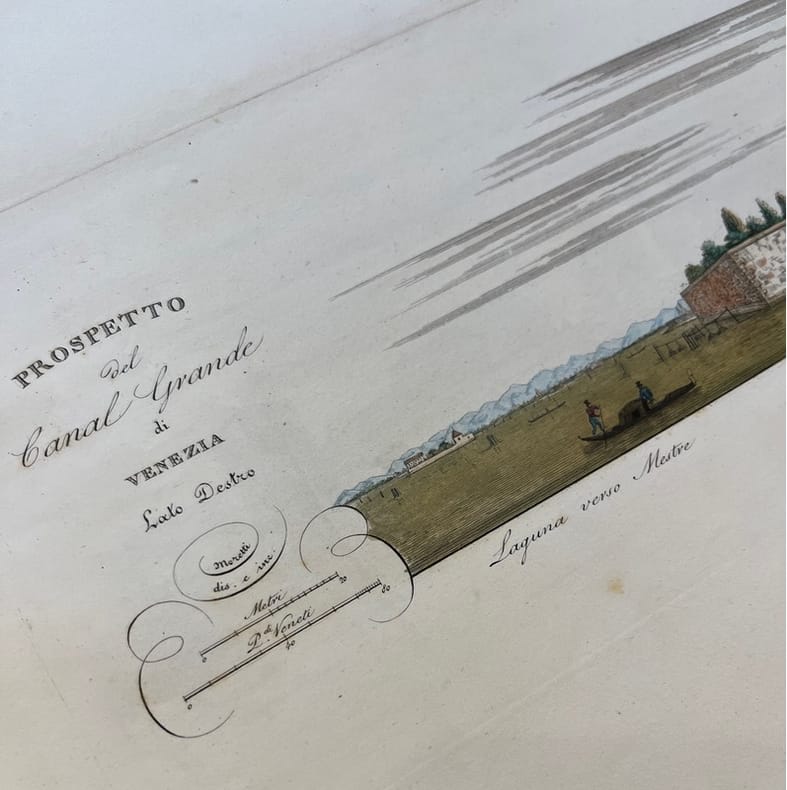
réf. 16-4335Venezia: Tipografia di commercio 1831. Oblong folio. 28 x 42 cm. Original printed boards. 4 36pp. and 15 plates. Engraved plan and 15 engraved plates by and after Morretti with Quadri's 'A.Q.' blindstamp. Occasional light spotting or marking principally affecting text Title page creased in margin.OCLC Number: 718265955.In-folio oblong cartonnage couvertures imprimées et illustrées. Album composé de 16 planches gravées formant un panorama de la place Saint-Marc.Bon exemplaire conservé dans son cartonnage d'origine. Légères rousseurs. Venezia: Tipografia di commercio, 1831. hardcover
1998réf. 85604Grafiche ITE Snc. New. Hardcover. FREE UPGRADE to Courier/Priority Shipping Upon Request - IN STOCK AND IMMEDIATELY AVAILABLE FOR SHIPMENT - Flawless copy brand new pristine never opened -- Text in Italian Japanese French and English. 174 pages; many illustrations. -- with a bonus offer-- . 1998. Grafiche ITE Snc hardcover
réf. 32155Madrid. Jose Porrua Turanzas 1958. 1st Edition. Soft cover. fine. tall8vo& 4to 23 & 27cm 2 volumes text & atlas portfolio xviiiclxviii2021p & atlas 2nd Spanish edition; edited by Porrua this Octavo 2ndedition is limited to 225 numbered copies of which 25 are lettered and200 are numbered this being #192 in the De Luxe Binding with 8 viewplates & 9 folding maps and plans in the separate atlas portfolio onfine extra stock paper . . This set bound in de luxe binding inquarter crushed green morocco blind ruled raised bands gilt spinetitles Cockerel style marbled boards in fine condition. cgc Thisis a fine press edition from the very rare 1802 edition; this edition isequally rare. The commander of the expedition was Don DionysioAlcala-Galiano who was probably the author of this work. See Sabin69221. The text of the rare first edition is faithfully followed printedon fine paper and is accompanied by the same maps and plates. Howescalls this an "important voyage up the Pacific coast and the last to beundertaken by Spain ; written probably by the commander Galiano butattributed also to Jose de Espinosa y Tello. and to Cayetano Valdes. The Introduccion' giving a splendid historical sketch of earlier Spanishexplorations in the same region was the work of the maritime authorityMartin Fernandez de Navarrette." Henry R. Wagner suggests that the mapsare better in some respects than Vancouver's and were used by Humboldtas models for his Essai Politique sur le Royaume de la Nouvelle Espagne1811. Exceptionally scarce even in this Second Edition which wasproduced in thick card wraps it is very rare in this binding. Strathern167I; Howes Gallano. G18; Sabin 66221; Streeter 2458. We found norecords that mention this de-luxe binding. Madrid. Jose Porrua Turanzas, 1958 unknown
1824réf. 22682Venise, s.n., 1824 ; in-4° (228x310 mm) oblong, couverture cartonnée, dos imitation loupe de frêne, 33 ff. gravés à l'eau-forte et aquatinte, titre et 32 vues, accompagnées de légendes en italien et en français.
réf. MA09C-04520Sumptibus Sebastiani Cramoisy. Collectible - Acceptable. Paris: Sumptibus Sebastiani Cramoisy 1644-1650. 1st edition. 4 volume set. Incomplete vols. 1-4 of 5 missing vol 4 part 2. Folio Leather Bound. 841ppindex; 875ppindex; 906ppindex; 826pp. Latin. Fair set. Contemporary uniform calf with raised spine bands brown leather title label with gilt lettering. All volumes: Heavy edgewear. Boards heavily soiled and warped. Pages age toned. Most pages dampstained. Rubber stamp to the second front endpage and title page. With typical period foxing. Vol 1: Heavy chipping and worming to the crown and foot most of crown chipped away. Paper label removed from bottom compartment. Corners bumped upper rear corner heavily bumped. Lacking front endpaper. Very heavy soiling to the first and last several pages. Vol 2: Heavy chipping and worming to the crown with some worming to the foot and front board. Upper half of front joint split. Vol 3: Heavy chipping and worming to crown and foot. Very heavy soiling to many preliminary pages. Vol 4: Heavy worming to the crown and foot. In polypropylene bag. theology dogmas catholicism catholic Inquire if you need further information. NOT AVAILABLE FOR SHIPMENT OUTSIDE OF THE UNITED STATES. Sumptibus Sebastiani Cramoisy hardcover
réf. MA09C-04520Sumptibus Sebastiani Cramoisy. Collectible - Acceptable. Paris: Sumptibus Sebastiani Cramoisy 1644-1650. 1st edition. 4 volume set. Incomplete vols. 1-4 of 5 missing vol 4 part 2. Folio Leather Bound. 841ppindex; 875ppindex; 906ppindex; 826pp. Latin. Fair set. Contemporary uniform calf with raised spine bands brown leather title label with gilt lettering. All volumes: Heavy edgewear. Boards heavily soiled and warped. Pages age toned. Most pages dampstained. Rubber stamp to the second front endpage and title page. With typical period foxing. Vol 1: Heavy chipping and worming to the crown and foot most of crown chipped away. Paper label removed from bottom compartment. Corners bumped upper rear corner heavily bumped. Lacking front endpaper. Very heavy soiling to the first and last several pages. Vol 2: Heavy chipping and worming to the crown with some worming to the foot and front board. Upper half of front joint split. Vol 3: Heavy chipping and worming to crown and foot. Very heavy soiling to many preliminary pages. Vol 4: Heavy worming to the crown and foot. In polypropylene bag. theology dogmas catholicism catholic Inquire if you need further information. NOT AVAILABLE FOR SHIPMENT OUTSIDE OF THE UNITED STATES. Sumptibus Sebastiani Cramoisy hardcover books
1757réf. OB1039Romae sumptibus Venantii Monaldini MDCCLVII. 1757. Hard Cover. xv 184 66 pages illus.; 27 cm. Title continues: nunc Crypta-Ferrata D. Basilii Cardoni. disceptatio apologetica." Cardoni's work has special title-page: De Tusculano M.T. Ciceronis nunc Crypta-Ferrata adversus P. Joan Lucam Zuzzeri. D. Basilii Cardoni. disceptatio apologetica. Romae sumptibus Venantii Monaldini MDCCLVII. Tusculum the ancient city in the Alban Hills near Rome and Cicero's summer place yielded rich finds to early archaeologists including the Greek coins amply illustrated here. Stock#OB1039. Very Good bound in full contemporary vellum. sumptibus Venantii Monaldini hardcover
1882réf. 37306PRIMERA EDICION.- Ciudad-Rodrigo: Establecimiento Tipográfico de Angel Cuadrado y Rosado 1882.- 248 p.: Tras la portada lámina con gran escudo coronado en oro y rojo; 4º mayor 283 cm.; Holandesa en pergamino época.- La encuadernación con algunas señales del tiempo en los bordes por lo demás en muy buen estado. RARISIMA OBRA. CASTILLA-LEÓN Libro en español Establecimiento Tipográfico de Angel Cuadrado y Rosado paperback
1641réf. 12830PARIS: Sebastiani Cramoisy 1641. 4º menor.- Pleno pergamino.- 2 tomos en un volumen.- I: 700 páginas.- II: 291 páginas. . Brunet 21207 T. IV col. 528 Sebastiani Cramoisy unknown
2023réf. x-3031268512Springer Nature 2023. Paperback. New. 914 pages. 9.25x6.10x1.81 inches. Springer Nature paperback
1771réf. 5843Roma: Marco Pagliarini. Good with no dust jacket. 1771. First Edition. Hardcover. xiv 172 pp. In Italian. Very scarce octavo in 3/4 leather. The first section of the book up to page155 is Denis the Carthusian Denis le Chartreux treatise on the Christian life in the church. The second is the discourse on "the advantage of psalmody" or "De psalmodii bono" which had for many years been attributed as here to Saint Nicetius of Trier 513-566 but which has lately been reattributed to Saint Nicetas of Remesiana 335-414. There are very few recorded copies of this book -- Worldcat has only 2 one in California one in Lyons OCLC58887969 and there are no sales or auction records for the book at all. It is in fairly good antiquarian condition. The leather corners especially at the top front are quite worn brown leather spine cover is chipped and worn with some sort of paper spine label at the top spine head very chipped. Attractive printed paper covered boards with normal scuffing and wear. All edges with a multi-colored spatter decoration. Interior end papers have an old owner inscript dated 1892 and some pencil notations look bibliographic but we can't make them out first free endpaper has a small hole at the top corner. Text is clean and nice a few small worm holes in the margins otherwise unmarked and strong. Attractive title page with Pagliarini's mark and one nice engraved head piece. A good copy of this extremely scarce little work. ; 8vo 8" - 9" tall; 186 pages . Marco Pagliarini hardcover
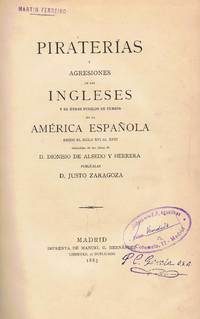
réf. 2595Madrid: Manuel G. Hernández 1883. Hardcover. Very good . 8vo 23 x 18 cm. 130 introduction LII forward 525 10 index pp. Three folding maps one with frayed edge. Brown quarter calf over marbled covers. Gilt titles to spine. Paper library label of 19th century Spanish author Fernandez Duro to front paste-down endpaper rest of text block tight and unmarked. OCLC 1337624802. Manuel G. Hernández hardcover
réf. 1041628. . Publícalas Justo Zaragoza. Madrid. Imp. Manuel G. Hernández. 1883. 24x16 cm. 525 págs. 4 h. de índices 3 grandes mapas plegados. Holandesa piel nervios tejuelo. Dedicatoria y firma autógrafa del autor. Sello anterior biblioteca. # América. unknown
1942réf. 37829PRIMERA EDICION.- Madrid : Ediciones Escorial 1942 - en la cubierta Madrid: Editora Nacional 1943 en colofón Imp. en los talleres de Silverio Aguirre 1943.- 92 p. 1 h.: Láminas e ilustraciones dibujadas por José R. Escasi; 4º 24 x 174 cm.; Cartulina Ed.- RARO EJEMPLAR. Con una dedicatoria autógrafa del autor en la portadilla. Pequeñas reparaciones en el lomo por lo demás impecable. LITERATURA Y FILOSOFÃA ESPAÑOLAS DE LOS SIGLOS XIX-XXI Y SU HISTORIA EN GENERAL Libro en español Ediciones Escorial paperback
1982réf. 3820114Salamanca.: Asociación de Amigos de Ciudad-Rodrigo. 1982. Hardcover. Cons cub orig . Good. 21 cm. 204 p. Encuadernación en tapa dura artesanal hol puntas. Prólogo de Miguel Cid Cebrián. Ciudad Rodrigo. Historia . Cons cub orig . ISBN: 8430067507 Historia de los distintos estados y países 94460.187 Ciudad Rodrigo Asociación de Amigos de Ciudad-Rodrigo. hardcover
réf. DADAX0199259143New unknown
réf. 306386Seville Imprenta y Libreria Espanola y Extrangera de Rafael Tarasco y Lassa 1882. First edition thus. 8vo. Full contemporary gilt stamped black morocco front joint cracked; t.e.g. Good-very good. xx 315 pages. No foxing. Bookplate of Irish prelate Vincent Lloyd Russell on the front pastedown. One of 300 copies on large paper Sociedad de Bibliofilos Andaluies. Palau 139797. Hardcover. Good. Seville, Imprenta y Libreria Espanola y Extrangera de Rafael Tarasco y Lassa, 1882. hardcover
réf. 306386Seville Imprenta y Libreria Espanola y Extrangera de Rafael Tarasco y Lassa 1882. First edition thus. 8vo. Full contemporary gilt stamped black morocco front joint cracked; t.e.g. Good-very good. xx 315 pages. No foxing. Bookplate of Irish prelate Vincent Lloyd Russell on the front pastedown. One of 300 copies on large paper Sociedad de Bibliofilos Andaluies. Palau 139797. Hardcover. Good. Seville, Imprenta y Libreria Espanola y Extrangera de Rafael Tarasco y Lassa, 1882. hardcover books