628 résultats
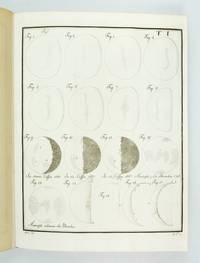
1796réf. ST20813Helmstedt: Printed and commissioned by C. G. Fleckeisen 1796. FIRST EDITION. 275 x 225 mm. 10 3/4 x 9". XVI 250 2 pp. Contemporary brown paste paper boards smooth spine with red roan label. WITH 10 ENGRAVED PLATES one folding by "G. T." after Schröter. Honeyman 2825; de la Lande p. 635; Poggendorff II 846; cf. DSB XII p. 226 NDB XXIII 590 Schröter and 510 Schrader. See also Sheehan and Baum "Observations and inference: Johann Hieronymous Schroeter 1745-1816" Journal of the British Astronomical Association vol.105 no.4 p.171-175. Joints and extremities somewhat rubbed boards with a hint of chafing occasional very minor foxing including to the final plate half a dozen leaves with faint dampstain to head edge but a really excellent copy the other plates clean and bright the text especially clean and fresh and the binding entirely sound. This is a very rarely seen early work on the topography of Venus written by the astronomer who first observed the planet's so-called phase anomaly and illustrated with 10 folding plates. One of a series of "fragments" Schröter published--the others concerning the sun the moon Saturn and Mercury--"Aphroditographische Fragmente" discusses the author's observations of Venus' surface at the same time coining the term "Aphroditographie" in reference to the Greek version of the goddess' name. The most important observation contained in our work concerns the phases of Venus: like the moon Venus appears to wax and wane when observed through a telescope. However due to the thickness of its atmosphere the planet will always appear less full than mathematical calculations indicate it should be. This phenomenon known as Venus' phase anomaly--or the Schröter Effect--first observed by the man who gave it its name in 1793 is discussed in detail in this text which is accompanied by highly detailed plates. Eight of these are focused on Venus primarily depicting its phases; another is a diagram of the telescope; and the other depicts the Orion Nebula to which there is a short addendum. Schröter 1745-1816 built a state-of-the-art observatory at Lilienthal in Lower Saxony equipped with the largest telescopes available at the time. One such instrument which he built in his own workshop was an impressive 27-foot telescope discussed in the present work which has sometimes been incorrectly credited to Schröter's colleague William Herschel 1738-1822. Schröter made systematic long-term observations of the surfaces of the moon and planets something DSB tells us he was the first to do. Not everything he discovered or asserted turned out to be true. Based on his findings he posited the existence of a mountain range on Venus' surface and suggested a rotation period for the planet. Both subsequently were disproven modern scientists have suggested that Schröter's "mountain" may have been an overly optimistic observation of a cloud formation but like the rest of his work they demonstrated the commitment to observational astronomy that leads astronomy historians William Sheehan and Richard Baum to call Schröter "the man who laid the foundations of planetology and modern selenography." His long and impressive astronomical career came to an unfortunate end in 1813 when during the Napoleonic invasion the French reportedly set fire to his observatory. His library instruments unpublished notes and copies of many of his works which were published in small runs at his expense were said to have been destroyed in the fire a fact that may partly explain the current rarity of our book. We have been able to trace at auction only an ex-library copy of the book with significant condition problems that sold in 1981 for a hammer price of £260; the fact that such an unattractive copy came from the distinguished Honeyman collection reinforces how difficult the work is to obtain. Printed and commissioned by C. G. Fleckeisen unknown
1796réf. ST20813Helmstedt: Printed and commissioned by C. G. Fleckeisen 1796. FIRST EDITION. 275 x 225 mm. 10 3/4 x 9". XVI 250 2 pp. Contemporary brown paste paper boards smooth spine with red roan label. WITH 10 ENGRAVED PLATES one folding by "G. T." after Schröter. Honeyman 2825; de la Lande p. 635; Poggendorff II 846; cf. DSB XII p. 226 NDB XXIII 590 Schröter and 510 Schrader. See also Sheehan and Baum "Observations and inference: Johann Hieronymous Schroeter 1745-1816" Journal of the British Astronomical Association vol.105 no.4 p.171-175. Joints and extremities somewhat rubbed boards with a hint of chafing occasional very minor foxing including to the final plate half a dozen leaves with faint dampstain to head edge but a really excellent copy the other plates clean and bright the text especially clean and fresh and the binding entirely sound. This is a very rarely seen early work on the topography of Venus written by the astronomer who first observed the planet's so-called phase anomaly and illustrated with 10 folding plates. One of a series of "fragments" Schröter published--the others concerning the sun the moon Saturn and Mercury--"Aphroditographische Fragmente" discusses the author's observations of Venus' surface at the same time coining the term "Aphroditographie" in reference to the Greek version of the goddess' name. The most important observation contained in our work concerns the phases of Venus: like the moon Venus appears to wax and wane when observed through a telescope. However due to the thickness of its atmosphere the planet will always appear less full than mathematical calculations indicate it should be. This phenomenon known as Venus' phase anomaly--or the Schröter Effect--first observed by the man who gave it its name in 1793 is discussed in detail in this text which is accompanied by highly detailed plates. Eight of these are focused on Venus primarily depicting its phases; another is a diagram of the telescope; and the other depicts the Orion Nebula to which there is a short addendum. Schröter 1745-1816 built a state-of-the-art observatory at Lilienthal in Lower Saxony equipped with the largest telescopes available at the time. One such instrument which he built in his own workshop was an impressive 27-foot telescope discussed in the present work which has sometimes been incorrectly credited to Schröter's colleague William Herschel 1738-1822. Schröter made systematic long-term observations of the surfaces of the moon and planets something DSB tells us he was the first to do. Not everything he discovered or asserted turned out to be true. Based on his findings he posited the existence of a mountain range on Venus' surface and suggested a rotation period for the planet. Both subsequently were disproven modern scientists have suggested that Schröter's "mountain" may have been an overly optimistic observation of a cloud formation but like the rest of his work they demonstrated the commitment to observational astronomy that leads astronomy historians William Sheehan and Richard Baum to call Schröter "the man who laid the foundations of planetology and modern selenography." His long and impressive astronomical career came to an unfortunate end in 1813 when during the Napoleonic invasion the French reportedly set fire to his observatory. His library instruments unpublished notes and copies of many of his works which were published in small runs at his expense were said to have been destroyed in the fire a fact that may partly explain the current rarity of our book. We have been able to trace at auction only an ex-library copy of the book with significant condition problems that sold in 1981 for a hammer price of £260; the fact that such an unattractive copy came from the distinguished Honeyman collection reinforces how difficult the work is to obtain. Printed and commissioned by C. G. Fleckeisen unknown books
1513In-8°; cc. (12). Edizione originale del poema di Giovanni Francesco Pico della Mirandola, una delle prime fonti sulla collezione di statuaria antica conservata al Giardino del Belvedere in Vaticano. Scritto nell’ultimo anno del pontificato di Giulio II (1503-1513), l’opera sottolinea la passione per le antichità classiche che con questo papa divenne una vera e propria moda nella Roma del tempo. Molti si domandarono se fosse idoneo consevare nel tempio della cristianità una collezione che esaltava anche le divinità pagane. Pico, seguace della corrente savonaroliana che denigrava la cultura rinascimentale del recupero e dell’imitazione dei classici romani e greci, si serve di quest’opera per stigmatizzare questa contrasto, proponendo nei suoi versi la Vergine Maria come contraltare alla Venere classica, presentando la collezione del vaticano come la manifestazione fisica della corruzione culturale e morale della Roma di Giulio II. Nella lettera a Francesco Giraldi, umanista ed erudito nativo di Ferrara, datata 1512, Pico offre una sorta di panoramica sulle statue collocate nel Belvedere: sono tra le prime parole che vengono spese sul posizionamento in quel luogo di quello che fu il simbolo della rinascita del classico, il gruppo del Laocoonte ritrovato presso la Domus Aurea nel 1506 e acquistato da Giulio II. Vengono anche citate la statua di Apollo e Cleopatra, e la grande immagine del Tevere. Giovanni Francesco Pico della Mirandola (1470-1533), nipote di Giovanni Pico, autore di una biografia su Savonarola, si fece portavoce di una difesa degli insegnamenti cristiani contro la nuova cultura nascente. Salvatore Settis, Sonia Maffei, Ludovico Rebaudo, Laocoonte, fama e stile: “La matrice antica del luogo, giardino delle Esperidi, luogo ideale per l’ozio filosofico, centro della nuova politica di Giulio II colpisce Giovanni Pico della Mirandola; è li che egli ambienta il De Venere et cupidine cogliendo la natura pagana del luogo: Laocoonte e le anticaglie solo identificate per veloci evocazioni, sono quasi come idoli chiamati ad animare il regno di Venere e della vana venustas”. The original edition of the poem by Pico della Mirandola, one of the first sources on the collection of ancient statues preserved in the Belvedere Vatican Garden. Written during the last year of pontificate by Julius II (1513), the work underlines the passion for classic antiquities that became, with this Pope, a fever in contemporary Rome. Many was wondering if it was suitable to put a heaten sculpture collection in Vatican. Pico, follower of Savonarola in blaming Renaissance culture of recovery and imitation of Roman empire, through this work means to criticize the moral and cultural corruption of Iulius II Rome, putting this collection as its physical manifestation, and in his verses he puts the Holy Mary to counterbalance the classic Venus. In his letter to Giraldi, Pico offers a bird’s eye view on statues put in Belvedere. These are between the first words spent about the putting in this place of a symbol of Classic rebirth: the Laocoon found in the Domus Aurea area and bought by the pope.