683 risultati
2009rif. BN643765MERCURE DE FRAN 2009. 2009. La forêt de l'amour en nous La forêt de l'amour en nous AdonisIssa Makhlouf und Vénus Khoury-Ghata MERCURE DE FRAN unknown
rif. DADAX0244777187New unknown
1979rif. S7030In: Science Vol. 205 No. 4401 6 July 1979. Washington D.C.:: American Association for the Advancement of Science 1979. 1979. FIRST EDITION. 4to. Pages 99-102. Entire issue: 1-130 pp. 4 figs. 1 table. Pictorial wrappers. Fine. with: KLIORE et al. "Polar ionosphere of Venus near the terminator from early pioneer Venus Orbiter radio occultations." In: Science Vol. 203 No. 4382 23 February 1979. Washington D.C.: American Association for the Advancement of Science 1979. FIRST EDITION. 4to. Pages 695-826. Entire issue: 1-130 pp. 3 figs. 1 table. Pictorial wrappers. Fine. American Association for the Advancement of Science, 1979. unknown books
1960rif. 63315Paris, EDLF, o. J. (um 1960). Gr.-8°. Mit zahlr. Aktfotografien. 14 nn. Bll., Illustr.-OKart.
rif. 200701440Paris, Dargaud, 2005 ; in-4, 60 pp., cartonnage de l'éditeur.
1962rif. LFA-126734911"Revue mensuelle de l'essentiel" : 120 pages, format 150 x 210 mm, illustrée, brochée, bon état
rif. 200810215Belgique, Paquet, 2001 ; in-4, 57 pp., cartonnage de l'éditeur. Eo tome1.
rif. 200810214Belgique, Paquet, 2001 ; in-4, 57 pp., cartonnage de l'éditeur. Eo tome1.
rif. 200803879Belgique, Paquet, 2001 ; in-4, 57 pp., cartonnage de l'éditeur. Eo tome1.
1951rif. 33879Paris Librairie Maloine 1951 Ensemble 3 fascicules in-12, en feuilles, couvertures imprimes (embotage de l'diteur).Edition orne de nombreuses illustrations en noir et en couleurs de Pierre Leroy, graves sur bois par Roger Boyer. Un des 900 exemplaires numrots sur vlin Johannot.
1963rif. 900318AG1963. Blattmaß: 24 x 31 (quer),
1963rif. 900320AG1963. Blattmaß: 31 x 24 cm,
1675rif. 14546Paris, Guillaume Desprez, 1675 ; in-16 ; plein veau havane granité, dos à nerfs décoré et doré, titre doré, roulette sur les coupes (reliure de l'époque) ; (36) (titre, Epistre, Préface et Table), 457 pp., (1) p. de Privilège, 59 figures et schémas dont 13 hors-texte.
rif. 72591Stockholm Carl Gust. Cronland 1791. 4:o. 78 s. Liten fläck på första och sista sidan. Tagen ur band. Ur Ericsbergs bibliotek. Setterwall 3344. Bring Rättegångshandlingar 726:2. Ärendet var först uppe i regementskrigsrätten för att sedan avgöras i krigshovrätten. Fregatten Venus byggd av Chapman 1783 befann sig i juni 1789 utanför norska kusten under befäl av kapten Hanson. De råkade där ut för en rysk eskader som öppnade eld och efter en stunds strid måste Hanson och hans män kapitulera och Venus togs av ryssarna. Efter att tillbringat en tid i rysk fångenskap kom Hanson 1791 hem och ställdes inför domstol för förlusten av fartyget. Han bedömdes dock inte ha handlat brottsligt utan endast slarvigt och dömdes till böter motsvarande en halv årslön. unknown
1989rif. LFA-126746829Une revue de 98 pages, format 215 x 285 mm, illustrée, brochée couverture couleurs, bon état
1990rif. LFA-126746837Une revue de 80 pages, format 215 x 285 mm, illustrée, brochée couverture couleurs, bon état
1942rif. 012873Saint-Maurice d'Etelan Pierre Bettencourt 1942 In-8 broché, couverture illutrée
1973rif. LFA-126733682N° 56 (Mars 1973) : 86 pages, format 215 x 285 mm, illustré, broché couverture couleurs, bon état
1724rif. 4333Cologne, héritiers de Herman Demen, [Bruxelles, Foppens], 1724 ; in-8 ; plein veau glacé caramel, dos à nerfs orné, armes du marquis Jacques de La Cour de Balleroy en tête et en pied, roulette décorative dorée sur les coupes, tranches rouges (reliure de l'époque) ; (4) ff. (frontispice, titre imprimé en rouge et noir, Avis au lecteur, table), 352 pp.
1976rif. LFA-126716937Volume 138 - 15e Série - Tome VII - 1976 : 309 pages, format 160 x 240 mm, illustré, broché, bon état
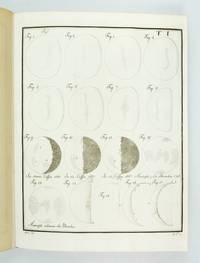
1796rif. ST20813Helmstedt: Printed and commissioned by C. G. Fleckeisen 1796. FIRST EDITION. 275 x 225 mm. 10 3/4 x 9". XVI 250 2 pp. Contemporary brown paste paper boards smooth spine with red roan label. WITH 10 ENGRAVED PLATES one folding by "G. T." after Schröter. Honeyman 2825; de la Lande p. 635; Poggendorff II 846; cf. DSB XII p. 226 NDB XXIII 590 Schröter and 510 Schrader. See also Sheehan and Baum "Observations and inference: Johann Hieronymous Schroeter 1745-1816" Journal of the British Astronomical Association vol.105 no.4 p.171-175. Joints and extremities somewhat rubbed boards with a hint of chafing occasional very minor foxing including to the final plate half a dozen leaves with faint dampstain to head edge but a really excellent copy the other plates clean and bright the text especially clean and fresh and the binding entirely sound. This is a very rarely seen early work on the topography of Venus written by the astronomer who first observed the planet's so-called phase anomaly and illustrated with 10 folding plates. One of a series of "fragments" Schröter published--the others concerning the sun the moon Saturn and Mercury--"Aphroditographische Fragmente" discusses the author's observations of Venus' surface at the same time coining the term "Aphroditographie" in reference to the Greek version of the goddess' name. The most important observation contained in our work concerns the phases of Venus: like the moon Venus appears to wax and wane when observed through a telescope. However due to the thickness of its atmosphere the planet will always appear less full than mathematical calculations indicate it should be. This phenomenon known as Venus' phase anomaly--or the Schröter Effect--first observed by the man who gave it its name in 1793 is discussed in detail in this text which is accompanied by highly detailed plates. Eight of these are focused on Venus primarily depicting its phases; another is a diagram of the telescope; and the other depicts the Orion Nebula to which there is a short addendum. Schröter 1745-1816 built a state-of-the-art observatory at Lilienthal in Lower Saxony equipped with the largest telescopes available at the time. One such instrument which he built in his own workshop was an impressive 27-foot telescope discussed in the present work which has sometimes been incorrectly credited to Schröter's colleague William Herschel 1738-1822. Schröter made systematic long-term observations of the surfaces of the moon and planets something DSB tells us he was the first to do. Not everything he discovered or asserted turned out to be true. Based on his findings he posited the existence of a mountain range on Venus' surface and suggested a rotation period for the planet. Both subsequently were disproven modern scientists have suggested that Schröter's "mountain" may have been an overly optimistic observation of a cloud formation but like the rest of his work they demonstrated the commitment to observational astronomy that leads astronomy historians William Sheehan and Richard Baum to call Schröter "the man who laid the foundations of planetology and modern selenography." His long and impressive astronomical career came to an unfortunate end in 1813 when during the Napoleonic invasion the French reportedly set fire to his observatory. His library instruments unpublished notes and copies of many of his works which were published in small runs at his expense were said to have been destroyed in the fire a fact that may partly explain the current rarity of our book. We have been able to trace at auction only an ex-library copy of the book with significant condition problems that sold in 1981 for a hammer price of £260; the fact that such an unattractive copy came from the distinguished Honeyman collection reinforces how difficult the work is to obtain. Printed and commissioned by C. G. Fleckeisen unknown books
1796rif. ST20813Helmstedt: Printed and commissioned by C. G. Fleckeisen 1796. FIRST EDITION. 275 x 225 mm. 10 3/4 x 9". XVI 250 2 pp. Contemporary brown paste paper boards smooth spine with red roan label. WITH 10 ENGRAVED PLATES one folding by "G. T." after Schröter. Honeyman 2825; de la Lande p. 635; Poggendorff II 846; cf. DSB XII p. 226 NDB XXIII 590 Schröter and 510 Schrader. See also Sheehan and Baum "Observations and inference: Johann Hieronymous Schroeter 1745-1816" Journal of the British Astronomical Association vol.105 no.4 p.171-175. Joints and extremities somewhat rubbed boards with a hint of chafing occasional very minor foxing including to the final plate half a dozen leaves with faint dampstain to head edge but a really excellent copy the other plates clean and bright the text especially clean and fresh and the binding entirely sound. This is a very rarely seen early work on the topography of Venus written by the astronomer who first observed the planet's so-called phase anomaly and illustrated with 10 folding plates. One of a series of "fragments" Schröter published--the others concerning the sun the moon Saturn and Mercury--"Aphroditographische Fragmente" discusses the author's observations of Venus' surface at the same time coining the term "Aphroditographie" in reference to the Greek version of the goddess' name. The most important observation contained in our work concerns the phases of Venus: like the moon Venus appears to wax and wane when observed through a telescope. However due to the thickness of its atmosphere the planet will always appear less full than mathematical calculations indicate it should be. This phenomenon known as Venus' phase anomaly--or the Schröter Effect--first observed by the man who gave it its name in 1793 is discussed in detail in this text which is accompanied by highly detailed plates. Eight of these are focused on Venus primarily depicting its phases; another is a diagram of the telescope; and the other depicts the Orion Nebula to which there is a short addendum. Schröter 1745-1816 built a state-of-the-art observatory at Lilienthal in Lower Saxony equipped with the largest telescopes available at the time. One such instrument which he built in his own workshop was an impressive 27-foot telescope discussed in the present work which has sometimes been incorrectly credited to Schröter's colleague William Herschel 1738-1822. Schröter made systematic long-term observations of the surfaces of the moon and planets something DSB tells us he was the first to do. Not everything he discovered or asserted turned out to be true. Based on his findings he posited the existence of a mountain range on Venus' surface and suggested a rotation period for the planet. Both subsequently were disproven modern scientists have suggested that Schröter's "mountain" may have been an overly optimistic observation of a cloud formation but like the rest of his work they demonstrated the commitment to observational astronomy that leads astronomy historians William Sheehan and Richard Baum to call Schröter "the man who laid the foundations of planetology and modern selenography." His long and impressive astronomical career came to an unfortunate end in 1813 when during the Napoleonic invasion the French reportedly set fire to his observatory. His library instruments unpublished notes and copies of many of his works which were published in small runs at his expense were said to have been destroyed in the fire a fact that may partly explain the current rarity of our book. We have been able to trace at auction only an ex-library copy of the book with significant condition problems that sold in 1981 for a hammer price of £260; the fact that such an unattractive copy came from the distinguished Honeyman collection reinforces how difficult the work is to obtain. Printed and commissioned by C. G. Fleckeisen unknown
1935rif. 15438Paris, Vigot, 1935 ; in-16, broché ; 84 pp., (4) pp. de catalogue, couverture orange illustrée, figures.
1936rif. 15422Paris, Editions du Chariot, 1936 ; in-8, broché ; 32 pp. et couverture rouge.
1929rif. 15423Paris, Editions du Chariot (Saint-Etienne, Imprimerie Spéciale), décembre 1929 ; in-8, broché ; 32 pp., couverture rouge illustrée d'un grand bois gravé occultiste. Directeur - Gérant : A. Valetta.