2 188 résultats
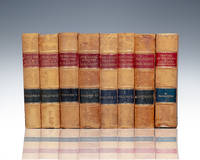
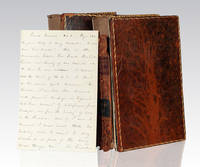
1885réf. 145720New York: Charles L. Webster & Company 1885-86. Exceedingly rare first edition of the autobiography of Ulysses S. Grant the 18th President of the United States which focusing mainly on his military career during the Mexican War and the Civil War entirely singular owned and annotated by Grant's close friend and most esteemed general: William Tecumseh Sherman. Octavo 2 volumes bound in the original full deluxe tree calf with gilt titles and elegant tooling to the spine gilt ruled borders to the front and rear panels gilt inner dentelles all edges gilt engraved portrait frontispieces illustrated with numerous facsimile letters 2 folding maps and wood engravings. William Tecumseh Sherman evidently read thes volumes in great detail making marginal notes on at least 18 pages in Vol. I several of them signed with his initials. On the last page of Vol. I Sherman wrote: "Read at St. Louis Mo. Dec 5 6 1885. This account of the Civil War is wonderfully accurate and him. W.T.S." Many of the notes are small corrections and additions by Sherman. On a passage regarding the Yazoo Pass Expedition on page 435 of Vol. I Sherman pointedly writes: "This conforms literally to my memoirs on the point most contested by Grant's pretended friends. W.T.S." He provides further thoughts regarding political interference on the next page: "If Grant had gone ahead living off the country we would have been inside of Vicksburg by Christmas 1862 the distance from Grenada to Vicksburg is little more than the circuit we afterward made from Bruinsberg via Jackson to Vicksburg --- This was my understanding when we parted at Oxford and the intervening country was better supplied with hay hominy. W.T.S." On p. 440-441 Grant wrote about the need to assign politically-connected John McClernand as Corps Commander: "I would have been glad to put Sherman in command to give him an opportunity to accomplish what he had failed in the December before; but there seemed no other way out of he difficulty for he was junior to McClernand. Sherman's failure needs no apology." In the margins Sherman's distinctive hand writes passionately: "because it was no failure at all." There is only one marginal annotation in Vol. II; however an autograph note is laid in at p. 123 supplying Sherman's recollection of Grant's first meeting with Lincoln which corroborates Grant's account. While Sherman was not present at the meeting between Grant and Lincoln he almost certainly heard about what transpired from Grant himself. The note reads in full: "Grants Memoirs Vol 2 Page 123 A good story is very correct. 'Si non vero ben trovalo.' Even if it is not true it is well conceived. This is the conversation between Genl. Grant President Lincoln and Secretary of War Stanton at the time he was addressed to command all the Armies of the U.S. Grant said in his usual quiet manner 'Mr. Lincoln I am told that several well planned campaigns in Virginia have been marred by interference from Washington viz from the Secretary of War or the President now if I am to command I must insist that no military order be issued to any detachment or part of the Army except through me' Mr. Lincoln in his inimitable way turning to Stanton said 'Stanton you and I have been running this machine for two years and have not made a brilliant success. I guess we had better trust this little man' Grant and then then and there the promise was made. And it is to the credit of Mr. Lincoln to say that he kept his word literally never interfering or making any order even when Washington was in real peril from Early's Army in 1865." Grant's insistence that there would be no political interference was likely particularly important to General Sherman who famously hated politicians. In good condition with detaching of the front boards and spines of each volume detaching of the rear board and separation of the folding facsimile letter at p. 312-313. Copies bound in highly polished gilt tree calf are extremely rare with only three other copies known. The first prospectus of Grant's Memoirs listed only 4 bindings: fine cloth full sheep fine half morocco and full Turkey morocco. The only other copy of Grant's Memoirs bound in tree calf was sold at auction - a copy presented to Mark Twain by Julia Grant and inscribed by both. Only two other known copies are located in private collections. To date no copies bound in the tree calf have been traced to institutional collections. As Grant died before publication was complete the only copy that he saw before his death was a prospectus bound in cloth; the extant tree calf copies suggest that the binding was perhaps reserved exclusively for presentations made by Julia Grant. Even the copies presented by publisher Mark Twain to his friends and colleagues were bound in one of the other available bindings. Though this copy bears no presentation inscription by Julia Grant Mark Twain or anyone else it is plausible that one of these figures would have sent the copy directly to General Sherman. After his second presidential term and world tour President Grant was stripped of nearly all of his life's earnings by conman Ferdinand Ward. Grant had forfeited his and his widow's military pension when he resigned as general to assume the presidency and his recent throat cancer diagnosis brought him deep concern about how his wife and family would manage financially after his death. In this moment of crisis Sherman rushed to Grant's aid and assisted him in restructuring his debt ensuring that Grant was able to keep his most prized possesions. Most importantly Sherman also encouraged Grant to do what he should have done years ago - write his memoirs. By June 1884 Grant had begun publishing articles on his major engagements of the Civil War for 'Century Magazine' which paid him $500 for each submission. The articles were received with great enthusiasm and Grant met with the magazine's representatives in early September to arrange for the publication of his memoirs. However when Samuel Clemens popularly Mark Twain learned of the potential arrangement with 'Century Magazine' he convinced Grant to sign with his own subscription publishing company which was able to offer Grant 70% of the net profit made from the sale of his memoirs. This rate was exorbitantly higher than what 'Century Magazine' had proposed. Grant began writing his memoirs in earnest racing against the illness to finish and ensure his family's financial stability. During this time Grant welcomed Sherman's repeated visits. On December 24 1884 Sherman wrote to his wife Ellen: "Grant says my visits have done him more good than all the doctors" Flood p.395. Grant with the moral support of Sherman lived to finish the memoir dying five days after its completion. Widely considered the finest military narrative ever published the memoirs were a national bestseller and Grant's widow Julia would eventually receive nearly $450000 about ~$14000000 today in royalties from their sale. Charles L. Webster & Company hardcover
1599réf. 007445Bologna Francesco De Franceschi, Baptista Ballagamba, Giovanni-Battista Ferroni, Nicolai Tebaldini 1599 in folio cuir Satisfaisant
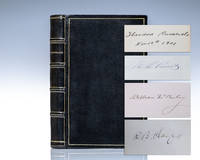
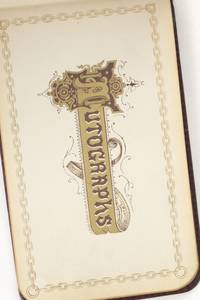
1872réf. 149519Philadelphia: J.B. Lippincott & Co 1872. Rare and remarkable autograph book compiled by West Virginia senator and industrialist Henry Gassaway Davis 1823-1916 containing 289 historic autographs including seven presidents seven vice presidents and scores of members of the Senate House of Representatives and presidential cabinets as well as a few other 19th-century notables. Octavo bound in full crushed levant morocco by the Harcourt Bindery with gilt titles and tooling to the spine in six compartments within raised gilt bands gilt ruling to the front and rear panels gilt-scrolled inner dentelles stamp-signed by the Harcourt Bindery all edges gilt title page printed in gilt. With Davis' ownership signature and subsequently that of his daughter to the title page "H. G . Davis 1872" and "Grace T. Davis 1887" Miss Davis was 18 in 1887. The book has approximately 300 unnumbered pages but only the first 144 which were numbered in pencil by hand at some point include the autographs generally three on each side of a page most often including the person's home state or in the case of cabinet members their office title. The highlights of the album are the signatures of seven presidents representing a half-century of American politics: U. S. Grant Rutherford B. Hayes James A. Garfield Grover Cleveland Benjamin Harrison twice William McKinley and Theodore Roosevelt. Also included are seven vice presidents - Hannibal Hamlin Schuyler Colfax Henry Wilson William A. Wheeler Levi P. Morton Garrett A. Hobart and Charles W. Fairbanks - and one first lady Frances F. Cleveland. With the later presidents' autographs are several examples of partial cabinets including: Harrison Secretary of the Treasury Charles Foster Secretary of War Stephen B. Elkins Attorney General William H. H. Miller Postmaster General John Wanamaker Secretary of the Navy Benjamin F. Tracy Secretary of the Interior John W. Noble and Secretary of Agriculture Jeremiah M. Rusk Cleveland Secretary of State Walter Q. Gresham Secretary of the Treasury John G. Carlisle Secretary of the Navy Daniel S. Lamont Attorney General Richard Olney Postmaster General Wilson S. Bissell Secretary of the Navy Hilary A. Herbert Secretary of the Interior Hoke Smith and Secretary of Agriculture J. Sterling Morton McKinley Secretary of State John Sherman Secretary of the Treasury Lyman J. Gage Secretary of War Russel A. Alger Attorney General Joseph McKenna Postmaster General James A. Gary Secretary of the Navy John D. Long Secretary of Agriculture James Wilson and Secretary of the Interior Cornelius N. Bliss and Roosevelt Secretary of State John Hay Attorney General Philander C. Knox Postmasters General Charles Emory Smith and Henry C. Payne and Secretary of the Interior Ethan A. Hitchcock. Others significant names include influential members of the House and Senate many of whom were celebrated veterans of the Civil War. These include: Hamilton Fish William M. Evarts Charles Sumner David Davis Simon Cameron James G. Blaine George S. Boutwell Augustus H. Garland Roscoe Conkling Ambrose Burnside John A. Logan John B. Gordon Carl Schurz Wade Hampton John T. Morgan Henry W. Slocum and William Mahone. Interestingly one page features the autographs of James Cardinal Gibbons Archbishop of Baltimore and famed agnostic lecturer Robert G. Ingersoll. In fine condition. A remarkable collection spanning half a century of American politics. J.B. Lippincott & Co unknown
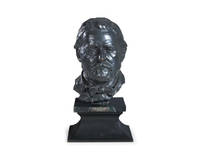
réf. 102885Original bronze bust of Ulysses S. Grant by Henry Shrady the famed sculptor of the Ulysses S. Grant Memorial on the west front of the United States Capitol in Washington D.C. Mounted on socle and base the entire piece measures 18.5 inches in height. In fine condition. An exceptional piece of Americana. Henry Merwin Shrady was an American sculptor known for the Ulysses S. Grant Memorial on the west front of the United States Capitol in Washington D.C. Shrady and architect Edward Pearce Casey won the competition to build the Ulysses S. Grant Memorial in 1902. In the twenty years Shrady spent executing its sculpture program he studied biology at the American Museum of Natural History and dissected horses to gain a better understanding of animal anatomy. The memorial was dedicated on April 27 1922 two weeks after Shrady's death. The Grant Memorial is described as "one of the most important sculptures in Washington" by James M. Goode in The Outdoor Sculpture of Washington D.C. It consists of a colossal equestrian statue of Grant atop a marble pedestal with bas relief plaques guarded by four lions. unknown books
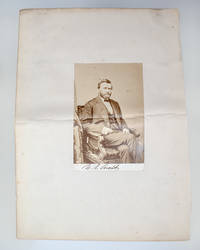
réf. 143272Rare collection of documents related to the 1871 Treaty of Washington including signatures of all of the key figures involved in its signing including President Ulysses S. Grant his Secretary of State Hamilton Fish and the British delegation led by George Robinson Earl de Grey and Ripon. The collection was assembled by Frederic Daustini Cremer who acted as secretary to de Grey and travelled with him and his son Viscount Goderich to Washington for the proceedings where he also obtained letters by William Sherman amongst others for his collection and contains: Two lined folio pages containing the signatures of the British and American signatories of the Treaty of Washington including: the British High Commissioners George Robinson the Earl de Grey and Ripon chairman Stafford Northcote Edward Thornton John Macdonald and Montague Bernard and the American delegation U.S. Secretary of State Hamilton Fish chairman Robert Schenck Samuel Nelson Ebenezer Hoar and George Williams with seven other protagonists. 2 pages folio written on recto only on lined paper watermark 'Department of State/ US' creased page one affixed to an album leaf page two loose dated at head "May 8 1871 11am." A portrait photograph of President Ulysses S. Grant seated in an armchair signed in ink on lower margin "U.S. Grant." Affixed to the reverse of the above album leaf. An autograph note in the third person from General W. T. Sherman to Earl de Grey accepting an invitation to dine on US Army Headquarters notepaper. One page on a bifolium lined paper affixed to an album leaf dated "28 February 1871." Two autograph letters signed "U.S. Grant" the first to Hamilton Fish making arrangements to meet the Italian Minister on Executive Mansion notepaper one page on a bifolium creased dated 13 May 1870; the second to an unknown recipient arranging to meet at Harrisburg 3 pages on a bifolium lined paper torn along fold creased sent from Long Branch N.J. 6 August 1870 both affixed to an album leaf with an accompanying letter to Frederic Daustini Cremer on Executive Mansion notepaper sending him ".an autograph letter of Gen Grant's as a memento. it is one selected for the reason that it is entirely unofficial." Three pages on a bifolium sent from Washington 5 May 1871. An autograph letter signed "Hamilton Fish" to Hon Ogden Hoffman of San Francisco a letter of introduction for ".Lord Goderich and his friend Mr Cremer. The former is the son of the Earl de Grey & the latter is his Lordships Secretary." 2pp. on a bifolium sent from Washington 6 May 1871. With an accompanying autograph envelope; and two autograph letters from Charles Sumner one to Mrs Fish regarding a book of Froissart illustrations and another in the third person to Earl de Grey accepting an invitation 4 pages 7 May 1866 and 13 March no date; with autograph letter signed "Schulyer Colfax" to Hamilton Fish reporting he has not yet received his copies of the Lincoln Memorial on Vice President's Chamber notepaper one page on a bifolium Washington 9 July 1870; with signature of J. G. Blaine Speaker dated 19 April 1871 one page three items affixed to an album leaf the others loose. An autograph letter signed "de Grey" to Cremer written on the voyage back to England after the signing of the Treaty sorry to leave Washington and regretting that the Senate would not ratify the Treaty before he left talking of the Free Trade movement in the US and asking him to report back on the reaction to the treaty in Canada 8pp. creased remains of guard 31 May 1871; with a manuscript fragment outlining two points of the treaty with regards to inshore fisheries one page torn from a larger sheet. In very good to near fine condition. Provenance: The Rev. Frederic Daustini Cremer 1848-1927; thence by descent to the present owner. The 1871 Treaty of Washington augmented permanent peaceful relations between the United States and Canada and the United States and Britain by settling various disputes lingering from the civil war navigation and fishing rights and defining the rules for neutral governments during times of war thereby establishing a precedent for future international arbitration. unknown
1864réf. 2764930/12/1864. Welles had written at the President's suggestion: ""The largest naval force ever assembled is ready"" Fort Fisher guarded the port of Wilmington NC the last port open to blockade runners supplying Robert E. Lee’s Confederate forces in Virginia <img class=""alignnone wp-image-28384 size-post-window"" src=""https://cdn.raabcollection.com/wp-content/uploads/20231204120136/Grant_168-2-1-e1694097936583-1600x492.jpg"" alt="""" width=""1600"" height=""492"" /> As 1864 dawned Wilmington North Carolina protected by Fort Fisher was one of the Confederacy’s last remaining major ports on the Atlantic open to blockade runners and was the chief supply line for General Robert E. Lee’s Army of Northern Virginia. Navy Secretary Gideon Welles reintroduced the idea of a joint operation against Wilmington to the Secretary of the War Edwin Stanton but Stanton saw it as premature. After the Navy’s occupation of Mobile Bay in August all eyes turned to Wilmington. In October 1864 Wilmington finally became the next objective for a joint amphibious operation. Admiral David Porter was chosen to command the naval squadron and General Benjamin Butler the army contingent. On December 24 the 63 ships of Porter’s fleet prepared to bombard the fort. Thirty-seven ships formed in three lines of battle end-to-end facing the enemy. Just after midday Porter commenced the Navy’s first bombardment of the fort and continued firing until it became too dark to aim the guns effectively. While the Confederate troops hid and huddled beneath the mounds of the fort this bombardment actually did little damage with the exception of the wooden quarters of the garrison which were set ablaze. Butler’s force returned too late on that first night to attempt a landing. The next morning December 25 the fleet resumed its barrage while a naval contingent sought to secure a landing area for the Union infantry north of the fort. A group of sailors was sent to take soundings south of the fort but Porter withdrew the sounding party after it became clear that the army group was making no progress north of the fort. The timely arrival of Confederate reinforcements caused Butler to question the strength of his position. He felt his forces could not take the fort without a siege for which they were unprepared. Butler immediately began to re-embark his soldiers. On December 27 he called off the expedition and directed the transports to return to Hampton Roads. The U.S. Navy had suffered 83 casualties and the U.S. Army 12. Thus the first attempt by the Union forces to close the port of Wilmington ended in failure. While Butler returned to Hampton Roads Porter remained off the coast of North Carolina dedicated to preparing another attempt to capture Fort Fisher. Following the fall of Savannah on December 21 1864 General William T. Sherman prepared to march through the Carolinas. Knowing Sherman could soon be in North Carolina and ready to try to capture the fort again on December 25 Porter wrote to Sherman clearly expressing his frustration with Butler’s decision to abandon the joint operation. Porter was also in communication with Welles. With these communications in hand Welles spoke to President Lincoln who was all for trying again to take the fort. On December 29 Welles wrote to General U.S. Grant in overall command of the army that the President hoped that another joint operation might be forthcoming. Welles’s telegram to Grant stated: “December 29 1864 at 9:30 pm. The substance of dispatches and reports from Rear-Admiral Porter off Wilmington is briefly this: The ships can approach nearer to the enemy’s works than was anticipated. Their fire can keep the enemy away from their guns. A landing can easily be effected upon the beach north of Fort Fisher not only of troops but all their supplies and artillery. This force can have its flanks protected by gun-boats. The navy can assist in the siege of Fort Fisher precisely as it covered the operations which resulted in the capture of Fort Wagner. The winter season is the most favorable for operations against Fort Fisher. The largest naval force ever assembled is ready to lend its co-operation. Rear-Admiral Porter will remain off Fort Fisher continuing a moderate fire to prevent new works from being erected and the ironclad have proved that they can maintain themselves in spite of bad weather. Under all these circumstances I invite to such a military co-operations as will insure the fall of Fort Fisher the importance of which has already received your careful consideration. This telegram is made at the suggestion of the President and in hopes that you will be able at this time to give the troops which heretofore were required elsewhere. If it cannot be done the fleet will have to disperse whence it cannot again be brought to this coast.” <img class=""alignnone wp-image-28385 size-post-window"" src=""https://cdn.raabcollection.com/wp-content/uploads/20231204120124/Grant_177-1-1-e1694097999755-1600x684.jpg"" alt="""" width=""1600"" height=""684"" /> Grant responded to Welles immediately. Autograph letter signed headquarters at City Point Va. December 30 1864 to Welles. “Your dispatch of 9:30 p.m. 29th received. I will advise fully with the Sec. of War about what you propose. Please call on him for information. U.S. Grant Lieut. Gen.” Thus Grant promised to inform Stanton “fully” about the plan and requested that Welles consult with Stanton to finalize it. Grant had told Stanton that he did not intend to correspond with the Navy Department except through Stanton and this letter further indicates that. Porter had a good working relationship with Grant and a solid record of success in joint operations. Due to this Welles was able to argue successfully with Lincoln for Porter’s retention as commander. In early January Porter coordinated directly with Sherman and Grant about plans for a renewal of operations against Fort Fisher. As Sherman marched north the port of Wilmington was now more important to the U.S. Army than it had been during the first battle for Fort Fisher. Butler rightly took the blame for the first expedition’s failure. For his replacement Grant chose General Alfred Terry one of Butler’s staff officers. Grant assigned him the same troops that had participated in the first attempt augmented with an additional brigade for a total of 8000 soldiers. On January 4 1865 the second expedition to capture Fort Fisher embarked from Bermuda Landing in Virginia. On January 12 they headed for Fort Fisher. Arriving that night Porter and Terry prepared to commence their attack the next day. At dawn on January 13 8000 Federal soldiers landed above the fort as the Navy began its bombardment. Sailors were landed on the 15th and drew fire. This diversion allowed the army to breach the walls of the fort. By 10 p.m. the fort was in possession of the Federal forces. The Confederates started a retreat and when Federal infantry caught up with them General Terry accepted the formal surrender of the fort. The first battle of Fort Fisher was the most concentrated naval bombardment of the war. The fleet fired 20271 projectiles into the fort during the first battle. Another 19682 were fired during the second battle. In total the U.S. Navy expended 39953 projectiles at the fort. After Fort Fisher’s capture Porter proceeded to put vessels over the bar and into the Cape Fear River. He declared the port of Wilmington to be “hermetically sealed against blockade runners”. Five weeks after the fall of Fort Fisher the Federal army occupied the city of Wilmington. This occupation ended the trickle of supplies coming along the Wilmington and Weldon Railroad to the Army of Northern Virginia. The fall of Wilmington contributed directly to this army’s surrender at Appomattox Courthouse in April 1865. <img class=""alignnone wp-image-25018 size-post-window"" src=""https://cdn.raabcollection.com/wp-content/uploads/20231204144051/Folder-site-11-1600x1327.jpg"" alt="""" width=""1600"" height=""1327"" /> unknown
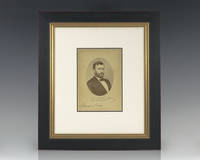
réf. 94709Rare original Mathew Brady photograph of Ulysses S. Grant. Boldly signed by Grant as the 18th President of the United States "U.S. Grant March 18th 1875." One of the earliest photographers in American history Mathew B. Brady brought home the reality of the Civil War to the American public with his innovative use of a mobile studio and darkroom to capture thousands of war scenes throughout the Civil War. Brady was also recognized as one of the premier photographic portraitists of the 19th century taking photographs of numerous celebrities including Andrew Jackson John Quincy Adams Abraham Lincoln and Robert E. Lee among others. Double matted and framed. The entire piece measures 19 inches by 16.5 inches. In near fine condition. Rare and desirable with such a strong signature signed by Grant during his presidency. Ulysses S. Grant served as president of the United States from March 4 1869 to March 4 1877. On January 29 1877 five days before he left office Grant gave an address to the Senate of the United States regarding a controversial dispute that had arisen over the results of the upcoming presidential election. In the address Grant argued that the people must put their trust in Congress stating: "In all periods of history controversies have arisen as to the succession or choice of the chiefs of states and no party or citizens loving their country and its free institutions can sacrifice too much of mere feeling in preserving through the upright course of law their country from the smallest danger to its peace on such an occasion; and it can not be impressed too firmly in the hearts of all the people that true liberty and real progress can exist only through a cheerful adherence to constitutional law. unknown books
réf. 102885Original bronze bust of Ulysses S. Grant by Henry Shrady the famed sculptor of the Ulysses S. Grant Memorial on the west front of the United States Capitol in Washington D.C. Mounted on socle and base the entire piece measures 18.5 inches in height the base measures 9.5 inches square. In fine condition. An exceptional piece of Americana. Henry Merwin Shrady was an American sculptor known for the Ulysses S. Grant Memorial on the west front of the United States Capitol in Washington D.C. Shrady and architect Edward Pearce Casey won the competition to build the Ulysses S. Grant Memorial in 1902. In the twenty years Shrady spent executing its sculpture program he studied biology at the American Museum of Natural History and dissected horses to gain a better understanding of animal anatomy. The memorial was dedicated on April 27 1922 two weeks after Shrady's death. The Grant Memorial is described as "one of the most important sculptures in Washington" by James M. Goode in The Outdoor Sculpture of Washington D.C. It consists of a colossal equestrian statue of Grant atop a marble pedestal with bas relief plaques guarded by four lions. unknown
1885réf. 2007Philadelphia: S.n. 1885. Leather over boards. Oblong duodecimo. 54 leaves. Near fine. Leather over thin board with gilt-stamped upper board. Professionally restored with about half of the original gilt-ornamented spine retained. Wesson's name card laid down on front pastedown. A fantastic and eclectic trove of 19th century autographs collected by one Edward Wesson apparently associated with the Continental Hotel in Philadelphia. The autographs range from military figures to actors and actresses singers diplomats explorers and more. Some of the most notable figures whose autographs appear here include Ulysses S. Grant Edwin Booth William Tecumseh Sherman P. T. Barnum King David KalÄkaua of Hawaii Henry Ward Beecher David Ross Locke aka 'Petroleum V. Nasby' and Hannibal Hamlin Vice-President under Abraham Lincoln. There are also autographs from survivors of the tragic Jeanette Expedition to the Arctic including John W. Danenhower Louis P. Noros William F. C. Nindemann and George W. Melville. Among the other entertainment figures of the day to sign Mr. Wesson's album were actresses Maggie Mitchell and Emma Abbott and several others. Of the 54 leaves only 5 are blank on both sides with the remaining 49 having autographs on one or both sides and one autograph on the recto of rear free endpaper for a total of 57 autographs in all. The album originated at Philadelphia's Continental Hotel one of the grandest and most socially prominent establishments of the 19th century. Opened in 1860 and famed for hosting presidents generals and celebrities-including Abraham Lincoln who stayed there en route to his 1861 inauguration-the Continental stood as a national landmark until its 1924 demolition to make way for the Benjamin Franklin Hotel. Apart from a single tipped‑in signature from a Mayor of Mt. Vernon NY every autograph in this volume is penned directly onto its original pages. This is of vital significance because unlike albums assembled from clipped signatures from various sources this is a continuous artifact: the very book that moved through the hands of each signer. To hold it now is to experience that unique connection with each of the historical figures who once inscribed it. A truly remarkable artifact. (S.n.) unknown
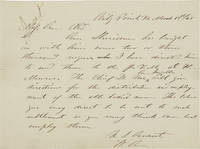
1865réf. WRCAM53987City Point Va 1865. 1p. 6 x 7 3/4 inches. Verso docketed with an 1896 penciled presentation inscription to Chicago manufacturing magnate W.W. Wilcox with a faint ink stamp recording the date of presentation. Old horizontal folds light edge toning one tiny tear at bottom edge else fine condition. An important and revealing original communication from the pen of Lieutenant General Ulysses S. Grant near the close of the Civil War. Here Grant writes a telegram to Major General Edward Ord who was at that time in command of the Army of the James in Virginia. Ord's forces were participating in the Appomattox Campaign and achieved their greatest success at the Breakthrough at Petersburg just about two weeks after this telegram was sent. Ord would later be present for Lee's surrender at Appomattox Court House. In this letter Grant informs Ord that Sheridan has just brought in thousands of freed African Americans to work as laborers for the Union. Grant sends them to the provost marshal at Fort Monroe in Hampton Roads and informs Ord that he may employ some of the men however he might see fit. The text of the telegram reads: "Gen. Sheridan has brought in with him some two or three thousand negroes. I have directed him to send them to the F.V. at Ft. Monroe. The Chief Ar. Ms. Gen. Ingalls will give directions for the distribution and employment of the able bodied men. The balance you may direct to be sent to such settlement as you may think can best employ them. U.S. Grant Lt. Gen." Ord and his men were instrumental in bringing an end to the Civil War in the weeks that followed this telegram. On April 9 Ord led a forced march to Appomattox Court House that is credited with in part forcing Lee's final surrender. Of this march Gen. William Tecumseh Sherman wrote in an 1880 letter that he "had always understood that Ord's skillful hard march the night before was one of the chief causes of Lee's surrender." It is poetic justice of the highest order to consider that some of the African-American former slaves mentioned in this telegram were likely part of Ord's forces at Appomattox where they could have borne witness to the end of the Confederacy. THE WAR OF THE REBELLION: A COMPILATION OF THE OFFICIAL RECORDS OF THE UNION AND CONFEDERATE ARMIES Washington: Government Printing Office 1894 Series I Vol. XLVI Part III p.41. unknown books
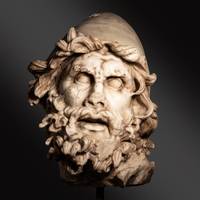
réf. 148696A marble bust of the head of the Sperlonga Odysseus. The sculptures discovered at the former villa of Emperor Tiberius in Sperlonga form one of the most significant ensembles of Hellenistic-style Roman sculpture depicting dramatic mythological scenes such as the Blinding of Polyphemus and the Scylla Group. These monumental marble groups likely created by Rhodian sculptors in the early first century CE reflect both the imperial taste for Greek artistic models and the political utility of myth aligning Tiberius with heroic figures like Odysseus to reinforce themes of cunning survival and imperial power. In very good condition with some pitting and cracking to the figure's right cheek right side of his neck and back. The height of the bust is 14 inches and with the mount is 23 inches. Odysseus the hero of Homer’s Odyssey stands as a quintessential figure in classical literature embodying the traits of cunning resilience and complex morality. Unlike the straightforward martial valor of Achilles in the Iliad Odysseus is defined by his metis—intelligence and strategic thinking—which allows him to navigate the physical and ethical challenges of his long journey home from Troy. His character reflects the ancient Greek ideal of versatility and adaptability as he must assume disguises negotiate with gods and mortals and confront both monsters and temptations. At the same time Odysseus’ actions raise enduring questions about identity leadership and the costs of war making him a deeply ambivalent figure whose legacy has resonated through centuries of Western literature and thought. unknown
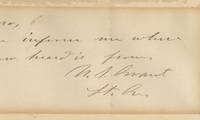
1864réf. 334181864. This letter has been for several generations in a private collection and is unpublished In January 1864 General Ambrose E. Burnside was asked to reorganize the IX Corps. He asked for and was granted permission by Secretary of War Edwin Stanton to form a division of “colored troops.” The 4th Division of the IX Corps infantry would be all black troops commanded by General Edward Ferrero. The regiments were divided into two brigades; the first brigade was made up by the 27th 30th 39th and 43rd USCT. The second brigade was the 30th Connecticut Colored Infantry only 4 companies formed then consolidated into 31st USCT 19th 23rd 31st USCT. The 28th and 29th USCT regiments would be added to the second brigade. These regiments came from all across the North. When the 4th Division of the IX Corps left Camp Stanton in Annapolis Maryland they were paraded in front of President Abraham Lincoln and General Burnside in Washington DC. The 23rd joined the division when the men marched across the bridge into Virginia. In March 1864 Ulysses S. Grant was appointed by President Abraham Lincoln commander of the Union Armies. Grant developed a strategy to defeat the Confederacy by placing his army between the rebel capital of Richmond and Gen. Robert E. Lee’s Army of Northern Virginia. Grant moved southeast to try to create a wedge between Lee and Richmond but Lee's army successfully followed up the engagements by foiling that maneuver. Then Grant's assaults at Cold Harbor his most mistaken plan of the war and the one he most regretted resulted in a sharp defeat. Grant thus found that he was unable to take Richmond directly. Next Grant focused on Petersburg due south of Richmond. If Grant could take Petersburg then the Confederates would have to abandon Richmond. Grant's attempt to take it quickly failed so by mid-June 1864 Lee ended up in Petersburg with the Appomattox River protecting his back and surrounding the city below the river he built two lines of works that covered the entire area. Grant would besiege Petersburg and the IX corps played a part under General Ferrero. The 23rd USCT became the first colored troops to fight in “directed combat” against Lee’s Army of Northern Virginia. The skirmish was fought at the intersection of Catharpin and Old Plank Roads originally Orange Plank Road on May 15 1864. The 23rd was at the Chancellorsville ruins when the Union 2nd Ohio Cavalry was chased by General Thomas Rosser’s Confederate Cavalry Brigade. The 2nd asked for assistance and the only soldiers nearby were General Edward Ferrero’s colored division. The 23rd USCT “double quicked” the two miles to the intersection and drove back Rosser’s cavalry as ordered by General Ferrero. The black soldiers were cheered by the 2nd Ohio who now gave chase to Rosser’s cavalry. This battle action proved to the white troops that black soldiers would fight against the Confederate army. With the end of that campaign Grant ended up besieging the city and his Army of the Potomac built works from the river northeast of Petersburg down to south of the city as far as they could go. The Confederates controlled all the ground from Grant’s southern tip west up to the river. Grant’s main objective during the ten-month Siege of Petersburg was to extend his lines south and west to cut Lee’s railroad links and encircle him at the same time. Lee’s problem was that he was stuck in Petersburg and every Union successful extension west forced him to extend his lines. And every time he had to extend those lines became thinner. In mid June as Grant prepared for his long assault on Petersburg Ferrero's black soldiers were now placed in the trenches with the other three divisions. The part of the line occupied by the IX Corps was very near the enemy's works and an incessant firing was kept up during the siege resulting in a daily loss of men killed or wounded. While there was a comparative quiet in front of the other corps positions the men of the IX Corps were subjected to the terrible strain of a constant watchfulness and deadly exposure. The enemy seemed to be excited to an undue activity by the presence of Ferrero's Colored Division. In late July 1864 during the Battle of the Crater Ferrero's men had been trained for the attack on the Confederate line. However due to a last minute change by General George G. Meade the black soldiers were the last to enter the battle instead of the first. The three white divisions of the IX Corps did not follow General Burnside’s plan and delayed the attack. By the time the colored troops entered the battle the Confederates were ready to counterattack. Before being driven into the Crater the black troops advanced further than the white troops. The Confederate counterattack was a furious attack that won the day for the Confederate army. The black troops sustained the worst casualties. Ferrero initially accused of dereliction in this duty was cleared. Autograph letter signed no date but during the early siege perhaps mid to late June 1864 to General Ferrero. ""General Ferrero please inform me where the firing now heard is from."" This letter has been for several generations in a private collection and is unpublished. We are not aware of another letter of Grant to Ferrero. <img class=""alignnone wp-image-25018 size-post-window"" src=""https://cdn.raabcollection.com/wp-content/uploads/20231204144051/Folder-site-11-1600x1327.jpg"" alt="""" width=""1600"" height=""1327"" /> unknown
1885réf. 125381New York: Henry-Bonnard Bronze Co. c. 1885. Attractive bronze bust of of Ulysses S. Grant as General of the Army by famed American sculptor Henry Kirke Bush-Brown. The adopted nephew of sculptor Henry Kirke Brown Henry Kirke Bush-Brown was revered for his accurate realist sculptures illustrating American history. He produced three equestrian bronze sculptures erected at the Gettysburg battlefield depicting General George Mead the victor at Gettysburg General John F. Reynolds killed in action July 1 1863 and General John Sedgwick the senior most Union casualty of the American Civil War. In addition Bush-Brown made a bust of Abraham Lincoln dedicated in 1912 as part of the Lincoln Speech Memorial commemorating Lincoln's Gettysburg Address. Mounted on a bronze base the entire piece measures 7.75 inches in height. In fine condition. Following the close of the American Civil War Congress revisited the idea of a superior General rank initially intended for bestowal upon George Washington who held the rank of “General and Commander-in-Chief” which was a grade senior to all American major generals and brigadier generals from the American Revolutionary War but only entitled him to the three-star insignia of an Army lieutenant general. On July 25 1866 Congress enacted legislation authorizing the grade of General of the Army and on that same date the new grade was conferred on Lieutenant General Ulysses S. Grant as a reward for saving the Union in the American Civil War. The grade was recognized and continued in various acts until the Act of July 15 1870 which contained the requirement that “the offices of general and lieutenant general shall continue until a vacancy shall exist in the same and no longer and when such vacancy shall occur in either of said offices shall become inoperative and shall by virtue of this act from thence forward be held to be repealed.” Henry-Bonnard Bronze Co. unknown
1885réf. 147086New York: Charles L. Webster & Company 1885-1891. Rare Shoulder Strap set of five Civil War histories printed by Twain's publishing house in its short-lived but impressive decade of operation. Octavo eight volumes bound in full tan sheep skin with gilt titles and ruling to the spine in five compartments within raised bands red and black spine labels all edges marbled marbled endpapers tissue-guarded frontispiece portraits to each volume illustrated with steel engravings maps and woodcuts. The set features: a first edition of Personal Memoirs of U. S. Grant Two volumes 1885-1886; a first edition of McClellan's Own Story: The War for the Union the Soldiers Who Fought It and His Relations to It and to Them 1887; a first edition of Tenting on the Plains: or Gen. Custer in Kansas and Texas 1887; a first edition of Personal Memoirs of P. H. Sheridan Two volumes 1888; and a fourth edition of Memoirs of Gen. W. T. Sherman Two volumes 1891. In very good to good condition with rubbing to the extremities and light toning to the title pages of each volume evidence of interior hinge repair and library stamps to the first and last leaves of the Sherman and Custer memoirs a gift inscription to the first volume of Sheridan's memoirs darkening to the top edge of both volumes of the Sheridan memoir library checkout card and pocket to the rear pastedown of the Custer volume. An exceptionally rare set especially in this condition. Featuring the finest of contemporary Civil War histories the Great War Library "Shoulder Strap" series pays tribute to Mark Twain's brief but impressive venture into publishing. In 1884 Twain joined with Charles Webster who was married to Twain's niece in an effort at first to publish "his own books and he began successfully with Huckleberry Finn in 1885. Almost fortuitously he got the contract to publish U.S. Grant's Memoirs 1885-86—a huge success . . . Other Civil War generals preparing their memoirs naturally hoped to appear with their great commander" Paine 831. Charles L. Webster & Company hardcover
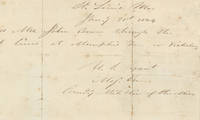
1864réf. 3548131/01/1864. Written by Grant while on a visit to his family in St. Louis as he awaited his promotion to Lieutenant General His great victory at the Battle of Chattanooga in November 1863 made Major General Ulysses S. Grant the most prominent Union general. Soon legislation would be introduced in Congress to revive the rank of Lieutenant General—previously held only by George Washington and Winfield Scott—specifically to give Grant command of all Union armies. This Congress did on February 29 1864 and Grant would officially receive this promotion and the role of General-in-Chief on March 10. In January 1864 Grant fresh from his victories in the West was still serving as the commander of the Military Division of the Mississippi overseeing Union operations in the Western Theater of the war. His activities that month focused on administrative and inspection tours of Kentucky and Tennessee and assessing supply lines. Finding the Cumberland Gap route for supplies unfeasible due to terrible road conditions he favored using the Nashville & Stevenson Railroad and the Tennessee River instead. More importantly he also concentrated on planning for the crucial 1864 spring campaign and the development of a grand strategy for the war. In a letter of January 19 to Gen. Henry Halleck demonstrating his proactive approach to ending the war Grant suggested a bold plan to invade North Carolina from New Bern to cut Confederate supply lines through Wilmington and capture Raleigh. Amidst all these activities Grant also took time to join his family in St. Louis for a short trip from January 27-February 3. <img class=""alignnone wp-image-35510 size-post-window"" src=""https://cdn.raabcollection.com/wp-content/uploads/20260125192231/Grant-Jan-31-1864-1-1600x664.jpg"" alt="""" width=""1600"" height=""664"" /> After his promotion Grant's subsequent strategy implemented from the field with the Army of the Potomac focused on simultaneous relentless pressure on Confederate forces leading to eventual victory. Mrs. Bowen was the wife of Confederate general John Bowen a fine military commander who battled Grant and his armies in the final defense of Vicksburg. Bowen would die of disease just as the battle concluded in 1863. The Bowens were from St. Louis and when Gen. Bowen first left St. Louis to enter the war his wife Mary was by his side leaving their two young children at the family home to be cared for by Mary's mother. It is known that Mrs. Bowen passed through the lines after her husband’s demise and her passing back and forth to St. Louis and her access to Grant suggest this pass was almost certainly. for her. Autograph document signed St. Louis Mo. January 31 1864. “Pass Mrs. John Bowen through the Federal lines at Memphis Tenn. or Vicksburg Miss.” It is signed “U.S. Grant Maj. Gen. commanding Mil. Div. of the Miss.” Grant was known to be helpful to southern women so this would be consistent with his practice. This must be one of the few papers Grant signed while on the brief visit to his family. <img class=""alignnone wp-image-25018 size-post-window"" src=""https://cdn.raabcollection.com/wp-content/uploads/20231204144051/Folder-site-11-1600x1327.jpg"" alt="""" width=""1600"" height=""1327"" /> unknown
1885réf. 125381New York: Henry-Bonnard Bronze Co. c. 1885. Attractive bronze bust of of Ulysses S. Grant as General of the Army by famed American sculptor Henry Kirke Bush-Brown. The adopted nephew of sculptor Henry Kirke Brown Henry Kirke Bush-Brown was revered for his accurate realist sculptures illustrating American history. He produced three equestrian bronze sculptures erected at the Gettysburg battlefield depicting General George Mead the victor at Gettysburg General John F. Reynolds killed in action July 1 1863 and General John Sedgwick the senior most Union casualty of the American Civil War. In addition Bush-Brown made a bust of Abraham Lincoln dedicated in 1912 as part of the Lincoln Speech Memorial commemorating Lincoln's Gettysburg Address. Mounted on a bronze base the entire piece measures 7.75 inches in height. In fine condition. Following the close of the American Civil War Congress revisited the idea of a superior General rank initially intended for bestowal upon George Washington who held the rank of "General and Commander-in-Chief" which was a grade senior to all American major generals and brigadier generals from the American Revolutionary War but only entitled him to the three-star insignia of an Army lieutenant general. On July 25 1866 Congress enacted legislation authorizing the grade of General of the Army and on that same date the new grade was conferred on Lieutenant General Ulysses S. Grant as a reward for saving the Union in the American Civil War. The grade was recognized and continued in various acts until the Act of July 15 1870 which contained the requirement that "the offices of general and lieutenant general shall continue until a vacancy shall exist in the same and no longer and when such vacancy shall occur in either of said offices shall become inoperative and shall by virtue of this act from thence forward be held to be repealed. Henry-Bonnard Bronze Co. unknown books
1875réf. 011828Washington: Department of the Interior 1875. Book. Very good condition. No Binding. Signed by Authors. First Edition. A large partly printed document appointing A. J. Carrier to the position of Indian Agent for the Ponca Indians in Dakota Territory signed by President Ulysses S. Grant on January 13 1875. The document meaures 20.75 w x 16 h and is framed. Countersigned by Acting Secretary of the Interior B. R. Cowan. Included is an intersting archive of almost 30 items most of which relates to Carrier's service as Indian Agent at the Ponca Agency. Many are on Agency or United States letterhead. One document lists 16 Indians by name for rations stopped or doubled; another is a detail of picket guard one mile west of Point Village against Sioux attacks and lists an Indian Sergeant and 10 Indian Privates; many documents are receipts of payment to Indians for services at the Agency including Little Snake Peter Primeaux Frank Le Fleash Sick Bull Rough Face etc.; another is a large document torn at folds listing the names of 211 Indians signed with their marks receiving annuity payments witness and signed by A. J. Potter and A. J. Abbott and Charles P. Morgan interpreter. Additionally there are three printed govenrment publications including Army HQ General Orders No. 97 a Senate Petition by Carrier and a House of Representatives Report submitted by Carrier. There is also a statement of equipage and supplies for 1864-1865 signed by Carrier for the 198th Regiment Pennsylvania Volunteers Infantry Company A of which Carrier was an officer. There is also a five page "Descriptive List of Curiosities furnished by the Ponca Indians of Dakota." An interesting and unique collection of original documents. Department of the Interior unknown books
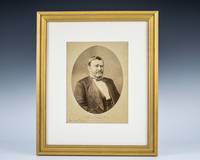
1877réf. 46081877. Large signed photograph of Ulysses S. Grant as President of the United States. Boldly signed below the image by Grant. The entire piece measures 14.5 inches by 17 inches. Handsomely matted and framed. Scarce and desirable signed by Grant. Ulysses S. Grant served as president of the United States from March 4 1869 to March 4 1877. On January 29 1877 five days before he left office Grant gave an address to the Senate of the United States regarding a controversial dispute that had arisen over the results of the upcoming presidential election. In the address Grant argued that the people must put their trust in Congress stating: “In all periods of history controversies have arisen as to the succession or choice of the chiefs of states and no party or citizens loving their country and its free institutions can sacrifice too much of mere feeling in preserving through the upright course of law their country from the smallest danger to its peace on such an occasion; and it can not be impressed too firmly in the hearts of all the people that true liberty and real progress can exist only through a cheerful adherence to constitutional law.” unknown
réf. 114911 leaf of wallpaper sample mimeographed title-page & 20 leaves of wallpaper samples with typewritten captions. Small 8vo 173 x 110 mm. orig. gray paper wrappers orig. burgundy cloth binding tape around spine staple-bound. Amsterdam: In-Out Productions 1973. First edition of an exceptionally rare Ulises Carrión bookwork that embodies the type of book he would champion in his influential manifesto "The New Art of Making Books." This edition comprises just 50 copies each with a unique selection of wallpaper samples; we know of two examples of this edition in North American libraries. According to Tineke Reijnders in her essay on the In-Out Center Archives website the bookwork originated with Carrión's discovery of discarded sample books produced by the illustrious wallpaper manufacturer Rath & Doodeheefver. He cut these up to constitute the leaves of what became the first edition of the present book. The numbered edition of 50 copies was quickly disseminated by sale gift or exchange. Carrión made a second edition in a slightly wider format in 1974 in an unknown number of copies. This bookwork gives us a tour of the imagined bedrooms of the people in his life. In order we are presented with wallpaper specimens for: "my room" "my parent's room" "my sister's room" "my oncle's room" "my wife's room" "my teacher's room" "my doctor's room" "my accountant's room" "my lawyer's room" "my psychiatrist's room" "my boss' room" "my lover's room" "my friend's room" "my neighbour's room" "my servant's room" "Guest room" "Their room" "Your room" "A room" ".'s room." Omitting any suggestion of narrative the artist leaves us to form our own associations and interpretations of the wallpaper selections and the rooms we visit through the course of the bookwork. The array of samples vary from copy to copy. "The bookwork was assembled from an assortment of wallpaper swatches and literalizes Carrión's idea of the book as a space-time sequence. Emphasizing the book object's architecture more patently than previous bookworks it plays with the slippage between a book's underlying structure and architectural spaces as such. For Carrión a lyric poem's stanzaic structure relies on the space of the page yet it belongs in the old art for this space is not the physical space of the page but an 'ideal abstract impalpable' one according to 'The New Art.' In this bookwork however recto pages made of actual wallpaper samples index the rooms of a constellation of potential figures in the reader's familial and social circles. Pages are empty and inscrutable but for the labels indicating where the wallpaper supposedly belongs. If we gather anything from traversing the bookwork's different time-space units it's that the reader it imagines is not the alienated individual mirrored in a lyric poem but a late twentieth-century professional whose compartmentalized relations are mostly familiar or transactional."-M. de la Torre "An Essay in Nine Bookworks and Not" in S. Hamerman & J. R. Ramos eds. Ulises Carrión: Bookworks and Beyond 2024 p. 33. An elusive and important bookwork in fine condition. It was purchased at Carrión's Other Books and So 1975-78 with the pencil price in the upper corner of the title-page. ⧠S. Hamerman & J. R. Ramos eds. Ulises Carrión: Bookworks and Beyond 2024 pp. 33-35 pictured & p. 172. J. J. Agius & R. Ocampo eds. Ulises Carrión: Books & More Catalogue Raisonné 2013 6. T. Reijnders "Ulises Carrión and the In-Out Center" In-Out Center Archives website accessed August 2025. unknown
1877réf. 46081877. Large signed photograph of Ulysses S. Grant as President of the United States. Boldly signed below the image by Grant. The entire piece measures 14.5 inches by 17 inches. Handsomely matted and framed. Scarce and desirable signed by Grant. Ulysses S. Grant served as president of the United States from March 4 1869 to March 4 1877. On January 29 1877 five days before he left office Grant gave an address to the Senate of the United States regarding a controversial dispute that had arisen over the results of the upcoming presidential election. In the address Grant argued that the people must put their trust in Congress stating: "In all periods of history controversies have arisen as to the succession or choice of the chiefs of states and no party or citizens loving their country and its free institutions can sacrifice too much of mere feeling in preserving through the upright course of law their country from the smallest danger to its peace on such an occasion; and it can not be impressed too firmly in the hearts of all the people that true liberty and real progress can exist only through a cheerful adherence to constitutional law. unknown books
1886réf. 61992Boston:: The U.U. Instantaneous Photographic Co. 1886. First edition. publisher's full black morocco gilt a.e.g. Some very minor soiling to a just a few of the images; some minor use to the binding; very attractive. . Large oblong folio. This copy contains ninety-nine original albumen photographs many retouched at time of issue other located copies contain 98 and 97 photographs; with printed captions on mounts. The U.U. Instantaneous Photographic Co., unknown
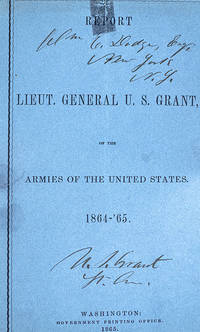
1865réf. 114672Washington: Government Printing Office 1865. Rare Civil War era report cover inscribed by Ulysses S. Grant as Lieutenant General of the United States Army. One page report cover inscribed by Grant "Wm E. Dodge Esq. New York N.Y. U.S. Grant Lt. Gen." Abraham Lincoln promoted Grant to Lieutenant General of the United States Army on March 1864 a rank which had only previously been held by George Washington. Following Lincolns assassination in April of 1865 Grant became America's first four-star general and played an important role in aiding Congress in their effort to reconstruct the South. In near fine condition. With a first edition of the complete report which is in very good condition. Rare and desirable. As Commanding General of the United States Army 1864–69 Grant worked closely with President Abraham Lincoln to lead the Union Army to victory over the Confederacy in the Civil War. He implemented Congressional Reconstruction often at odds with Lincoln's successor Andrew Johnson. Twice elected president Grant led the Republicans in their effort to remove the vestiges of Confederate nationalism and slavery protect African-American citizenship and supported unbridled nationwide industrial expansionism during the Gilded Age. Government Printing Office unknown
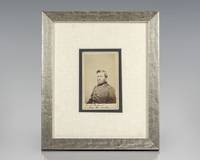
réf. 109556Rare original carte de visite signed by Ulysses S. Grant "U.S. Grant Maj. Gen. U.S.A." In near fine condition. Matted and framed. The entire piece measures 9.5 inches by 8 inches. Ulysses S. Grant was the 18th President of the United States 1869–77. As Commanding General of the United States Army 1864–69 Grant worked closely with President Abraham Lincoln to lead the Union Army to victory over the Confederacy in the Civil War. He implemented Congressional Reconstruction often at odds with Lincoln's successor Andrew Johnson. Twice elected president Grant led the Republicans in their effort to remove the vestiges of Confederate nationalism and slavery protect African-American citizenship and supported unbridled nationwide industrial expansionism during the Gilded Age. unknown
réf. 5510Original carte de visite signed "U.S. Grant Lt. Gen. U.S.A." Mounted on stiff ivory card stock the carte-de-visite measures 2.6 inches by 4 inches. Signed below the image on the print. Matted and framed. Rare and desirable. Grant's inscription "Lt. Gen. U.S.A." establishes the date of this carte-de-visite as after March 9 1864 Simpson 457. It was then that Lincoln gathered his cabinet "to witness something that had occurred only once before in the history of the republic. As soon as everyone had arrived Lincoln presented Ulysses S. Grant with his commission as a lieutenant general. Only Washington had risen to that rank in the U.S. Army before him" Civil War Times Magazine. As Grant was rarely in the capital returning only briefly to outline his plans to Lincoln this photographic portrait may well have been taken very soon afterward. The mount verso features the Washington D.C. studio imprint of renowned Civil War photographer Alexander Gardner which he opened in 1863. By that time Gardner was "arguably the most talented and ambitious photographer working in America. If Brady had perhaps conceived the grand idea of an epic documentation of the Civil War it was Gardner who actually executed it" Photography and the American Civil War 81. unknown books
1865réf. 114672Washington: Government Printing Office 1865. Rare Civil War era report cover inscribed by Ulysses S. Grant as Lieutenant General of the United States Army. One page report cover inscribed by Grant "Wm E. Dodge Esq. New York N.Y. U.S. Grant Lt. Gen." Abraham Lincoln promoted Grant to Lieutenant General of the United States Army on March 1864 a rank which had only previously been held by George Washington. Following Lincolns assassination in April of 1865 Grant became America's first four-star general and played an important role in aiding Congress in their effort to reconstruct the South. In near fine condition. With a first edition of the complete report which is in very good condition. Rare and desirable. As Commanding General of the United States Army 1864-69 Grant worked closely with President Abraham Lincoln to lead the Union Army to victory over the Confederacy in the Civil War. He implemented Congressional Reconstruction often at odds with Lincoln's successor Andrew Johnson. Twice elected president Grant led the Republicans in their effort to remove the vestiges of Confederate nationalism and slavery protect African-American citizenship and supported unbridled nationwide industrial expansionism during the Gilded Age. Government Printing Office unknown books