2449 risultati
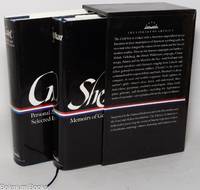
1990rif. 350676New York: Literary Classics of the United States 1990. 1191p. & 1136p. hardcover reprints bound in blue cloth boards and gilt with unclipped dust jackets and slipcase in very good condition. Library of America #50 & 51. Literary Classics of the United States unknown books
1972rif. 78254Helsinki: Eurographica 1972. First edition. 50 pp. Fine in wrappers and fine printed dust jacket. Edited by Rolando Pieraccini. One of 350 numbered copies on special Michelangelo Paper SIGNED by Elytis. Contemporary Poets in Signed Limited Editions 1. Elytis was awarded the Nobel Prize in 1979. Helsinki: Eurographica unknown books
1974rif. 76278Philadelphia: Temple University Press 1974. First edition. vii 200 pp w/notes & bibliography. Foxing to page edges rubbing to lower edges of boards. In all very good plus in near fine dust jacket with lightly tanned spine. Translated with an introduction and notes by Kimon Friar. Philadelphia: Temple University Press hardcover books
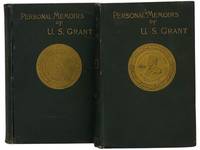
1885rif. 2349284New York: Charles L. Webster & Company 1885. First Edition. Hard Cover. Good/Very Good. 9x5x1. First edition of first volume 1892 reprint of second volume. Boards of second volume stained and discolored front hinge of first volume just beginning to weaken. Text clean and unmarked. 1885 Hard Cover. 584; 647 pp. 8vo. Original green cloth with gilt titles and rules. Engravings and maps throughout text as well as fold-out facsimiles of the original terms of Lee's surrender which Grant wrote himself and of General Buckner's dispatch regarding terms of capitulation with Grant's reply and Buckner's response surrendering Fort Donelson. The famous memoirs of the leader of the Union army during the American Civil War including accounts of his boyhood and early career during the Mexican War. Mark Twain can be partially credited for the release of Grant's memoirs: Grant's health was ailing he soon died of cancer and Twain encouraged Grant to write them as a way to provide for his family after his death. The books were barely completed before Grant passed away and were published posthumously. Charles L. Webster & Company hardcover books
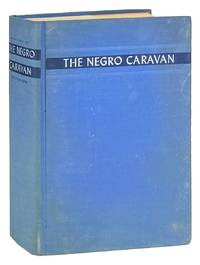
1941rif. 1395657New York New York: The Dryden Press 1941. First Edition. Hardcover. Octavo vii 1082 pages. In Good plus condition. Spine is navy with gilt detailing and black lettering. Boards have moderate general scuffing and rubbing wear spine mildly cocked and mild fraying along rear head joint. Text block moderately scuffed and age toned along edges has mild bending wear p. vii. DL Consignment. Shelved Case 1. Contains sections on Short Stories Novels Selections Poetry Folk Literature Drama Speeches Pamphlets and Letters Biography and Essays. From the Preface: "This anthology of the writings of American Negroes has three purposes: 1 to present a body of artistically valid writings by American Negro authors 2 to present a truthful mosaic of Negro character and experience in America and 3 to collect in one volume certain key literary works that have greatly influenced the thinking of American Negroes and to a lesser degree that of Americans as a whole." 1395657. Shelved Dupont Bookstore. The Dryden Press hardcover books
1941rif. 49734New York: Citadel Press / Dryden Press 1941. Very Good. New York: Citadel Press by arrangement with the Dryden Press 1941. Early Reprint. Thick octavo 20.5cm; publisher's light blue cloth lettered and blocked in navy and silver foil; xviii1082p. Cloth a bit mottled and dust-soiled corners nudged endpapers unevenly toned brief pencil check marks to table of contents else Very Good and sound. Important early anthology of Black writing including fiction poetry folklore drama biography and essays. Citadel Press / Dryden Press unknown books
1915rif. 1122Albany: J.P. Lyon 1915. Book. First edition. Thick. 4to orig. green cloth gilt lettering. Pp. xii 371. Frontis plus 56 full-page color plates. Slight rubbing to extremities; internally fine. J.P. Lyon hardcover books
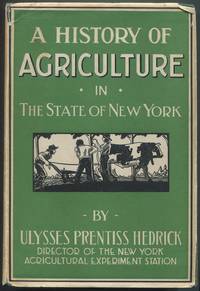
1933rif. 628758New York: New York State Agricultural Society 1933. Hardcover. Near Fine/Very Good. First edition. 462pp. Illustrated with black and white plates. Slight edgewear and owner name on the front free endpaper else near fine in a very good dust jacket with chips tape repairs tears and toning. New York State Agricultural Society hardcover books
rif. 41206London: T. Gosden. Margins: 222x146 mm. Some very faint soiling around the edges. T. Gosden unknown books
rif. 41205Margins: 175x119 mm. Remnants of mounting on reverse of print very small tear on bottom margin. unknown books
rif. 41203Margin: 200x135 mm. Some foxing. unknown books
1869rif. 36730Washington D.C. 1869. Single page entirely in ink manuscript Very Good. Randall was a Pennsylvania Democrat born in Philadelphia and a Union soldier during the War. He was Speaker of the House 1876-1881. This letter is an early unfavorable evaluation of President Grant's character only two weeks after Grant's inauguration as President. "The chief characteristic thus far developed is his vindictiveness. He must have much changed from the time when he received Lee's surrender. But we shall see the end is not yet. unknown books
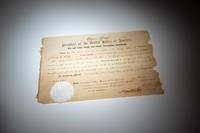
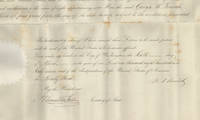
1873rif. 19315Washington D.C.: Executive Branch 1873. Signed Political Appointment. Parchment. Good. Signed by President Ulysses S. Grant the political appointment of Charles C. Miller as Deputy Postmaster at Penn Yan New York dated March 26 1873. Document printed on parchment paper seal at bottom left corner. Notable chipping and wear along margins. Document is countersigned by Secretary of State Hamilton Fish. Signed by Ulysses S. Grant along the bottom right with his signature partially obscured by dampstain. The recipient of this appointment Sergeant Charles C. Miller was a Republican political appointee who served as postmaster from 1873 to 1879. Miller served in Company I 148th New York Volunteers during the Civil War. Full document reads: "Ulysses S. Grant President of the United States of America to all who shall see these presents Greeting: Know ye That reposing special trust and confidence in the Integrity Ability and Punctuality of Charles C. Miller I do appoint him Deputy Postmaster at Penn Yan in the State of New York and do authorize and empower him to execute and fulfil the duties of that Office according to law to have and to hold the said Office with all the powers privileges and emoluments to the same of right appertaining unto him the said Charles C. Miller for the term of four years from the day of the date hereof; subject to the conditions prescribed by law. In testimony whereof I have caused these Letters to be made Patent and the Seal of the United States to be hereunto affixed. Given under my hand at the City of Washington the Twenty-sixth day of March in the year of Our Lord one thousand eight hundred and Seventy-three and of the Independence of the United States of America the Ninety-seventh. By the President. [Executive Branch] unknown books
rif. 9666Color illus. 143 pp. & colophon. 8vo pictorial softcover title on spine. New York: Jonathan A. Hill Bookseller Inc. 2023. Our second catalogue on the Mexican artist Ulises Carrión 1941-89 offering 58 items for sale including manuscripts rare bookworks exhibition ephemera etc. A number of the materials come from the collection of Guy Schraenen 1941-2018. In her Substack review of the catalogue Johanna Drucker writes: "The catalogue is an exquisitely produced collection of facsimiles of the materials the bookseller is managing. The care with which the presentation has been put together and the production values in design printing photography and expertly meticulous cataloguing make it an exemplary piece for study.Finally the value of this catalogue is not only in its presentation of the work of a much-respected artist but in the preservation of the fabric of culture of aesthetics of artistic communities and lives." As new. Edition of 500 copies. Designed by Flat Fix and printed by KOPA in Lithuania. N.B. International shipping by Fedex starts at $25.00. OCLC Accession No.: 1403378417. unknown books
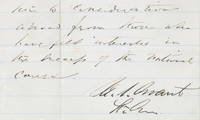
1865rif. 3776421/12/1865. Ulysses S. Grant through his intelligence determination iron will and patriotism was the military man most responsible for leading the United States through the greatest time of crisis and chaos in the nation’s history. As general of the Army during the Civil War he commanded hundreds of thousands of soldiers leading the Union Army to victory over the Confederacy. Moreover all recognized that his strategy had compelled Lee and the Confederacy to fight the kind of war they could not win. Later as president he guided the nation through Reconstruction helping to bind the wounds between North and South while empowering newly freed African Americans. In November 1865 President Andrew Johnson sent Grant on a fact-finding tour of the defeated South to assess conditions and report back on Reconstruction. Grant returned and submitted his report to Johnson on December 18 1865. Grant recommended continuing a reformed Freedmen's Bureau though he advised against using Black troops in garrisons believing it discouraged farm labor. Johnson seized on the generally lenient tone of Grant's report to bolster his own position: Grant's report recommended a lenient Reconstruction policy and that December Johnson declared the reconstruction process complete — a declaration that outraged Radical Republicans in Congress who had just reconvened that same month and were refusing to seat the newly elected Southern representatives including several former Confederate generals and cabinet officers. Samuel Stephen Curtis was born in 1838 in McConnelsville Ohio the son of Samuel Ryan Curtis the future Union major general and congressman from Iowa. Before the war he made his way west to the Colorado gold country where he became a prominent figure in the young territory — laying out the streets of Denver naming one Curtis Street after himself building a business in real estate mercantile trade and mining and serving as the city's postmaster. When the Civil War broke out Colorado's territorial governor sent him east to Fort Laramie to secure arms and munitions for the territory's volunteer companies then on to Washington to lobby for funding — missions he carried out successfully enough to earn a major's commission in the 2nd Colorado Infantry. He was promoted to lieutenant colonel in 1862 and joined the staff of his father then commanding in the Trans-Mississippi theater serving as his aide-de-camp through campaigns in Arkansas and later duty with the Departments of Kansas Missouri and the Northwest. He briefly left his father's staff to command Camp Weld Colorado's training post near Denver at the request of territorial governor John Evans before returning to serve alongside his father for the remainder of the war. Mustered out of the volunteer service at war's end Curtis embarked on a tour of Europe in December 1865 Letter signed Washington December 21 1865 on official “Head-Quarters Armies of the United States” letterhead. “Col. S.S. Curtis late an officer of the Volunteer Service of the United States is about visiting Europe on a trip of information and pleasure. His services and late rank entitle him to consideration abroad from those who have felt interested on the success of the National Cause.” <img class=""alignnone wp-image-25018 size-post-window"" src=""https://cdn.raabcollection.com/wp-content/uploads/20231204144051/Folder-site-11-1600x1327.jpg"" alt=""historical memorabilia dealer"" width=""1600"" height=""1327"" /> unknown books
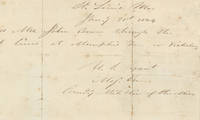
1864rif. 3548131/01/1864. Written by Grant while on a visit to his family in St. Louis as he awaited his promotion to Lieutenant General His great victory at the Battle of Chattanooga in November 1863 made Major General Ulysses S. Grant the most prominent Union general. Soon legislation would be introduced in Congress to revive the rank of Lieutenant General—previously held only by George Washington and Winfield Scott—specifically to give Grant command of all Union armies. This Congress did on February 29 1864 and Grant would officially receive this promotion and the role of General-in-Chief on March 10. In January 1864 Grant fresh from his victories in the West was still serving as the commander of the Military Division of the Mississippi overseeing Union operations in the Western Theater of the war. His activities that month focused on administrative and inspection tours of Kentucky and Tennessee and assessing supply lines. Finding the Cumberland Gap route for supplies unfeasible due to terrible road conditions he favored using the Nashville & Stevenson Railroad and the Tennessee River instead. More importantly he also concentrated on planning for the crucial 1864 spring campaign and the development of a grand strategy for the war. In a letter of January 19 to Gen. Henry Halleck demonstrating his proactive approach to ending the war Grant suggested a bold plan to invade North Carolina from New Bern to cut Confederate supply lines through Wilmington and capture Raleigh. Amidst all these activities Grant also took time to join his family in St. Louis for a short trip from January 27-February 3. <img class=""alignnone wp-image-35510 size-post-window"" src=""https://cdn.raabcollection.com/wp-content/uploads/20260125192231/Grant-Jan-31-1864-1-1600x664.jpg"" alt="""" width=""1600"" height=""664"" /> After his promotion Grant's subsequent strategy implemented from the field with the Army of the Potomac focused on simultaneous relentless pressure on Confederate forces leading to eventual victory. Mrs. Bowen was the wife of Confederate general John Bowen a fine military commander who battled Grant and his armies in the final defense of Vicksburg. Bowen would die of disease just as the battle concluded in 1863. The Bowens were from St. Louis and when Gen. Bowen first left St. Louis to enter the war his wife Mary was by his side leaving their two young children at the family home to be cared for by Mary's mother. It is known that Mrs. Bowen passed through the lines after her husband’s demise and her passing back and forth to St. Louis and her access to Grant suggest this pass was almost certainly. for her. Autograph document signed St. Louis Mo. January 31 1864. “Pass Mrs. John Bowen through the Federal lines at Memphis Tenn. or Vicksburg Miss.” It is signed “U.S. Grant Maj. Gen. commanding Mil. Div. of the Miss.” Grant was known to be helpful to southern women so this would be consistent with his practice. This must be one of the few papers Grant signed while on the brief visit to his family. <img class=""alignnone wp-image-25018 size-post-window"" src=""https://cdn.raabcollection.com/wp-content/uploads/20231204144051/Folder-site-11-1600x1327.jpg"" alt="""" width=""1600"" height=""1327"" /> unknown books
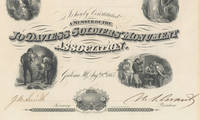
1865rif. 3462628/08/1865. Ulysses S. Grant was living in Galena Illinois when the Civil War broke out. The Civil War won on August 18 1865 Galena celebrated Grant’s heroic return. Following a jubilant procession with much flag waving and speeches a group of Galena citizens presented the General with a handsome furnished house on Bouthillier Street. Today the house is managed by the Illinois Historic Preservation Agency as the U.S. Grant Home State Historic Site. The Soldiers Monument Association was a group of local organizations founded after the American Civil War to fund and erect monuments to fallen soldiers and veterans. In 1865 many such groups formed and one of these was the Jo Daviess Soldiers Monument Association in Galena Illinois established to honor that county's soldiers who served in the Civil War. The Association is known for its handsome membership certificates which pictured vignettes of Lincoln Liberty flags and soldiers and were signed by Grant who was the honorary president. In time a monument to the soldiers of Jo Daviess County was constructed in Grant Park Galena. A membership certificate to the Soldiers Monument Association with compelling vignettes including Lincoln constituting individuals as members of the Jo Daviess Soldiers Monument Association Galena dated August 28 1865 and signed by Grant as President of the Association. Gen. J.C. Smith has also signed as Secretary. This is the first Soldiers Monument Association certificate we have ever carried and it is particularly compelling with its association of Grant and Lincoln. <img class=""alignnone wp-image-25018 size-post-window"" src=""https://cdn.raabcollection.com/wp-content/uploads/20231204144051/Folder-site-11-1600x1327.jpg"" alt="""" width=""1600"" height=""1327"" /> unknown books
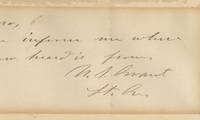
1864rif. 334181864. This letter has been for several generations in a private collection and is unpublished In January 1864 General Ambrose E. Burnside was asked to reorganize the IX Corps. He asked for and was granted permission by Secretary of War Edwin Stanton to form a division of “colored troops.” The 4th Division of the IX Corps infantry would be all black troops commanded by General Edward Ferrero. The regiments were divided into two brigades; the first brigade was made up by the 27th 30th 39th and 43rd USCT. The second brigade was the 30th Connecticut Colored Infantry only 4 companies formed then consolidated into 31st USCT 19th 23rd 31st USCT. The 28th and 29th USCT regiments would be added to the second brigade. These regiments came from all across the North. When the 4th Division of the IX Corps left Camp Stanton in Annapolis Maryland they were paraded in front of President Abraham Lincoln and General Burnside in Washington DC. The 23rd joined the division when the men marched across the bridge into Virginia. In March 1864 Ulysses S. Grant was appointed by President Abraham Lincoln commander of the Union Armies. Grant developed a strategy to defeat the Confederacy by placing his army between the rebel capital of Richmond and Gen. Robert E. Lee’s Army of Northern Virginia. Grant moved southeast to try to create a wedge between Lee and Richmond but Lee's army successfully followed up the engagements by foiling that maneuver. Then Grant's assaults at Cold Harbor his most mistaken plan of the war and the one he most regretted resulted in a sharp defeat. Grant thus found that he was unable to take Richmond directly. Next Grant focused on Petersburg due south of Richmond. If Grant could take Petersburg then the Confederates would have to abandon Richmond. Grant's attempt to take it quickly failed so by mid-June 1864 Lee ended up in Petersburg with the Appomattox River protecting his back and surrounding the city below the river he built two lines of works that covered the entire area. Grant would besiege Petersburg and the IX corps played a part under General Ferrero. The 23rd USCT became the first colored troops to fight in “directed combat” against Lee’s Army of Northern Virginia. The skirmish was fought at the intersection of Catharpin and Old Plank Roads originally Orange Plank Road on May 15 1864. The 23rd was at the Chancellorsville ruins when the Union 2nd Ohio Cavalry was chased by General Thomas Rosser’s Confederate Cavalry Brigade. The 2nd asked for assistance and the only soldiers nearby were General Edward Ferrero’s colored division. The 23rd USCT “double quicked” the two miles to the intersection and drove back Rosser’s cavalry as ordered by General Ferrero. The black soldiers were cheered by the 2nd Ohio who now gave chase to Rosser’s cavalry. This battle action proved to the white troops that black soldiers would fight against the Confederate army. With the end of that campaign Grant ended up besieging the city and his Army of the Potomac built works from the river northeast of Petersburg down to south of the city as far as they could go. The Confederates controlled all the ground from Grant’s southern tip west up to the river. Grant’s main objective during the ten-month Siege of Petersburg was to extend his lines south and west to cut Lee’s railroad links and encircle him at the same time. Lee’s problem was that he was stuck in Petersburg and every Union successful extension west forced him to extend his lines. And every time he had to extend those lines became thinner. In mid June as Grant prepared for his long assault on Petersburg Ferrero's black soldiers were now placed in the trenches with the other three divisions. The part of the line occupied by the IX Corps was very near the enemy's works and an incessant firing was kept up during the siege resulting in a daily loss of men killed or wounded. While there was a comparative quiet in front of the other corps positions the men of the IX Corps were subjected to the terrible strain of a constant watchfulness and deadly exposure. The enemy seemed to be excited to an undue activity by the presence of Ferrero's Colored Division. In late July 1864 during the Battle of the Crater Ferrero's men had been trained for the attack on the Confederate line. However due to a last minute change by General George G. Meade the black soldiers were the last to enter the battle instead of the first. The three white divisions of the IX Corps did not follow General Burnside’s plan and delayed the attack. By the time the colored troops entered the battle the Confederates were ready to counterattack. Before being driven into the Crater the black troops advanced further than the white troops. The Confederate counterattack was a furious attack that won the day for the Confederate army. The black troops sustained the worst casualties. Ferrero initially accused of dereliction in this duty was cleared. Autograph letter signed no date but during the early siege perhaps mid to late June 1864 to General Ferrero. ""General Ferrero please inform me where the firing now heard is from."" This letter has been for several generations in a private collection and is unpublished. We are not aware of another letter of Grant to Ferrero. <img class=""alignnone wp-image-25018 size-post-window"" src=""https://cdn.raabcollection.com/wp-content/uploads/20231204144051/Folder-site-11-1600x1327.jpg"" alt="""" width=""1600"" height=""1327"" /> unknown books
1870rif. 3292608/01/1870. John Quincy Adams first enlisted in 1862 with the 38th Ohio Volunteers. On October 15 of that year he was a quartermaster sergeant with the 10th Ohio Cavalry reporting to Cairo Ill. for Instruction on February 23 1863. After a stint as acting lieutenant on July 15 1864 he was appointed by the President Second Lieutenant to date from March 3 1863. Adams was actively involved in the Georgia campaign conducted by Gen. William T. Sherman. He was with left wing of the 16th Army Corps on the march to Chattanooga Tenn. In the Atlanta Campaign he participated in the battles of Resaca Dallas Kennesaw Mountain. and Jonesboro. He manned signal corps stations at Kennesaw Mt. and Allatoona. Adams was on the ""the March to the Sea"" with Sherman’s forces. He was in the engagements at Port McAllister and Rice Mill station in the campaign from Savannah through the Carolinas including battles at Columbia Bentonville and Raleigh; and at the surrender of Confederate Gen. Joseph E. Johnston to Sherman on April 26 1865. Adams was breveted 1st lieutenant for gallant and meritorious service in the Signal Corps at the battle of Allatoona; he was breveted captain for gallant and meritorious services in the Signal Corps at the capture of Fort McAllister and Savannah and throughout the war. Adams was mustered out August 22 1865. After the war he was in the 1st U. S. Cavalry and was in the Indian wars and finished his career as captain and aide to Gen. O.O. Howard in October 1884. He is listed on the roster of the U.S. Signal Corps in the Civil War. This is President Ulysses S. Grant’s appointment of Adams as First Lieutenant in the 1st U. S. Cavalry. Document signed Washington January 8 1870 naming Adams “First Lieutenant in the First Regiment of Cavalry” to rank as such from the fourteenth of September 1869. The document is countersigned by William Belknap as Secretary of War. In 1866 the 1st Cavalry Division was sent west to California and other western states and it served during the Indian Wars in the west. In June 1884 while Adams was still serving with the regiment it was transferred to the Department of Dakota. In their new assignment the troops were assigned to various forts which had been established during the Indian wars to subjugate the Sioux Cheyenne Crow and other Native Americans. <img class=""alignnone wp-image-25018 size-post-window"" src=""https://cdn.raabcollection.com/wp-content/uploads/20231204144051/Folder-site-11-1600x1327.jpg"" alt="""" width=""1600"" height=""1327"" /> unknown books
1879rif. 3244413/05/1879. We are aware of no other autographs of Grant from this trip having reached the market Richard Nixon was not the first President to visit China. On February 20 1979 the New York Times reported: ""When President Nixon arrives in China today on an unprecedented state visit he will not be the first American President to have set foot on that nation's shores. Nearly one hundred years ago while the Manchu dynasty still held sway over the crumbling Chinese Empire Gen. Ulysses S. Grant entered the gates of Peking and was borne in an imperial palanquin into the heart of the Forbidden City. Just one month after the expiration of his Presidential term General Grant embarked on a worldwide tour which took him to Europe Asia Minor India and Indochina on his way to the two great realms of the Far East. In all he spent six weeks In China visiting the cities of Canton Swatow Amoy Shanghai Tientsin and Chefoo with a full week in Peking from June 3 to 10 1879. During his stay he was entertained in the royal manner and granted interviews with Prince Kung the ruling regent of the Manchu Court —the real Emperor was only 5 years old at the time—and Li Hung_chang the Western_oriented strongman of North China."" The Chinese had hopes largely unrealized that Grant would help them handle diplomatic and military crises with Japan and Vietnam where the French had influence. He went with a delegation of his own which included his wife and son officers of the US Navy and one of the earliest US ministers to China Chester Holcombe. Document signed Swatow Shantou China May 13 1879 a place card for the dinner held in Grant's honor that evening belonging to a Mrs. Scott. Signed by Ulysses S. Grant his son Frederick Dent Grant his wife Julia Grant Charge d'Affaires Chester Holcombe two representatives from his naval escort. <img class=""alignnone wp-image-25018 size-post-window"" src=""https://cdn.raabcollection.com/wp-content/uploads/20231204144051/Folder-site-11-1600x1327.jpg"" alt="""" width=""1600"" height=""1327"" /> unknown books
1869rif. 3251406/04/1869. The Dakota Territory was created by an Act of Congress on March 2 1861. Boundaries of the Dakota Territory changed on a number of occasions. Originally the territory comprised an area that included the present states of North Dakota South Dakota and much of Montana and Wyoming. From 1863 to 1864 the area of the territory was limited to the present day Dakotas. The territory included most of the present state of Wyoming and the Dakotas from 1864 to 1868. And from 1868 to 1889 the territory comprised the present states of North Dakota and South Dakota. The territorial capital was established in Yankton in 1861 and later removed to Bismarck in 1883. When the final extent of the reduced territory was split and admitted to the Union as the states of North and South Dakota the Supreme Court of the Dakotas was abolished by operation of law and its function was taken over by the North Dakota Supreme Court and the South Dakota Supreme Court. Document signed Washington April 6 1869 appointing George W. French subject to the advice and consent of the Senate to be the Chief Justice of the Supreme Court of the Territory of Dakota. <img class=""alignnone wp-image-25018 size-post-window"" src=""https://cdn.raabcollection.com/wp-content/uploads/20231204144051/Folder-site-11-1600x1327.jpg"" alt="""" width=""1600"" height=""1327"" /> unknown books
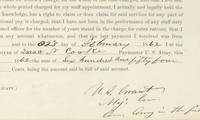
1862rif. 806901/03/1862. In it he also pays for his servants 3 of whom were black; An extreme rarity the first such document we can find having reached the market in a quarter century The battle of Fort Henry in Tennessee took place on February 6 1862 and an obscure and virtually unknown brigadier general named Ulysses S. Grant captured the fort and opened the Tennessee River to Union movements. This early in the war Union victories of any kind were scarce and this one was probably the most consequential of the war to date. Grant then moved directly on Fort Donelson entrapping the place both by land and sea from February 11-16. On the morning of February 15 the Confederate commander Simon B. Buckner sent a note to Grant requesting an armistice and asking terms of surrender. Buckner was expecting to give up the fort but get his soldiers paroled so they would not be prisoners of war. Grant refused to give terms but demanded unconditional surrender. The Confederates surrendered the next day the 16th. This victory opened the Cumberland River an important avenue for the invasion of the South to Union operations and Grant became instantly famous earning the nickname ""Unconditional Surrender"" Grant. President Lincoln took note of the fact that in Grant he had a general who could win. On February 20 1862 Lincoln promoted Grant to the rank of Major General a prerequisite to Grant's being able to command a large army. However Grant’s very successes at Forts Henry and Donelson incurred the jealousy of his superior Gen. Henry Halleck who was in command of the whole Western Theater of war. Grant not yet realizing the peril Halleck's opposition placed him in knew Nashville was wide open with little in the way of defensive forces. Though Halleck had expressly forbade him to advance Grant ordered Union forces to enter Nashville. It fell on February 25 with Gen. Don Carlos Buell accepting the city's surrender. Nashville thus became the first Confederate state capital to fall into Union hands. Over the next week thousands of Union soldiers poured into the city and Grant took a boat upriver from Donelson to Nashville to confer with Buell. Halleck saw the taking of Nashville not as Grant recognizing and seizing an important opportunity but as willful disobedience of an order. And Grant's unauthorized trip to see Buell there only added to Halleck's anger. <img class=""alignnone wp-image-32063 size-post-window"" src=""https://cdn.raabcollection.com/wp-content/uploads/20240907140939/Grant-March-1-1862-1-1-1600x348.jpg"" alt="""" width=""1600"" height=""348"" /> So on March 1 1862 Halleck decided to tie Grant's hands by ordering him to return to Fort Henry and from there to launch an expedition up the Tennessee River to the state of Mississippi. The objective was the destruction of several key railroad bridges. Grant was to “avoid any general engagement with strong forces” and was told that it was “better to retreat than to risk a general battle.” Grant went to Fort Henry as ordered but did not communicate with Halleck directly. The next day Halleck complained to Gen. McClellan that he had heard no word from Grant for a week and that “his army seems to be as much demoralized by the victory of Fort Donelson as was that of the Potomac by the defeat of Bull Run.” On March 4 Halleck relieved Grant from his command writing him: “You will place Maj. Gen. C. F. Smith in command of expedition and remain yourself at Fort Henry.” Grant was shocked. “Thus"" say Grant's Memoirs ""in less than two weeks after the victory at Donelson the two leading generals Halleck and McClellan in the army were in correspondence as to what disposition should be made of me and in less than three weeks I was virtually in arrest and without a command.” Grant turned over command to Smith on March 5. Even as he did so he felt intensely frustrated and longed for action writing on the same day “I have not been well for the last ten days and don’t see that I will be much better until I can get to moving again.” Grant and Halleck exchanged letters after which Grant on March 11 demanded that Halleck relieve him from duty altogether in order to clear his name. ""There is such a disposition to find fault with me that I again ask to be relieved from further duty until I can be placed right in the estimation of those higher in authority."" Perhaps this letter caused a change of mind or it may be that Halleck just could not risk loss of the popular Grant altogether. In any event surprisingly he refused and instead told Grant he would receive a new command writing him ""You cannot be relieved from your command. There is no good reason for it…Instead of relieving you I wish you as soon as your new army is in the field to assume the immediate command and lead it on to new victories."" Just four days later Grant was actually given a new command - he was placed in charge of Union forces in Tennessee. He proceeded to Pittsburg Landing Tennessee and arriving on the 17th established a wide camp with his forward units around Shiloh Church some 2.5 miles south of Pittsburg Landing. He wrote ""I at once put all the troops at Savannah in motion for Pittsburg Landing knowing that the enemy was fortifying at Corinth and collecting an army there under Johnston. It was my expectation to march against that army as soon as Buell who had been ordered to reinforce me with the Army of the Ohio should arrive; and the west bank of the river was the place to start from. Pittsburg is only about twenty miles from Corinth…When all reinforcements should have arrived I expected to take the initiative by marching on Corinth and had no expectation of needing fortifications though this subject was taken into consideration."" He reported to Halleck on his troop dispositions and imminently awaited reinforcements so he could move against Corinth. Halleck meanwhile continued to nitpick at Grant for supposed failure to discipline his troops properly. The month of March was a significant one in Grant's career one that saw the tables turn twice on him. First in the flush of his great successes at Forts Henry and Donelson he was victimized by jealousy and relieved of command. Then when all seemed lost he was given an even greater command. And as he assumed that command and awaited reinforcements so he would move on Corinth he was unwittingly actually preparing for the Battle of Shiloh one of the most fateful of the war. <img class=""alignnone wp-image-32064 size-post-window"" src=""https://cdn.raabcollection.com/wp-content/uploads/20240907141021/Grant-March-1-1862-2-1600x657.jpg"" alt="""" width=""1600"" height=""657"" /> Document signed Pittsburg Landing Tenn. April 2 1862 being a voucher for his own pay and expenses and those of his four private servants for the period from March 1 to March 31 1862. His pay was $220 per month and he received $52 per month for the pay of his servants. Forage for his seven horses came to $56 for the month. He received $10 per month as a clothing allowance and he was entitled to ""double rations for commanding army in the field"" which came to over 1000 rations for the month. The rations called ""subsistence"" cost $316.20. At the end the document recites that Grant has received a total of $654.20 from the paymaster and he has signed ""U.S. Grant Maj. Gen. Commanding Army in the field."" Interestingly Grant's four servants are named and their skin color height and eye and hair color given. Frank was white; and Dan Jim and Sam were black. The voucher is docketed on the verso. This is the first signed voucher for Grant's pay during the Civil War that we have seen. Research in public records going back 40 years discloses one previous monthly voucher having reach the market and that was a quarter century ago. On April 6 1862 just four days after signing this document the Confederates commenced the Battle of Shiloh by bursting through Union lines and threatening to drive Grant's men back into the Tennessee River. Historians differ on whether Grant was at fault in being surprised but it is clear that Union forces only escaped being routed with the arrival of Buell's army. The next day the Union recaptured the initiative and drove the Confederates back in disorder. The battle was essentially a draw while also being the bloodiest battle yet to occur on the American continent. When the news reached the North where expectations had been high a storm of abuse broke out against Grant who was held responsible. He may well have not deserved the blame but he admitted reassessing the war after Shiloh. He wrote “Up to the battle of Shiloh I as well as thousands of other citizens believed that the rebellion against the Government would collapse suddenly and soon if a decisive victory could be gained over any of its armies. Donelson and Henry were such victories.But when Confederate armies were collected which not only attempted to hold a line farther south.but assumed the offensive and made such a gallant effort to regain what had been lost then indeed I gave up all idea of saving the Union except by complete conquest.” <img class=""alignnone wp-image-25018 size-post-window"" src=""https://cdn.raabcollection.com/wp-content/uploads/20231204144051/Folder-site-11-1600x1327.jpg"" alt="""" width=""1600"" height=""1327"" /> hardcover books
1864rif. 2764930/12/1864. Welles had written at the President's suggestion: ""The largest naval force ever assembled is ready"" Fort Fisher guarded the port of Wilmington NC the last port open to blockade runners supplying Robert E. Lee’s Confederate forces in Virginia <img class=""alignnone wp-image-28384 size-post-window"" src=""https://cdn.raabcollection.com/wp-content/uploads/20231204120136/Grant_168-2-1-e1694097936583-1600x492.jpg"" alt="""" width=""1600"" height=""492"" /> As 1864 dawned Wilmington North Carolina protected by Fort Fisher was one of the Confederacy’s last remaining major ports on the Atlantic open to blockade runners and was the chief supply line for General Robert E. Lee’s Army of Northern Virginia. Navy Secretary Gideon Welles reintroduced the idea of a joint operation against Wilmington to the Secretary of the War Edwin Stanton but Stanton saw it as premature. After the Navy’s occupation of Mobile Bay in August all eyes turned to Wilmington. In October 1864 Wilmington finally became the next objective for a joint amphibious operation. Admiral David Porter was chosen to command the naval squadron and General Benjamin Butler the army contingent. On December 24 the 63 ships of Porter’s fleet prepared to bombard the fort. Thirty-seven ships formed in three lines of battle end-to-end facing the enemy. Just after midday Porter commenced the Navy’s first bombardment of the fort and continued firing until it became too dark to aim the guns effectively. While the Confederate troops hid and huddled beneath the mounds of the fort this bombardment actually did little damage with the exception of the wooden quarters of the garrison which were set ablaze. Butler’s force returned too late on that first night to attempt a landing. The next morning December 25 the fleet resumed its barrage while a naval contingent sought to secure a landing area for the Union infantry north of the fort. A group of sailors was sent to take soundings south of the fort but Porter withdrew the sounding party after it became clear that the army group was making no progress north of the fort. The timely arrival of Confederate reinforcements caused Butler to question the strength of his position. He felt his forces could not take the fort without a siege for which they were unprepared. Butler immediately began to re-embark his soldiers. On December 27 he called off the expedition and directed the transports to return to Hampton Roads. The U.S. Navy had suffered 83 casualties and the U.S. Army 12. Thus the first attempt by the Union forces to close the port of Wilmington ended in failure. While Butler returned to Hampton Roads Porter remained off the coast of North Carolina dedicated to preparing another attempt to capture Fort Fisher. Following the fall of Savannah on December 21 1864 General William T. Sherman prepared to march through the Carolinas. Knowing Sherman could soon be in North Carolina and ready to try to capture the fort again on December 25 Porter wrote to Sherman clearly expressing his frustration with Butler’s decision to abandon the joint operation. Porter was also in communication with Welles. With these communications in hand Welles spoke to President Lincoln who was all for trying again to take the fort. On December 29 Welles wrote to General U.S. Grant in overall command of the army that the President hoped that another joint operation might be forthcoming. Welles’s telegram to Grant stated: “December 29 1864 at 9:30 pm. The substance of dispatches and reports from Rear-Admiral Porter off Wilmington is briefly this: The ships can approach nearer to the enemy’s works than was anticipated. Their fire can keep the enemy away from their guns. A landing can easily be effected upon the beach north of Fort Fisher not only of troops but all their supplies and artillery. This force can have its flanks protected by gun-boats. The navy can assist in the siege of Fort Fisher precisely as it covered the operations which resulted in the capture of Fort Wagner. The winter season is the most favorable for operations against Fort Fisher. The largest naval force ever assembled is ready to lend its co-operation. Rear-Admiral Porter will remain off Fort Fisher continuing a moderate fire to prevent new works from being erected and the ironclad have proved that they can maintain themselves in spite of bad weather. Under all these circumstances I invite to such a military co-operations as will insure the fall of Fort Fisher the importance of which has already received your careful consideration. This telegram is made at the suggestion of the President and in hopes that you will be able at this time to give the troops which heretofore were required elsewhere. If it cannot be done the fleet will have to disperse whence it cannot again be brought to this coast.” <img class=""alignnone wp-image-28385 size-post-window"" src=""https://cdn.raabcollection.com/wp-content/uploads/20231204120124/Grant_177-1-1-e1694097999755-1600x684.jpg"" alt="""" width=""1600"" height=""684"" /> Grant responded to Welles immediately. Autograph letter signed headquarters at City Point Va. December 30 1864 to Welles. “Your dispatch of 9:30 p.m. 29th received. I will advise fully with the Sec. of War about what you propose. Please call on him for information. U.S. Grant Lieut. Gen.” Thus Grant promised to inform Stanton “fully” about the plan and requested that Welles consult with Stanton to finalize it. Grant had told Stanton that he did not intend to correspond with the Navy Department except through Stanton and this letter further indicates that. Porter had a good working relationship with Grant and a solid record of success in joint operations. Due to this Welles was able to argue successfully with Lincoln for Porter’s retention as commander. In early January Porter coordinated directly with Sherman and Grant about plans for a renewal of operations against Fort Fisher. As Sherman marched north the port of Wilmington was now more important to the U.S. Army than it had been during the first battle for Fort Fisher. Butler rightly took the blame for the first expedition’s failure. For his replacement Grant chose General Alfred Terry one of Butler’s staff officers. Grant assigned him the same troops that had participated in the first attempt augmented with an additional brigade for a total of 8000 soldiers. On January 4 1865 the second expedition to capture Fort Fisher embarked from Bermuda Landing in Virginia. On January 12 they headed for Fort Fisher. Arriving that night Porter and Terry prepared to commence their attack the next day. At dawn on January 13 8000 Federal soldiers landed above the fort as the Navy began its bombardment. Sailors were landed on the 15th and drew fire. This diversion allowed the army to breach the walls of the fort. By 10 p.m. the fort was in possession of the Federal forces. The Confederates started a retreat and when Federal infantry caught up with them General Terry accepted the formal surrender of the fort. The first battle of Fort Fisher was the most concentrated naval bombardment of the war. The fleet fired 20271 projectiles into the fort during the first battle. Another 19682 were fired during the second battle. In total the U.S. Navy expended 39953 projectiles at the fort. After Fort Fisher’s capture Porter proceeded to put vessels over the bar and into the Cape Fear River. He declared the port of Wilmington to be “hermetically sealed against blockade runners”. Five weeks after the fall of Fort Fisher the Federal army occupied the city of Wilmington. This occupation ended the trickle of supplies coming along the Wilmington and Weldon Railroad to the Army of Northern Virginia. The fall of Wilmington contributed directly to this army’s surrender at Appomattox Courthouse in April 1865. <img class=""alignnone wp-image-25018 size-post-window"" src=""https://cdn.raabcollection.com/wp-content/uploads/20231204144051/Folder-site-11-1600x1327.jpg"" alt="""" width=""1600"" height=""1327"" /> unknown books
1984rif. 30836Newark: The Newark Museum 1984. Softcover. VG some general shelf wear and wear to wraps. Light grey colo-illustrated wraps. 125 pp. Illustrated in B&W and color. Includes Biloxi Bybee Clewell Metal Art Dedham Fulper Hampshire Omar Khayyam Paul Revere Rookwood Roseville Volkmar Weller and many others. The Newark Museum paperback books
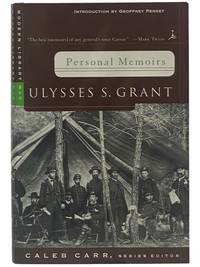
1999rif. 2350141New York: The Modern Library 1999. Reissue. Trade Paperback. Near Fine. 6x1x9. Reissue. Minor blemish to top edge faint wrinkle to jacket from mylar applied too tightly now removed. 1999 Trade Paperback. xxx 702 pp. Edited by Caleb Carr with an introduction by Geoffrey Perret. The memoirs of Ulysses S. Grant are compelling and powerful. In this autobiography the former president of the United States guides us through his campaigns as a General during the Civil War. He gives insight in how strategic decisions are made but also shows the human and emotional side of war without losing his sense of humour. A great book of and by an extraordinary gentleman and leader. A must-read. The Modern Library paperback books