2908 risultati
rif. SONG1409410005Routledge 2011-03-28. 1. hardcover. Used: Good. 6.25x1.00x9.25. Buy with confidence. Excellent Customer Service & Return policy. Routledge hardcover
2019rif. 2-9402416536Springer Nature 2019. Paperback. New. reprint edition. 496 pages. 9.25x6.10x1.12 inches. Springer Nature paperback
2018rif. x-9402415505Springer 2018. Hardcover. New. 486 pages. 9.25x6.25x1.25 inches. Springer hardcover
1998rif. Q-1888952954Cumberland House Publishing 1998-08-01. Paperback. New. New. In shrink wrap. Looks like an interesting title! Cumberland House Publishing paperback
2016rif. 1-3330738332Novas Edições Acadêmicas 2016. Paperback. New. 220 pages. Portuguese language. 8.66x5.91x0.50 inches. Novas Edições Acadêmicas paperback
rif. ORD-3761Catalogue N°500. Établissements Fabre. Vaison-la-Romaine. s.d. (sans doute vers 1930). Gd in-8 br. couverture imprimée, 83pp., 2 pp. de photos (5) de la Maison, Portrait de A. Perret-Maisonneuve avec présentation d'étiquettes couleurs pour le miel au verso et très nombreuses illustrations in-t., essentiellement reproduction de matériel. Petits défauts à la couverture, sinon bon exemplaire.
rif. 32658Paris, Dunod, 1966. 15 x 22, 289 pp., nombreuses figures, broché, bon état (dos légèrement défraîchi).
rif. 500294811Dunod Sans date.
2009rif. 87768Pediment Publishing; Museum. New. Paperback. FREE UPGRADE to Courier/Priority Shipping Upon Request - IN STOCK AND IMMEDIATELY AVAILABLE FOR SHIPMENT - Flawless copy brand new pristine never opened -- 120 pages; 164 illus. -- with a bonus offer--; Masterpieces of Art Pottery 1880-1930 the highly anticipated encore production to Great Pots: Contemporary Ceramics is a visual feast of art pottery from the 1880s to the end of the Roaring Twenties. Superb examples of American European Asian and Native American art pottery are drawn from the Newark Museum's world-renowned ceramics collection many of them published here for the first time. 120 pages . 2009. 159725228X . Pediment Publishing; Museum paperback
rif. B193747-1Wien 1985. 24pp. Prof. illus. partly color. 4to. Wraps. Wien, 1985. paperback books
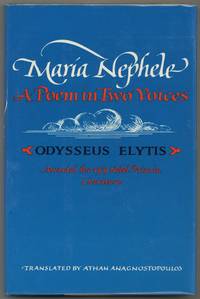
1981rif. 60394Boston: Houghton Mifflin 1981. First Edition. 8vo pp. 74. VG copy in dj. Review copy with PR sheets laid in. Book Translation into English byAthan Anagnostopoulos of the work for which Odysseas Elytis was awarded the 1979 Nobel Prize for Literature. Houghton Mifflin unknown books
1981rif. 589056Boston: Houghton Mifflin Company 1981. Hardcover. Fine/Fine. First American edition. Translated from the Greek by Athan Anagnostopoulos. Fine in a fine dust jacket with just a touch of wear. Advance Review Copy with publishers material laid in. Houghton Mifflin Company hardcover books
1981rif. 76981Boston:: Houghton Mifflin. Near Fine in Near Fine dust jacket. 1981. Hardcover. 0395294657 . Translated from the Greek by Athan Anagnostopoulos. First American printing. Near fine in a near fine old sale price on front flap dust jacket. . Houghton Mifflin, hardcover books
1981rif. 10657Boston:: Houghton Mifflin. Fine in Near Fine dust jacket. 1981. Hardcover. 0395294657 . Translated from the Greek by Athan Anagnostopoulos. First American printing. Fine in an about fine trace rubbing to the spine dust jacket. . Houghton Mifflin, hardcover books
1981rif. 509897Houghton Mifflin 1981. First Edition. Hardcover with Dust Jacket. FINE/NEAR FINE. SIGNED and INSCRIBED by Elytis on half-title 'For Stathis and Ralph' in GREEK. First English Edition First Printing. 74pp. Orange speckled paper over boards with blue-gilt lettering to front cover backed in blue finished cloth with silver-gilt spine lettering red endpapers. An exceedingly clean and crisp copy. Dust jacket has some trivial rubbing to head and tail of spine entirely crisp and bright otherwise. Ralph Sylvester and Stathis Orphanos were publishers of the fine-press publishing company 'Sylvester & Orphanos.' Stathis was a noted photographer and born of Greek parents maintaining a residence on the island of Samos throughout his life. First published in Greece in 1978 the year before Elytis was awarded the Nobel Prize Maria Nefeli was a stark departure from the earlier work that had won him renown as the greatest Greek poet of his generation. Its novelty gave many early readers pause but 'despite the initial reservations voiced by some critics Maria Nefeli came to be regarded as the summa of Elytis's later writings.' Poetry Foundation. Houghton Mifflin hardcover
1981rif. 60394Boston: Houghton Mifflin 1981. First Edition. 8vo pp. 74. VG copy in dj. Review copy with PR sheets laid in. Book Translation into English byAthan Anagnostopoulos of the work for which Odysseas Elytis was awarded the 1979 Nobel Prize for Literature. Houghton Mifflin unknown
rif. 0395294657.Ghardcover. Good. Access codes and supplements are not guaranteed with used items. May be an ex-library book. hardcover
1981rif. Q-0395294657Houghton Mifflin Co 1981-01-01. Hardcover. New. In shrink wrap. Looks like an interesting title! Houghton Mifflin Co hardcover
rif. 9786555268676-11-23486MIZUNO. New. MIZUNO unknown
rif. 9788578900847-11-09750Servanda. New. Servanda unknown
rif. 9788589206457-11-09752HABERMANN. New. HABERMANN unknown
rif. 3838334310.Gpaperback. Good. Access codes and supplements are not guaranteed with used items. May be an ex-library book. paperback
rif. 1342126351.Ghardcover. Good. Access codes and supplements are not guaranteed with used items. May be an ex-library book. hardcover
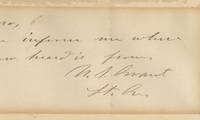
1864rif. 334181864. This letter has been for several generations in a private collection and is unpublished In January 1864 General Ambrose E. Burnside was asked to reorganize the IX Corps. He asked for and was granted permission by Secretary of War Edwin Stanton to form a division of “colored troops.” The 4th Division of the IX Corps infantry would be all black troops commanded by General Edward Ferrero. The regiments were divided into two brigades; the first brigade was made up by the 27th 30th 39th and 43rd USCT. The second brigade was the 30th Connecticut Colored Infantry only 4 companies formed then consolidated into 31st USCT 19th 23rd 31st USCT. The 28th and 29th USCT regiments would be added to the second brigade. These regiments came from all across the North. When the 4th Division of the IX Corps left Camp Stanton in Annapolis Maryland they were paraded in front of President Abraham Lincoln and General Burnside in Washington DC. The 23rd joined the division when the men marched across the bridge into Virginia. In March 1864 Ulysses S. Grant was appointed by President Abraham Lincoln commander of the Union Armies. Grant developed a strategy to defeat the Confederacy by placing his army between the rebel capital of Richmond and Gen. Robert E. Lee’s Army of Northern Virginia. Grant moved southeast to try to create a wedge between Lee and Richmond but Lee's army successfully followed up the engagements by foiling that maneuver. Then Grant's assaults at Cold Harbor his most mistaken plan of the war and the one he most regretted resulted in a sharp defeat. Grant thus found that he was unable to take Richmond directly. Next Grant focused on Petersburg due south of Richmond. If Grant could take Petersburg then the Confederates would have to abandon Richmond. Grant's attempt to take it quickly failed so by mid-June 1864 Lee ended up in Petersburg with the Appomattox River protecting his back and surrounding the city below the river he built two lines of works that covered the entire area. Grant would besiege Petersburg and the IX corps played a part under General Ferrero. The 23rd USCT became the first colored troops to fight in “directed combat” against Lee’s Army of Northern Virginia. The skirmish was fought at the intersection of Catharpin and Old Plank Roads originally Orange Plank Road on May 15 1864. The 23rd was at the Chancellorsville ruins when the Union 2nd Ohio Cavalry was chased by General Thomas Rosser’s Confederate Cavalry Brigade. The 2nd asked for assistance and the only soldiers nearby were General Edward Ferrero’s colored division. The 23rd USCT “double quicked” the two miles to the intersection and drove back Rosser’s cavalry as ordered by General Ferrero. The black soldiers were cheered by the 2nd Ohio who now gave chase to Rosser’s cavalry. This battle action proved to the white troops that black soldiers would fight against the Confederate army. With the end of that campaign Grant ended up besieging the city and his Army of the Potomac built works from the river northeast of Petersburg down to south of the city as far as they could go. The Confederates controlled all the ground from Grant’s southern tip west up to the river. Grant’s main objective during the ten-month Siege of Petersburg was to extend his lines south and west to cut Lee’s railroad links and encircle him at the same time. Lee’s problem was that he was stuck in Petersburg and every Union successful extension west forced him to extend his lines. And every time he had to extend those lines became thinner. In mid June as Grant prepared for his long assault on Petersburg Ferrero's black soldiers were now placed in the trenches with the other three divisions. The part of the line occupied by the IX Corps was very near the enemy's works and an incessant firing was kept up during the siege resulting in a daily loss of men killed or wounded. While there was a comparative quiet in front of the other corps positions the men of the IX Corps were subjected to the terrible strain of a constant watchfulness and deadly exposure. The enemy seemed to be excited to an undue activity by the presence of Ferrero's Colored Division. In late July 1864 during the Battle of the Crater Ferrero's men had been trained for the attack on the Confederate line. However due to a last minute change by General George G. Meade the black soldiers were the last to enter the battle instead of the first. The three white divisions of the IX Corps did not follow General Burnside’s plan and delayed the attack. By the time the colored troops entered the battle the Confederates were ready to counterattack. Before being driven into the Crater the black troops advanced further than the white troops. The Confederate counterattack was a furious attack that won the day for the Confederate army. The black troops sustained the worst casualties. Ferrero initially accused of dereliction in this duty was cleared. Autograph letter signed no date but during the early siege perhaps mid to late June 1864 to General Ferrero. ""General Ferrero please inform me where the firing now heard is from."" This letter has been for several generations in a private collection and is unpublished. We are not aware of another letter of Grant to Ferrero. <img class=""alignnone wp-image-25018 size-post-window"" src=""https://cdn.raabcollection.com/wp-content/uploads/20231204144051/Folder-site-11-1600x1327.jpg"" alt="""" width=""1600"" height=""1327"" /> unknown books
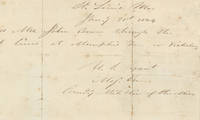
1864rif. 3548131/01/1864. Written by Grant while on a visit to his family in St. Louis as he awaited his promotion to Lieutenant General His great victory at the Battle of Chattanooga in November 1863 made Major General Ulysses S. Grant the most prominent Union general. Soon legislation would be introduced in Congress to revive the rank of Lieutenant General—previously held only by George Washington and Winfield Scott—specifically to give Grant command of all Union armies. This Congress did on February 29 1864 and Grant would officially receive this promotion and the role of General-in-Chief on March 10. In January 1864 Grant fresh from his victories in the West was still serving as the commander of the Military Division of the Mississippi overseeing Union operations in the Western Theater of the war. His activities that month focused on administrative and inspection tours of Kentucky and Tennessee and assessing supply lines. Finding the Cumberland Gap route for supplies unfeasible due to terrible road conditions he favored using the Nashville & Stevenson Railroad and the Tennessee River instead. More importantly he also concentrated on planning for the crucial 1864 spring campaign and the development of a grand strategy for the war. In a letter of January 19 to Gen. Henry Halleck demonstrating his proactive approach to ending the war Grant suggested a bold plan to invade North Carolina from New Bern to cut Confederate supply lines through Wilmington and capture Raleigh. Amidst all these activities Grant also took time to join his family in St. Louis for a short trip from January 27-February 3. <img class=""alignnone wp-image-35510 size-post-window"" src=""https://cdn.raabcollection.com/wp-content/uploads/20260125192231/Grant-Jan-31-1864-1-1600x664.jpg"" alt="""" width=""1600"" height=""664"" /> After his promotion Grant's subsequent strategy implemented from the field with the Army of the Potomac focused on simultaneous relentless pressure on Confederate forces leading to eventual victory. Mrs. Bowen was the wife of Confederate general John Bowen a fine military commander who battled Grant and his armies in the final defense of Vicksburg. Bowen would die of disease just as the battle concluded in 1863. The Bowens were from St. Louis and when Gen. Bowen first left St. Louis to enter the war his wife Mary was by his side leaving their two young children at the family home to be cared for by Mary's mother. It is known that Mrs. Bowen passed through the lines after her husband’s demise and her passing back and forth to St. Louis and her access to Grant suggest this pass was almost certainly. for her. Autograph document signed St. Louis Mo. January 31 1864. “Pass Mrs. John Bowen through the Federal lines at Memphis Tenn. or Vicksburg Miss.” It is signed “U.S. Grant Maj. Gen. commanding Mil. Div. of the Miss.” Grant was known to be helpful to southern women so this would be consistent with his practice. This must be one of the few papers Grant signed while on the brief visit to his family. <img class=""alignnone wp-image-25018 size-post-window"" src=""https://cdn.raabcollection.com/wp-content/uploads/20231204144051/Folder-site-11-1600x1327.jpg"" alt="""" width=""1600"" height=""1327"" /> unknown books