Ulysses Von SalisBiblio.com

2.443 Ergebnisse
Best.-Nr. A9781166056193New. unknown
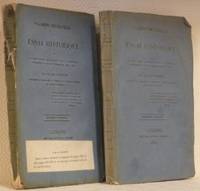
1833Best.-Nr. 61260Lausanne : Marc Ducloux 1833. broché. GUINAND Ulysse.Fragmens Neuchâtelois ou Essai Historique sur le Droit public neuchâtelois sur la domination prussienne et sur les événemens de 1830 à 1832. Première et seconde livraisons 2 vol. Lausanne Marc Ducloux1833 220x140mmXV- 443 pages broché. Intérieurs propre. Couvertures abîmées. Dos abîmés fortement sur seconde livraison. Manque également la quatrième de couverture de la seconde livraison. Cahier des pages 105-126 se détache. Une nouvelle reliure serait souhaitable. No hidden customs fees for orders shipped to the U.S.A with a value of up to 800 USD PDDP shipping we pay the VAT in advance Marc Ducloux unknown
Best.-Nr. 10221Montbéliard, imp. Hoffmann, 1896, 1 br., dos insolé. in-8 de 154 pp. ;
Best.-Nr. 42292Lausanne, chez Marc Ducloux, 1833. In-8°, XV-443p. Reliure demi-basane d'époque, dos lisse avec pièce de titre orange.
Best.-Nr. 61260Lausanne, Marc Ducloux 1833, 220x140mm, XV- 443pages, broché. Intérieurs propre. Couvertures abîmées. Dos abîmés, fortement sur seconde livraison. Manque également la quatrième de couverture de la seconde livraison. Cahier des pages 105-126 se détache. Une nouvelle reliure serait souhaitable.
Best.-Nr. 131633aafLausanne, Chez Marc Ducloux, éditeur, 1833, in-8vo, XV (+1 blanche) + 192 p., qqs rousseurs, ex-libris heraldique Albert de Montet, reliure en d.-toile d’époque.
1833Best.-Nr. 20259Lausanne, Marc Ducloux, 1833. 2 volumes in-8 brochés, couvertures imprimées. Manques de papier aux dos et petites déchirures à l'un des premiers plats, avis au relieur collé au premier plat du second volume.
Best.-Nr. 121187aafO.A.: Wilhelm Haas Sohn, Basel, 1792, kl. in-8vo, 2 Titelbl. (mit wiederholter allegor. Vignette gest. v. Heiz) + XXX + 371 S., 2. Titelbl. etwas fleckig, ansonsten sehr frisch / Titelbl. mit gest. Vign. + 187 S. ; Titelbl. + + 258 S. + 1 Bl. Druckfehler, hs. Besitzervermerk ‘Richard Kirchgraber’ auf Titelbl., Gebunden in Halbleder d. Zeit, Lederrückenschildchen. Schönes Exemplar
1966Best.-Nr. 202030New York: Penguin 1966. First Edition; First Printing. Softcover. Very Good in wraps. Penguin unknown
Best.-Nr. 67465142-6BFI Publishing. Used - Very Good. Former library copy. Pages intact with possible writing/highlighting. Binding strong with minor wear. Dust jackets/supplements may not be included. Includes library markings. Stock photo provided. Product includes identifying sticker. Better World Books: Buy Books. Do Good. BFI Publishing unknown
2004Best.-Nr. __1844570150British Film Inst 2004. Hardcover. New. 185 pages. 8.50x5.75x1.00 inches. British Film Inst hardcover
2004Best.-Nr. x-1844570169British Film Inst 2004. Paperback. New. 2004 ed. edition. 185 pages. 8.25x5.50x0.75 inches. British Film Inst paperback
1982Best.-Nr. 30590Franz Steiner Verlag. Very Good. Paperback. Faint edgewear. Minor shelfwear.; Hermes. Einzelschriften Heft 46; 170 pages . 1982. 3515036407 . Franz Steiner Verlag paperback
1874Best.-Nr. 23500Washington D. C.: Government Printing Office 1874. First Impression. Hardcover. In exceptionally good condition. Octavo 23.5cm/9.25 inches full embossed rose-madder cloth sans dust jacket pp. xxvii 710; xxiii 1456 indexed. Fully Illustrated with aforementioned large folded map Please feel free to inquire as to particulars and/or additional snapshots. Government Printing Office hardcover
1876Best.-Nr. 23666Washington D. C.: Government Printing Office 1876. First Impression. Hardcover. In exceptionally good condition. Octavo 23.5cm/9.25 inches full embossed rose-madder cloth sans dust jacket pp. lvi 648 indexed. Please Feel free to inquire as to particulars and/or additional snapshots. Government Printing Office hardcover
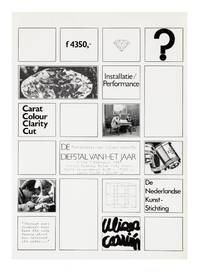
Best.-Nr. 8079Coated paper with black & white illus. Assen Netherlands: 1982. The rare promotional poster for one of Ulises Carrión’s experimental public installations; the present copy is in particularly fine condition and has not been folded or creased. Entitled The Robbery of the Year this exhibition was designed by the artist as a test of visitors’ self-restraint. A large diamond was placed on a cushion without any enclosure but with a single spotlight trained on it in an otherwise dark room. Visitors were invited to enter the room while a photographer took pictures of the space and the visitors. An expected theft failed to transpire and near the end of the exhibition the photographer was withdrawn. Soon thereafter the diamond disappeared. “De Diefstal van het Jaar was an exhibition of a diamond in which visitors are surreptitiously invited to steal the stone raising interesting questions about viewing and stealing a precious object worthy of public exhibition and evoking images associated with museum heists with subsequent analysis on issues such as the value and ownership of objects on display.”–Guy Schraenen ed. Dear reader. Don’t read. 2016 pp. 44 & 164 pictured. On his series of public experiments Carrión is quoted as saying: “In my work I use all kinds of materials objects processes and people as formal elements. The final result is only partially determined in advance and the process that leads to that point is influenced by all the factors mentioned above. It is a game without fixed rules and with no winners or losers.”–Guy Schraenen ed. “We have won! Haven’t we” 1992 p. 69. In excellent condition. unknown books
Best.-Nr. 8079Coated paper with black & white illus. Assen Netherlands: 1982. The rare promotional poster for one of Ulises Carrión’s experimental public installations; the present copy is in particularly fine condition and has not been folded or creased. Entitled The Robbery of the Year this exhibition was designed by the artist as a test of visitors’ self-restraint. A large diamond was placed on a cushion without any enclosure but with a single spotlight trained on it in an otherwise dark room. Visitors were invited to enter the room while a photographer took pictures of the space and the visitors. An expected theft failed to transpire and near the end of the exhibition the photographer was withdrawn. Soon thereafter the diamond disappeared. “De Diefstal van het Jaar was an exhibition of a diamond in which visitors are surreptitiously invited to steal the stone raising interesting questions about viewing and stealing a precious object worthy of public exhibition and evoking images associated with museum heists with subsequent analysis on issues such as the value and ownership of objects on display.”–Guy Schraenen ed. Dear reader. Don’t read. 2016 pp. 44 & 164 pictured. On his series of public experiments Carrión is quoted as saying: “In my work I use all kinds of materials objects processes and people as formal elements. The final result is only partially determined in advance and the process that leads to that point is influenced by all the factors mentioned above. It is a game without fixed rules and with no winners or losers.”–Guy Schraenen ed. “We have won! Haven’t we” 1992 p. 69. In excellent condition. unknown
Best.-Nr. 9985Black & white illus. Illustrated flyer horizontal & vertical folds. Amsterdam: 1979. Promotional flyer for the artist’s forthcoming bookwork offered for 12.50 guilders or $6 per copy. In fine condition. unknown books
Best.-Nr. 9985Black & white illus. Illustrated flyer horizontal & vertical folds. Amsterdam: 1979. Promotional flyer for the artist’s forthcoming bookwork offered for 12.50 guilders or $6 per copy. In fine condition. unknown
1975Best.-Nr. 58516Graz-Wien-Köln, Verlag Styria, (1975). 8°. 111 S., OBrosch. m. illustr. OUmschlag (v. Gregor Traversa).
1975Best.-Nr. 64687Graz-Wien-Köln, Verlag Styria, (1975). 8°. 111 S., OBrosch. m. illustr. OUmschlag (v. Gregor Traversa).
Best.-Nr. 44223187like new. unknown
1974Best.-Nr. 023315Bloomington , London., Indiana University Press., 1974. Edited and with an Introduction by Thomas F. Stanley. Einbandränder minimal fleckig, die Kanten des Schutzumschlags sind leicht berieben. 8°. H OLeinen mit OUmschlag.
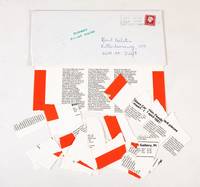
Best.-Nr. 8076Single sheet exhibition invitation torn into ca. two dozen pieces. Amsterdam: Pieter Brattinga Gallery 1981. One of Ulises Carrión’s rarest mail art projects with the original mailed envelope sent to the collector Tjeerd Deelstra b. 1937. As the artist intended explained below a small torn portion is not present. “In 1981 when the Print Gallery Pieter Brattinga invited Carrión to exhibit his work there Carrión thought of a response project in which he instructed participants to reconstruct in any way they desired the bottom half of an invitation which had been shredded. They were then to sign it and mail it back to the gallery. The lower section of the invitation included a definition of mail art which the artist had torn up and from which he had then removed a small fragment. This way the definition of mail art could never be reconstructed and the instruction given by the artist was impossible to accomplish. The project resulted in 243 responses in all sorts of formats; not only intervened letters but also objects. By making participants reconstruct the invitation the project had a cyclical component that was emphasized by having the word ‘feedback’ in its title. In this way Feedback Pieces takes one step further Carrión’s intentions to reformulate not only the artwork but also the communication system through which it travels.”–Aimé Iglesias Lukin “King Kong Archives: Ulises Carrión on Mail and Art” in Ulises Carrión: The Big Monster 2019 pp. 11-13 pictured. Both the envelope and torn-up invitation are in excellent condition. ⧠Juan J. Agius ed. Ulises Carrión & The Big Monster 2014 pp. 120-35 pictured. unknown books
Best.-Nr. 8076Single sheet exhibition invitation torn into ca. two dozen pieces. Amsterdam: Pieter Brattinga Gallery 1981. One of Ulises Carrión’s rarest mail art projects with the original mailed envelope sent to the collector Tjeerd Deelstra b. 1937. As the artist intended explained below a small torn portion is not present. “In 1981 when the Print Gallery Pieter Brattinga invited Carrión to exhibit his work there Carrión thought of a response project in which he instructed participants to reconstruct in any way they desired the bottom half of an invitation which had been shredded. They were then to sign it and mail it back to the gallery. The lower section of the invitation included a definition of mail art which the artist had torn up and from which he had then removed a small fragment. This way the definition of mail art could never be reconstructed and the instruction given by the artist was impossible to accomplish. The project resulted in 243 responses in all sorts of formats; not only intervened letters but also objects. By making participants reconstruct the invitation the project had a cyclical component that was emphasized by having the word ‘feedback’ in its title. In this way Feedback Pieces takes one step further Carrión’s intentions to reformulate not only the artwork but also the communication system through which it travels.”–Aimé Iglesias Lukin “King Kong Archives: Ulises Carrión on Mail and Art” in Ulises Carrión: The Big Monster 2019 pp. 11-13 pictured. Both the envelope and torn-up invitation are in excellent condition. ⧠Juan J. Agius ed. Ulises Carrión & The Big Monster 2014 pp. 120-35 pictured. unknown