Ulysses S GrantBiblio.com
2961 risultati
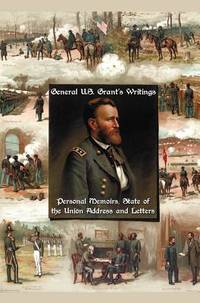
rif. 6101416916Benediction Classics . Hardback. New. pp. 836 Benediction Classics hardcover
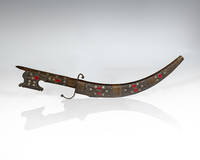
rif. 147820Rare Indo-Persian khanjar a 20th century curved dagger from the collection of General William T. Sherman preserved in his military trunk. The khanjar has decorative wooden and metal inlays and intricate detailing to the handle and sheath with etchings to the blade. Ulysses S. Grant a close friend of Sherman's went on a "World Tour" after his second presidential term had ended. It has been suggested that Grant collected a few souvenirs for his dear friend while visiting Asia. When the Grant family returned from their trip Sherman greeted Grant at a reunion held by the veterans of the Army of the Tennessee. In very good condition. The piece measures approximately 15.5 inches. General William Tecumseh Sherman and General Ulysses S. Grant were key figures in the Union Army during the American Civil War forming a close personal and professional relationship that significantly influenced the war’s outcome. Grant known for his strategic leadership recognized Sherman’s military talents early in the war and the two collaborated on major campaigns including the Vicksburg Campaign 1863 and Sherman’s March to the Sea 1864–1865. Their coordinated efforts exemplified the Union’s strategy of total war aimed at crippling the Confederacy’s resources and morale. After the war their partnership continued with Sherman succeeding Grant as Commanding General of the U.S. Army in 1869 when Grant became President. Their mutual trust and shared military philosophy played a crucial role in shaping U.S. military strategy and post-war reconstruction efforts. unknown
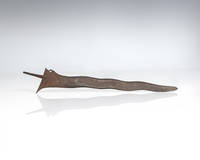
rif. 147821Rare Javanese kris commonly used in the pencak silat martial art native to Indonesia from the collection of General William T. Sherman preserved in his military trunk. Ulysses S. Grant a close friend of Sherman’s went on a “World Tour” after his second presidential term had ended. It has been suggested that Grant collected a few souvenirs for his dear friend while visiting Asia. When the Grant family returned from their trip Sherman greeted Grant at a reunion held by the veterans of the Army of the Tennessee. In good condition with handle missing. The piece measures 14.5 inches. General William Tecumseh Sherman and General Ulysses S. Grant were key figures in the Union Army during the American Civil War forming a close personal and professional relationship that significantly influenced the war’s outcome. Grant known for his strategic leadership recognized Sherman’s military talents early in the war and the two collaborated on major campaigns including the Vicksburg Campaign 1863 and Sherman’s March to the Sea 1864–1865. Their coordinated efforts exemplified the Union’s strategy of total war aimed at crippling the Confederacy’s resources and morale. After the war their partnership continued with Sherman succeeding Grant as Commanding General of the U.S. Army in 1869 when Grant became President. Their mutual trust and shared military philosophy played a crucial role in shaping U.S. military strategy and post-war reconstruction efforts. unknown
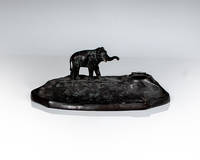
rif. 147816Rare bronze sculpture of an elephant most likely used as an ink well from the collection of General William T. Sherman preserved in his military trunk. Ulysses S. Grant a close friend of Sherman's went on a "World Tour" after his second presidential term had ended. It has been suggested that Grant collected a few souvenirs for his dear friend while visiting Asia. When the Grant family returned from their trip Sherman greeted Grant at a reunion held by the veterans of the Army of the Tennessee. In very good condition with some patina. The piece measures 9.5 inches by 4.5 inches. General William Tecumseh Sherman and General Ulysses S. Grant were key figures in the Union Army during the American Civil War forming a close personal and professional relationship that significantly influenced the war’s outcome. Grant known for his strategic leadership recognized Sherman’s military talents early in the war and the two collaborated on major campaigns including the Vicksburg Campaign 1863 and Sherman’s March to the Sea 1864–1865. Their coordinated efforts exemplified the Union’s strategy of total war aimed at crippling the Confederacy’s resources and morale. After the war their partnership continued with Sherman succeeding Grant as Commanding General of the U.S. Army in 1869 when Grant became President. Their mutual trust and shared military philosophy played a crucial role in shaping U.S. military strategy and post-war reconstruction efforts. unknown
1887rif. 001282Boston Massachusetts: Cupples Upham & Co 1887. Light soil to covers and a touch of rubbing at the extremities. Pages show a thin strip of light damp stain at the bottom edge only less than 1/4 inch - text is not affected else Very Good condition. No owner's name or bookplate. No underlining. No highlighting. No margin notes. This 1887 first edition is not in Broadfoot. . First Edition. Hardcover. Original green cloth gilt/No dust jacket. 66pp. 37 page publisher's catalog. Cupples, Upham & Co Hardcover
rif. 1333046901.Gpaperback. Good. Access codes and supplements are not guaranteed with used items. May be an ex-library book. paperback
rif. 1020755733.Ghardcover. Good. Access codes and supplements are not guaranteed with used items. May be an ex-library book. hardcover
rif. 0548244820.Ghardcover. Good. Access codes and supplements are not guaranteed with used items. May be an ex-library book. hardcover
rif. 1017077223.Ghardcover. Good. Access codes and supplements are not guaranteed with used items. May be an ex-library book. hardcover
rif. 0267509308.Ghardcover. Good. Access codes and supplements are not guaranteed with used items. May be an ex-library book. hardcover
rif. 0364604913.Ghardcover. Good. Access codes and supplements are not guaranteed with used items. May be an ex-library book. hardcover
rif. 1330842022.Gpaperback. Good. Access codes and supplements are not guaranteed with used items. May be an ex-library book. paperback
rif. B9781017077223Hardback. New. hardcover
rif. 033194264X.Ghardcover. Good. Access codes and supplements are not guaranteed with used items. May be an ex-library book. hardcover
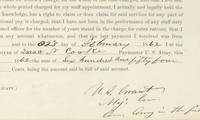
1862rif. 806901/03/1862. In it he also pays for his servants 3 of whom were black; An extreme rarity the first such document we can find having reached the market in a quarter century The battle of Fort Henry in Tennessee took place on February 6 1862 and an obscure and virtually unknown brigadier general named Ulysses S. Grant captured the fort and opened the Tennessee River to Union movements. This early in the war Union victories of any kind were scarce and this one was probably the most consequential of the war to date. Grant then moved directly on Fort Donelson entrapping the place both by land and sea from February 11-16. On the morning of February 15 the Confederate commander Simon B. Buckner sent a note to Grant requesting an armistice and asking terms of surrender. Buckner was expecting to give up the fort but get his soldiers paroled so they would not be prisoners of war. Grant refused to give terms but demanded unconditional surrender. The Confederates surrendered the next day the 16th. This victory opened the Cumberland River an important avenue for the invasion of the South to Union operations and Grant became instantly famous earning the nickname ""Unconditional Surrender"" Grant. President Lincoln took note of the fact that in Grant he had a general who could win. On February 20 1862 Lincoln promoted Grant to the rank of Major General a prerequisite to Grant's being able to command a large army. However Grant’s very successes at Forts Henry and Donelson incurred the jealousy of his superior Gen. Henry Halleck who was in command of the whole Western Theater of war. Grant not yet realizing the peril Halleck's opposition placed him in knew Nashville was wide open with little in the way of defensive forces. Though Halleck had expressly forbade him to advance Grant ordered Union forces to enter Nashville. It fell on February 25 with Gen. Don Carlos Buell accepting the city's surrender. Nashville thus became the first Confederate state capital to fall into Union hands. Over the next week thousands of Union soldiers poured into the city and Grant took a boat upriver from Donelson to Nashville to confer with Buell. Halleck saw the taking of Nashville not as Grant recognizing and seizing an important opportunity but as willful disobedience of an order. And Grant's unauthorized trip to see Buell there only added to Halleck's anger. <img class=""alignnone wp-image-32063 size-post-window"" src=""https://cdn.raabcollection.com/wp-content/uploads/20240907140939/Grant-March-1-1862-1-1-1600x348.jpg"" alt="""" width=""1600"" height=""348"" /> So on March 1 1862 Halleck decided to tie Grant's hands by ordering him to return to Fort Henry and from there to launch an expedition up the Tennessee River to the state of Mississippi. The objective was the destruction of several key railroad bridges. Grant was to “avoid any general engagement with strong forces” and was told that it was “better to retreat than to risk a general battle.” Grant went to Fort Henry as ordered but did not communicate with Halleck directly. The next day Halleck complained to Gen. McClellan that he had heard no word from Grant for a week and that “his army seems to be as much demoralized by the victory of Fort Donelson as was that of the Potomac by the defeat of Bull Run.” On March 4 Halleck relieved Grant from his command writing him: “You will place Maj. Gen. C. F. Smith in command of expedition and remain yourself at Fort Henry.” Grant was shocked. “Thus"" say Grant's Memoirs ""in less than two weeks after the victory at Donelson the two leading generals Halleck and McClellan in the army were in correspondence as to what disposition should be made of me and in less than three weeks I was virtually in arrest and without a command.” Grant turned over command to Smith on March 5. Even as he did so he felt intensely frustrated and longed for action writing on the same day “I have not been well for the last ten days and don’t see that I will be much better until I can get to moving again.” Grant and Halleck exchanged letters after which Grant on March 11 demanded that Halleck relieve him from duty altogether in order to clear his name. ""There is such a disposition to find fault with me that I again ask to be relieved from further duty until I can be placed right in the estimation of those higher in authority."" Perhaps this letter caused a change of mind or it may be that Halleck just could not risk loss of the popular Grant altogether. In any event surprisingly he refused and instead told Grant he would receive a new command writing him ""You cannot be relieved from your command. There is no good reason for it…Instead of relieving you I wish you as soon as your new army is in the field to assume the immediate command and lead it on to new victories."" Just four days later Grant was actually given a new command - he was placed in charge of Union forces in Tennessee. He proceeded to Pittsburg Landing Tennessee and arriving on the 17th established a wide camp with his forward units around Shiloh Church some 2.5 miles south of Pittsburg Landing. He wrote ""I at once put all the troops at Savannah in motion for Pittsburg Landing knowing that the enemy was fortifying at Corinth and collecting an army there under Johnston. It was my expectation to march against that army as soon as Buell who had been ordered to reinforce me with the Army of the Ohio should arrive; and the west bank of the river was the place to start from. Pittsburg is only about twenty miles from Corinth…When all reinforcements should have arrived I expected to take the initiative by marching on Corinth and had no expectation of needing fortifications though this subject was taken into consideration."" He reported to Halleck on his troop dispositions and imminently awaited reinforcements so he could move against Corinth. Halleck meanwhile continued to nitpick at Grant for supposed failure to discipline his troops properly. The month of March was a significant one in Grant's career one that saw the tables turn twice on him. First in the flush of his great successes at Forts Henry and Donelson he was victimized by jealousy and relieved of command. Then when all seemed lost he was given an even greater command. And as he assumed that command and awaited reinforcements so he would move on Corinth he was unwittingly actually preparing for the Battle of Shiloh one of the most fateful of the war. <img class=""alignnone wp-image-32064 size-post-window"" src=""https://cdn.raabcollection.com/wp-content/uploads/20240907141021/Grant-March-1-1862-2-1600x657.jpg"" alt="""" width=""1600"" height=""657"" /> Document signed Pittsburg Landing Tenn. April 2 1862 being a voucher for his own pay and expenses and those of his four private servants for the period from March 1 to March 31 1862. His pay was $220 per month and he received $52 per month for the pay of his servants. Forage for his seven horses came to $56 for the month. He received $10 per month as a clothing allowance and he was entitled to ""double rations for commanding army in the field"" which came to over 1000 rations for the month. The rations called ""subsistence"" cost $316.20. At the end the document recites that Grant has received a total of $654.20 from the paymaster and he has signed ""U.S. Grant Maj. Gen. Commanding Army in the field."" Interestingly Grant's four servants are named and their skin color height and eye and hair color given. Frank was white; and Dan Jim and Sam were black. The voucher is docketed on the verso. This is the first signed voucher for Grant's pay during the Civil War that we have seen. Research in public records going back 40 years discloses one previous monthly voucher having reach the market and that was a quarter century ago. On April 6 1862 just four days after signing this document the Confederates commenced the Battle of Shiloh by bursting through Union lines and threatening to drive Grant's men back into the Tennessee River. Historians differ on whether Grant was at fault in being surprised but it is clear that Union forces only escaped being routed with the arrival of Buell's army. The next day the Union recaptured the initiative and drove the Confederates back in disorder. The battle was essentially a draw while also being the bloodiest battle yet to occur on the American continent. When the news reached the North where expectations had been high a storm of abuse broke out against Grant who was held responsible. He may well have not deserved the blame but he admitted reassessing the war after Shiloh. He wrote “Up to the battle of Shiloh I as well as thousands of other citizens believed that the rebellion against the Government would collapse suddenly and soon if a decisive victory could be gained over any of its armies. Donelson and Henry were such victories.But when Confederate armies were collected which not only attempted to hold a line farther south.but assumed the offensive and made such a gallant effort to regain what had been lost then indeed I gave up all idea of saving the Union except by complete conquest.” <img class=""alignnone wp-image-25018 size-post-window"" src=""https://cdn.raabcollection.com/wp-content/uploads/20231204144051/Folder-site-11-1600x1327.jpg"" alt="""" width=""1600"" height=""1327"" /> hardcover books
1862rif. 806901/03/1862. In it he also pays for his servants 3 of whom were black; An extreme rarity the first such document we can find having reached the market in a quarter century The battle of Fort Henry in Tennessee took place on February 6 1862 and an obscure and virtually unknown brigadier general named Ulysses S. Grant captured the fort and opened the Tennessee River to Union movements. This early in the war Union victories of any kind were scarce and this one was probably the most consequential of the war to date. Grant then moved directly on Fort Donelson entrapping the place both by land and sea from February 11-16. On the morning of February 15 the Confederate commander Simon B. Buckner sent a note to Grant requesting an armistice and asking terms of surrender. Buckner was expecting to give up the fort but get his soldiers paroled so they would not be prisoners of war. Grant refused to give terms but demanded unconditional surrender. The Confederates surrendered the next day the 16th. This victory opened the Cumberland River an important avenue for the invasion of the South to Union operations and Grant became instantly famous earning the nickname ""Unconditional Surrender"" Grant. President Lincoln took note of the fact that in Grant he had a general who could win. On February 20 1862 Lincoln promoted Grant to the rank of Major General a prerequisite to Grant's being able to command a large army. However Grant’s very successes at Forts Henry and Donelson incurred the jealousy of his superior Gen. Henry Halleck who was in command of the whole Western Theater of war. Grant not yet realizing the peril Halleck's opposition placed him in knew Nashville was wide open with little in the way of defensive forces. Though Halleck had expressly forbade him to advance Grant ordered Union forces to enter Nashville. It fell on February 25 with Gen. Don Carlos Buell accepting the city's surrender. Nashville thus became the first Confederate state capital to fall into Union hands. Over the next week thousands of Union soldiers poured into the city and Grant took a boat upriver from Donelson to Nashville to confer with Buell. Halleck saw the taking of Nashville not as Grant recognizing and seizing an important opportunity but as willful disobedience of an order. And Grant's unauthorized trip to see Buell there only added to Halleck's anger. <img class=""alignnone wp-image-32063 size-post-window"" src=""https://cdn.raabcollection.com/wp-content/uploads/20240907140939/Grant-March-1-1862-1-1-1600x348.jpg"" alt="""" width=""1600"" height=""348"" /> So on March 1 1862 Halleck decided to tie Grant's hands by ordering him to return to Fort Henry and from there to launch an expedition up the Tennessee River to the state of Mississippi. The objective was the destruction of several key railroad bridges. Grant was to “avoid any general engagement with strong forces” and was told that it was “better to retreat than to risk a general battle.” Grant went to Fort Henry as ordered but did not communicate with Halleck directly. The next day Halleck complained to Gen. McClellan that he had heard no word from Grant for a week and that “his army seems to be as much demoralized by the victory of Fort Donelson as was that of the Potomac by the defeat of Bull Run.” On March 4 Halleck relieved Grant from his command writing him: “You will place Maj. Gen. C. F. Smith in command of expedition and remain yourself at Fort Henry.” Grant was shocked. “Thus"" say Grant's Memoirs ""in less than two weeks after the victory at Donelson the two leading generals Halleck and McClellan in the army were in correspondence as to what disposition should be made of me and in less than three weeks I was virtually in arrest and without a command.” Grant turned over command to Smith on March 5. Even as he did so he felt intensely frustrated and longed for action writing on the same day “I have not been well for the last ten days and don’t see that I will be much better until I can get to moving again.” Grant and Halleck exchanged letters after which Grant on March 11 demanded that Halleck relieve him from duty altogether in order to clear his name. ""There is such a disposition to find fault with me that I again ask to be relieved from further duty until I can be placed right in the estimation of those higher in authority."" Perhaps this letter caused a change of mind or it may be that Halleck just could not risk loss of the popular Grant altogether. In any event surprisingly he refused and instead told Grant he would receive a new command writing him ""You cannot be relieved from your command. There is no good reason for it…Instead of relieving you I wish you as soon as your new army is in the field to assume the immediate command and lead it on to new victories."" Just four days later Grant was actually given a new command - he was placed in charge of Union forces in Tennessee. He proceeded to Pittsburg Landing Tennessee and arriving on the 17th established a wide camp with his forward units around Shiloh Church some 2.5 miles south of Pittsburg Landing. He wrote ""I at once put all the troops at Savannah in motion for Pittsburg Landing knowing that the enemy was fortifying at Corinth and collecting an army there under Johnston. It was my expectation to march against that army as soon as Buell who had been ordered to reinforce me with the Army of the Ohio should arrive; and the west bank of the river was the place to start from. Pittsburg is only about twenty miles from Corinth…When all reinforcements should have arrived I expected to take the initiative by marching on Corinth and had no expectation of needing fortifications though this subject was taken into consideration."" He reported to Halleck on his troop dispositions and imminently awaited reinforcements so he could move against Corinth. Halleck meanwhile continued to nitpick at Grant for supposed failure to discipline his troops properly. The month of March was a significant one in Grant's career one that saw the tables turn twice on him. First in the flush of his great successes at Forts Henry and Donelson he was victimized by jealousy and relieved of command. Then when all seemed lost he was given an even greater command. And as he assumed that command and awaited reinforcements so he would move on Corinth he was unwittingly actually preparing for the Battle of Shiloh one of the most fateful of the war. <img class=""alignnone wp-image-32064 size-post-window"" src=""https://cdn.raabcollection.com/wp-content/uploads/20240907141021/Grant-March-1-1862-2-1600x657.jpg"" alt="""" width=""1600"" height=""657"" /> Document signed Pittsburg Landing Tenn. April 2 1862 being a voucher for his own pay and expenses and those of his four private servants for the period from March 1 to March 31 1862. His pay was $220 per month and he received $52 per month for the pay of his servants. Forage for his seven horses came to $56 for the month. He received $10 per month as a clothing allowance and he was entitled to ""double rations for commanding army in the field"" which came to over 1000 rations for the month. The rations called ""subsistence"" cost $316.20. At the end the document recites that Grant has received a total of $654.20 from the paymaster and he has signed ""U.S. Grant Maj. Gen. Commanding Army in the field."" Interestingly Grant's four servants are named and their skin color height and eye and hair color given. Frank was white; and Dan Jim and Sam were black. The voucher is docketed on the verso. This is the first signed voucher for Grant's pay during the Civil War that we have seen. Research in public records going back 40 years discloses one previous monthly voucher having reach the market and that was a quarter century ago. On April 6 1862 just four days after signing this document the Confederates commenced the Battle of Shiloh by bursting through Union lines and threatening to drive Grant's men back into the Tennessee River. Historians differ on whether Grant was at fault in being surprised but it is clear that Union forces only escaped being routed with the arrival of Buell's army. The next day the Union recaptured the initiative and drove the Confederates back in disorder. The battle was essentially a draw while also being the bloodiest battle yet to occur on the American continent. When the news reached the North where expectations had been high a storm of abuse broke out against Grant who was held responsible. He may well have not deserved the blame but he admitted reassessing the war after Shiloh. He wrote “Up to the battle of Shiloh I as well as thousands of other citizens believed that the rebellion against the Government would collapse suddenly and soon if a decisive victory could be gained over any of its armies. Donelson and Henry were such victories.But when Confederate armies were collected which not only attempted to hold a line farther south.but assumed the offensive and made such a gallant effort to regain what had been lost then indeed I gave up all idea of saving the Union except by complete conquest.” <img class=""alignnone wp-image-25018 size-post-window"" src=""https://cdn.raabcollection.com/wp-content/uploads/20231204144051/Folder-site-11-1600x1327.jpg"" alt="""" width=""1600"" height=""1327"" /> hardcover
rif. 0483879150.Ghardcover. Good. Access codes and supplements are not guaranteed with used items. May be an ex-library book. hardcover
rif. ANAIS-0972558810Doris Duke Charitable Foundation. paperback. Good. 9.5X6.5X1.5. Buy with confidence. Excellent Customer Service & Return policy. Doris Duke Charitable Foundation paperback
rif. 0972558810.Gpaperback. Good. Access codes and supplements are not guaranteed with used items. May be an ex-library book. paperback
2003rif. DADAX0972558810Brand: Doris Duke Charitable Foundation 2003-01-01. paperback. New. 0.00x0.00x0.00. Buy with confidence. Excellent Customer Service & Return policy. Brand: Doris Duke Charitable Foundation paperback
2003rif. SONG0972558810Brand: Doris Duke Charitable Foundation 2003-01-01. paperback. Used: Good. 0.00x0.00x0.00. Buy with confidence. Excellent Customer Service & Return policy. Brand: Doris Duke Charitable Foundation paperback
2026rif. LRB530574Paris: Editions Recreasoft 2026 Langue : Français. Environ 508 pages. Français : Réimpression à la demande. Édition originale : 1899-1901. Ouvrage de référence sur l'histoire ecclésiastique de la France consacré aux archevêchés évêchés et abbayes avec de nombreux documents authentiques issus des archives vaticanes et locales. Cette vaste entreprise érudite s'adresse aux historiens chercheurs en histoire religieuse et amateurs de bibliographie ancienne. Images du livre non contractuelles English : Print-on-demand reprint. Original edition : 1899-1901. Reference work on the ecclesiastical history of France devoted to archbishoprics bishoprics and abbeys with numerous authentic documents drawn from Vatican and local archives. This extensive scholarly study will appeal to historians researchers in religious history and collectors of antiquarian works. Book images are non-contractual. Editions Recreasoft. Softcover. New. Editions Recreasoft paperback
2026rif. LRB45018850Paris: Editions Recreasoft 2026 Langue : Français. Environ 724 pages. Français : Réimpression à la demande. Édition originale : 1899-1901. Ouvrage en français. Ouvrage fondamental pour l'histoire religieuse de la France la Gallia christiana novissima offre une étude détaillée des archevêchés évêchés et abbayes enrichie de documents authentiques issus des archives vaticanes et locales. Travail de référence pour les chercheurs en histoire ecclésiastique et en patrimoine religieux. Images du livre non contractuelles English: Print-on-demand reprint. Original edition : 1899-1901. Text in French. This essential work on the religious history of France the Gallia christiana novissima provides a detailed study of archdioceses dioceses and abbeys supplemented by authentic documents from the Vatican and local archives. A key reference for researchers in ecclesiastical history and religious heritage. Book images are non-contractual. Editions Recreasoft. Softcover. New. Editions Recreasoft paperback
2026rif. LRB45018851Paris: Editions Recreasoft 2026 Langue : Français. Environ 730 pages. Tome 3 d'un ouvrage en plusieurs volumes. / Volume 3 of a multi-volume work. Français : Réimpression à la demande. Édition originale : 1899-1901. Ouvrage en français. Ouvrage fondamental pour l'histoire religieuse de la France la Gallia christiana novissima rassemble des documents authentiques sur les archevêchés évêchés et abbayes du pays. Compilé à partir des archives vaticanes et locales ce travail offre une source précieuse pour les chercheurs en histoire ecclésiastique et régionale. Images du livre non contractuelles English: Print-on-demand reprint. Original edition : 1899-1901. Text in French. A fundamental work for the religious history of France the Gallia christiana novissima gathers authentic documents on the archdioceses dioceses and abbeys of the country. Compiled from the Vatican and local archives this work provides a valuable resource for researchers in ecclesiastical and regional history. Book images are non-contractual. Editions Recreasoft. Softcover. New. Editions Recreasoft paperback
2026rif. LRB25017566Paris: Editions Recreasoft 2026 Langue : Français. Environ 562 pages. Tome 7 d'un ouvrage en plusieurs volumes. / Volume 7 of a multi-volume work. Français : Réimpression à la demande. Édition originale : 1899. Cette reproduction moderne de Gallia Christiana novissima = Histoire des archeveches eveches & abbayes de France: d'apres les documents authentiques recueillis dans les registres du Vatican et les archives locales / par J.-H. Albanes completeé annoteé et publieé par Ulysse Chevalier de Auteur non identifié rend accessible un texte ancien ou rare pour la consultation la recherche bibliographique et les collections spécialisées. Images du livre non contractuelles English : Print-on-demand reprint. Original edition : 1899. Ecclesiastical history of France based on authentic documents drawn from Vatican records and local archives. This reference work gathers scholarly material on the archbishoprics bishoprics and abbeys of France with particular value for the religious institutional and territorial history of the French sees. The edition is notable for its critical apparatus bibliographic references and indexes making it useful to historians researchers and collectors of historical sources. Book images are non-contractual. Editions Recreasoft. Softcover. New. Editions Recreasoft paperback