109 risultati
1754rif. 22566à Amsterdam Paris: S. n. 1754. Fine. S. n. à Amsterdam Paris 1754 10 x 17 cm relié Rare first edition of this literary hoax spuriously attributed by the translator to Cadmus of Miletus in a lengthy explanatory preface. Illustrated with a frontispiece after Cochin. Contemporary full blond calf binding. Spine gilt-tooled between raised bands. Red morocco title label. Headcap partly worn and upper joint split at the head. Surface abrasions to the boards. The volume opens with a preface on the attribution of the tale to Cadmus of Miletus followed by a well-documented chapter on the establishment of Greek colonies in Asia Minor. The tale recounts the life of a young prince son of the king of the Dorides servingwithin the tradition of the philosophical taleas a pretext for the unveiling of certain truths. Chevalier d'Arcq 1721-1795 the natural son of the Count of Toulouse played a significant role in the intellectual life of the eighteenth century notably through his close interest in economic and social issues. More conventionally in this tale the author addresses human passions and the nature of power. S. n. hardcover
rif. 14852Amsterdam, Paris, Desaint & Saillant, Durand, Vincent, Duchesne, 1758 - Edition originale in-12 - Complet en 2 volumes, seuls édités - Reliure plein veau de l'époque (coiffes et coins frottés) - Dos à nerfs orné de caissons fleuronnés - Pièce de titre havane - titre doré - Ecoinçons dorés aux 1 & 4 plats - Gardes marbrées - Toutes tranches rouges - signet - LVIII-[2]-317 & 448 pp - Bon exemplaire, très propre - Envoi rapide et soigné
1754rif. 117931754 basane claire, dos à n. in-12, P. 1754
rif. 6727Dix oeuvres de Philippe Auguste Benoit d'Entrevaux dans un même ouvrage, relié dans un demi chagrin superbe, rouge, dos à quatre nerfs, titre et auteur dorés. Le premier fascicule comporte un envoi et une signature de l'auteur , à sa fille , un deuxiemme se trouve sur un autre no ....
rif. 194912 titres en 1 volume in-12. 1er titre : Londres, Paris, Duchesne, 1756, in-12 de 215-(1) pp., frontispice d'après Eisen gravé par Sornique - 2e titre : sans lieu ni nom d'éditeur, 1756. rel. d'ép. de plein veau brun granité, dos lisse orné de fers dorés, une pièce de titre de maroquin rouge, la seconde de maroquin jaune en dessous, petites armes effacées en pied, sinon très bon ex.
1716rif. 003228A Paris, par la Compagnie des Libraires. 2 vol.in-12 (16,9 x 10 cm), 21 ff. préliminaires, 360 pp. - 4 ff. préliminaires, 479 pp. Reliure veau brun d'époque, dos à cinq nerfs orné, coupes guillochées, tranches rouges. Première édition imprimée en France, l'édition originale de cette traduction datant de 1700, à Amsterdam, chez Louis de Lorme. L'illustration comprend un frontispice, 13 jolies gravures hors texte dont deux repliées, une carte dépliante du Pérou, bandeaux, lettrines et culs-de-lampe.
1756rif. 25586A Paris, de l'Imprimerie royale, 1756 et 1758. 2 forts vol. au format in-4 (263 x 198 mm) de 1 frontispice allégorique gravé, clxxvi - 372 pp. ; viii - 614 pp. et 1 f. bl. Reliures uniformes de l'époque de plein veau glacé et marbré blond, plats jansénistes, dos à nerfs ornés de filets gras à froid, roulette dorée sur les nerfs, doubles caissons d'encadrement dorés, caissons dentelés dorés, large décor fleuronné doré, semis de fleurettes dorées, pièces de titre de maroquin havane, titre doré, tomaison dorée sur fond ébène, palette dorée en queue, roulette dorée sur les coupes, tranches rouges.
1756rif. 58799Imprimerie Royale | à Paris 1756 - 1758 | 20 x 26 cm | 2 volumes reliés
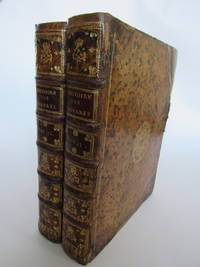
1756rif. 58799à Paris: Imprimerie Royale 1756. Fine. Imprimerie Royale à Paris 1756 - 1758 20 x 26 cm 2 volumes reliés First edition rare of the only two volumes published of this ambitious Histoire générale des guerres printed in Paris by the Imprimerie royale in 1756 and 1758. Conceived as a work in three great periods extending from the earliest times to 1748 the project was never continued beyond these two volumes devoted to Armenia and the peoples of Asia Minor. The first volume is illustrated with an allegorical frontispiece and a large folding genealogical table. A copy intended for Louis XV bound with his arms and cipher. Contemporary full mottled brown calf spines with raised bands decorated with the royal cipher repeated four times and fleurs-de-lys in the corners red morocco lettering- and numbering-pieces the royal arms of France at the centre of the boards triple gilt fillet borders red edges. Headcaps restored several splits along the upper joints of both volumes corners and some sections of the board edges restored. Loss to the right-hand corner of the first free endpaper. Some very pale dampstaining chiefly marginal extending slightly into the text towards the end of the first volume and affecting several endpapers in the second. The royal binding directly reflects the presentation of the work itself. D'Arcq addresses his undertaking to Louis XV in a prefatory epistle while its printing by the Imprimerie royale places the book from the outset within the sphere of royal patronage. The sovereign's arms on the covers and his cipher repeated on the spines materially extend that homage giving the present set a particularly close coherence with the work's dedication. Philippe-Auguste de Sainte-Foy chevalier d'Arcq was himself connected to the Bourbon dynasty whose king he addressed. Born in 1721 he was the natural son of Louis-Alexandre de Bourbon comte de Toulouse the legitimised son of Louis XIV and Madame de Montespan and was therefore a natural grandson of the Sun King. After serving in the cavalry during the War of the Austrian Succession he left the army in 1748 and increasingly devoted himself to letters. His military experience helps explain the governing principle of the present work: to recount the history of peoples through the conflicts that determined the rise transformation and fall of their kingdoms. The extensive preliminary discourse sets out a deliberately critical method. D'Arcq rejects traditions lacking adequate evidence distinguishes established facts from conjecture and where certainty is impossible confines himself to what he considers the best-supported hypotheses. Political history is continually related to geography genealogy and institutions; war however remains the principal thread through which the destinies of states are organised and interpreted. The first volume is devoted to Greater and Lesser Armenia and Cappadocia; the second continues through the peoples and kingdoms of Asia Minor including Pontus Paphlagonia Heraclea Bithynia Pergamum Phrygia and Lydia. The allegorical frontispiece places this military history within a programme that links the contemporary campaigns of d'Arcq's own age with the great victories of antiquity thus setting his experience as an officer in continuity with the wars he undertook to describe. The work received a favourable response from learned critics including the Journal des sçavans which reviewed the two volumes in turn; the extensive programme announced by the author was nevertheless never carried beyond this second volume. Left unfinished the Histoire générale des guerres remains the fragment of a much larger historiographical project in which war was intended to serve as one of the principal means of understanding universal history. Remaining the only two volumes published of a project intended to encompass the universal history of warfare these copies destined for Louis XV give d'Arcq's undertaking a particular resonance: that of a m Imprimerie Royale hardcover