1 080 résultats
2017réf. 129224Hatje Cantz. New. Hardcover. FREE UPGRADE to Courier/Priority Shipping Upon Request - IN STOCK AND IMMEDIATELY AVAILABLE FOR SHIPMENT - BRAND NEW FLAWLESS COPY NEVER OPENED - with a bonus offer-- . 2017. 3775742190 . Hatje Cantz hardcover
1568In-4°, 127cc, (3) cc, grandi capilettera figurati incisi su legno. Legatura in piena pergamena coeva con titolo manoscritto al dorso e tagli in azzurro. Edizione originale molto rara. Copia Fletcher. Si tratta della prima traduzione in prosa della prima parte del poema epico cavalleresco di Niccolò da Casola, redatta a partire da un celebre manoscritto databile nei primi decenni della seconda metà del Trecento. L’Attila di Barbieri è al contempo una grande opera filologica di studio della lingua provenzale, un affresco storico dell’Italia contemporanea riletto attraverso la leggenda delle invasioni barbariche, un quadro della vita cortigiana del tempo e, soprattutto, la celebrazione della famiglia estense, cui l’autore doveva personalmente molto per essere stato accolto alla corte di Ferrara, e che grazie a un illuminato mecenatismo si era conquistata la riconoscenza di letterati e uomini d’arte. Giovanni Maria Barbieri, erudito e filologo modenese (1519-1574), apprese il provenzale durante il suo soggiorno alla corte di Francesco I d’Este, e ne promosse gli studi; rientrato a Modena divenne amico di Castelvetro ed entrò a far parte della corte di Alfonso II d’Este che gli affidò il compito di tradurre questo antico poema provenzale, il cui manoscritto era conservato presso la Biblioteca Estense. Gamba 1160; G. Stendardo, G. Bertoni, Niccolò da Casola. La guerra d’Attila poema franco-italiano, Società tip. Modenese, 1941. In-4 °, 127cc, (3) cc, large figured woodcut letterheads . Full parchment coeval binding with handwritten title on the spine and cuts in blue. Very rare original edition. Fletcher copy. This is the first prose translation of the first part of Niccolò da Casola's epic chivalric poem, drawn up from a famous manuscript datable to the first decades of the second half of the fourteenth century. Barbieri's Attila is at the same time a great philological work of study of the Provencal language, a historical fresco of contemporary Italy reinterpreted through the legend of the barbarian invasions, a picture of the courtly life of the time and, above all, the celebration of the Este family, to which the author personally owed much for having been accepted at the court of Ferrara, and who, thanks to an enlightened patronage, had won the recognition of writers and men of art. Giovanni Maria Barbieri, a scholar and philologist from Modena (1519-1574), learned Provençal language during his stay at the court of Francesco I d’Este, and promoted his studies; back in Modena he became a friend of Castelvetro and joined the court of Alfonso II d’Este who entrusted him with the task of translating this ancient Provençal poem, whose manuscript was kept in the Estense Library. Leg 1160; G. Stendardo, G. Bertoni, Niccolò da Casola. The war of Attila Franco-Italian poem, Society tip. Modenese, 1941.
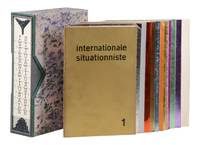
1969réf. 140949816Paris: Internationale Situationniste 1969. Near Fine. All 12 issues of Internationale Situationniste plus the supplement to Issue 11. All are first editions first printings except No. 2 which is the second printing from 1962. Text in French. Staple-bound in publisher's metallic wraps supplement in white wraps. Overall Near Fine with light rubbing and shelf wear musty odor. Chipping to metallic coating at Vol. 2 extremities writing impressions to back cover and foxing to terminals. Small bump to upper right corners of Vols. 7 8 and 10. Housed in a striking custom slipcase with a peg and bead Galton board design to the spine a reference to Guy Debord's famous drift theory which linked aimless movement through an urban landscape to the random trajectory of a pinball. A complete metal rainbow comprising the primary theses of the Situationist International. The small avant-garde Marxist group had tiny branches around the world but was centered in Paris and held its place at the forefront of politics philosophy and art from the Beat era to the tail end of the 1960s. Situationists were pivotal in the student revolts in Paris in May 1968. Their critique of society in all of its facets was so dense and nuanced it anticipated the revolutionaries of the next five decades and set the bar high for them perhaps impossibly so. But as one of the slogans spray-painted around Paris in May 1968 went "Be realistic. Demand the impossible. Internationale Situationniste unknown
1969réf. 140949816Paris: Internationale Situationniste 1969. Near Fine. All 12 issues of Internationale Situationniste plus the supplement to Issue 11. All are first editions first printings except No. 2 which is the second printing from 1962. Text in French. Staple-bound in publisher's metallic wraps supplement in white wraps. Overall Near Fine with light rubbing and shelf wear musty odor. Chipping to metallic coating at Vol. 2 extremities writing impressions to back cover and foxing to terminals. Small bump to upper right corners of Vols. 7 8 and 10. Housed in a striking custom slipcase with a peg and bead Galton board design to the spine a reference to Guy Debord's famous drift theory which linked aimless movement through an urban landscape to the random trajectory of a pinball. A complete metal rainbow comprising the primary theses of the Situationist International. The small avant-garde Marxist group had tiny branches around the world but was centered in Paris and held its place at the forefront of politics philosophy and art from the Beat era to the tail end of the 1960s. Situationists were pivotal in the student revolts in Paris in May 1968. Their critique of society in all of its facets was so dense and nuanced it anticipated the revolutionaries of the next five decades and set the bar high for them perhaps impossibly so. But as one of the slogans spray-painted around Paris in May 1968 went "Be realistic. Demand the impossible. Internationale Situationniste unknown books
1909réf. 1379Budapest: Privately published printed at Világosság könyvnyomda 1909. First edition. Limited numbered 1/250/300. The artist’s father’s copy. In original brown cardboard cover with blue title vignette printed in black bound with yellow ribbon. Illustrated title page one plate with ex-libris illustration eight lithographic plates and two text plates in Hungarian and French. Title vignette slightly rubbed. Front and rear cover somewhat sunned chipped at the edges. Small water stain at the upper right part of the cover. Small damage to the cover at the binding. Pages moderately dusted at the extremities with no effect on text or illustration. One page with two light stains. Overall in very good condition. First edition. Limited numbered 1/250/300. The artist’s father’s copy. In original brown cardboard cover with blue title vignette printed in black bound with yellow ribbon. Illustrated title page one plate with ex-libris illustration eight lithographic plates and two text plates in Hungarian and French. 12 leaves. 240 × 315 mm. Extremely scarce first edition of Attila Sassy’s portfolio of Art Nouveau erotic drawings. Copy of artist’s father. This portfolio created in the genre of Aubrey Beardsley is considered as one of the highlights of Hungarian Art Nouveau. It was first published in a very limited number of copies for Sassy’s closest friends and family. This copy was made exclusively for the artist’s father Ãrpád Sassy. The portfolio was reissued for the broader public nine years later still in very limited number. Attila Sassy 1880–1967 known under the pseudonym Aiglon is associated with the circles of modern artists in Paris and in Nagybánya the cradle of modern Hungarian painting. He became known mostly for his graphic works many of which are in the collection of the Museum of Applied Arts in Hungary. . [Privately published, printed at Világosság könyvnyomda] unknown