54 résultats
1939réf. 140948628New York: Sheridan House 1939. First Edition. Near Fine/Good. First edition first printing. Association copy signed by Art Young on the half-title page and warmly inscribed to Sara Bard Field her name misspelled with date Nov. 22 1939. ALS to Field dated Feb. 18 1941 laid in. xii 467 1 pp. Bound in publisher's red cloth stamped in gilt printed endpapers. Near Fine with light soiling to textblock edges light toning to endpapers and thumbing and erased bookseller inscriptions to half-title page. In a Good dust jacket with light soiling insect damage along upper and lower edges and rear flap fold. The autobiography of the prominent socialist cartoonist Art Young inscribed to a woman he names in his book with the correct spelling of her first name as one of "the beautiful women I have met who were active in progressive or radical affairs." Sara Bard Field was a suffragist poet and Christian socialist married to the writer and civil liberties activist Charles Erskine Scott Wood. Young refers to Wood in his letter to Field: "I am impelled to write you because of your good poem in the Marxist magazine New Masses. The foreword too interested me because I think of you both -- often I can picture our Grand Old Man looking heroically toward the sunset. Tell him I'm with him such a spirit will never die. We of the old guard: artists and writers recall his fine record of doing and daring when we meet here in New York and discourse." Young signs with his name and a small sketch of a sunset over water. He wrote his affectionate note two days before Wood's 89th birthday a touching tribute from one famous pacifist to another not long before their country would be plunged into total war -- the subject of the poem that prompted Young's letter. Sheridan House unknown books
réf. 2617Book. New-York: Collins & Co. 1811. 8vo early half-calf and pink paste-pape r boards. Pp. vi 7-112. Illus. Spine rubbed hinges worn but intact fine within. First edition by the distinguished physician and founder of Columbia Medical College who with his friend Robert Livingston was an early proponent of merino sheep in America and among the first to import them. A scarce book the second on its subject published in this country. Imprints 22298; Rink 16077. hardcover books
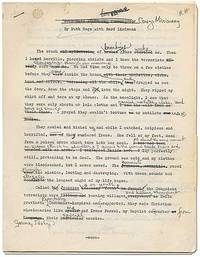
1964réf. 3245651964. Unbound. Near Fine. Typed manuscript. 16pp. Single sheets typed rectos only stapled at the corner with some wear to the corners a spot on the first sheet and oxidation marks on the rear near fine. The manuscript has extensive holograph corrections throughout including a new title and two stapled yellow sheets replacing paragraphs. The harrowing account of a missionary woman in the turbulent period after Congo's independence in 1960 later expanded by Hege into a full length book We Two Alone. Hege's co-missionary Irene Ferrell was executed by Communist-trained terrorists and Hege barely escaped the same fate. unknown books
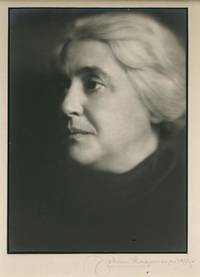
1927réf. 225931Carmel Calif 1927. Vintage gelatin silver print bust portrait in profile. Signed and dated in pencil "Johan Hagemeyer 1927" on the mount. 1 vols. 22 x 16.5 cm. 8-3/4 x 6-1/2 inches. Matted. Fine. Docketed on verso of mount in pencil "#3. Vintage gelatin silver print bust portrait in profile. Signed and dated in pencil "Johan Hagemeyer 1927" on the mount. 1 vols. 22 x 16.5 cm. 8-3/4 x 6-1/2 inches. Magnificent portrait of the great suffragist reformer activist free-thinker and poet Sara Bard Field 1882-1974. Field was also the passionate lover of the anarchist C.E.S. Wood and the couple lived together in a celebrated "free union" first in San Francisco then in Los Gatos "where they built a house . that became a gathering place for Bay area writers artists and political activists" American National Biography; and where the famous Bay area photographer Johan Hagemeyer 1884-1962 made this fine indelible portrait in the year her first volume of poems appeared THE PALE WOMAN. According to THE BANCROFT LIBRARY'S on line "Guide to the Johan Hagemeyer Photograph Collection": "In late 1916 just prior to Hagemeyer's return to California - and despite having had little photographic experience - Hagemeyer visited Stieglitz's 291 salon in New York City. The two developed an immediate rapport and the meeting proved to be decisive for Hagemeyer. "We talked" Hagemeyer later recalled "and he practically by way of speaking made me follow photography. I had already gone overboard for it" OHT 22. "Back in California Hagemeyer first apprenticed with a Berkeley-based commercial portrait photographer named McCullagh. Soon afterwards he moved south to Pasadena and in early 1918 met Edward Weston already by then an accomplished photographer based in Tropico now Glendale. The two took an immediate liking to each other and formed a friendship and working partnership that was of mutual benefit: Weston opened his home and studio to the upstart Hagemeyer and Hagemeyer introduced the relatively unschooled Weston to new worlds of intellectual and aesthetic learning. The two would have a profound influence on each others' artistic development for years to come. Arch. see essays by Lorenz and Schaefer "Hagemeyer's talent developed rapidly and by the early 1920s he was exhibiting his work in many important photographic salons and garnering much popular and critical acclaim. After moving to San Francisco at the end of World War One Hagemeyer soon discovered the intellectual and artistic colony of Carmel-by-the-Sea. In 1923 he established his first studio in Carmel and would remain anchored there for over 20 years. In 1924 he established the town's first art gallery - based out of his studio - where he exhibited the works of local painters sculptors and photographers and hosted very popular musical performances. Shortly thereafter Hagemeyer opened a second studio in San Francisco whose clientele could be rivaled by that of Carmel only during the smaller town's summer vacation season. In 1927 he was appointed staff photographer of the artistic/literary magazine The San Franciscan . unknown books