SCALIGER, Julius CaesarBiblio.com
904 risultati
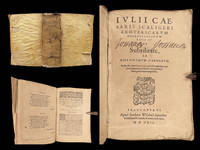
1592rif. 257391592 Scaliger Exotericarum Subtilitate Cardano Physics Kepler Leibniz Philosophy Julius Caesar Scaliger was a 16th-century Italian scholar who wrote a number of important orations and commentaries. Some of his most important works were criticisms of Aristotle and other classical authors. One of his best works was written at the end of his life – "Exotericarum exercitationum" a commentary on Gerolamo Cardano's "De Subtilitate". In this work Scaliger provided a new approach to natural philosophy and physics which was known to greatly influence philosophers such as Lipsius Francis Bacon Leibniz and Kepler. Item number: #25739 Price: $1500 SCALIGER Julius Caesar Exotericarum exercitationum liber XV. De subtilitate ad Hieronymum cardanum. In fine duo sunt indices Francofurti: Apud Andreae Wecheli heredes Claudium Marnium & Ioann. Aubrium 1592. Details: <!-- if !supportLists-->· <!--endif-->Collation: Complete with all pages <!-- if !supportLists-->o <!--endif-->16 1129 93 <!-- if !supportLists-->o <!--endif-->Several woodcut illustrations throughout <!-- if !supportLists-->· <!--endif-->Language: Latin <!-- if !supportLists-->· <!--endif-->Binding: Vellum; tight and secure <!-- if !supportLists-->· <!--endif-->Size: ~6.5in X 4.25in 16.5cm x 11cm <!-- if !supportLists-->· <!--endif-->VERY rare and desirable Our Guarantee: Very Fast. Very Safe. Free Shipping Worldwide. Customer satisfaction is our priority! Notify us with 7 days of receiving and we will offer a full refund without reservation! 25739 Photos available upon request. Andreae Wecheli heredes Claudium Marnium, & Ioann. Aubrium hardcover
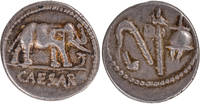
rif. 994Northern Italy: Mint Moving with Caesar 49BCE. Elephant right trampling serpent more standing than walking like the one plated by Crawford. “CAESAR” in exergue. 4 emblems on reverse though some including Crawford have said the elephant is the rev. side. Cr. Crawford RRC 443/1. BMC British Museum Catalog Gaul 27. Kestner 3516. Exf. The first silver Caesar and the first to bear his name a military issue originally struck at the mobile mint traveling with the legions for the sole purpose of paying Caesar’s troops on the eve of crossing the Rubicon and on the march to Rome that followed commencing the civil war and assuring that no further funds would be forthcoming from the Senate. And Sear says that this coin continued to be struck once Caesar arrived in Rome and had confiscated the reserve bullion stores left in the aerarium treasury by the fleeing Pompeians 15000 bars of gold 30000 bars of silver and 7500000 denarii in cash. It was however confined to military payment as the Roman mintiers struck different denarii for civilian commerce. This is a relatively common Caesar coin but it is not so common in this condition with sharp details as well as orange yellow and red iridescence. The majority of examples of this type belong to one of two artistic designs when considering the elephant the more realistic and accurate depiction this coin and one in which the elephant has short legs and an almost pig like appearance. Mint Moving with Caesar unknown
rif. 994Northern Italy: Mint Moving with Caesar 49BCE. Elephant right trampling serpent more standing than walking like the one plated by Crawford. “CAESAR” in exergue. 4 emblems on reverse though some including Crawford have said the elephant is the rev. side. Cr. Crawford RRC 443/1. BMC British Museum Catalog Gaul 27. Kestner 3516. Exf. The first silver Caesar and the first to bear his name a military issue originally struck at the mobile mint traveling with the legions for the sole purpose of paying Caesar’s troops on the eve of crossing the Rubicon and on the march to Rome that followed commencing the civil war and assuring that no further funds would be forthcoming from the Senate. And Sear says that this coin continued to be struck once Caesar arrived in Rome and had confiscated the reserve bullion stores left in the aerarium treasury by the fleeing Pompeians 15000 bars of gold 30000 bars of silver and 7500000 denarii in cash. It was however confined to military payment as the Roman mintiers struck different denarii for civilian commerce. This is a relatively common Caesar coin but it is not so common in this condition with sharp details as well as orange yellow and red iridescence. The majority of examples of this type belong to one of two artistic designs when considering the elephant the more realistic and accurate depiction this coin and one in which the elephant has short legs and an almost pig like appearance. Mint Moving with Caesar unknown books
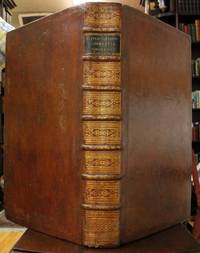
1712rif. B5212London: Jacob Tonson c. 1712. A handsome example of this magnificent work. . Edition: First Edition Binding: Contemporary full brown calf with blind tooled decorative border on top and bottom cover. Spine of raised bands in eight heavily gilt compartments with black label with gilt text on 2. Gilt dentelles on all edges of top and bottom cover. Pasted and free marbled endpapers. All edges speckled. Notes: Text is in Latin. Samuel Clarke's Caesar is generally regarded as one of the finest examples of 18th-century English publishing: "The most sumptuous classical work which this country has produced" Dibdin. Edward Harwood views on the book were also highly praiseworthy: "Although his Caesar achieved elegance mainly through profuse ornament the typography nonetheless has qualities of stateliness and dignity which set the book far above the usual product of the time and place.” During his lifetime Caesar was regarded as one of the best orators and prose authors in Latin — even Cicero spoke highly of Caesar's rhetoric and style. Only Caesar's war commentaries have survived. A few sentences from other works are quoted by other authors. Size: Large Folio 475x300mm. Illustration: Illustrated with an engraved title page frontis portrait of John Duke of Marlborough and of Julius Caesar 6 maps one hand-coloured in outline 78 plates and plans 55 of them double-page and/or folding by Huyberts and others all numbered from 1 to 87; numerous engraved initials and vignettes to text. The double page plate of the Bison is in this copy. References: Brunet I 1456; Dibdin Greek and Latin Classics I 361-3; Huntington Library Great Books in Great Editions 15. Pages: P. Endpapers. Blank. Engraved title page. Title page. Frontis portrait of Marlborough. Authors note. Frontis portrait of Caesar. Lectori. Fold out map. Fold out map. Title page. 3-560. Blank. Endpapers. Category: Book Europe Italy; Book Plate Books General; Book Military; Book Literature; Book Classics; Book Europe United Kingdom; Jacob Tonson hardcover