102 résultats
grand in-8°, 387 pages, broche, couverture. Tres bel exemplaire, non coupe / Very Good ++ [EN-2/3]
1993cm. 17 x 24, 432 pp. con 148 ill. n.t. b.n. e col. Accademia Nazionale Virgiliana di Scienze Lettere e Arti 1177 gr. 432 p.
1960pp. 387, cm 25x16, brossura.
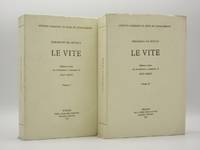
1970réf. 1231I163Firenze Florence: Nella Sede Dell'Istituto Palazzo Strozzi 1970-1976. 1st Edition . Paperback. Printed pages: lxvi 601; 731. Good Plus. 6 x 8.5 inches 15 x 22 cm. Complete two volume set. Card wraps. Light soiling and slight foxing to covers. Crease to front cover of volume I. Slight wear to edges of covers. Light foxing to page edges. Clean text throughout. Italian languange. Overall condition is Good Plus. Please Note: This is a heavy item and international postage will be more than the standard rate. Actual Royal Mail postage costs are: Europe £23.00; USA £33.00; Oceania £40.00; Rest of World £37.00. A postage supplement will be requested after the order has been placed. Size: 6 x 8.5 inches 15 x 22 cm. Nella Sede Dell'Istituto Palazzo Strozzi paperback
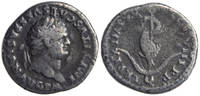
réf. 62084Rome AD 79-80. 18 mm. diameter. Dolphin entwined around anchor on one side and Draped bust of Tutus turning right on the other side. An excellent near mint specimen. 305 g. Obverse: IMP TITVS CAES VESPASIAN AVG P M laureate head rightReverse: TR P IX IMP XV COS VIII P P dolphin coiled around an anchor.RIC 26a RSC 309. Good specimen of the beautiful and rare coin that inspired Aldus Manutius' famous printer's device the dolphin-and-anchor the most famous logo in the history of book printing and the trademark of the Renaissance. The Aldus coin is the only book- or printing-related ancient coin in existence.Aldus Manutius the most famous printer of all times had been given a copy of the Titus coin with the dolphin-and-anchor logo on the verso as a gift by Pietro Bembo. He was extremely taken by the magnificent logo that in Roman times by Titus Vespasian had been used to illustrate the proverb "Festina lente" "make haste slowly" and was so inspired by it that he began using it as his printer's device at the very beginning of the 16th century. Before it appears as his printer's device for the first time he used it as an illustration in one of his most magnificent books Colonna's "Hypnerotomachia Poliphili" 1499.In his "Adagiorum Collectanea" the collection of classical proverbs that he kept revising throughout his life Erasmus Roterodamus had composed a lengthy essay on the "festina lente" proverb which intrigued him immensely. Erasmus traced the motto back to the emperor Titus Vespasian who had minted a coin with the emblem i.e. the present coin and had the rare opportunity to inspect that very coin - namely that which belonged to his printer Aldus Manutius who had been given it by the great Italian scholar Pietro Bembo. The second edition of Erasmus' "Adagiorum Collectanea" was published by Aldus in Venice in 1508 and Erasmus subsequently praises his printer to the skies in the course of explaining "festina lente". Erasmus explains the motto as such: "the circle as having neither beginning nor end represents eternity. The anchor which holds back and ties down the ship and binds it fast indicates slowness. The dolphin as the fastest and in its motions most agile of living creatures expresses speed. If then you skillfully connect these three they will make up some such principle as "Ever hasten slowly" and adds that by claiming it as his own recognizable and marketable emblem Aldus gave "fresh celebrity to the same device that was once approved by Vespasian". Not only is it "most familiar it is highly popular among all those everywhere in the world to whom sound learning is either familiar or dear." Erasmus seems to also suggest that the device had perhaps become too popular: "the city of Venice with its many claims to distinction has none the less become distinguished through the Aldine press so much so that any books shipped from Venice to foreign countries immediately find a readier market merely because they bear that city's imprint."And he might have been right. In fact the Aldine press was so successful and renowned and Aldus' printer's device as taken from the Titus Vespatian coin so incorporated a symbol of elegant correct printing and higher learning that it was imitated by printers all over Europe. By using the dolphin-and-anchor device other printers although much inferior would benefit from the authority and prestige of the Aldine press. In spite of Erasmus' attempts to make the public aware of this by praising the efforts of Aldus and opposing them to "those common printers who reckon one pitiful gold coin in the way of profit worth more than the whole realm of letters" publishers kept using the Aldus device for centuries. Aldus Manutius Grolier Club: no 129RIC 26a RSC 309. unknown
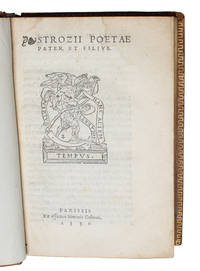
1530réf. 45363Parisiis Ex officina Simonis Colinaei 1530. 8vo. Bound in a very fine later full calf around 1700 profusely gilt spine titlelabel in leather with gilt lettering broad gilt borders on covers edges of covers gilt edges of leaves gilt. A very small nick to top of spine. 8 lvs. 1-2563 lvs. 1 blank. A small and very faint dampstain to upper inner margins of the first 8 lvs. Otherwise very clean throughout. A beautifull printed and wide-margined copy 17x115 cm. Scarce second edition of the "opera" of the poetical works of both father and son. Their collected opere were first published by Aldus Manutius in 1513 together with works of his son under the title Strozii poëtae pater et filius. The offered edition is copied from this Aldus-edition. They were both members of the famous Strozzi-family exiled from Florence.Adams S 1957. - Graesse VI: 512. hardcover
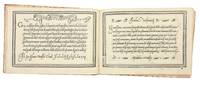
1580réf. 5531Venice: Alessandro Gardano 1580. THIRTEENTH EDITION first printed in 1548. All editions are rare. Hardcover. Fine. Bound in 18th c. paste-paper over boards with a slim red morocco spine light wear to boards and spine upper joint starting corners bumped. A very nice copy preserving earlier endpapers with a 17th c. ownership inscription and a calligraphic flourish. The volume is overall very fresh with just a very light stain to the inner margin of the first few leaves light soiling to the title with two early ownership inscriptions and last leaf some scattered marginal soiling and a few small stains on two leaves. Illustrated throughout with 101 pages of woodcut alphabets and writing examples. An influential writing manual by the Franciscan friar and writing master Vespasiano Amphiareo who practiced and taught calligraphy in Florence before moving to Venice around 1518. In the introduction to the first edition of his book 1548 he tells us that he had already been practicing his craft for thirty years. The book showcases Amphiareo's "bastarda del frate" script which combined elements of the mercantile and chancery hands to produce a more fluid form that would serve the needs of both the chancery scribe and the merchant as well as non-professional letter writers. As the author writes in his dedication to Prince Francesco Donato the Doge of Venice "Having through my own art and industry newly devised a form and a character of handwriting called bastarda which like a mystical body of nature partakes of many styles of writing it seems to me that it may be equally suited to the chancery scribe because it is somewhat elongated and graceful and useful to the merchant because it is cursive and swift; and therefore to every other sort of person." The book first appeared in 1548 and went through no fewer than 18 editions-with the addition of two new scripts after 1572-up to the year 1620. In addition to the writing examples which occupy 101 pages Amphiareo includes instructions for making black blue red and gold inks; as well as instructions for making and holding a pen. Amphiareo's was the first writing book in oblong format designed to better reflect the dimensions of writing paper rather than the vertical format used by printers. In his letter to the reader Amphiareo explains how he developed his script: "For many years I had it in mind to find a form of letters so easy and quick that both chancery clerks and merchants could write it readily and that would fully serve them for letters and for keeping books. This inclination of mine was greatly spurred on by men of outstanding intellect in Florence at the time when I was pursuing my usual occupation in that most illustrious city. "There a certain mercantile letter with heavy strokes was in use not very unlike the Venetian mercantile. Since it was difficult and slow both to write and to learn I set myself to study and sharpen my wits so much that I adapted certain bodies and certain strokes of the one and the other letter. In the judgment of men of understanding my idea turned out gracefully. This letter which I named the Bastarda del Frate was so welcome and so praised that in the said city of Florence fathers would not have their sons learn any other letter. This proved a success both for them and for me since they learned to write with the highest excellence and I drew no small profit from it. Because my intention is to share with all the world the skill that God has given me and I cannot be bodily in more than one place I have had this present little book engraved at incredible expense to myself." In addition to the bastarda chancery and mercantile hands Amphiareo includes "a number of gothic hands: bollatica francesca rognosa etc. all in appropriate texts; a number of alphabets: ornate roman capitals signed in interlaced ciphers of the sort expounded by Palatino followed by a set of decorated roman capitals made up of twisted boughs or logs; a handsome set of gothic entrelac initials two to the page decorated with putti heads and the like; a decorated gothic set also two to the page; a set of simplified geometrically constructed minuscules round gothic based on Fanti's; and roman inscriptional outline capitals against horizontally ruled squares. "Amphiareo's choice of format was also a significant change. The books of his predecessors from 1514 until his own had all been vertical octavos apart from Tagliente's one perhaps abortive experiment in this format in 1525. Their layouts were modeled on book practice. Amphiareo's format showed off to best advantage his layouts inspired not by book pages but by epistolary practice. The letter of his day was generally written on a wide short sheet of paper or vellum folded after writing to produce an envelope - somewhat on the order of today's airletter form turned sideways. Amphiareo's pages suggest this shape quite successfully."Morison "On Some Italian Scripts of the XV and XVI Centuries" in "Selected essays on the history of letter-forms in manuscript and print" Vol. 2 Ch.8 p. 89 ff. Alessandro Gardano hardcover
réf. H1616Paris.Ducher; bzw. Dresden Gilbers 1877. Folio. 12 S. und 51 Lichtdruck-Tafeln. Original-Halbleinenmappe mit bedrucktem Original-Vorderdeckel leicht berieben und beschabt Tafeln etwas gebräunt 3 Tafeln mit Randläsuren gutes Exemplar. unknown
réf. 1016966954.Ghardcover. Good. Access codes and supplements are not guaranteed with used items. May be an ex-library book. hardcover
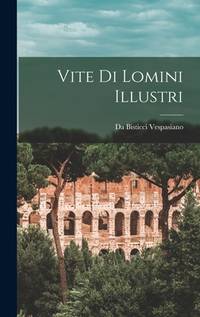
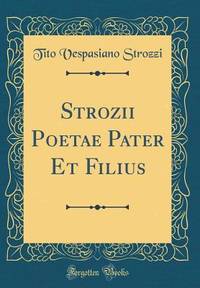
réf. ria9781017069068_inpHardcover. New. New Book; Fast Shipping from UK; Not signed; Not First Edition; This work has been selected by scholars as being culturally important and is part of the knowledge base of civilization as we know it.This work is in the "public domain in the United States of America and possibly other nations. Withi hardcover
réf. ria9781017570755_inpHardcover. New. New Book; Fast Shipping from UK; Not signed; Not First Edition; This work has been selected by scholars as being culturally important and is part of the knowledge base of civilization as we know it.This work is in the "public domain in the United States of America and possibly other nations. Withi hardcover
1968réf. 476726Fano Italy : Typis Paulinis 1968. First Edition. Softcover. Very good paperback copy; wrapper edges slightly worn and sun-toned. Remains well-preserved overall; internally tight bright clean and especially sharp-cornered. This copy from a limited edition of 160. Physical description; 32 pages ; 25 cm. Notes; Preface in English; poems in Latin. Subjects; Strozzi Tito Vespasiano 1425-1505 – Criticism and interpretation. Latin poetry Medieval and modern – 15th century. Humanism – Italy. Fano [Italy] : Typis Paulinis paperback
1977réf. 347046München: Fink 1977. 1st Edition. Hardcover. Very good copy in the original title-blocked cloth. Slight suggestion only of dust-dulling to the spine bands and panel edges. Remains particularly well-preserved overall; tight bright clean and strong. Physical description: 414 pages: 2 facsimiles; 25 cm. Subjects: Borso d'Este Duke of Ferrara Modena and Reggio 1413-1471; Poetry. Borso d'Este Duke of Ferrara Modena and Reggio b.1413 Poetry. Epic poetry Latin Medieval and modern Italy. Renaissance Italy; Poetry. Epic poetry Latin Medieval and modern. Renaissance Poetry. München: Fink hardcover
1964réf. 98104New York : Cooper Square Publishers 1964. First Edition. Hardback. Three fine copies in the original gilt-blocked cloth. All remain particularly well-preserved overall; tight bright clean and especially sharp-cornered. Still in the Publisher's protective stiff-card box. ; 0 pages; Complete in 3 volumes 2 volumes and a checklist volume . Subjects: Frontier and pioneer life - United States - Bibliography. America - Discovery and exploration - Bibliography. New York : Cooper Square Publishers hardcover
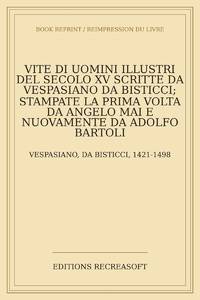
2026réf. LRB1014693Paris: Editions Recreasoft 2026 Lingua: Italiano. Circa 608 pagine. Italiano : Ristampa su richiesta. Edizione originale : 1859. Raccolta biografica dedicata agli uomini illustri del secolo XV opera attribuita a Vespasiano da Bisticci fonte preziosa per la storia culturale e umanistica del Rinascimento italiano. Il volume interessa sia per il contenuto storico sia per il valore documentario della testimonianza su figure eminenti ambienti intellettuali e pratiche di scrittura del Quattrocento. Immagini del libro non contrattuali English : Print-on-demand reprint. Original edition : 1859. Biographical collection devoted to eminent men of the fifteenth century attributed to Vespasiano da Bisticci and valued as an important source for the cultural and humanistic history of the Italian Renaissance. The volume is of interest both for its historical content and for its documentary value in relation to notable figures intellectual circles and writing practices of the fifteenth century. Book images are non-contractual. Editions Recreasoft. Softcover. New. Editions Recreasoft paperback
réf. 45477761like new. unknown
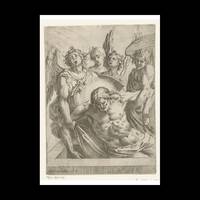
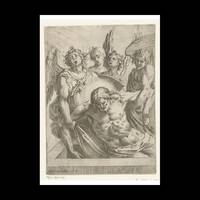
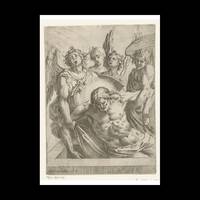
réf. 3559358Contentum Ltd. Loose sheet. New. High-quality art print based on an original work from the Rijksmuseum. Created in the 16th century 1592. Professionally printed on premium fine-art paper Museum Etching museum quality in size A3. The artwork is printed with a white border museum-style presentation. Contentum Ltd. unknown
réf. 3559360Contentum Ltd. Loose sheet. New. High-quality art print based on an original work from the Rijksmuseum. Created in the 16th century 1592. Professionally printed on premium fine-art paper Photo Rag 308 premium quality in size A2. The artwork is printed with a white border museum-style presentation. Contentum Ltd. unknown
réf. 3559359Contentum Ltd. Loose sheet. New. High-quality art print based on an original work from the Rijksmuseum. Created in the 16th century 1592. Professionally printed on premium fine-art paper Photo Rag Bright White in size A2. The artwork is printed with a white border museum-style presentation. Contentum Ltd. unknown
réf. 3559361Contentum Ltd. Loose sheet. New. High-quality art print based on an original work from the Rijksmuseum. Created in the 16th century 1592. Professionally printed on premium fine-art paper Museum Etching museum quality in size A2. The artwork is printed with a white border museum-style presentation. Contentum Ltd. unknown
réf. 1915035Contentum Ltd. Loose sheet. New. High-quality art print based on an original work from the Rijksmuseum. Created in the 16th century 1592. Professionally printed on premium fine-art paper Museum Etching museum quality in size A3. The artwork is printed with a white border museum-style presentation. Contentum Ltd. unknown
réf. 1915038Contentum Ltd. Loose sheet. New. High-quality art print based on an original work from the Rijksmuseum. Created in the 16th century 1592. Professionally printed on premium fine-art paper Museum Etching museum quality in size A2. The artwork is printed with a white border museum-style presentation. Contentum Ltd. unknown
réf. 1915037Contentum Ltd. Loose sheet. New. High-quality art print based on an original work from the Rijksmuseum. Created in the 16th century 1592. Professionally printed on premium fine-art paper Photo Rag Bright White premium quality in size A2. The artwork is printed with a white border museum-style presentation. Contentum Ltd. unknown
réf. 1915036Contentum Ltd. Loose sheet. New. High-quality art print based on an original work from the Rijksmuseum. Created in the 16th century 1592. Professionally printed on premium fine-art paper Photo Matt Fibre in size A2. The artwork is printed with a white border museum-style presentation. Contentum Ltd. unknown
réf. 1391854543.Ghardcover. Good. Access codes and supplements are not guaranteed with used items. May be an ex-library book. hardcover