274 resultados
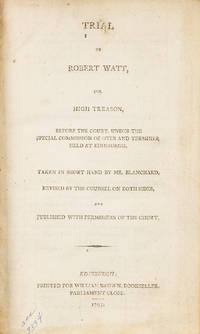
1795ref. 822471795. Edinburgh: Printed for William Brown 1795. Edinburgh: Printed for William Brown 1795. An Ill-Founded Plot to Establish an Independent Scotland Trial. Watt Robert c.1761-1794 Defendant. Trial of Robert Watt For High Treason Before the Court Under the Special Commission of Oyer and Terminer Held at Edinburgh. Taken in Short Hand by Mr. Blanchard Revised by the Counsel on Both Sides And Published with the Permission of the Court. Edinburgh: Printed for William Brown 1795. ii 364 pp. Folding plate illustrating pikes found in Watt's possession. Octavo 8" x 4-3/4". Contemporary three-quarter calf over paper-covered boards gilt rules to boards along calf blind ornaments and gilt fillets and title to spine speckled edges. Light rubbing and a few minor spots and smudges to boards moderate rubbing to extremities corners bumped and moderately worn. Moderate toning to interior negligible light foxing and tiny smudges and stains to preliminaries plate final leaf of text and rear endleaves. A handsome copy. $450. Only edition. Watt a wine merchant and political radical was the architect of a somewhat confused plot to establish Scotland as an independent country. After a search of his house turned up a number of pikes and the type for a seditious handbill he was arrested and tried for treason. A co-conspirator was pardoned but Watt was not so lucky. He was convicted and sentenced to be hanged and beheaded despite the jury's recommendation of mercy. The sentence reflected the court's opinion of the severity of Watt's crime. It was also intended to be a warning to other radicals. English Short-Title Catalogue N013806. unknown books
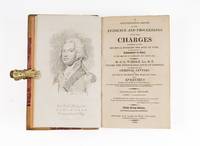
1809ref. 822571809. One of the Great Scandals of Georgian England Trial. Wardle Gwyllym Lloyd 1762-1833 Reporter. Frederick Augustus Prince Duke of York and Albany 1763-1827 Defendant. A Circumstantial Report of the Evidence and Proceedings Upon the Charges Preferred Against His Royal Highness the Duke of York in the Capacity of Commander in Chief In the Months of February and March 1809. Before the House of Commons. Including the Whole of the Original Letters of His Royal Highness the Duke of York; The Speeches Correctly Taken in Full Of the Various Members; With All the Other Documents Produced in the Course of the Investigation And the Decision of the House of Commons Upon This Very Important Subject. Illustrated by Portraits. Albion Press Edition. London: Printed for James Cundee Ivy-Lane 1809. viii 3-700 pp. Stipple-engraved frontispiece 12 stipple-engraved plates. Complete. Octavo 8-1/4" x 5". Nineteenth-century three-quarter calf over marbled boards raised bands gilt fillets and red and black lettering pieces to spine edges colored yellow. Negligible light rubbing and a few minor scuffs to boards moderate rubbing to extremities corners bumped and lightly worn small bookseller stamp Lawrance & Hill London to verso of front free endpaper. Moderate toning to interior light foxing in places finger smudges to a few leaves small hale to leaf 3E2 pp. 403-404 with minor loss to text. $350. Only edition. This trial was one of the great scandals of Georgian England. In 1806 it was discovered that Mary Anne Clarke the mistress of Prince Frederick Duke of York and Albany 1763-1827 commander-in-chief and the second son of King George III was selling commissions for personal profit presumably with Frederick's cooperation. Investigated by Parliament Frederick was exonerated but he resigned his post however because a large minority voted against him. He was reinstated two years later. Clarke was forced to leave London. She was convicted for libel in 1813 and served a nine-month prison sentence. She then moved to France and spent the rest of her life there. Lloyd a former military officer and the reporter of this account initiated the case as a Member of Parliament. British Museum Catalogue Compact Edition 26:691. unknown books
1843ref. 822711843. New York: Tribune Office 160 Nassau Street 1843. New York: Tribune Office 160 Nassau Street 1843. The Only Mutiny Plot That Occurred on a U.S. Navy Ship Trial. MacKenzie Alexander Slidell 1803-1848 Defendant. Case of the Somers' Mutiny. Defence of Alexander Slidell Mackenzie Commander of the U.S. Brig Somers Before the Court Martial Held at the Navy Yard Brooklyn. New York: Tribune Office 160 Nassau Street 1843. 30 11 pp. Octavo 9-1/4" x 6". Stab-stitched pamphlet in printed wrappers. Light soiling a few minor stains to exterior spine ends abraded faint traces of erased penciled annotation to front wrapper. Light toning to interior light foxing to p. ii. A well-preserved copy. $450. First and only edition. This trial concerns the only time a mutiny plot was discovered on a U.S. Navy ship. "Alexander Slidell Mackenzie was a career naval officer and author of many books. In 1842 while he was commander of the brig Somers Mackenzie executed three members of his crew for allegedly plotting a mutiny. The three Philip Spencer Samuel Cromwell and Elisha Small were executed without a hearing. The incident aroused much public interest and criticism since Spencer was the son of the secretary of war John C. Spencer. Although a court of inquiry cleared Mackenzie the secretary of the navy charged him with murder. A court martial held at Mackenzie's request found him innocent" Cohen. Because it was the first and as time would show only attempted mutiny in the history of the U.S. Navy this case attracted a fair amount of subsequent attention most recently Philip McFarland's 1985 account Sea Dangers: The Affair of the Somers. Cohen Bibliography of Early American Law 13563. unknown books
1918ref. 823221918. Chicago: General Defense Committee 1918. Chicago: General Defense Committee 1918. An Important Trial for Organized Labor Trial. Haywood William 1869-1928. Evidence and Cross-Examination of William D. Haywood in the Case of the U.S.A. vs. Wm. D. Haywood et al. Chicago: General Defense Committee 1918. 312 pp. Portrait. Stapled in stiff printed wrappers. Light soiling and faint creasing to wrappers owner signature Olga S. Halsey and small tear to head of front wrapper faint stain to rear wrapper tearing to spine. Light toning partial crack in text block after title page all leaves secure internally clean. $450. The Haywood trial concerned the murder of Frank R. Steunenberg who had called in federal troops to break miners' strikes as former governor of Idaho. Harry Orchard a former member of the Western Federation of Miners confessed to the crime but when threatened with hanging claimed that he had committed the murder on the orders of senior members of WFM leadership including William "Big Bill" Haywood. Haywood and two other men implicated in the plot were extradited to Idaho from Colorado and tried for murder. The trial became a flashpoint for organized labor. Famed American attorney Clarence Darrow led Haywood's defense successfully undermining Orchard's character and securing an acquittal after one of the passionate closing summaries that would become his trademark as an attorney. Olga Spencer Halsey c.1889-1970 the probable former owner of this item was a social scientist and researcher for the American Association for Labor Legislation. A passionate advocate of health insurance reform she drafted some of the first health insurance legislation in the U.S. unknown books
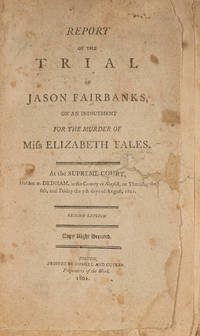
1801ref. 822491801. McDade 297: One of the Most Sensational American Trials of the Early 1800s Trial. Fairbanks Jason Defendant. Report of the Trial of Jason Fairbanks On an Indictment for the Murder of Miss Elizabeth Fales. At the Supreme Court Holden at Dedham in the County of Norfolk On Thursday the 6th And Friday the 7th Days of August 1801. Boston: Printed by Russell and Cutler 1801. 87 pp. Octavo 8-1/2" x 5-1/2". Stab-stitched pamphlet with untrimmed edges bound into later cloth gilt title and fillets to spine. Light rubbing to extremities moderate browning and light foxing to interior corner folds and small chips to edges of a few leaves tears with early repairs to title page and following leaf. $350. Second edition one of four editions all issued in 1801. The second third and fourth editions have a history of the case and an eye-witness account of Fairbanks's execution. This was one of the most sensational American trials of the early 1800s. The parents of Elizabeth Fales objected to Fairbanks's suit and he in revenge or frustration slit her throat in a field attempting at the same time to commit suicide. When apprehended he claimed that she tried to kill herself. After his conviction Fairbanks escaped custody and almost reached Canada but was apprehended in Vermont. He was hanged a short time later. Cohen Bibliography of Early American Law 12550. McDade The Annals of Murder 297. unknown books
1818ref. 825711818. A Near-Fatal Response to Negative Criticism Trial. Hagerman Henry B. 1786-1853 Defendant. Bacon David Reporter. Trial of Henry B. Hagerman Esq. On an Indictment for an Assault and Battery With Intent to Murder Committed on William Coleman Esq. Editor of the N.Y. Evening Post. Taken in Short Hand by David Bacon. New York: Printed by Oram and Mott 1818. 68 pp. Octavo 8-1/4" x 5-1/4". Disbound stab-stitched pamphlet. Moderate toning light foxing to most of text small embossed library stamp to final leaf chips to both of its outside corners small de-accession ink stamp of the Long Island Historical Society to title page small chip to its lower outside corner. An appealing copy of an uncommon title. $750. Only edition. Coleman 1766-1829 was the editor of Alexander Hamilton's newspaper The New York Evening Post now the New York Post which opposed to New York's Democratic Party. Shortly after he published a highly critical article about Hagerman a prominent Democrat and state official he was surprised and viciously beaten by Hagerman on a city street. Coleman's recovery took weeks and he suffered bouts of paralysis for the rest of his life. Hagerman pleaded guilty to assault and battery and not guilty to the charge of attempted murder. He was fined and acquitted on the murder charge. In a later civil suit he was ordered to pay Coleman $4000. a notably large award for that time. OCLC locates 8 copies in law libraries Baylor Columbia Harvard Library of Congress LA County Law Library Social Law University of Minnesota U.S. Supreme Court. Cohen Bibliography of Early American Law 13829. unknown books
1792ref. 812901792. An Important 1792 Trial Related to an Election From the Library of Anne Renier Trial. Tooke John Horne 1736-1812 Defendant. Fox Charles James 1749-1806 Plaintiff. Johnson Joseph 1738-1809 Publisher. Proceedings in an Action for Debt Between the Right Honorable Charles James Fox Plaintiff And John Horne Tooke Esq. Defendant. Published by the Defendant. London: Printed for and Sold by the Booksellers 1792. 39 1 pp. Octavo 8-1/4" x 5-1/4". Disbound stab-stitched pamphlet. Moderate toning light foxing light rubbing to extremities final two leaves partially detached owner name "Renier" to verso of title page owner initials "AR" to verso of final leaf. $250. First edition one of two issues from 1792. This was a legally and politically important trial. Tooke one of the great English radicals of the period opposed Fox in the Westminster elections of 1790. Defeated by a large majority he petitioned the House of Commons for redress based on allegations of riotous conduct by the electors. The action was declared frivolous and Tooke was sued by Fox for 198 damage. To make matters worse under the 1789 law against vexatious suits Tooke was held liable as well for costs. The trial heard before Lord Kenyon gave Tooke a platform from which he condemned Parliamentary corruption and spoke eloquently against the severe limitations imposed upon juries in this and other trials of a similar nature--from a legal point of view perhaps the most interesting feature of the trial. Counsel for Fox was Thomas Erskine. Despite its topicality this pamphlet had an unusually long history; it was re-issued in 1793 1812 1815 and 1819. This copy belonged to Anne Renier 1911-1988. She and her husband Fernand Gabriel Renier 1905-1988 were important collectors of popular books pamphlets and ephemera. English Short-Title Catalogue N11983. unknown books
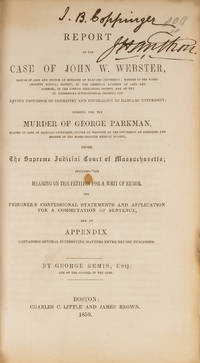
1850ref. 801331850. America's Classic Murder" Trial. Bemis George. Webster John White 1793-1850 Defendant. Report of the Case of John W. Webster Master of Arts and Doctor of Medicine of Harvard University . Indicted for the Murder of George Parkman Master of Arts of Harvard University Doctor of Medicine of the University of Aberdeen And Member of the Massachusetts Medical Society Before The Supreme Judicial Court of Massachusetts; Including the Hearing on the Petition for a Writ of Error The Prisoner's Confessional Statements and Application for a Commutation of Sentence And an Appendix Containing Several Interesting Matters Never Before Published. Boston: Charles C. Little and James Brown 1850. xii 628 pp. With a tissue-guarded frontispiece. Illustrated. Octavo 9-1/4" x 5-1/4". Later library cloth red and black lettering pieces to spine endpapers renewed cloth hinges. Light soiling and shelfwear to exterior lettering pieces abraded hinges starting small ink stamp William C. Schroeder to front free endpaper which has a small clean tear to its upper gutter. Toning to interior light soiling and tiny faint stains in a few places owner signature of J.H. Anthon dated 1858 to front endleaf and title page along with owner signature of J.B. Coppinger pencil underling and brief annotations to several leaves annotations between pp. 469-498. $85. First edition. As McDade notes "The murder in the Harvard Medical School of Dr. George Parkman a prominent Bostonian and Harvard Alumnus by Professor John W. Webster was in the words of Edmund Pearson 'America's classic murder.'" The present account is "the basic book on the case and contains all the evidence." A two-volume edition appeared the same year and the work was reprinted in 1879. The J.H. Anthon who owned this copy was likely John Hone Anthon 1832-1874 a New York attorney and the son of John Anthon an important American jurist and a founder of the New York Law Institute. J.B. Coppinger may have been John B. Coppinger a first lieutenant and adjutant in the 83d New York Infantry during the Civil War. The pencil annotations which provide brief but often lively commentary do not appear to be in either's hand. McDade The Annals of Murder 1060. unknown books
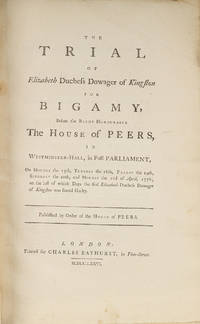
1776ref. 802001776. London: Charles Bathurst 1776. London: Charles Bathurst 1776. In Original Wrappers Trial. Kingston Elizabeth Chudleigh Hervey Duchess of 1720-1788 Defendant. The Trial of Elizabeth Duchess Dowager of Kingston for Bigamy Before the Right Honourable the House of Peers In Westminster-Hall In Full-Parliament On Monday the 15th Tuesday the 16th Friday the 19th Saturday the 20th and Monday the 22d of April 1776; On the Last of Which Days the Said Elizabeth Duchess Dowager of Kingston was Found Guilty. Published by Order of the House of Peers. London: Printed for Charles Bathurst 1776. iv 176 pp. Title page preceded by imprimatur leaf. Folio 15" x 10"; 38 x 25.4 cm. Original wrappers untrimmed edges. Light soiling to exterior light wear to spine ends moderate soiling to edges light toning to interior. A very good copy uncommon in wrappers. $450. Only edition. When she determined to marry the Duke of Kingston Elizabeth feared the scandal of divorce from her first husband Augustus Hervey later Earl of Bristol who wanted a divorce so she instituted a suit of jactitation against him. His negative response ignored she took an oath that she was unmarried and the court so declared her. She married the Duke of Kingston in 1769 and he died in 1770 and left her a substantial estate on the condition that she remain a widow. The duke's nephew Mr. Evelyn Meadow brought suit against her for bigamy shortly after the duke's death while she was traveling in Italy. She returned to England to stand trial. Found guilty she would have been "burned on the hand" but she claimed the privilege of her peerage which served to exempt her from corporal punishment. She continued a life of travel and adventure until her sudden death in Paris in 1788. Famous because of this trial Kingston was often depicted directly or indirectly in popular and serious literature. She is believed to have been the inspiration William Makepeace Thackeray's character of Beatrix Esmond Baroness Bernstein in The History of Henry Esmond and The Virginians. Dictionary of National Biography IX:730. English Short-Title Catalogue T92941. unknown books
1795ref. 801421795. Edinburgh: Printed by C. Denovan 1795. Edinburgh: Printed by C. Denovan 1795. A Landmark Case with the First Use of an Insanity Defense in Scotland Trial. Kinloch Sir Archibald Gordon c.1749-1800 Defendant. The Trial of Sir Archibald Gordon Kinloch Of Gilmerton Bart. For the Murder of Sir Francis Kinloch Bart. His Brother-German. Before the High Court of Justiciary on Monday June 29 1795. Taken in Short Hand--And Carefully Revised by the Counsel. Edinburgh: Printed by C. Denovan 1795. vi 161 pp. With a half-title. Octavo 8-1/4" x 5"; 21 x 12.7 cm. Disbound stab-stitched pamphlet. Light soiling to exterior corner folds to lower outside corners of first few leaves. Moderate toning light foxing to a few leaves. $150. Only edition. Sir Francis was murdered in his home by his brother Sir Archibald. Although Archibald was convicted he was released into the care of his family rather than sentenced to death because he was judged to be insane. This was the first time an insanity defense was presented in a Scottish court and one of the very first trials in Great Britain to consider the criminal liability of the insane. Catalogue of the Library of the Harvard Law School 1909 II:1121. unknown books
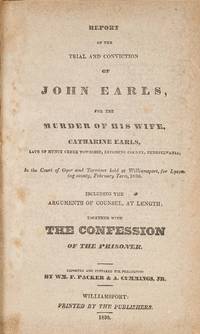
1836ref. 802841836. A Poisoning in Pennsylvania: McDade 280 Trial. Earls John 1802-1836 Defendant. Packer William F. Reporter Editor. Cummings Alexander Jr. Reporter Editor. Report of the Trial and Conviction of John Earls For the Murder of His Wife Catharine Earls Late of Muncy Creek Township Lycoming County Pennsylvania; In the Court of Oyer and Terminer Held at Williamsport For Lycoming County February Term 1836. Including the Arguments of Counsel At Length; Together with the Confession of the Prisoner. Williamsport PA: Printed by the Publishers Packer and Cummings 1836. iv 188 pp. Octavo 8-1/2" x 5-1/4". Contemporary quarter sheep over paper-covered boards lettering piece and blind fillets to spine. Light soiling spotting and a few minor stains to boards joints cracked wear to spine ends edges of lettering piece and fore-edges of boards edges corners bumped front hinge partially cracked. Moderate toning to interior light browning in places light foxing to a few leaves "G.W. Stout/ from Elisha Allis/ Oct: 5 1870" to front pastedown. $500. Only edition. Earls murdered his wife with poison and this trial account discusses poisons at length. McDade notes: "Earls' motive was the usual other-woman. He gave as his reason for purchasing the poison 'to kill mink and muskrats' an imaginative variant. He poisoned his wife the day after she gave birth." "G.W. Stout" is likely George W. Stout 1830-1906 a prominent Easton Pennsylvania lawyer. The giver is likely Elisha Allis 1832-1893 also a resident of Easton. His wife Sarah was the daughter of William F. Packer 1807-1870 one of the reporters of our account who later became the governor of Pennsylvania. McDade The Annals of Murder 280. unknown books
1832ref. 802881832. Philadelphia: G.W. Mentz & Son 1832. Philadelphia: G.W. Mentz & Son 1832. "The True Character of the Spanish Adventurer": McDade 169 Trial. Chapman Lucretia 1788-1841 Defendant. Du Bois William E. 1810-1881 Compiler. Trial of Lucretia Chapman Otherwise Called Lucretia Espos y Mina Who was Jointly Indicted with Lino Amalia Espos y Mina For the Murder of William Chapman Esq. In the Court of Oyer and Terminer Held at Doylestown for Bucks December Term 1831 Continued to February Term 1832. Philadelphia: G.W. Mentz & Son 1832. 213; 11 pp. Final section 11 pp. has the drop-head title Supplement to the Trial of Mrs. Chapman Published by George W. Mentz & Son Philadelphia. Octavo 9" x 6". Contemporary sheep blind rules to boards blind fillets to spine lettering piece lacking. Light rubbing and a few scuffs to boards front board detached rear board partially detached but secure moderate rubbing to extremities spine abraded spine ends and corners worn early owner bookplate Owen Stover to front pastedown. Moderate toning and light foxing to interior offsetting to margins of endleaves annotations in early hand to rear free endpaper. $350. First and only edition with the Supplement that as noted by Cohen was not included in all copies. Lucretia Chapman began an affair with Lino Amalia Espos y Mina a Spanish boarder who claimed to be the son of the governor of California. They poisoned Chapman's husband with arsenic moved to New York and married. McDade notes: "Almost immediately the true character of the Spanish adventurer came out with the disappearance of the family silver and other obvious signs of his chicanery. Other swindles drew the attention of the Philadelphia constable to him and once suspicion was directed to the curious couple the evidence mounted rapidly. . In separate trials she was acquitted while he was convicted and executed. It is difficult to tell whether they had acted in concert in the murder; at least the jury gave her the benefit of the doubt." The former owner of our copy was likely Owen Stover 1801-1878 an attorney from Chester County Pennsylvania. Cohen Bibliography of Early American Law 12416. McDade The Annals of Murder 169. unknown books
1822ref. 802081822. Imprisoned for Criticizing the Court of Session Trial. Hay John. A Narrative of Procedure Before the Court of Session And Circumstances Connected Therewith In the Trial of John Hay Who was Prosecuted at the Instance of the Lord Advocate of Scotland And Without the Verdict of a Jury Sentenced to Four Months Imprisonment By the Judges of the Court of Session. Edinburgh: Printed by D. Webster and Son for John Hay 1822. viii 123 115 pp. Octavo 8-3/4" x 5". Later three-quarter sheep over marbled boards lettering piece and gilt date to spine edges untrimmed marbled renewed endpapers. Moderate rubbing and light wear to extremities corners bumped and worn small bookseller ticket and later bookplate Geoffrey G. Briggs to front pastedown. Moderate toning to interior occasional light foxing and soiling. $150. Only edition. Hay an Edinburgh merchant publicly alleged that the Court of Session had erred in settling his father-in-law's estate. The criticisms led to contempt of court charges. Hay was denied a jury trial and his case was decided by the judges of the Court of Session who ruled against him. He then published this account of his prosecution and trial. Our copy was owned by Sir Geoffrey Briggs 1914-1993 an English lawyer and judge who served as Chief Justice of Hong Kong and Brunei. Catalogue of the Library of the Harvard Law School 1909 II:1096. unknown books
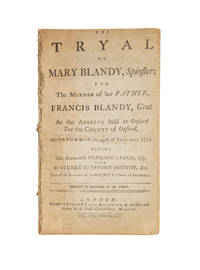
1752ref. 803961752. The "Love Philter" was Arsenic Trial. Blandy Mary 1720-1752 Defendant. The Tryal of Mary Blandy Spinster; For the Murder of Her Father Francis Blandy Gent. At the Assizes Held at Oxford for the County of Oxford On Saturday the 29th of February 1752 Before the Honourable Heneague Legge Esq; and Sir Sydney Stafford Smythe Knt. Two of the Barons of His Majesty's Court of Exchequer. Published by Permission of the Judges. London: Printed for John and James Rivington At the Bible and Crown In St. Paul's Church Yard 1752. ii 46 pp. Folio 11-3/4" x 7". Disbound stab-stitched pamphlet. Moderate toning margins trimmed closely with no loss to text. Light soiling to exterior clean tear from a fold near center of lower half of text block early repairs to inner margins of several leaves a few minor tears and chips to edges of title page chips a few tears with minor loss to text to final leaf. $250. Only edition one of three issues the others an octavo issued by Rivington and an octavo issued in Dublin by Faulkner. Blandy was the daughter of a prosperous lawyer. Her father Francis advertised a large dowry of 10000 which attracted many suitors including one who captivated her Captain William Henry Cranstoun the son of a Scottish nobleman. Francis learned later that he was married and a father. Confronted with these facts by Francis Cranstoun claimed his marriage was invalid and made several attempts he claimed to have it annulled. Over time Francis became suspicious about Cranstoun's motives. Sensing danger Cranstoun gave Mary a "love philtre" and told her to mix it into one of her father's meals. He said it would change his behavior towards him. It was actually arsenic. When Mary realized what she had done she foolishly burned Cranstoun's letters and discarded the rest of the arsenic. Cranstoun fled to France. Mary was tried and sentenced to death by hanging. This was a sensational trial and it was covered extensively by the press. It also generated a secondary literature that included several contributions written by Mary such as "Miss Mary Blandy's Own Account of the Affair between Her and Mr. Cranstoun." As indicated by her last request to the execution officials she remained a proper middle-class lady to the end. "For the sake of decency gentlemen" she pleaded "don't hang. unknown books
1686ref. 806181686. London: Printed for Dorman Newman 1686. London: Printed for Dorman Newman 1686. A Member of a Plot to Depose James II Trial. Warrington Henry Booth Earl of 1652-1694 Defendant. The Tryal of Henry Baron Delamere for High-Treason In Westminster-Hall The 14th Day of January 1685. Before the Right Honourable George Lord Jeffreys Baron of Wemm Lord High Chancellour of England Constituted Lord High Steward on that Occasion. On Which Day After Full Hearing The Lord Delamere was Acquitted from All Matters Laid to His Charge. London: Printed for Dorman Newman 1686. iv 87 1 pp. With imprimatur leaf. Folio 12" x 7-1/2". Disbound stab-stitched pamphlet spine discreetly reinforced with archival tissue. Moderate toning faint dampstaining to top-edge not affecting text occasional light foxing light soiling and a few faint stains to exterior. $150. Only edition. Warrington was indicted as a participant in Monmouth's rebellion an attempt by the Duke of Monmouth an illegitimate son of Charles II to claim the throne and depose James II. The special charge against Delamere "was that at the time of Monmouth's rebellion he had gone secretly to Cheshire with the view of inciting a rising in the north of England." While it is nearly certain that Delamere sympathized with Monmouth's designs he was able to explain his journey as a wish to visit a favorite child who was dangerously ill. "Moreover Thomas Saxon the only witness who would positively swear to the correspondence of Delamere and Monmouth so hopelessly contradicted himself that he was afterwards convicted of perjury" DNB. Dictionary of National Biography DNB II:842-844. English Short-Title Catalogue R23568. unknown books
1681ref. 806151681. Treason Trial of a Founding Member of the Whig Party Trial. Shaftesbury Anthony Ashley Cooper Earl of 1621-1683. The Proceedings at the Sessions House in the Old-Baily London on Thursday the 24th Day of November 1681. Before His Majesties Commissioners of Oyer and Terminer Upon the Bill of Indictment for High-Treason Against Anthony Earl of Shaftsbury. Published by His Majestie Special Command. London: Printed for Samuel Mearne and John Baker 1681. iv 48 pp. With initial blank leaf. Folio 11" x 6-3/4". Disbound stab-stitched pamphlet spine discreetly reinforced with archival tissue. Moderate toning negligible light foxing in a few places light browning to edges of margins light soiling and a few minor stains to exterior folds and light wear to corners of several leaves faint smudge to head of leaf B1 p.1. $250. Only edition. A founder of the Whig party and an important patron of John Locke Shaftesbury was a prominent English politician during the Interregnum and reign of King Charles II. He was an outspoken supporter of the Exclusion Bill which was intended to exclude the Catholic James II from ascending the thrones of England Scotland and Ireland. Shaftesbury was arrested for high treason by the Tory leadership after the failure of the bill in 1681. The prosecution was dropped several months later. However in 1682 after the Tories had gained the ability to pack London juries Shaftesbury fled the country to avoid a second trial. He died in Amsterdam in 1683. English Short-Title Catalogue R21380. unknown books
1681ref. 809481681. The Cartoonist Executed: The Treason Trial of the "Protestant Joiner" Trial. College Colledge Stephen c.1635-1681. The Arraignment Tryal and Condemnation of Stephen Colledge for High-Treason In Conspiring the Death of the King The Levying of War And the Subversion of the Government. Before the Right Honourable Sr. Francis North Lord Chief Justice of the Court of Common-Pleas And Other Commissioners of Oyer and Terminer and Gaol Delivery Held at the City of Oxon for the County of Oxon The 17th and 18th of August 1681. London: Printed for Thomas Bassett at the George in Fleetstreet And John Fish Near the Golden Tun in the Strand 1681. vi 30 27-62 69-84 79-102 pp. Pagination irregular. With imprimatur leaf. Folio 12-1/4" x 7-1/2". Stab-stitched pamphlet bound into recent paper-covered boards pebbled-cloth spine with calf lettering piece endpapers renewed. Light browning to interior light soiling to title page and verso of final leaf minor worming near foot of gutter of first half of text block chipping to corners of several leaves notable chipping to edges of title page following leaf and final leaf of text corrections to page numbers in recent penciled hand to several leaves. $450. First and only contemporary edition. College a fine carpenter famously known as the "Protestant Joiner" was a radical Whig activist and inventor of the "Protestant Flail." This trial represents a peak in the Exclusion Crisis hysteria; after a London grand jury famously returned an "Ignoramus" refusal to indict verdict the Crown moved the proceedings to Oxford to ensure a conviction. Notably College's own satirical prints were used as evidence against him-a rare instance of political cartoons serving as a basis for a treason charge. He was subsequently executed via hanging drawing and quartering. English Short-Title Catalogue R015865. unknown books
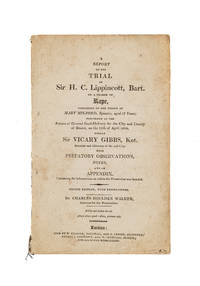
1810ref. 786311810. Rare Trial Report Notable for its Insights Into Gender and Class in Georgian Society Trial. Lippincott Henry Cann Defendant. Walker Charles Houlden Reporter. A Report of the Trial of Sir H.C. Lippincott Bart. On a Charge of Rape Committed on the Person of Mary Milford Spinster Aged 17 Years; Preferred at the Assizes of General Gaol-Delivery for the City and County of Bristol On the 18th of April 1810 Before Sir Vicary Gibbs Knt. Recorder and Alderman of the Said City. With Prefatory Observations Notes And an Appendix Containing the Information on Which the Presecution was Founded. Second Edition With Emendations. London: Sold by W. Chapple And B. Crosby J. Lansdown And W. Sheppard And All Other Booksellers 1810. xvi 54 pp. Octavo 8-1/4" x 5-1/4". Disbound stab-stitched pamphlet. Moderate toning light foxing to several leaves moderate edgewear to title page faint fold lines to upper-outside corner of text block minor chips and tears to edges of a few leaves. $750. Second final and definitive edition. Milford an inmate in an almshouse accused Lippincott of rape. He was acquitted but Walker his prosecutor claimed he was guilty and wrote this pamphlet ostensibly a report to prove his case in the court of public opinion. Walker claims Lippincott was able to evade justice due to his social position. His account is unusually moralistic and notable for its insights into the nature of gender and class in Georgian society. The first edition was published in Bristol in 1810. It and the second edition are rare. OCLC locates 2 copies in North American law libraries University of Memphis Law Library York University Law Library. Neither edition in the Harvard Law Catalogue or the British Museum Catalogue. unknown books
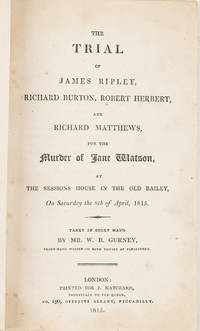
1815ref. 786451815. A Deadly Riot at the Home of a Future Prime Minister Trial. Ripley James Primary Defendant. The Trial of James Ripley Richard Burton Robert Hebert And Richard Matthews For the Murder of Jane Watson At the Sessions House in the Old Bailey On Saturday the 8th of April 1815. Taken in Short Hand by Mr. W.B. Gurney Short-Hand Writer to Both Houses of Parliament. London: Printed for J. Hatchard 1815. 100 pp. Octavo 8" x 5". Stab-stitched pamphlet disbound and recently resewn spine reinforced with tissue. Light toning occasional light foxing small stains to a few leaves. $350. Only edition. Ripley was a butler and his fellow defendants soldiers. All were called upon to defend the house of Frederick John Robinson a senior trade minister and future Prime Minister after an angry mob gathered at his house; Robinson was the target of public ire for his sponsorship of the Corn Laws of 1815 which led to high grain prices that disproportionately burdened the poor. A woman was shot in the chaos and later died of her wounds. Ripley pled self-defense citing Hale Hawkins and Mansfield among others. He and his fellow defendants were acquitted. OCLC locates 7 copies of this title 2 in law libraries Library of Congress Harvard. British Museum Catalogue Compact Edition 21:691. unknown books
1862ref. 786631862. A Lethal Dose of Strychnine Intended to Induce Abortion Trial. Hersey George C Defendant. Yerrinton James M.W. Reporter. Report of the Case of Geo. C. Hersey Indicted for the Murder of Betsy Frances Tirrell Before the Supreme Judicial Court of Massachusetts; Including the Hearing on the Motion in Arrest of Judgment The Prisoner's Petition For a Commutation of Sentence The Death Warrant Officer's Return Upon It And the Confession. Boston: A. Williams & Co. 1862. 267 pp. Octavo 9-1/2" x 6". Original cloth blind stamped frames to boards gilt title to spine. Light rubbing and a few faint stains to boards moderate rubbing to extremities spine gilt oxidized chipping to spine ends joints starting at ends corners bumped and worn. Light browning to interior faint marginal dampstaining light foxing to a few leaves. $100. First edition. According to McDade "Hersey had been living in Weymouth Massachusetts with the Tirrell family since the sudden death four months before of their daughter and his fiancee Mary Tirrell. A second daughter Betsy became pregnant by him and he gave her a drug which he represented would cause an abortion. Actually it was strychnine which he had obtained in Boston allegedly to poison a dog. He was convicted and hanged. The preface claims this to be the only in 1862 published trial in which strychnine was detected by analysis in the deceased." McDade The Annals of Murder 472. unknown books
1795ref. 789051795. Edinburgh: Printed for William Brown 1795. Edinburgh: Printed for William Brown 1795. The Trial of a Would-Be Revolutionary Trial. Watt Robert c.1761-1794 Defendant. Trial of Robert Watt For High Treason Before the Court Under the Special Commission of Oyer and Terminer Held at Edinburgh. Taken in Short Hand by Mr. Blanchard Revised by the Counsel on Both Sides And Published with the Permission of the Court. Edinburgh: Printed for William Brown 1795. ii 364 pp. Folding plate illustrating pikes found in Watt's possession. Octavo 8-1/4" x 4-3/4". Contemporary calf gilt fillets to spine lettering piece lacking blind tooling to board edges. Light rubbing and a few small nicks and scratches to boards which are slightly bowed and separated but secured by cords faint dampstain to front board moderate rubbing to extremities shelf location in ink to foot of spine corners bumped and worn faint offsetting to preliminaries front free endpaper loosening but secure. Light toning to interior light soiling in a few places edgewear and light creasing to folding plate brief recent ink annotation to title page. $250. Only edition. Watt a wine merchant and political radical was the architect of a somewhat confused plot to establish Scotland as an independent country. After a search of his house turned up a number of pikes and the type for a seditious handbill he was arrested and tried for treason. A co-conspirator was pardoned but Watt was not so lucky. He was convicted and sentenced to be hanged and beheaded despite the jury's recommendation of mercy. The sentence reflected the court's opinion of the severity of Watt's crime. It was also intended to be a warning to other radicals. English Short-Title Catalogue N013806. unknown books
1794ref. 790191794. New York: Samuel Campbell 1794. New York: Samuel Campbell 1794. Copy of an Account of an Anti-Radical Crackdown Owned by Two Lawyers Who Were Union Army Officers Trial. Gerrald Joseph 1763-1796. The Trial of Joseph Gerrald Delegate from the London Corresponding Society To the British Convention. Before the High Court of Justiciary at Edinburgh On the 3d 10th 13th And 14th of March 1794. For Sedition. Taken in Short-Hand by Mr. Ramsey. New York: Printed and Sold by Samuel Campbell No. 124 Pearl-Street 1794. 207 1 pp. With a frontispiece portrait of Gerrald. Octavo 7-3/4" x 4-3/4". Contemporary quarter calf over plain paper-covered boards gilt fillets and hand-lettered title to spine edges dyed yellow. Light rubbing to boards a few faint stains to front board moderate rubbing to extremities front joint starting at head corners lightly worn hinges cracked later pencil notes to front free endpaper which has a small clean tear at fore-edge affecting annotations book label of "H. Scofield's/ Library/ No. 15913" to its verso. Moderate toning to interior light foxing in a few places faint offsetting from frontispiece early owner signature of Benjamin F. Butler to head of title page. A very good copy in a well preserved original and unsophisticated 18th century New York binding. $750. First American edition. Gerrald a radical political activist and reformer was a member of the Society for Constitutional Information and the London Corresponding Society. During a wave of prosecutions of radical activists after the French Revolution Gerrald was arrested along with four of his colleagues and tried for sedition. Like others carried out during this time the trials resulted in guilty verdicts; the group of Scottish activists tried between 1793 and 1794 are often referred to as the "Scottish Martyrs." Gerrald was sentenced to fourteen years' transportation and died in 1796 in Botany Bay. Other American editions were published by Campbell the same year. Remembered today as a general in the U.S. Army during the Civil War Butler 1818-1893 was a leading Massachusetts trial lawyer who practiced in Lowell and Boston. Later he was a member of the U.S. House of Representatives where he played a central role in the impeachment of President Andrew Johnson and governor of Massachusetts. Hiram Scofield 1830-1906 was a prominent lawyer and Civil War colonel. A dedi. unknown books
1794ref. 788761794. New York: Re-printed by James Carey 1794. New York: Re-printed by James Carey 1794. A Member of the "Scottish Martyrs to Liberty" Trial. Margarot Maurice Defendant 1745-1815. The Trial of Maurice Margarot Before the High Court of Justiciary At Edinburgh On the 13th and 14th of January 1794 On an Indictment for Seditious Practices. Taken in Shorthand by Mr. Ramsey. New York: London: Printed. New-York: Re-Printed by James Carey no. 91 Broad-street 1794. 166 pp. Portrait frontispiece of Margarot. Octavo 8-1/4" x 5". Disbound stab-stitched pamphlet. Moderate toning light soiling to exterior occasional light foxing frontispiece and title page just starting to separate at head but secure. $250. Only New York edition reprinted from the London edition of the same year. Margarot was one of the founding members of the London Corresponding Society a radical group inspired by the French Revolution to demand parliamentary reform in the late eighteenth century. Due to the wave of anti-radical and anti-French hysteria initiated by the French Revolution he and four other radicals later known as the "Scottish Martyrs to Liberty" were convicted and transported to Australia in May 1794. English Short-Title Catalogue W20960. unknown books
1794ref. 788791794. New York: Re-printed by James Carey 1794. New York: Re-printed by James Carey 1794. A Member of the "Scottish Martyrs to Liberty" Trial. Margarot Maurice Defendant 1745-1815. The Trial of Maurice Margarot Before the High Court of Justiciary At Edinburgh On the 13th and 14th of January 1794 On an Indictment for Seditious Practices. Taken in Shorthand by Mr. Ramsey. New York: London: Printed.New-York: Re-Printed by James Carey no. 91 Broad-Street 1794. 166 pp. Portrait frontispiece of Margarot. Octavo 8" x 5". Disbound stab-stitched pamphlet. Light browning faint dampstaining to bottom edge occasional light foxing frontispiece and title page separating at foot but light soiling to exterior occasional light foxing light edgewear to frontispiece which is just starting to separate at head with title page but secure. $200. Only New York edition reprinted from the London edition of the same year. Margarot was one of the founding members of the London Corresponding Society a radical group inspired by the French Revolution to demand parliamentary reform in the late eighteenth century. Due to the wave of anti-radical and anti-French hysteria initiated by the French Revolution he and four other radicals later known as the "Scottish Martyrs to Liberty" were convicted and transported to Australia in May 1794. Cohen Bibliography of Early American Law 13350. unknown books
1886ref. 791321886. London: Stevens and Haynes 1886. London: Stevens and Haynes 1886. Bartlett Adelaide Defendant. Beal Edward Editor. Clarke Edward Preface. The Trial of Adelaide Bartlett for Murder. Held at the Central Criminal Court Monday April 12 to Saturday April 17th 1886. London: Stevens and Haynes 1886. x 313 pp. Octavo 8-1/2" x 6". Original cloth. Bookplate of "Sir John Hall of Dunglass Baronet" to front pastedown. Some shelfwear and dampstaining binding somewhat cocked. Internally clean. A good copy. $95. The Dunglass family was a noble Scottish family. The plate may belong to Sir John Richard Hall of Dunglass 9th Bt 1865-1928 who was an author and decorated serviceman appointed to Commander Order of the British Empire. thepeerage.com. One of the more unusual and baffling English murder cases it involved liquid chloroform and an incestuous family. Mrs. Bartlett the lover of her brother-in-law was accused of poisoning her husband in order to inherit his estate. How she murdered him remains a mystery however. Although chloroform was found in his stomach no traces were found in his mouth or throat. Unable to determine how she could have killed her husband the jury did not convict Mrs. Bartlett. unknown books