112 résultats
réf. 25787PARIS, Charpentier -1872 - 2 ème édition revue & corrigée -1 vol. in-8 reliure demi-chagrin maroquiné rouge - Dos lisse - Portrait gravé d'après Suvée, protégé par serpente - rousseurs - 2 ff., CXXIII-I-491 pages
réf. 7808Institutions, hommes et faits.In 4 demi-chagrin rouge à nerfs, titre et caissons dorés,plats percaline chagrinée, filets à froid en encadrement.Armes de Paris et Prix Municipal d’excellence,dorés.Faux-titre,titre,VIII,235 pages,texte sur 2 colonnes,illustrations.Tranches dorées. Paris Librairie Furne Jouvet & Cie éditeurs,1893,très bon état
réf. ORD-19337Paris. Le livre club du libraire. 1964. In-8 (136 x 225 mm) pleine percaline rouge de l'éditeur, vigneette collée sur le 1er plat, titre en noir au dos, gardes noires, 2ff., 4 pages imprimées sur papier jaune, 226 pages, illustrations hors texte tirées sur papier jaune et légendées au dos. Bel exemplaire, n°1645 d'un tirage limité à 2000 exemplaires réservés aux membres du club.
réf. 242021Champ Vallon, 2012 22 x 14 x 2,2 cm., 308 pp, Broché
réf. 980326Champ Vallon Editions Seyssel 2012 In-8 ( 220 X 140 mm ) de 308 pages, broché sous couverture illustrée. Très bel exemplaire.
réf. 16228Paris, Edition France-Empire, 1989 16 x 24, 195 pp., broché, bon état.
1890réf. 31565Partitions sur Paris Paname,Partitions sur la Justice,Partitions sur la Prison Bruant Aristide 1890 approx.
1892réf. 30803Partitions sur Paris Paname,Partitions sur la Prison Salabert 1892
1900réf. 15508Partitions sur la Révolution Française Ondet 1900 approx.
1819réf. 901891AGCarlsruhe:, Mylius, 1819. Federlithographie 12 x 33,5 cm, Blattgröße 17 x 36 cm.
grand in-8°, 320 pp., cartonnage de l"editeur, jaquette illustree en couleurs. Bon etat (accrocs a la jaquette). [CA29-30][TX-20]
1912réf. 413LYON. PARIS. 1912. IN-8 DE (4) + 355 PAGES, RELIURE A LA BRADEL 1/2 PERCALINE ROUGE A COINS, TITRE DORE SUR DOS LISSE, COUVERTURE CONSERVEE. (L'AFFAIRE DU COLLIER. VARENNES. MARIE-ANTOINETTE. LOUIS XVII. LE TRIBUNAL REVOLUTIONNAIRE. LA GUILLOTINE. CARRIER. SIEYES. BILLAUD-VARENNE.....). BON EXEMPLAIRE (EX-LIBRIS DE SAEGHER-VAN LANCKER).
réf. 4699In 12 broché,faux-titre,frontispice,titre,225 pages, planches hors-texte,2 feuillets tables des gravures,table des matières. Librairie Académique Perrin & Cie 1911/ Marges jaunies
réf. 6218in 8 demi-cuir vert glacé époque,dos lisse,titre,filets, palmette dorés.Filets à froid.Faux-titre,titre,VIII,396 pages,non rgné,12 gravures hors-texte encadrées d’un filet noir;sur chine collé, sous serpentes,de RAFFET et JOHANNOT Perrotin éditeur 1832 édition originale.Rousseurs,fortes à très fortes,à certaines pages.
réf. 1649696175.Gpaperback. Good. Access codes and supplements are not guaranteed with used items. May be an ex-library book. paperback
réf. 5914In 8 broché,faux-titre,titre,IV,408 pages Paris Persan, Delaunay, Mongié,libraires 1830,édition originale. Très bon exemplaire.
1988réf. 134708Reinbek bei Hamburg : Rowohlt-Taschenbuch-Verl. 1988. 220, [16] S. : 18 Ill. 19*12 cm. OBroschur.
1988réf. 84641Reinbek, Rowohlt Taschenbuch Verlag, 1988. 221 S. 8° Oktav, Softcover/Paperback
réf. 6271Cartouche,Mandrin,Fra Diavolo,Schinderhannes,José Maria, Rosa Chandor …in 12 demi-toile muette chagrinée,faux-titre, titre,381 pages,1 feuillet table des matières,gravures sur bois dépliantes en fin de volume.(supplice de Cartouche)la troupe de Mandrin au chateau du Procureur,Mandrin se fait ermite, la victime de la caverne,procès de julie Blasius, Rosa Chandor etc.)Lebigre-Duquesne frères 1866
1817Sm. 8vo., First Edition thus, small age-mark on half-title verso; contemporary half calf, marbled boards, back ruled in gilt, second compartment with red leather label lettered in gilt, all other compartments tooled in gilt with a floral motif, joints cracked (but hinges and binding entirely sound), a most attractive and remarkably crisp, clean copy. Complete with half-title, and 6pp publisher's catalogue (dated February 1817) bound in at end. RARE. We have seen this edition confused with a very similar but shorter (and apparently less elusive) version of Angouleme's memoirs published by Constable in Edinburgh later the same year. NICE COPY OF A KEY DOCUMENTARY RECORD IN THE HISTORY OF FRANCE, THE REVOLUTION AND THE TERROR, AND AFTER CLERY ONE OF THE MOST IMPORTANT CONTEMPORARY ACCOUNTS OF THE IMPRISONMENT OF LOUIS XVI.
G/G (intact dj chipped and worn edges and white back cover lightly soiled, clean red cloth with gilt lettering on spine, good sound clean copy with tiny ownership initials front free endpaper and one dog-eared corner) octavo 224pp. First British edition. Biography of the man who gave his name to the guillotine and who only narrowly escaped execution himself in the French Revolution, and whose sole motive in suggesting the use of the guillotine was the prevention of further suffering to the victims. Illustrated with b/w plates.
2021réf. LFA-126742290Revue de 98 pages, format 200 x 265 mm, illustrée, brochée couverture couleurs, bon état
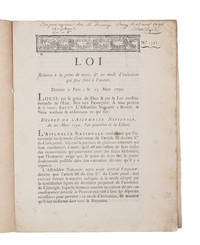
1792réf. 63223Paris L'Imprimerie Royale 1792. 4to. Stitched in later marbled wrappers with printed book label "Collection Quarré-Reyboyrbon Lille" to inside of front wrapper. Contemporary handwritten inscription above head-piece "Bon pour imprimeur chez M. Descamps Douay le 12 avril 1792." presumably in the hand of Quarré-Reybourbon. A bit of brownspotting and soiling but overall very nice. 4pp. Scarce first printing of the legal document that led to the guillotine becoming France's standard method of judicial execution. This groundbreaking decree of the National Assembly given 20 March 1792 suspended all pendig death punishments and authorized the use of necessary expenses to achieve a more humane method of execution throughout the kingdom. The methods for achieving this humane form of execution is explained in the the annexed text signed by Antoine Louis see below the permanent secretary of the Academy of Surgery. The decree is as follows: “The National Assembly considering that the uncertainty regarding the method of execution of Article III of Title 1 of the Penal Code suspends the punishment of several criminals who are sentenced to death; that it is urgent to put an end to inconveniences which could have unfortunate consequences; that humanity requires that the death penalty be as painless as possible in its execution decrees that there is an emergency.” The Penal Code of 1791 title 1 article 3 Tout condamné aura la tête tranchée “Every condemned person will have their head cut off” should be executed “according to the manner indicated and the method adopted by the consultation signed by the Permanent Secretary of the Academy of Surgery which remains annexed to this decree” and the National Assembly “consequently authorizes the Executive Power to incur the necessary expenses to achieve this method of execution so that it may be uniform throughout the Kingdom.” p. 1 Prior to 1791 under the Ancien Régime there existed a variety of means of capital punishment in France depending on the crime and the status of the condemned person. In 1791 there was a campaign towards the abolition of the death penalty but later that year The National Assembly refused to pass such a law. However torture was abolished and a single method of execution was declared that of beheading which had previously only been applied to nobles. In 1791-92 the development of a mechanical beheading device was set in force by a committee in order to make the death penalty "as painless as possible in its execution" and "uniform throughout the kingdom”. Note that before the use of a mechanical beheading device manual beheading and a variety of other methods of execution had been in force in France. Ironically what is now known as the guillotine was developed with the help from Louis XVI – who was a skilled amateur locksmith – with regards to the shape of the blade. This change towards a more painless method was ignited by physician Joseph-Ignace Guillotin in October 1789 at the National Assembly. Later a committee was formed under Antoine Louis the inventor of the guillotine and physician to the King and Secretary to the Academy of Surgery. This committee included Guillotin and although he did not invent the guillotine and opposed the death penalty his name became an eponym for it. After its adoption the device remained France's standard method of judicial execution until the abolition of capital punishment in 1981. The last execution with a guillotine in France took place in 1977. unknown
1814réf. 46404431Paris, Imprimerie de J. R. Lottin, (1814) ; in-8, demi-veau de l’époque. 51 pp.C’est la liste chronologique des personnes condamnées par les tribunaux, soit 1343 noms, avec l’indication de la profession. À la fin on trouve le certificat de Descloseaux, ancien avocat, propriétaire du cimetière de la Madeleine. Parmi les noms de cette liste figurent l’écrivain J. Cazotte, le Roi, le général Custine, la Reine, Brissot, Hébert, le Père Duchesne, Cloots dit Anacharsis, Fabre d’Eglantine, Camille Desmoulins, Heraut de Séchelles, Barras, Malesherbes, l’amiral d’Estaing, Lavoisier, etc. Entre les pp. 2 et 3 on trouve 2 ff. ajoutés l’un portant un plan du cimetière, l’autre l’explication de ce plan (2 pp. manuscrites). Tourneux 12439. Relié à la suite : FONDATION de la chapelle funéraire de Picpus. Paris, J. L. Lottin, (1814) ; 79 pp.Fondation d’une chapelle funéraire sur le terrain où étaient enfouis les restes des condamnés exécutés à la barrière du Trône entre le 14 juin et le 27 juillet 1794. Liste des personnes qui ont souscrit pour cet établissement depuis 1802. Liste des victimes immolées à la barrière du Trône et inhumées au cimetière de Picpus. Liste de 1298 personnes avec leur profession et leur âge et le lieu de leur naissance. Tourneux 12445. Réunion rare de ces deux listes. Rousseurs, fente à une charnière.