Thompson, Kenneth W, Morgenthau, Hans JBiblio.com
315 risultati
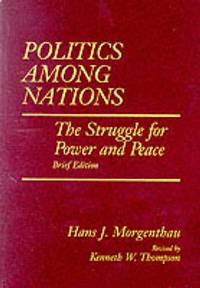
1992rif. 5175977McGraw-Hill Higher Education 09/01/1992. Paperback. Used; Very Good. WE SHIP WITHIN 24 HRS FROM LONDON UK 98% OF OUR ORDERS ARE RECEIVED WITHIN 7-10 DAYS. We believe you will be completely satisfied with our quick and reliable service. All orders are dispatched as swiftly as possible! Buy with confidence! Greener Books. McGraw-Hill Higher Education paperback
1978rif. mon0000584750Alfred A. Knopf 1978T. hardcover. Acceptable. 3.2995 in x 23.8579 in x 16.4975 in. NOT an ex-library book. Well read with some wear but still very useable. Alfred A. Knopf hardcover
1925rif. 510267Duncker & Humboldt 1925. Hardcover with Dust Jacket. VERY GOOD. Personal copy of political theorist Hans Morgenthau with his neat marginal pencilling and newsprint placemarkers. 8vo half black cloth over green marbled boards gilt stamped spine lettering and printer's device to front cover. With publisher's original plain brown dust jacket quite brittle and tattered; original plain slipcase present in a tattered state as well. Provenance: From Hans Morgenthau's daughter Susanna Morgenthau. The penciling matches that of the dozens of other books we have cataloged from his library. The Catholic jurist and political philosopher Carl Schmitt was one of the most influential political thinkers of the 20th Century in no small part for his role in establishing the ideological underpinnings of the Third Reich. He was unavoidably a key interlocutor for all German political scholars of the Weimar Era including Hans Morgenthau who would go on to become one of the most influential political thinkers of the 20th century in his own right from a much different but related vantage point.William Scheuerman writes 'the young Hans Morgenthau was involved in an intense 'hidden dialogue' with Carl Schmitt twentieth-century Germany’s most significant right-wing authoritarian political thinker.' 'Although committed to a sociologically minded analysis of international law shaped by left-wing Weimar legal thought the young Morgenthau turned early on to the work of the right-wing authoritarian thinker Carl Schmitt in order to develop his realistic or sociological approach. Morgenthau's precocious fascination with Schmitt though at first glance surprising is by no means difficult to fathom. Other members of the Sinzheimer School - including Ernst Frankel and Franz Neumann - similarly pursued a close and at times surprisingly sympathetic examination of Schmitt's work during the 1930s. Like Morgenthau they vociferously criticized his extreme right-wing political preferences while acknowledging that Schmitt offered the outlines of a realistic i.e. power-oriented vision of politics too often missing from mainstream jurisprudence and legal positivism. Morgenthau's early writings highlighted deep flaws in Schmitt's thinking not only denouncing his political choices but ultimately describing his theory as fundamentally unsound. Yet he credited Schmitt with acknowledging the need for precisely that realistic account of power relations in the international arena which legal orthodoxy had failed to deliver. Like Morgenthau Schmitt had long been skeptical of mainstream international law which he analogously interpreted as veiling the brutal realities of inequality at the international level. Morgenthau initially appears to have identified Schmitt's theory despite its weaknesses and troublesome political orientation as a potentially useful source of insights for his own alternative theory of international law. Morgenthau's first mention of Schmitt in 1929 . offered a critical response to a widely read 1927 essay by Schmitt in which the right-wing theorist had defined the political as constituting a fundamentally distinct and independent sphere of activity existing alongside alternative modes of human activity. In Schmitt's initial formulation morality concerned the problem of good and bad aesthetics was occupied with the distinction between beautiful and ugly economics was preoccupied with profitability and unprofitability whereas only politics concerned the contrast between what Schmitt famously described as friend and foe. The young Morgenthau astutely diagnosed the Achilles' heel of this position: Schmitt's exposition misleadingly implied that political activity was limited to a pre-given set of objects or concerns thereby obscuring the possibility that any conceivable sphere of activity could take on political qualities. In its stead Morgenthau proposed that politics be described as 'a characteristic quality or coloration which any substance can take on' IRWG 67. The distinctive attribute of political activity was captured best by focusing on the degree of intensity of the conflict at hand. Although drawing their substantive concerns from any of a host of moral aesthetic and economic arenas of human activity identifiably political concerns were those in which a high degree of intensity of conflict had surfaced IRWG 69. Even though he admitted the difficulty of determining at what specific juncture a particular conflict had become intense and thus authentically political Morgenthau insisted that his alternative model of intensity offered a superior way of capturing the distinctive traits of political life. In his view politics was never an either/or state of affairs but always a matter of degree necessarily depending on how intense - and potentially violent - a conflict had become. Schmitt apparently agreed. As Morgenthau noted in his 1978 autobiographical reflections Schmitt subsequently 'changed the second 1932 edition of the Concept of the Political in the light of the new propositions of my thesis without lifting the veil of anonymity from their author.'47 In fact Schmitt's 1932 study dropped the misleading imagery of politics as a distinct or separate sphere instead following Morgenthau's conceptualization of politics as concerning conflicts characterized by intense enmity. Yet Schmitt never bothered to acknowledge his debts to the young left-leaning Jewish Morgenthau. For a politically upwardly mobile right-wing thinker busy cultivating influence with Germany's rising authoritarian political groupings such an admission would have been incon-venient. In his 1978 comments Morgenthau went so far as to accuse Schmitt of having engaged in mean-spirited plagiarism. He recounted a humiliating 1929 meeting with Schmitt in which Morgenthau hoped to discuss their shared interest in the political only to encounter a calculating mean-spirited careerist: 'when I walked down the stairs from Schmitt's apartment I stopped on the landing between his and the next floor and said to myself: 'Now I have met the most evil man alive.' Schmitt's subsequent kowtowing to the Nazis apparently did not take Morgenthau by surprise.' Morgenthau: Key Contemporary Thinkers 32-34. Duncker & Humboldt hardcover
1964rif. 25651VG HC w/DJ Clarendon Press hardcover
2004rif. 187528New York: Museum of Jewish Heritage 2004. First Edition; First Printing. Hardcover. Near Fine in a Near Fine dust jacket. Museum of Jewish Heritage hardcover
1987rif. G0932840051I4N00University Publishing Associates Incorporated 1987. Paperback. Very Good. May have limited writing in cover pages. Pages are unmarked. ~ ThriftBooks: Read More Spend Less.Dust jacket quality is not guaranteed. University Publishing Associates, Incorporated paperback
2024rif. x-1621908992Univ of Tennessee Pr 2024. Paperback. New. 311 pages. 8.75x5.75x1.00 inches. Univ of Tennessee Pr paperback
1965Features: A River Dies - and is Reborn again - New Jersey's Raritan River; We are deluding ourselves in Vietnam - Hans J. Morgenthau; Even if they can't read, They should have the right to vote - Andrew Hacker; After Fifty Years the cry of Ypres still Echoes - 'Gas!' - the beginning of chemical warfare in 1915 - chlorine and tear gas; Secret of the Nureyev Spell; The New York World's Fair - Act II; Crossword completed, otherwise unmarked. Average wear. A sound copy. Book
1932rif. 41082New York: J.C. Morgenthau 1932. First edition. Paper wrappers. A very good clean copy. 26 pp. Illus. with b/w photos. 8vo. 82 items described. Lancour 5893. J.C. Morgenthau unknown books
1971rif. 244278New York: Ticknor & Fields 1971. Hardcover. Very Good/Very Good. First edition. Very good in very good dust jacket. Hardcover and dust jacket both lightly rubbed at spine ends and corners book corners lightly bumped writing on front endpaper. Ticknor & Fields hardcover books
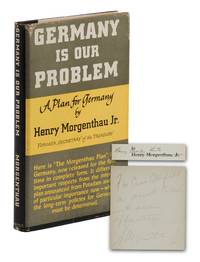
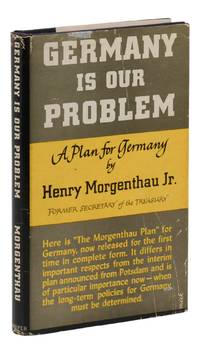
1945rif. 140948892New York and London: Harper & Brothers 1945. First Edition. Near Fine/Near Fine. First edition first printing. A remarkable association copy not only signed by author Henry Morgenthau on the front free endpaper and inscribed to the then-President of the book's publisher known for picking Pulitzer Prize winners: "For Cass Canfield a swell Publisher with sincere affection." Additionally it is signed in pencil on the book's title page by one its primary ghostwriters government official Harry Dexter White with Morgenthau's name suggestively crossed-out. As White's biographer David Rees put it "White was now to supervise the writing of a book by Treasury staff explaining the Morgenthau Plan eventually published a year later under Morgenthau's name as Germany is Our Problem." Morgenthau himself acknowledged White's role in the signed copy he gave White in 1945 cited in James Boughton's Harry White and the American Creed. In 1948 a handwritten note by White to Whittaker Chambers would embroil him in a covert hunt for Soviet moles within the U.S. government. He died that year but five years later his face would grace newspapers all over the world as he was accused of being a spy for the Soviet Union connected to the network of Nathan Silvermaster. His degree of culpability remains debated to this day although release of the Venona decrypts provided damning evidence. The posthumous nature of White's notoriety has meant that his signature is extremely rare especially on books rather than documents. viii 4 ix - xiii iii 239 pp. foldout map printed on speckled wartime paper. Bound in publisher's navy cloth with gilt lettering to spine. Near Fine light rubbing to extremities dulled gilt and dust jacket clipping tipped to front pastedown. In a Near Fine unclipped dust jacket with lightly worn with a few small tape repairs to verso. Uncommon especially in such nice shape. The book outlines what would become known as The Morgenthau Plan for postwar Germany. The U.S. Secretary of the Treasury called for the defeated enemy's radical total deindustrialization decentralization and transformation into a pastoral society. President Franklin Delano Roosevelt regretted his initial support for Morgenthau's plan after it was vigorously decried at home and abroad and his successor favored the less vengeful and more pragmatic Marshall Plan. White's role in formulating the plan that would bear his superior at the Treasury Department's name remains little-known as it itself has fallen into obscurity since the early Cold War. Less controversial was White's role in co-founding both the International Monetary Fund and World Bank. Harper & Brothers unknown books
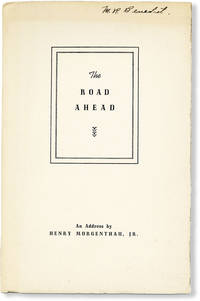
1938rif. 49609Philadelphia: Alliance Printing Co. 1938. First Edition. Octavo 25.5cm.; publisher's pale grey staplebound card wrappers; 15pp. Extremities a bit toned ownership signature at head of upper cover. Commencement speech delivered at Temple University by the Secretary of the Treasury under FDR chiefly responsible for the designing of the New Deal. [Alliance Printing Co.] unknown books
1945rif. 58191ABNew York, Harper & Brothers. 1945. 8°. XIII, 239 S. mit 4 Seiten Faksimiletyposkript und einer gefalteten Karte. Originalleinwand mit Schutzumschlag.
1945rif. 140947693New York and London: Harper & Brothers 1945. First Edition. Near Fine/Near Fine. First edition first printing. viii 4 ix - xiii iii 239 pp. foldout map. Bound in publisher's navy cloth with gilt lettering to spine. Near Fine with light toning to contents and bookplate to front pastedown. In a Near Fine unclipped dust jacket with moderate toning and light edgewear and soiling. Several scratches to front panel 3 archival tape repairs to chipping at upper edge and small hole at lower right of front panel. Henry Morgenthau's controversial plan for postwar Germany. The U.S. Secretary of the Treasury called for the defeated enemy's total deindustrialization decentralization and transformation into a pastoral society. President Franklin Delano Roosevelt regretted his initial support for Morgenthau's plan after it was vigorously decried at home and abroad and his successor favored the less vengeful and more pragmatic Marshall Plan. Harper & Brothers unknown books
1945rif. 140941614New York: Harper & Brothers Publishers 1945. First Edition. First edition first printing. xiii iii 239 pp. fold-out map. Publisher's navy cloth spine lettered in gilt. Near Fine with typical toning to pages with age sticker wear to front free endpaper in Good original dust jacket with closed tear to head and long fore edge creasing along top of front panel small triangular chip to top of that panel as well small archival mending tissue repair to verso dampstaining visible from verso unclipped $2.00. Rare. The controversial plan for Germany post-WWII first announced by US Secretary of the Treasury Henry Morgenthau in 1944 which called for the immediate total deindustrialization of the country with a focus on extracting reparations for its wrongdoings during the war as well as its forced political and economic decentralization and transformation into a pastoral society. President Franklin Delano Roosevelt OK'd it only to regret it when the plan was vigorously decried at home and abroad. The Marshall Plan was adopted instead under Truman and efforts to deindustrialize and decartelize the Germany economy were limited. Harper & Brothers, Publishers unknown books
1964rif. 240100Chicago: University of Chicago Press 1964. hardcover. very good-/very good-. 8vo green cloth d.w. and cloth with a small amount of soiling on bottom of spine d.w. rubbed. Chicago: University of Chicago Press 1964. Politics in the Twentieth Century Volume III. University of Chicago Press unknown books
1944rif. 142931Washington DC : National Committee of Honorary Patrons The US Treasurey Department 1944. Softcover. VG with light sunning to cover edges. Blue and grey stapled card wraps with blue lettering and patriotic decoration. 12 pp. with no illus. The exhibition of works by artists which were reproduced in to posters used to encourage the US public to purchase war bonds. Abbott Laboratories paid the artists for their works and then donated the art to the Treasurey which sponsored the Art for Bonds exhibition an integral part of the Treasurey's Second War Loan campaign. Some of the artists whose works were included are Thomas Hart Benton John Steuart Curry N.C. Wyeth Ernest Fiene Reginal Marsh and several others. The exhibition included preliminary sketches the finished paintings and the posters reproduced from the works of art. National Committee of Honorary Patrons, The US Treasurey Department paperback books
1991rif. 101283New York: Ticknor & Fields 1991. Hardcover. Fine/Fine. First edition. Foreword by Arthur M. Schlesinger Jr. Minor bumping at the top corners else fine in fine dustwrapper. Ticknor & Fields hardcover books
1991rif. 200222New York: Ticknor & Fields 1991. hardcover. near fine/very good. Black & white illustrations. 501pp 8vo cloth-backed boards dust wrapper; signed by the author on the 1/2 title. New York: Ticknor & Fields 1991. Near fine. Ticknor & Fields unknown books
1941rif. 332084Washington DC: Treasury Department 1941. Pamphlet. 14 2p. wraps. Single vertical fold. Good. Included is a form letter on Office of Price Administration letterhead. Treasury Department unknown books
1940rif. 207102New York: Macmillan 1940. Later printing. Illustrated by Louise Mansfield. Reading copy. Book has brown stains inside the front and back cover foxing along the edges of the cover and cover is fading and worn. Macmillan unknown books
2016rif. 006262Baltimore MD: Passager Books. 81pp. Size: 8vo - over 7¾" - 9¾" tall. E6 . Fine. Paperback. First Edition. 2016. Passager Books paperback
rif. 1025448804.Ghardcover. Good. Access codes and supplements are not guaranteed with used items. May be an ex-library book. hardcover
rif. 1025452720.Gpaperback. Good. Access codes and supplements are not guaranteed with used items. May be an ex-library book. paperback
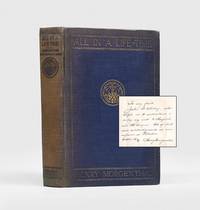
1922rif. 178738Garden City New York: Doubleday Page & Company 1922. First edition presentation copy inscribed by the author on the front free endpaper "To my friend John D. Whiting who helped me to understand & enjoy my visits to Machpelah and Mt Gerizim - both of which were outstanding events in our sojourn in Palestine October 15/29 Henry Morgenthau". Whiting 1882-1951 was the leader of the American Colony in Jerusalem a Christian utopian community. Henry Morgenthau Sr. served as US Ambassador to the Ottoman Empire from 1913 to 1916 during which he became one of the most prominent critics of the Armenian Genocide. He resigned in protest and returned to America to raise public awareness and funds for Armenian relief. His memoir charts his emigration from Germany to New York as a Jewish child his rise in business and politics and his experience as ambassador. Octavo. Original blue cloth spine and front cover lettered in gilt. Portrait of Morgenthau mounted to the front pastedown later notation to front free endpaper. Extremities and inner hinges neatly repaired spine sunned. A good copy. hardcover