735 Ergebnisse
Best.-Nr. SONG0548723567Used: Good unknown
Best.-Nr. DADAX1436550076New unknown
Best.-Nr. DADAX0548803331New unknown
1987Best.-Nr. LFA-126739809N° 35 (Juin 1987) 66 pages, format 205 x 285 mm, illustré, broché couverture couleurs, bon état
Best.-Nr. 19892Villegly, CNEC, Centre René Nelli, 1997, - 17x24 - broché, 213 pages ; illustrations. n° 26/:27
Best.-Nr. 19893Villegly, CNEC, Centre René Nelli, 1991, - 17x24 - broché, 138 pages ; illustrations. n°16
Best.-Nr. 19894Villegly, CNEC, Centre René Nelli, 2000, - 17x24 - broché, 135. pages ; illustrations. n° 32
Best.-Nr. 19895Villegly, CNEC, Centre René Nelli, 1994, - 17x24 - broché, 171 pages ; illustrations. n°22
Best.-Nr. 19896Villegly, CNEC, Centre René Nelli, 1992, - 17x24 - broché, 101 pages ; illustrations. n°19
Best.-Nr. 19897Villegly, CNEC, Centre René Nelli, 1993 - 17x24 - broché,168 pages ; illustrations. n°21
Best.-Nr. 19898Villegly, CNEC, Centre René Nelli, 1994, - 17x24 - broché, 149 pages ; illustrations. n°23
Best.-Nr. 19899Villegly, CNEC, Centre René Nelli, 1991, - 17x24 - broché,126 pages ; illustrations. n° 17
Best.-Nr. 19900Villegly, CNEC, Centre René Nelli, 1999, - 17x24 - broché, 155 pages ; illustrations. n° 29
Best.-Nr. 19901Villegly, CNEC, Centre René Nelli, 1998, - 17x24 - broché,127 pages ; illustrations. n° 28
Best.-Nr. 19902Villegly, CNEC, Centre René Nelli, 1990, - 17x24 - broché, 147 pages ; illustrations. n°15
Best.-Nr. 19903Villegly, CNEC, Centre René Nelli, 1999, - 17x24 - broché,122 pages ; illustrations. n°31
Best.-Nr. 19904Villegly, CNEC, Centre René Nelli, 1993, - 17x24 - broché, 135 pages ; illustrations. n° 20
Best.-Nr. 19905Villegly, CNEC, Centre René Nelli, 2000, - 17x24 - broché, 163 pages ; illustrations. n°33
Best.-Nr. 91722A Cologne, chez Pierre Marteau, 1793, 1 volume in-12 de 170x100 mm environ, (1) f., 1 page de titre, 505 pages (1) f., plein veau granité fauve, dos à nerfs portant titres dorés sur pièce de titre en maroquin bordeaux, orné de caissons à motifs dorés, coupes dorées, tranches mouchetées. Quelques rousseurs et pages brunies, petites infimes galeries de ver sur les bordures des pages de garde, coins émoussés, manques de cuir sur les coiffes, sinon bon état.
1976Best.-Nr. LFA-126740932Revue d'histoire populaire : 32 pages, format 210 x 295 mm, illustrée, brochée, bon état
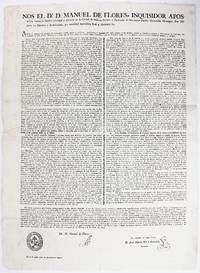
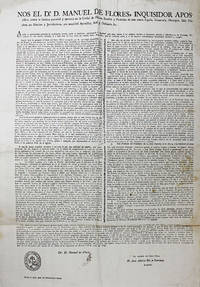
1815Best.-Nr. 5342Mexico: 8 de Julio 1815. Very good. Double-sheet broadside measuring 23.75 x 17 inches. Old fold lines some slight rumpling. Minor soiling and wear. A fascinating and rare broadside in which the Inquisition attempts to prohibit pro-independence publications including the 1814 Constitution of Apatzingán during the midst of the Mexican Revolution. Dated July 8 1815 this proclamation of the Inquisition first reiterates a blanket prohibition on what it labels seditious and anti-Catholic publications that is to say anything in favor of the revolution and independence. It warns that any statements in favor of liberty and democracy constitute heresy in the eyes of the Inquisition and that such calls in fact seek to subvert the natural order rather than re-establish it: "Producciones de una nueva raza de Filósofos hombres de espíritu corrompido que baxo del especioso titulo de defensores de la libertad maquinan realmente contra ella destruyendo de este suerte el orden político y social y gerarquia de la Religion cristiana exhortando con este language de seduccion á ascudir el yugo de subordinacion y sujecion á las lexítimas Potestades tan recomendada por Jesucristo y pretendiendo por aqui fundar si les fuera posible sobre las ruinas de la Religion y Monarquias aquella soñada libertad que malamente suponen concedida á todos los hombres por la naturaleza: razon porque prohibe los muchos libros que menciona y los demás que sean de la misma clase para precaver con oportuno remedio el daño que puedan occasionar." The proclamation then continues in seven numbered sections to outlaw specific works published by the revolutionary government its forces and its supporters. Most significantly the broadside outlaws the Decreto Constitucional para la Libertad de la América Mexicana more commonly known as the Constitution of Apatzingán. This document promulgated by the Congress of Anáhuac on October 22 1814 printed 242 articles for the establishment of republican government in Mexico although it was never brought into force. The propositions put forth by the Constitution are so egregious according to the Inquisition that it is impossible in one edict to denounce them all individually: "Excederia los límites de un edicto la especificacion particular de todos y de cada uno de los crasísimos errores que contiene este infernal papel; pero bastará advertir á los Fieles que en él baxo el respetable nombre de Religion Católica Apostólica Romana que sirve de escudo á sus tramas como antes servia el de Fernando VII contra quien tan iniquamente se han declarado rebeldes se introducen las mas groseras heregias y los mayores delerios." Nevertheless the authors go on to highlight the most transgressive articles condemn the inferred inspiration of the document from authors like Hobbes and Rousseau and emphasize the rejection of Church doctrine implicit in calls for revolution and democracy: "Mas como los Autores de Constitucion se han propuesto revelarse tambien contra la Doctrina expresa de la Iglesia dogmatizan ser licito á los Ciudadanos levantarse contra el Principe prevarle del Reyno mudar el Gobierno monárquico en republicano á pretexto de tirania como si fuera lo mismo fundarlo de nuevo que revelarse contra el ya fundado. Decir que es licito y justo el tal levantamiento contra el lexitimo Principe aunque sea baxo de pretexto de tirania es una proposicion condenada repetidamente por la Iglesia y heregia declarada." In the remaining six sections the Inquisition continues to condemn a litany of decrees sermons almanacs manuscripts and other texts that emanate from revolutionary sources or espouse democratic ideas. In all the document serves as an outstanding representation of the royalist Catholic and conservative forces that were attempting to hold power in Mexico during this period and a fascinating example of attempted censorship of revolutionary ideals. Rare we locate only two copies -- one at Berkeley and Medina's copy at the National Library of Chile. 8 de Julio unknown books
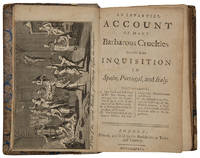
Best.-Nr. 107285London Printed and Sold by the Booksellers in Town and Country 1738. . First edition 8vo 17.5 x 11 cm; five engraved full-page plates including frontispiece woodcut headpieces tailpieces and initials ownership inscription in pen to front free endpaper leaves slightly toned hinges cracked but holding occasional minor tears lacking final few ff.; vellum-backed marbled boards MS spine corners slightly rubbed; x 11-416 pp. An extremely scarce collection of works on the Inquisition in Spain Portugal and Italy compiled anonymously from several tracts popular at the time including Isaac Martin's Trial and Sufferings first published in 1723 the Prosecution of the famous Molinos a narrative account of the Spanish quietist's trial in 1687 and William Lithgow's Travels and Sufferings relaying the author's seizure and imprisonment in Malaga in 1620. The work can be placed in the tradition of Protestant martyrologies dating back to Foxe's Actes and Monuments which sought to discredit the prosecution of heresy by the Catholic Church: 'Since Persecution and the very Methods now in Use among some Christians for propagating and defending their Religion were in these first Ages so destructive of and apparently opposite to the Gospel of Jesus Christ we may justly wonder how they have been introduced into any Church calling her self by his Name' p.vii. The work is illustrated with five engraved plates two of which are signed 'Hulett' probably the James Hulett d.1671 known for his later portraits of Essex and Lord Fairfax in Francis Peck's Memoirs of the Life and Actions of Oliver Cromwell 1740. ESTC records just four copies of An Impartial Account three in the British Isles London Library National Library of Scotland and Lincoln College Oxford and one in North America Pennsylvania State University. ESTC N16844. London, Printed, and Sold by the Booksellers in Town and Country, 1738. hardcover
1815Best.-Nr. 5342Mexico: 8 de Julio 1815. Very good. Double-sheet broadside measuring 23.75 x 17 inches. Old fold lines some slight rumpling. Minor soiling and wear. A fascinating and rare broadside in which the Inquisition attempts to prohibit pro-independence publications including the 1814 Constitution of Apatzingán during the midst of the Mexican Revolution. Dated July 8 1815 this proclamation of the Inquisition first reiterates a blanket prohibition on what it labels seditious and anti-Catholic publications that is to say anything in favor of the revolution and independence. It warns that any statements in favor of liberty and democracy constitute heresy in the eyes of the Inquisition and that such calls in fact seek to subvert the natural order rather than re-establish it: "Producciones de una nueva raza de Filósofos hombres de espíritu corrompido que baxo del especioso titulo de defensores de la libertad maquinan realmente contra ella destruyendo de este suerte el orden político y social y gerarquia de la Religion cristiana exhortando con este language de seduccion á ascudir el yugo de subordinacion y sujecion á las lexítimas Potestades tan recomendada por Jesucristo y pretendiendo por aqui fundar si les fuera posible sobre las ruinas de la Religion y Monarquias aquella soñada libertad que malamente suponen concedida á todos los hombres por la naturaleza: razon porque prohibe los muchos libros que menciona y los demás que sean de la misma clase para precaver con oportuno remedio el daño que puedan occasionar." The proclamation then continues in seven numbered sections to outlaw specific works published by the revolutionary government its forces and its supporters. Most significantly the broadside outlaws the Decreto Constitucional para la Libertad de la América Mexicana more commonly known as the Constitution of Apatzingán. This document promulgated by the Congress of Anáhuac on October 22 1814 printed 242 articles for the establishment of republican government in Mexico although it was never brought into force. The propositions put forth by the Constitution are so egregious according to the Inquisition that it is impossible in one edict to denounce them all individually: "Excederia los límites de un edicto la especificacion particular de todos y de cada uno de los crasísimos errores que contiene este infernal papel; pero bastará advertir á los Fieles que en él baxo el respetable nombre de Religion Católica Apostólica Romana que sirve de escudo á sus tramas como antes servia el de Fernando VII contra quien tan iniquamente se han declarado rebeldes se introducen las mas groseras heregias y los mayores delerios." Nevertheless the authors go on to highlight the most transgressive articles condemn the inferred inspiration of the document from authors like Hobbes and Rousseau and emphasize the rejection of Church doctrine implicit in calls for revolution and democracy: "Mas como los Autores de Constitucion se han propuesto revelarse tambien contra la Doctrina expresa de la Iglesia dogmatizan ser licito á los Ciudadanos levantarse contra el Principe prevarle del Reyno mudar el Gobierno monárquico en republicano á pretexto de tirania como si fuera lo mismo fundarlo de nuevo que revelarse contra el ya fundado. Decir que es licito y justo el tal levantamiento contra el lexitimo Principe aunque sea baxo de pretexto de tirania es una proposicion condenada repetidamente por la Iglesia y heregia declarada." In the remaining six sections the Inquisition continues to condemn a litany of decrees sermons almanacs manuscripts and other texts that emanate from revolutionary sources or espouse democratic ideas. In all the document serves as an outstanding representation of the royalist Catholic and conservative forces that were attempting to hold power in Mexico during this period and a fascinating example of attempted censorship of revolutionary ideals. Rare we locate only two copies -- one at Berkeley and Medina's copy at the National Library of Chile. 8 de Julio unknown
1815Best.-Nr. LL 577Nos el Dr. D. Manuel de Flores inquisidor apostoÌlico contra la hereÌtica pravedad y apostasiÌa en la ciudad de MeÌxico estados y provincias de esta Nueva España Guatemala Nicaragua Islas Filipinas sus distritos y jurisdicciones .: A todas y qualesquiera personas de qualquier estado . y habitantes en las ciudades villas y lugares de este nuestro distrito . salud en nuestro Señor Jesucristo . y aÌ los nuestros mandamientos firmemente obedecer y cumplir. Begins Sabed: Que la paternal solicitud del Santo Oficio encargada por la autoridad apostoÌlica leyes del reyno y una inmemorial costumbre . de extirpar en estos reynos no solo las heregias manifiestas sino quanto pueda ofender la pureza de la religion . ha clamado en todos tiempos contra los perversos perturbadores del buen orden religioso y social … Mexico: 8 de Julio 1815. Double-sheet broadside measuring 23.75 x 17 inches.Title from caption and beginning of text. Dated and signed at end: Dada en la Inquisicion de MeÌxico aÌ 8 de julio de 1815. Dr. D. Manuel de Flores with his rubric in manuscript. Por mandado del Santo Oficio D. JoseÌ Maria Ris y Garnica secretario with his rubric in manuscript. Title from caption and beginning of text.Dated and signed at end: Dada en la Inquisicion de MeÌxico aÌ 8 de julio de 1815 . Dr. D. Manuel de Flores with his rubric in manuscript. Por mandado del Santo Oficio D. JoseÌ Maria Ris y Garnica secretario with his rubric in manuscript. At foot of sheet: Nadie le quite pena de excomunion mayor.Text in double columns.Printed on 2 sheets joined together to form a single broadside. Seal of the Inquisition with caption "Domine Iudica Causam tuam. Exurge" printed at bottom left corner. A fascinating and rare broadside in which the Inquisition attempts to prohibit pro-indepedence publications including the 1814 Consitution of Apatzingán during the midst of the Mexican Revolution. Dated July 8 1815 this proclamation of the Inquisition first reiterates a blanket prohibition on what it labels seditious and anti-Catholic publications that is to say anything in favor of the revolution and independence. It warns that any statements in favor of liberty and democracy constitute heresy in the eyes of the Inquisition and that such calls in fact seek to subvert the natural order rather than re-establish it: "Producciones de una nueva raza de Filósofos hombres de espíritu corrompido que baxo del especioso título de defensores de la libertad maquinan realmente contra ella destruyendo de este suerte el orden político y social y gerarquia de la Religion cristiana exhortando con este language de seduccion á ascudir el yugo de subordinacion y sujecion á las lexítimas Potestades tan recomendada por Jesucristo y pretendiendo por aqui fundar si les fuera posible sobre las ruinas de la Religion y Monarquias aquella soñada libertad que malamente suponen concedida á todos los hombres por la naturaleza: razon porque prohibe los muchos libros que menciona y los demás que sean de la misma clase para precaver con oportuno remedio el daño que puedan occasionar." The proclamation then continues in seven numbered sections to outlaw specific works published by the revolutionary government its forces and its supporters. Most significantly the broadside outlaws the Decreto Constitucional para la Libertad de la América Mexicana more commonly known as the Constitution of Apatzingán. This document promulgated by the Congress of Anáhuac on October 22 1814 printed 242 articles for the establshment of republican government in Mexico although it was never brought into force. The propositions put forth by the Constitution are so egregious according to the Inquisition that it is impossible in one edict to denounce them all individually: "Excederia los límites de un edicto la especificacion particular de todos y de cada uno de los crasísimos errores que contiene este infernal papel; pero bastará advertir á los Fieles que en él baxo el respetable nombre de eligion Católica Apostólica Romana que sirve de escudo á sus tramas como antes servia el de Fernando VII contra quien tan iniquamente se han declarado rebeldes se introducen las mas groseras heregias y los mayores delerios." Nevertheless the authors go on to highlight the most transgressive articles condemn the inferred inspiration of the document from authors like Hobbes and Rousseau and emphasize the rejection of Church doctrine implicit in calls for revolution and democracy: "Mas como los Autores de Constitucion se han propuesto revelarse tambien contra la Doctrina expresa de la Iglesia dogmatizan ser licito á los Ciudadanos levantarse contra el Principe prevarle del Reyno mudar el Gobierno monárquico en republicano á pretexto de tirania como si fuera lo mismo fundarlo de nuevo que revelarse contra el ya fundado. Decir que es licito y justo el tal levantamiento contra el lexitimo Principe aunque sea baxo de pretexto de tirania es una proposicion condenada repetidamente por la Iglesia y heregia declarada." In the remaining six sections the Inquisition continues to condemn a litany of decrees sermons almanacs manuscripts and other text that emanate from revolutionary sources or espouse democratic ideas. In all the document serves as an outstanding representation of the royalist Catholic and conservative forces that were attempting to hold power in Mexico during this period and a fascinating example of attempted censorship of revolutionary ideals. ¶ Medina Mexico 11059 confusing the date for "8 de Febrero" instad of "8 de Julio. LL 577
Best.-Nr. 51815P., Peytieux, Corneille, 1824, in 12 relié demi basane vert-foncé, dos lisse orné, XLVII-311 pages ; des rousseurs et petits défauts mineurs.