[Emigration; Australia]Biblio.com

1881réf. 18727London: Her Majesty''s Sationery Office 1881. Very good condition. Circular providing information to those emigrating to Australia with an Addendum inserted at the front listing important changes in eligibility requirements recently imposed by the Agent General for New South Wales. The addendum states the changes which will take effect following June 1 1881: "Emigrants will be required to pay a moiety of the passage money. Only married couples not exceeding 35 with our without children and single women will be eligible." The circular provides descriptions of New South Wales resources including gold mining: "The Government is empowered to proclaim Crown lands to be gold fields and to grant what are called "miners' rights on the payment of a small fee which enables any person to search or dig for gold. Leases of auriferous tracts of alluvial ground . for limited periods may be granted at annual rents under special conditions as regards labour and machinery". Also includes current price lists of clothing & food principal trades and rates of wages railways telegraphs and customs duties. Small 8vo circular 12pp with color folding map. Color map showing the counties in color as well as established railways and those in progress. Map by J. Bartholomew FRGS. Trove 2385679. Her Majesty''s Sationery Office hardcover
1922réf. 21011461922. Malta Government Printing Office 1922. Foolscap folio. Original blue printed wrappers; pp. ii 71; margins of wrappers a bit frayed upper outer corner dog-eared; otherwise clean and fresh.Very rare first edition of this discussion of emigration from Malta to Australia Canada the US France and other European countries. 'The natives of the Maltese Islands are people of pure European race born within the British Empire who require no such leavening in order to carry and preserve the traditions of the British Empire and I submitted to Colonel Smith that physically and morally they are the equals of any of the Northern European people' p. 16. Great!'Mr Casolani 1869-1940 was Superintendent of Emigration in charge of the Department of Emigration until he retired in 1930. During his period in office more than 30000 prospective migrants applied and were interviewed by Mr Casolani. In 1921 we find him in France discussing the possibility of sending Maltese workers to those zones devastated by the First World War - this resulted in 624 workers being sent to France to work under the same conditions as the French. Apart from his enormous energy in his position he is probably best known for his capacity to convince the authorities including the imperial authorities in the UK of the need for establishing organised migration from Malta particularly to places like Australia. He made enormous efforts to convince the authorities in the UK including the various Australian States representatives that Maltese would make good migrants in Australia. He wrote endlessly about the suitability of Maltese migrants. He himself has noted: ""I have succeeded in creating a favourable image of our migrant"". He was always harping on the need for the preparation of migrants for their new destination. This involved not only the necessity to learn English but ""must also be prepared by being introduced to the laws customs history and geography of the country the intend to live in"". In particular he encouraged technical education evening classes for all adults and special courses on skills which were in demand' MaltaMigration.com.COPAC locates only two copies at Manchester and Oxford. unknown
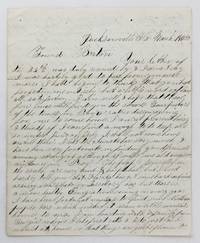
1858réf. 4106Jacksonville Fl: March 15 1858. Very good plus. 4pp. on a single folded sheet. Old mailing folds. An informative dispatch from antebellum Florida from A.C Scranton to "Friend Barton" in 1858. In his letter Scranton reports that despite some problems he is enjoying southern people and general life in Florida: "The people generally in the south are very kind & hospitibal but I need hardly to tell you that Florida has got some hard times as every new state or Territory has but thare is a more healthy Emigration coming in every year I have been fortunate anough to find some Northern people here which makes it seam a little more like home to me. I am boarding with a family from Georgia whome I like first rate & I do just as I would at home so that things are quite pleasant here considering I am amongst strangers." He then provides information on Jacksonville and then two disasters that hit his adopted hometown: "Jacksonville is the largest place in Florida & had at one time about 3000 inhabitants it is not as large as it was once some three years ago it was visited by a very destructive fire & burned nearly half of the town. Last summer there was some kind of Fever here that almost prostrated the place some called it the Yellow Fever & some the African but none could tell for certin.about a hundred & fifteen or twenty that died here in 3 months & a grate many left the town nearly all the stors wer closed not a sound of a hammer was to be heard. When cold weather came it stoped the sickness and it seams quite lively now. It has been for many years a grate resort in the winter season for invaleds but on account of the sickness last summer thare are but few this winter if it continus healthy this summer the place will revive but if not it will kill it entirely." Scranton also discusses the transportation system that served Jacksonville and the recent winding down of the Seminole Wars: "It is situated on the Johns River about 23 miles from the mouth and is connected with Charleston & Savana by a regular line of steamers that runs up the river a hundred miles to a place called Platka whare Emigrants land & then travel by land to the interior to settle the country thare is a railroad building from this place to Tallahasse the capital of the state a distance of a hundred & eighty miles which wen completed will be a little help to this place. There is also another in progress from Fernandina a new town that lays in the North East corner of the state to a place called cedar keys on the gulf side whare they intend to carry the US mail direct from New Orleans to New York insted of going round by Key west & will shorten the time considerable. Florida has cost Uncle Sam a large some of money.the government.will make a treaty with them & send them into the Indian Territory & then close the Indian war in Florida." Almost all of the Seminoles remaining in Florida relocated to Indian Territory in the year this letter was written. A wonderfully-detailed firsthand account of Jacksonville and its development and challenges during the late 1850s. A printed transcription accompanies the letter. March 15 unknown
2010réf. SBS-9780754676102ASHGATE 2010. Hardcover. New. ASHGATE hardcover
2010réf. SBS-9780754676102ASHGATE 2010. Hardcover. New. ASHGATE hardcover
1946réf. 6505Mexico: Secretaria del Trabajo y Prevision Social 1946. Very good. 120pp. Quarto. Illustrated. Original cream printed wrappers. Light wear heavier to extremities. Text toned. One of the first official studies on the subject of braceros. The study was carried out by Luis Fernández del Campo Director of Social Security for the Mexican Ministry of Labor. Fernández del Campo focuses on the characteristics that typify the Mexican migrant laborers who have emigrated to the North exploring the reasons that have prompted them to emigrate and the changes that the foreign environment in the United States has had on them. The introduction points put that "The southern region of the United States especially Texas has been for many years a market for Mexican labor cheap labor subject to multiple arbitrariness and even used to depress the salaries of North American workers and to displace them from their occupations. Cotton picking in the State of Texas was the activity that attracted the largest number of Mexican emigrant workers." The text also points out the disparities in wages for these workers depending on the region in which they work. The work contains chapters on international arrangements for migrant workers a statistical analysis of survey data gathered from braceros including their salaries and the mental disorders suffered by some migrant workers. Interspersed throughout the work are numerous photographs featuring groups of migrant workers in the application process and in the fields. A detailed informative and scarce work that is absolutely essential for the study of migrant labor in the southwestern United States. Secretaria del Trabajo y Prevision Social unknown
1878réf. 46954Red Cloud: Argus Steam Print n. d. ca 1878. 1878. First edition. First edition. 8vo. 13 1/2" x 12" illustrated map on one side plus pictures of the Farmers and Merchants Bank and the home of J. L. Miner Red Cloud and front and rear cover panels. The other side promotes Webster County and Red Cloud plus views of homes of prominent residents as well as businesses. A promotional booklet with plat map produced by the real estate firm of Warner & Warren of Republican Valley. Touted here are both Webster County and the city of Red Cloud including the businesses public schools street-car lines factories creamery real estate railroads and more. Advertisements for the Burlington & Missouri River Railway as well as the Chicago Burlington and Quincy R. R. both of which ran from Chicago to Red Cloud are included as well. The map of Webster County Nebraska shows the town of Red Cloud and sixteen of its neighboring counties as well as railroad lines rivers and property divisions. This map was produced by Fort Abstract Co. of Red Cloud said here to keep a complete set of books and plats of all towns and sub-divisions. Illustrations depict buildings in Red Cloud various residences of town citizens and appealing views of the town. Red Cloud was founded on homestead land in 1871 by a group of men including Silas Garber 1833-1905 who would go on to serve as Nebraska's Governor from 1875 to 1879. The town was named by Garber and local businessmen in honor of the chief of the Olgalala tribe of the Teton-Lakota Sioux. When Webster County was organized Red Cloud was designated as the county seat. In 1879 the Burlington & Missouri River Railway reached Red Cloud -- stimulating immigration from America's eastern seaboard and bringing a variety of cultural heritages to town including those of Germany Scandinavia Great Britain and Canada Austro-Hungary aka Bohemians and so forth. The town's cultural melting pot was marvelously depicted in the literary works of Willa Cather who lived in Red Cloud for several years with her family beginning in 1883 at the age of nine. Cather would use the town as the basis for such fictional towns as "Black Hawk" in My Antonia 1918. We could find no copies recorded in OCLC. A few small old water stains to the rear cover short separations and small punctures along old folds. Argus Steam Print, n. d. (ca 1878). unknown