New OrleansABAA

203 résultats
1902réf. 36478New Orleans: F.F. Hansell & Bro. Ltd. 1902. Original printed decorative and pictorial wrappers entitled in pink and black lettering 'Hansell's Guide to New Orleans Historical Descriptive.' Wrapper spine title. Detailed folding map frontis listing places and points of interest. Frontis engraving of area around Jackson Square one closed tear into image but no loss. 324 24 advertising pp. Original staples many illustrations Very Good. One of the most comprehensive of the contemporary city guides with detailed information maps and illustrations on almost everything about New Orleans except the Sporting District. Thompson 840. F.F. Hansell & Bro., Ltd. unknown books
1895réf. 36470New Orleans La.: Wm. Miller Printer 104 Gravier Street 1895. Original staples small bleedthrough and printed wrappers light wear. 4" x 6." 35 3 pp. Light uniform toning Very Good. Chalmette is a geographic area in St. Bernard Parish just east of downtown New Orleans. It is named after a local 18th century plantation owner. The Chalmette Benevolent Association was a mutual benefit organization whose members would "divide each other's sorrows and increase each other's joys to care for our sick and to bury our dead and to relieve our widows and orphans." Members were eligible for medical surgical and funeral assistance. The Charter from 1885 Constitution Bylaws and Rules of Order are printed through page 35. The list of officers and members is printed at pages 36-37 with an Index at page 38. Officers included a physician and an undertaker. There were about 110 members. White men between the ages of 18 and 45 years able-bodied and of good moral character who believed in a Supreme Being were eligible for membership. Members elected druggists and an undertaker; provision is made for a Health and Relief Committee and a Wake Committee. OCLC 731667710 1- LSU as of December 2019. Not in Thompson. Wm. Miller, Printer, 104 Gravier Street unknown books
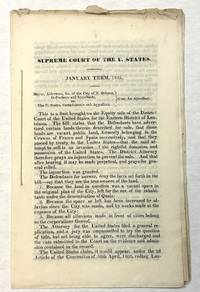
1833réf. 32746np 1833. 10 2 blank pp. Caption title as issued stitched untrimmed partly uncut. Minor dustsoiling on untrimmed edges. Else crisp and bright. Near Fine. This is the Brief submitted to the United States Supreme Court by the City of New Orleans. The City and the United States each claimed title to the same area of "vacant public land." The City sought to sell it. The United States objected on the ground that the land "formerly belonging to the Crowns of France and Spain successively passed by treaty to the United States." The U.S. District Court for the Eastern District of Louisiana enjoined the sale. The City appealed. The City's Brief an unusually detailed examination of its chain of title beginning in 1720 argues that ownership of the disputed lands did not vest in the United States under the treaty to purchase Louisiana; and that the "original plan of the City" left those lands "for the use of the inhabitants." The Supreme Court agreed. Its opinion by Justice McLean of Ohio is officially reported at 35 U.S. 662 1836. Daniel Webster and Edward Livingston-- who had spent years fending off U.S. claims to New Orleans alluvial lands-- represented the City; Attorney General Benjamin Franklin Butler was counsel for the United States. OCLC records only facsimiles as of August 2016 evidently from an original residing at the Harvard Law School. unknown books
1807réf. 32236City of Washington: A. & G. Way 1807. 7 1 blank pp. Toned with modern staples Good. Secretary of War Henry Dearborn advises John Randolph Chairman of the House Ways and Means Committee that he is "unable to state with correctness the present strength of the regular force now under general Wilkinson at New Orleans." On the best mode of defending that City he advises that "no system of fortification within our power at or about the city could be of any essential use for its defence." Secretary of the Navy Robert Smith reports on the naval force present at New Orleans and recommends deploying additional gun-boats and batteries. AI 13890 4. A. & G. Way unknown books
1873réf. 29323New Orleans: Picayune Steam Press 1873. Original printed wrappers clean but with a bit of corner wear with wrapper title as issued. 27 1 blank pp. Minor wear clean text Very Good plus. offered with Typescript Letter laid in from New Orleans March 22 1873 1 page: 'Dear Sir: We assume the liberty to commend to your patriotism and to your love of our common country the accompanying Report.' It is signed in type by Thos. A. Adams Chairman and five others comprising the Executive Committee of the Committee of Two Hundred Citizens. Fine. The Committee recites "the discontents pressures and grievances under which the people of the State were suffering from the unconstitutional and revolutionary action of a portion of the federal authorities" especially the federal court's intervention in the 1872 elections in favor of the Pinchback government. The elections produced rival claimants for the governor's office and sparked the Colfax massacre in which 280 blacks were killed some while attempting to surrender to armed whites. The Report is signed in type by Thomas A. Adams Chairman and five other members of the Executive Committee. FIRST EDITION. 136 Eberstadt 391. Thompson 1232. Picayune Steam Press unknown books
1809réf. 25953Washington: A. & G. Way 1809. 53 3 blanks pp. With the signature crossed out of John Smilie probably the Pennsylvanian then serving in Congress and an opponent of slavery. Contemporary signature also of Samuel Burch. Bound in modern cloth bit of lower spine discoloration. A bit of light spotting to the title page light numerical accession number at top margin of page 3 else a clean text. Very Good. Jean Gravier a major landowner in New Orleans claimed title to a river bank known as a batture. The Mississippi River covered it for three months of the year but during the other nine months it was dry and from time immemorial used by the public for its alluvium deposits and other purposes. Gravier's claims triggered litigation against the City which refused to acknowledge his title. In 1807 the Louisiana Superior Court awarded judgment to Gravier. The unpopularity of the decision resulted in years of acrimony and further litigation which Edward Livingston Gravier's successor in title carried on against the City as well as the national government. This publication offers a wealth of material in the form of public documents and affidavits gathered for the litigation demonstrating the nullity of Gravier's title. FIRST EDITION. Cohen 11679. AI 18892 3. Not in Harv. Law Cat. Marvin Marke Eberstadt Thompson. A. & G. Way unknown books
1891réf. 19362New Orleans 1891. Original printed wrappers chipped at extremities stitched 40pp. Scattered soil Good. The Board works on problems involving sanitary conditions disease transportation by rail and steam parks and postal service. Reports on agricultural and manufactured items are included. unknown books
1868réf. 1909040th Cong. 2d Sess.: HED172. 1868. 3 1 blank pp. Disbound. Caption-title as issued. Very Good. HED172. unknown books
1915réf. WRCAM55273New Orleans 1915. 96pp. printed throughout in red and black. 12mo. Original printed pale blue wrappers expertly rebacked in matching blue paper. Soft vertical crease to text minor toning upper outer corner of one leaf repaired. Very good. The last edition of the series of guides to the bawdy houses and prostitutes of New Orleans issued between 1900 and 1915 and known collectively as the "Blue Books" of Storyville. Heartman identifies this is as the twelfth or thirteenth edition. Pamela Arceneaux in GUIDEBOOKS TO SIN condenses Heartman's last two editions into the same print run having compared Heartman's two editions and finding them identical. Arceneaux further believes that this edition could have been printed as early as 1913 based on intertextual clues found during her research cross-referenced with contemporary New Orleans city directories. The red-light district of New Orleans operated in a very public way until the U.S. government suppressed it at the time of the American entrance into the First World War. This guide lists women by address followed by advertisements for brothels; all interspersed with advertisements for liquor and cigars. Included lists of burlesque houses names of landladies and names of prominent women in the trade. The prostitutes are often identified by race most commonly white black and octoroon. The earliest such guide appeared about 1896 and they were produced almost annually from 1900 to 1915. During this period all of the guides issued under the title BLUE BOOK were the product of Billy Struve allegedly from the second floor of Lulu White's saloon at the corner of Basin Street and Bienville though that story is likely apocryphal. More likely Struve assembled the BLUE BOOKS from his management offices at Anderson's a saloon owned by the "Mayor of Storyville" Tom Anderson located at the corner of Basin and Iberville where according to the city directories he also resided for most of the Storyville years. An advertisement for Tom Anderson's New Cabaret and Restaurant is found on the rear wrapper of this edition. The two photographs include the facade of Emma Johnson's famous "Studio" and a portrait of the Oriental Danseuse Rita Walker. Owing to their content and heavy use all BLUE BOOK guides are extremely rare. A nice example. HEARTMAN BLUE BOOKS XII/XIII. ARCENEAUX GUIDEBOOKS TO SIN 10. unknown books
1915réf. WRCAM55407New Orleans 1915. 96pp. printed throughout in black. 12mo. Original pale blue wrappers printed in red. Spine sunned minor edge wear. Internally clean. Very good plus. The last edition of the series of guides to the bawdy houses and prostitutes of New Orleans issued between 1900 and 1915 and known collectively as the "Blue Books" of Storyville. Heartman identifies this is as the twelfth or thirteenth edition. Pamela Arceneaux in GUIDEBOOKS TO SIN condenses Heartman's last two editions into the same print run having compared Heartman's two editions and found them identical. Arceneaux further believes that this edition could have been printed as early as 1913 based on intertextual clues found during her research cross-referenced with contemporary New Orleans city directories. Further the textblock of this copy is printed entirely in black unlike the normal red-and-black printing of most other copies of this edition. Arceneaux explains on p.105 of GUIDEBOOKS TO SIN: "There appears to have been a printing of this edition in which all of the text and design elements of the interior pages are printed only in black ink with none of the rubrication seen in THNOC's The Historic New Orleans Collection's seven identical copies. I have examined a copy of this item that is in private hands and its size the cover printing and the quality of the paper are exactly the same as THNOC's seven. There is one other exception - three staples are used to bind the text block rather than the usual two seen in most issues. The printing on the interior pages the overall wear and the accumulation of rust around the staples leads me to believe that even lacking the red-ink highlights of the others this one is also of the Storyville period." The only way in which the present copy differs from the above description is in the number of staples - the present copy has two as seen in the red-ink issue. Arceneaux does not postulate about the differences in this printing of the Blue Book from the red-ink version but we might propose that the all- black-ink version of the Blue Book was perhaps a trial printing executed at the beginning of the period of this edition or likely one of the very latest productions of this edition once the printer had exhausted the red ink and there was still demand for the guidebook. The red-light district of New Orleans operated in a very public way until the U.S. government suppressed it at the time of the American entrance into the First World War. This guide lists women by address followed by advertisements for brothels; all interspersed with advertisements for liquor and cigars. Included are lists of burlesque houses names of landladies and names of prominent women in the trade. The prostitutes are often identified by race most commonly white black and octoroon. The earliest such guide appeared about 1896 and they were produced almost annually from 1900 to 1915. During this period all of the guides issued under the title BLUE BOOK were the product of Billy Struve allegedly from the second floor of Lulu White's saloon at the corner of Basin Street and Bienville though that story is likely apocryphal. More likely Struve assembled the BLUE BOOKS from his management offices at Anderson's a saloon owned by the "Mayor of Storyville" Tom Anderson located at the corner of Basin and Iberville where according to the city directories he also resided for most of the Storyville years. An advertisement for Tom Anderson's New Cabaret and Restaurant is found on the rear wrapper of this edition. The two photographs include the facade of Emma Johnson's famous "Studio" and a portrait of the Oriental Danseuse Rita Walker. Owing to their content and heavy use all BLUE BOOK guides are extremely rare. A nice example of a rarely-encountered variant of the last Storyville BLUE BOOK. HEARTMAN BLUE BOOKS XII/XIII. ARCENEAUX GUIDEBOOKS TO SIN 10. unknown books
1807réf. WRCAM3793New Orleans: Printed by Bradford & Anderson 1807. 63pp. Modern half morocco and cloth. Foxed and tanned. Good. A printing in parallel English and French of some important post-cession acts including those confirming validity of original Spanish and French grants and so forth. Although these acts are frequently found bound with the ACTS PASSED AT THE SECOND SESSION. they were printed and paginated separately. A good example of the printing work of Bradford and Anderson. Bradford arrived in New Orleans in 1804 rising to the post of printer to the Territory in 1805. The patronage was withdrawn three years later because Bradford and Anderson repeatedly attacked Gov. Claiborne in their newspaper the ORLEANS GAZETTE. McMURTRIE LOUISIANA 99. SHAW & SHOEMAKER 11502 13789. FOOTE p.7. JUMONVILLE 144. THOMPSON 1078. Printed by Bradford & Anderson hardcover books
1862réf. WRCAM15106New Orleans 1862. 29pp. Original front printed wrapper rear lacking. Inscription on front wrapper wrap browned and gnawed old fold. Good. In half calf and cloth slipcase scuffed. Prints the correspondence between Commodore Farrague Maj.-Gen. Butler and the Mayor of New Orleans concerning the occupation of the city as well as relevant General Orders. An important document relating to the Federal seizure of New Orleans. hardcover books
1871réf. 51895New Orleans: Printed at the Commercial Bulletin Office 131 Gravier Street 1871. First edition. 31 pp. 1 vols. 8vo. Printed yellow wrappers. Minor coiling else fine. First edition. 31 pp. 1 vols. 8vo. Printed at the Commercial Bulletin Office, 131 Gravier Street unknown books
1915réf. 140940342New Orleans 1915. Very Good. ca. 1915. 96 pp. The last edition of the famed "Blue Books" a series of directories to houses of prostitution in New Orleans's red-light district Storyville. Bound in publisher's original pale blue wraps printed in red bound with three staples and text printed only in black. As bibliographer Pamela Arceneaux explains in Guidebooks to Sin "There appears to have been a printing of this edition in which all of the text and design elements of the interior pages are printed only in black ink with none of the rubrication seen in THNOC's The Historic New Orleans Collection's seven identical copies. I have examined a copy of this item that is in private hands and its size the cover printing and the quality of the paper are exactly the same as THNOC's seven. There is one other exception - three staples are used to bind the text block rather than the usual two seen in most issues. The printing on the interior pages the overall wear and the accumulation of rust around the staples leads me to believe that even lacking the red-ink highlights of the others this one is also of the Storyville period." Very Good with some toning and light wear to wraps. Colloquially named for the city alderman Sidney Story much to his chagrin who sponsored legislation to confine city-sanctioned prostitution to a 38-block area just north of the French Quarter the red-light district of Storyville lasted form 1897-1917. During that time guide books such as these were often available in barbershops and saloons. This lists burlesque houses prostitutes by race such as white black octoroon and landladies interspersed with ads for cigars and liquor and contains a notice that this guide must not be mailed as the distribution of suggestive material by the United States Postal Service was banned. unknown books
1940réf. 74599New Orleans: Antoine Restaurant. Very Good. 1940. Softcover. SOUVENIR DU RESTAURANT ANTOINE FONDE EN 1840. Roy L. Alciatore Proprietor. New Orleans Louisiana. No Date. 43 p. This pamphlet is soft-bound in white printed wrappers - contents are bright with illustrations - included 2 original postards oysters a la rockefeller being served 1938 . Antoine Restaurant paperback books
1833réf. 32746np 1833. 10 2 blank pp. Caption title as issued stitched untrimmed partly uncut. Minor dustsoiling on untrimmed edges. Else crisp and bright. Near Fine. This is the Brief submitted to the United States Supreme Court by the City of New Orleans. The City and the United States each claimed title to the same area of "vacant public land." The City sought to sell it. The United States objected on the ground that the land "formerly belonging to the Crowns of France and Spain successively passed by treaty to the United States." The U.S. District Court for the Eastern District of Louisiana enjoined the sale. The City appealed. The City's Brief an unusually detailed examination of its chain of title beginning in 1720 argues that ownership of the disputed lands did not vest in the United States under the treaty to purchase Louisiana; and that the "original plan of the City" left those lands "for the use of the inhabitants." The Supreme Court agreed. Its opinion by Justice McLean of Ohio is officially reported at 35 U.S. 662 1836. Daniel Webster and Edward Livingston-- who had spent years fending off U.S. claims to New Orleans alluvial lands-- represented the City; Attorney General Benjamin Franklin Butler was counsel for the United States. OCLC 1297855642 "Reproduction of the original from Harvard Law School Library" as of May 2026. unknown
1873réf. 29323New Orleans: Picayune Steam Press 1873. Original printed wrappers clean but with a bit of corner wear with wrapper title as issued. 27 1 blank pp. Minor wear clean text Very Good plus. offered with Typescript Letter laid in from New Orleans March 22 1873 1 page: 'Dear Sir: We assume the liberty to commend to your patriotism and to your love of our common country the accompanying Report.' It is signed in type by Thos. A. Adams Chairman and five others comprising the Executive Committee of the Committee of Two Hundred Citizens. Fine. The Committee recites "the discontents pressures and grievances under which the people of the State were suffering from the unconstitutional and revolutionary action of a portion of the federal authorities" especially the federal court's intervention in the 1872 elections in favor of the Pinchback government. The elections produced rival claimants for the governor's office and sparked the Colfax massacre in which 280 blacks were killed some while attempting to surrender to armed whites. The Report is signed in type by Thomas A. Adams Chairman and five other members of the Executive Committee. FIRST EDITION. 136 Eberstadt 391. Thompson 1232. Picayune Steam Press unknown
1871réf. 51895New Orleans: Printed at the Commercial Bulletin Office 131 Gravier Street 1871. First edition. 31 pp. 1 vols. 8vo. Printed yellow wrappers. Minor soiling else fine. First edition. 31 pp. 1 vols. 8vo. Printed at the Commercial Bulletin Office, 131 Gravier Street unknown
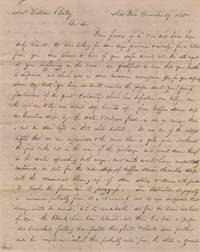
1835réf. BK0025New York City 1835. Autograph letter signed by the merchant firm Baker & Moore 4 pp. addressed to General William Battey care of Dr. Charles Luzenberg at the Franklin Infirmary on the Pontchartrain Railroad New Orleans. Stampless folded letter with red circular "NEW-YORK" December 31 datestamp and manuscript "25" rate. Appx. 1000 words. File folds; otherwise very good. A lengthy commercial letter written thirteen days after the Great Fire of New York describing the destruction of the city's mercantile district and tracing its immediate effects through insurance capital banking commodity prices and trade with New Orleans. Written by the New York firm of Baker & Moore to their associate William Battey the letter provides a near-contemporary account of the fire an assessment of the city's financial resilience and instructions for exploiting the resulting fluctuations in the markets for brandy wine raisins tobacco iron and copper. The fire began on the evening of December 16 during an extraordinary cold spell and northwest gale. Frozen hydrants wells cisterns and hoses left the city's volunteer fire companies largely unable to contain it. By the following day the fire had destroyed much of the commercial district between Wall Street and the East River including the Merchants' Exchange and hundreds of stores and warehouses. Buildings were eventually demolished with gunpowder to create firebreaks at Exchange Place and Coenties Slip. Contemporary estimates varied but approximately 674 buildings were destroyed with losses eventually placed at twenty million dollars or more.1 Baker & Moore begin by describing the extent of the burned district the severe weather and the use of explosives to arrest the flames: "Since my last you have no doubt received the paper sent you giving particulars of the great calamity which has befallen our City. On the 16th our City was about half burned up. From Coffee House Slip to Coenties Slip by the water & William Street is all in ruins. There is but one store left in that whole district. It was one of the coldest nights that we ever experienced & the wind blew a gale from Northwest. The fire broke out in the rear of the Exchange and went down through to the water spreading both ways and would have undoubtedly continued on but for the wide slips of Coffee House & Coenties Slip with the occasional blowing up of some stores & houses with powder to check the flame in its progress" The account quickly turns from the physical destruction to the distribution of its financial losses: "The destruction of property is immense probably from 10 to 15000000$ and it was supposed that many would be ruined but tis remarkable so far we have not heard of one. The Banks have been liberal and there has been a proper and benevolent feeling manifested throughout & should some further aid be brought in which probably will from the State or general government we think there may be no failures. The Insurance companies most of them are ruined and the principal loss is in Insurance capital. The loss will in some instances fall upon those who cannot well afford it. Many widows & orphans have had their all taken from them. The loss is large and New York has met with a great calamity but she is made of such materials & her facilities are so large & varied that the mercantile community will bear up under more than any other place in the Union & we think in one year's time it will be almost forgotten." The confidence expressed here correctly anticipated the city's rapid commercial recovery. Banks and government agencies extended credit and payment terms rebuilding began almost immediately and the burned district was reconstructed with new countinghouses and warehouses. The disaster also exposed the inadequacy of New York's water supply and firefighting arrangements contributing to later infrastructure and institutional reforms. Baker & Moore then apply the disaster to their own trade with New Orleans. Hundreds of warehouses and their contents had been destroyed increasing prices of imported foods wines and spirits. The firm instructs Battey to use the New York price current to obtain higher prices for their consignments: "This fire has advanced most all kinds of goods. Raisins are worth here $3-$3½. Wines such as Mess. Eastman's have advanced with us 4-6 cents. So many hundred casks destroyed must advance it and make it higher through the season. More than one half the Brandy was consumed tis now selling at $1.75 and some are asking $2. We wish what we sent you sold & this will be a favorable time to sell-show N.Y. price current-and get as good a price as you can. There will we think be no want of Brandy. Those raisins we think you had better dispose of at once. We think from N.O. current must pay something handsome for us. In regard to old Iron we find good old iron will always sell for the money for 112½ gross hundred equal to 1c per lb. Cast & wrought are same price. If you can come across a lot to do you may make it answer & pay us well. Copper if you can buy low enough may pay something. We thought hay might pay out but tis so high we cannot buy to send. We are of opinion that goods generally will be higher in consequence of this fire yet when we consign goods we wish them sold when they can to pay and we wish Eastman & Co. to sell and close up our affairs in their hands." The concluding paragraph briefly introduces events in Florida. The Second Seminole War had begun that month following mounting resistance to the forced removal of the Seminole people from Florida. Baker & Moore believed that the conflict might affect the movements of a brig expected in New Orleans: "We observe that trouble is anticipated with the Indians in Florida & if so our Brig may not get a load of them & be in N. Orleans earlier than we anticipated tis uncertain what will be the result they may detain her longer until they can get them on board." The wording appears to indicate that the vessel was expected to transport a group of Native people although the letter does not identify the brig its owners or the precise circumstances of the contemplated voyage. The recipient General William Battey was then in New Orleans apparently acting as Baker & Moore's commercial representative while also attending to his health at the Franklin Infirmary. The firm gave him considerable discretion to supervise consignments collect funds purchase goods when opportunities arose and forward current market information to New York. The address places him in the care of Dr. Charles Aloysius Luzenberg who founded the Franklin Infirmary with municipal support in 1835 and subsequently helped establish the Medical College of Louisiana the forerunner of Tulane's medical school.2 Baker & Moore appear to have been commission or importing merchants whose own affairs escaped direct damage but whose trade was immediately altered by the destruction of competing inventories. The letter thus follows the fire from the burned commercial district into the decisions of a New York firm and its representative in New Orleans. A substantial contemporary account of the Great Fire of 1835 documenting the destruction of New York's commercial center and the disaster's immediate movement through insurance banking commodity markets interregional credit and trade with New Orleans. We find no similar examples on the secondary market or in auction records. 1 Herbert Asbury "The Great Fire of 1835" The New Yorker July 26 1930. 2 Louisiana Historical Association "Luzenberg Charles Aloysius" in Dictionary of Louisiana Biography accessed August 2 2026 https://www.lahistory.org/resources/dictionary-louisiana-biography/dictionary-of-louisiana-biography-l/. . unknown
1903réf. 019998New Orleans: Dunlop Publishers The L. Graham Company Ltd. Printers 1903. Book. Very Good. New Cloth. First Edition. 8vo - over 7¾" - 9¾" tall. 150p. Profusely illustrated this was is an ex- institutional library book which has been expertly restored the original leather binding has been replaced with new gold embossed black cloth the original front cover has been re - mounted on the new cloth blind stamp on title page some pages edge chipped minor repairs quite incredible full page photographs of early New Orleans buildings group photos named many police from various precincts etc. Dunlop Publishers, The L. Graham Company Ltd., Printers Hardcover
1838réf. 707111838. LOUISIANA. NEW ORLEANS. Gibson's Guide and Directory of the State of Louisiana and the Cities of New Orleans & Lafayette. New Orleans: John Gibson 1838. viii384pp. plus 12pp. of ads. and numerous illustrations. Lacks frontispiece and map. Contemporary 3/4 sheep and marbled boards. Rebacked in matching gilt-decorated black calf boards lightly rubbed light scattered foxing. Later bookplate on front pastedown. A very good copy. Spear p. 225. Jumonville 1006. An early New Orleans directory containing "historical accounts of Louisiana and New Orleans" - Spear. Includes detailed information on buildings such as the Sugar Refinery and Orleans Cotton Press accompanied by illustrations. unknown
1840réf. 707101840. LOUISIANA. NEW ORLEANS. New-Orleans Directory for 1841; Made by the United States Deputy Marshalls While Taking the Late Census. Containing the Names Professions and Residences of All the Inhabitants of the City and Suburbs of New-Orleans Lafayette and Algiers. New Orleans: Michel & Co. 1840. vii1366pp. 12mo. Contemporary half sheep and marbled paper spine gilt. Boards rubbed spine chipping. Contemporary ownership signature on boards and flyleaves. Bookplate on front pastedown; faded ownership stamp on first leaf. Heavy foxing. Good. Scarce New Orleans directory containing a complete list of citizens and their professions. SABIN 53344. SPEAR p.225. unknown
2017réf. Gyan-9789353153762Facsimile Publisher 2017. Hardcover. New. 22.59 x 14.34 x 6.86 cm. English Facsimile Publisher hardcover
2017réf. Gyan-9789353153762Facsimile Publisher 2017. Hardcover. New. 22.59 x 14.34 x 6.86 cm. English Facsimile Publisher hardcover
réf. 0-25455Foto all'albumina 1890 circa di cm. 18 x 11 su cartoncino rigido animata immagine un pò debole. unknown