1 486 résultats
1908réf. 2201030038xbvkBlackburn, R. Denham & Co. / Southport, Shackerley Literary Agency; 1908. viii pages incl. foretitlepage, photographic frontispice-plate on glossy paper, titlepage, Dedication, 'Prelude', 'Contents' and prefaces to the first (''Feb. 16th, 1907.'') and this second edition (''Jan. 1st, 1908.''); 92 pages, except the photoplate printed on untrimmed handmade rag-paper throughout. - Publisher's illustrated cardboard-wrapper, titled in red and black, ornamentally framed; 8vo.(ca. 19,5 x 13,5 cm).
1791réf. 7496BBElberfeld, Chr. Wilhelm Giesen, 1791. 8°. XX S., (2) Bl., 608 S.; XXXIX, 574 S.; (4) Bl., 400 S. Mit gest. Portrait. Pappband der Zeit mit verg. Rückensch. + Wichtig: Für unsere Kunden in der EU erfolgt der Versand alle 14 Tage verzollt ab Deutschland / Postbank-Konto in Deutschland vorhanden +, bild 3 Bände.
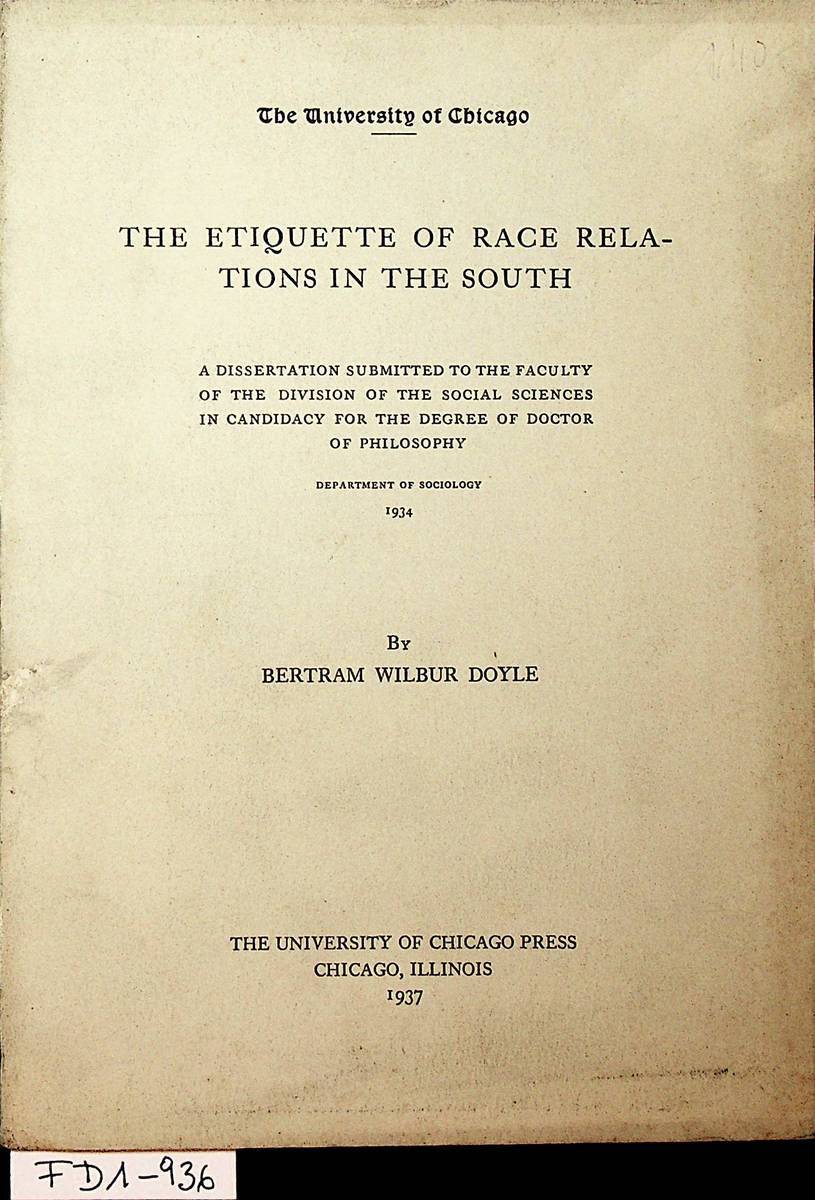
1937réf. FD1-936Chicago, Univ. of Chicago Pr, 1937. original Broschur, 8?, XXV, 249 pages, a good copy
1998réf. 40981BBArmonk, NY/London, Publishers: Sharpe, 1998. Original Flexible Boards. Very good Condition with only minimal Signs of Usage at the Cover. No Markings in the Text! No Underlinings! No Owner's Note! ('Latin American Realities').
1984réf. Ge1324New York/London, W.W. Norton, 1984. Kartoniert. Ebd. u. Schnitt mit minimalen Gerbrauchs- u. Lagerspuren.- Sonst sehr gut erhaltenes Expl. 8° Buch Softcover
1895réf. KULT0764Dresd. u. Lpz., Reißner 1895. VI, 200 S., HLn. d. Zt., Kanten leicht berieben u. abgewetzt, Ecken etwas bestoß., am vord. Innendeckel Besitzerstemp., vord. Vors. fingerfl., neu beschnitten.
1836réf. 011073, 1836. Erstausgabe Goldgeprägter Halblederband Solide, Materiell Gut
1850réf. 143199New York: M.B. Brady,, 1850. Format (Bildoval): 29 x 24,5 cm. Blattgröße: 37,5 x 27,5 cm.
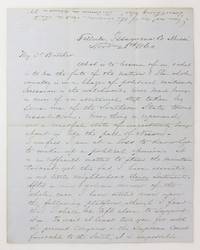
1860réf. 6445Tallula Ms: November 28 1860. Very good. 4pp. on a bifolium. Minor soiling and wear along old folds. Otherwise clean. Written in the immediate aftermath of the Election of 1860 this letter presents a ground-level account of Southern uncertainty at the onset of the secession crisis with a very notable section on the Texas slave insurrection panic of 1860. The writer Isaac E. Nicholson lived in a region of the Mississippi Delta with a large population of enslaved people and he attempts to balance a lingering attachment to the Union with mounting fears of insurrection political collapse and economic instability. The letter moves between national politics local anxieties reports of violence in Texas and personal family concerns. He begins by describing the intensity of the moment: "The whole country is in a blaze of political excitement. Secession is the watchword." Despite this Nicholson positions himself at least provisionally against immediate disunion advocating delay and negotiation: "To wait at least two yrs.and in the mean time make certain demands upon the Northern States. This will make it a test question.whether there is any spirit of compromise left." He adds that "With the present Congress & the Supreme Court favorable to the South it is impossible for her to suffer materially" though he concedes that he may be "Left alone to support it." That moderation is undercut by a stark expression of racialized fear: "We who live in a country with about 30 blacks to one white man slumbering over a volcano.cannot long remain silent." He continues "It is no trivial matter.to retire at night with a probability of being murdered before morning. This thing has a reality here." He concludes that "The fine alternative of Revolution.will become necessary unless their aggressions.cease." The most dramatic section concerns events in Texas where Nicholson reports that his brother suffered heavy losses during unrest in Dallas: "His office & furniture & his whole library were destroyed by fire" and "His dwelling house was set on fire at three different times." He attributes the destruction to "Abolition Preachers.forced to leave for tampering with slaves" who "Endeavored to avenge themselves" adding that "The whole town of Dallas West was laid in ruins. They were both hung by a mob." Financial losses are detailed as well: "About $2000" destroyed followed by news that a New Orleans firm holding "$4000 deposited. had failed." This account corresponds to the unrest surrounding the Texas slave insurrection panic of 1860 during which fires in Dallas were widely blamed on enslaved people and Northern abolitionists and suspected agitators including Methodist ministers were expelled or killed by vigilante groups. Three men -- Patrick Jennings Sam Smith and Cato -- were killed in a public execution near Dealey Plaza now renamed Martyrs' Park in their honor. Although Nicholson presents the destruction as organized retaliation historians have generally concluded that the fires were likely accidental with the conspiracy narrative emerging from rumor and fear. His description reflects how these events circulated in Southern correspondence at the time combining real violence with exaggerated or misinterpreted causes and the passages are notable for the blending of what was presumably fact -- his brother's house catching on fire -- with the fiction of abolitionists arsonists. We find no records of correspondence or any material relating to these events in auction records or on the market at the time of writing. Overall a scarce account overall of a tragic episode in Texas history and the rumor mill that fueled it. November 28 unknown
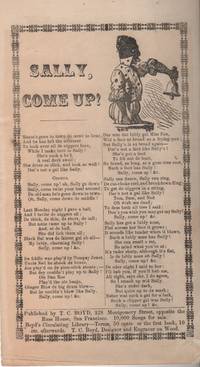
1860réf. 43380San Francisco: T.C. Boyd 1860. Near fine. Racist slavery-era broadside printed and designed by one T.C. . Boyd featuring a drawing and lyrics to a ballad which begins: "Massa's gone to town de news to hear / And he has left the overseer / To look over all de nrs here / While I make love to Sally!" Boyd notes he had 10000 such sheets for sale at his shop. Broadside 8.5" by 4.5". Printed from type and wood engraving. Very near fine with trivial crease to edges. T.C. Boyd unknown
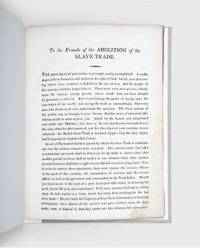
1807réf. 190225London: W. Flint 1807. First edition published soon after the abolition of the slave trade in the British Empire appealing for Britain to make the international end of the trade a core part of its aims in the ongoing Napoleonic Wars. Quarto 248 x 194 mm 4 pp. Recent white and grey boards printed paper label to front cover. Light stain at bottom fore corner and light spotting: a good copy. hardcover
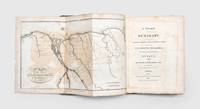
1807réf. 177680London: Richard Phillips 1807. First edition of this account of the British colonies within modern-day Guyana. Bolingbroke was a staunch supporter of the Transatlantic slave trade which he discusses in Chapter Five and dedicated this work to the colonial secretary William Windham. Henry Bolingbroke 1785-1855 was a Norfolk merchant who first visited Demerara in 1798. This region had been under the control of the French and Dutch until it was captured by the British in 1796. Bolingbroke remained in the colony until 1805; he then travelled to Surinam in Dutch Guiana to become Deputy Vendue Master in 1807 responsible for public sales and auctions including those of enslaved people. He was one of the 16 MPs who voted against the abolition of slavery in March 1807. In Chapter Five Bolingbroke writes about slavery and what he viewed as its economic importance. In his dedication to Windham 1750-1810 he praised him for relaxing monopoly restrictions and "resisting the abolition of a liberty essential at new settlements of importing additional labourers" p. iii. Quarto pp. xii 400. Folding engraved map. Original green paper-covered boards rebacked modern spine label edges untrimmed. Signature of one George Atkinson on front pastedown a few pencil notes internally. Spine head stabilized boards marked foxing and toning to map and contents two small closed tears to map repaired offsetting to title page: a very good copy. Sabin 6182. hardcover
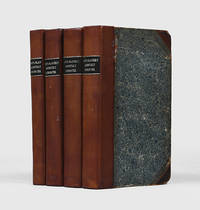
1827réf. 163198London: Printed for the London Society for the Mitigation and Abolition of Slavery in the British Dominions 1827-32. A new age of abolitionist agitation First collected editions being the full run under its original title of Zachary Macaulay's abolitionist magazine the leading organ of British abolitionist thought and campaigning. It was afterwards renamed the Anti-Slavery Reporter and has lasted under changing titles to this day. The journal "systematically collected information on the abuses of slavery" ODNB. "Highlighting the rise of abolitionist petition drives antislavery discussions in church and government venues and debates over unfree labor throughout the empire the paper celebrated a new age of abolitionist agitation" Newman pp. 44-45. The volumes collect the monthly issues from June 1825 to December 1831 with collective title pages and contents tables. 4 vols. octavo 216 x 129 mm. Contemporary half calf rebacked black morocco labels marbled sides edges speckled brown. Wear at extremities inner hinges reinforced a little browned and spotted: still very good copies. Richard S. Newman Abolitionism: A Very Short Introduction 2018. unknown
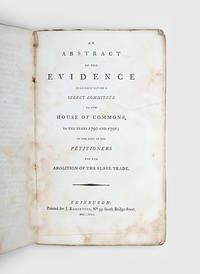
1791réf. 180598Edinburgh: Printed for J. Robertson 1791. Stepping up the campaign against slavery Second Edinburgh edition of this best-selling report on the colonial slave trade including a version of among the most famous abolitionist images the cross-section depicting the enslaved individuals transported aboard the Brookes. The Abstract is the first abolitionist work to ground its arguments not on biblical appeals or forceful rhetoric but on documented eyewitness accounts. Until 1790 the abolitionist campaign had been channelled through pamphlet and pulpit. After 1790 abolitionists turned to the new technique of mass petition campaigns against Parliament. The Abstract publishes the testimonies of the witnesses called by the petitioners arranging them thematically by chapter. Among others the select committee called planters traders naval officers and doctors. "The abolitionist petition campaign reached an apex during 1791-1792 where an unprecedented 519 abolitionist petitions coming from all over Britain were delivered to Parliament. Some 400000 persons signed these petitions 1 out of every 11 adults with Manchester alone contributing 20000 names from an adult population of about 30000" Fogel p. 212. Octavo pp. iv 128. Large folding plan of a slave ship folding map of the western coast of Africa tables in the text. Original paper wrappers spine lettered in manuscript ink edges uncut. Housed in custom orange cloth box. Contemporary presentation inscription from "Mr. Campbell" to "John White" on the front cover. Rubbing and chipping minor loss to spine and extremities browning and foxing to contents slight offsetting to plates folding plan loose: just about a very good fragile copy. ESTC N29168. William Fogel Without Consent or Contract 1989. hardcover
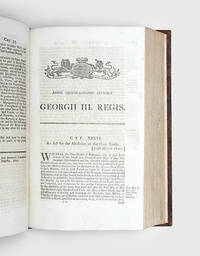
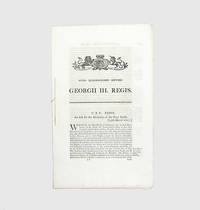
1807réf. 182125London: printed by George Eyre and Andrew Strahan 1807. The African Slave Trade. is hereby utterly abolished prohibited and declared to be unlawful First edition of one of the most consequential acts of legislation in world history abolishing the slave trade within the British Empire. The Act the culmination of many years of campaigning by British abolitionists ended two centuries in which Britain took the pre-eminent role in the transatlantic slave traffic. The act paved the way for other European empires to abolish the trade and for Britain to use its navy to intercept slave ships which effectively ended the transatlantic slave trade by the latter half of the century. However the act did not end slavery in the British Empire which did not follow until 1833. Parliamentary acts were issued individually and in collected format printed from the same type. This copy includes the full acts for 1807 comprising the only session of the Third Parliament with the first session of the Fourth the second session was held in 1808 together with the separately published report on vaccination. It was bound for use by the civic authorities of the town of Elgin in Scotland. 3 parts in 1 vol. folio 289 x 181 mm pp. 16 466 1; 14 578 2 blank; 16. Contemporary sprinkled calf twin red and green morocco labels "Town of Elgin Acts of Parliament / 1807" edges speckled blue. Pencilled notation at head of title page. Neatly restored at extremities very minor foxing and finger-soiling to contents. A very good copy. unknown
1807réf. 184142London: Printed by George Eyre and Andrew Strahan 1807. The African Slave Trade. is hereby utterly abolished prohibited and declared to be unlawful First edition of one of the most consequential acts of legislation in world history abolishing the slave trade within the British Empire. This copy is a well-preserved example of the separate folio printing. From 1807 enslaved persons could no longer be bought or sold within the British Empire while the Royal Navy was empowered to target vessels engaged in slave transportation a task it took up with vigour. Parliamentary acts were issued in collected annual volumes and as individual pamphlets all printed from the same type. As King's Printers Eyre & Strahan held the exclusive rights to publish and sell parliamentary statutes and this pamphlet would have been among those sold at their offices near Fleet Street. Folio 319 x 197 mm pp. 317-326 2. Woodcut headpiece. Stab-sewn as issued edges uncut. Minor offsetting else a near-fine copy. unknown
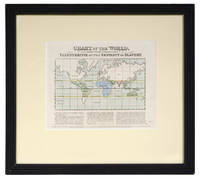
réf. 94420London Joseph Cross n.d. but c. 1825. . Hand coloured engraved map. The map shows the extent 30° north and south of the Equator in which sugar is grown. Australia is still shown as New Holland. 29.8 cm x 23.7 cm 11¾" x 9¼". Framed and glazed. Scarce colour-coded map concerning the sugar trade and its link to slavery. The section shaded yellow is the appropriate climate for the growing of sugar. The section shaded red is the area from which Britain may obtain sugar cheaply parts of South America and the West Indies under British rule. The blue section shows where Britain is unable to obtain sugar due to the devastating effects of the slave trade. The pink and green areas are those from which the sugar trade is limited by high duties and restrictions. The argument is that the duties and restrictions are there to protect the slave trade and ultimately damage the British economy. James Cropper was a successful and wealthy Quaker merchant philanthropist and disciple of Adam Smith. A major force in the anti-slavery movement he believed that eliminating tariff protections would lead to the end of slave labour in the West Indies. Cropper himself had interests in East Indian sugar and therefore stood to benefit from the reduction of tariffs which colored his role in the abolition movement. Nevertheless 'in Cropper's mind the intensity of Quaker Quietism had fused with the economic optimism of Adam Smith. Anti-slavery confirmed this union endowing laissez-faire with an immediate moral and spiritual purpose and enriching his faith in the inevitability of human progress' Davis James Cropper and the British Anti-Slavery Movement 1961. London, Joseph Cross, n.d. [but c. 1825]. unknown
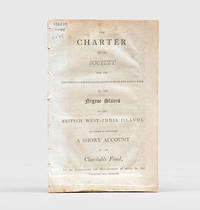
1794réf. 126550London no printer 1794 or later. First edition variously dated by ESTC and WorldCat between 1794 the date given at the end of the preliminary "Short Account of the origin and present state of the charitable fund" and 1823. The short account dated March 1794 is followed by a tipped in leaf reporting on the first meeting of the society which took place on Thursday April 3 1794 electing the Lord Bishop of London as president. The Charter of the Society 18 pages in length is dated at Westminster "this thirtieth Day of October in the thirty-fourth Year of our Reign" which again falls in 1794. Octavo 190 x 123 mm pp. ix 18. Sometime in a pamphlet vol. now disbound. Spine shows evidence of earlier binding sometime folded vertically; title lightly dust soiled page ix trimmed down and tipped onto p. viii; a good copy. Sabin 85881. unknown
1858réf. 660371858. Dividing Prize Money After the Capture of a Slave Ship Slavery. United States. In the Senate of the United States. February 21 1858-Ordered to Be Printed. Mr. Polk Made the Following Adverse Report To Accompany Bill S. C. of C. 108.: The Committee of Claims To Whom was Referred the Opinion of the Court of Claims in the Case of O.H. Berryman and Others Report: The Claimants in this Case are the Officers and Crew of the United States Schooner "On-Ka-Hy-E" drop-head title. Washington DC: S.n. 1858. 13 pp. Octavo 9" x 5-1/2". Disbound light rubbing to extremities some toning and light foxing. $100. 35th Congress 1st Session Senate Rep. Com. No. 33. This speech disputes the distribution of prize money between the Federal government and the crew that captured the slave ship Laurens. unknown
réf. DADAX030433264XUNKNO 0000-00-00. paperback. New. 5.50x0.75x8.75. Buy with confidence. Excellent Customer Service & Return policy. UNKNO paperback
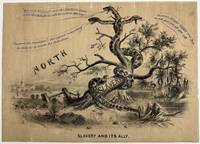
1864réf. 12816N.p. 1864. Lithograph 14.5 x 20.5 inches. Noticeable toning small areas of light discoloration along top margin short closed tear to left edge minor dust-soiling numerous creases and wrinkles. About very good. A dramatic political cartoon issued during the Civil War and satirizing the dangerous influence of those who argue a compromise on slavery or an easy solution to the war. The work was likely issued in the midst of the 1860 but more likely the 1864 presidential election campaign. The central image of the lithograph involves a three-headed snake -- labeled "The People's Party" and emerging from the American "South" personified by a moss-covered swamp -- which is wrapped around the length of a large tree labeled "Slavery." Each snake vocalizes a different misleading message about the issue of slavery and compromise seemingly aligned with political entities such as the Peace Party and the Copperheads. The messages from each snake head read respectively "Extend Slavery over the Northern States and the Rebellion will be over in 60 days;" "Persevere till after election and then we will give you all you ask;" and "'Support the President' - but oppose everything he may do to crush the Rebellion." This latter message indicates the author of the work supported President Lincoln. The North is personified in the background at left by a depiction of the U.S. Capitol Building. The central image of the lithograph carries echoes of the story of the Book of Genesis with the involvement of a deceptive serpent amid the tree of life. The lithograph is signed in the stone at bottom right reading simply "Brooks." Though the work came to us proposing the identify of the artist as Reuben Brooks 1794-1870 we were ultimately unable to confirm this authorship. The lack of an imprint in the lithograph also precludes easy research and identification. In fact the rarity of the lithograph makes it difficult to expound much more about it at all. OCLC reports just a single copy at the Peabody Essex Museum and it is not listed in Weitenkampf or Reilly. Given its rarity and content the present lithograph offers an outstanding opportunity for further research and contextualization. unknown
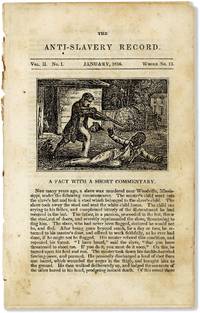
1836réf. 82919New York: American Anti-Slavery Society 1836. 12mo 19cm. Stitched self-wrappers; pp.1-12. Removed; first and final leaves detached but present; light soil scattered faint foxing; tear to bottom inch of bound edge away from text; complete and Good. Woodcut decoration at head of text a strikingly violent image depicting the murder of a Black man by his enslaver in Woolville Mississippi. Single issue of this monthly abolitionist periodical that ran from 1835 to 1837 published by the American Anti-Slavery Society under the direction of Elizur Wright. It was "a small magazine with excellent woodcuts containing principally extracts from other publications" that was "distributed freely without charge" and "found its way into the schools and colleges everywhere" Dumond p.267. Wright stated that in September 1835 the Society published 25000 copies of the Record p.267. BLOCKSON 9174. LCP AFRO-AMERICANA 622. American Anti-Slavery Society unknown
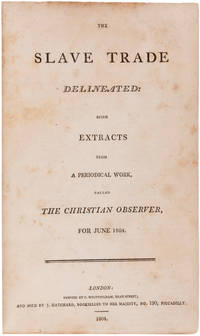
1805réf. 21055261805. London: Whittingham for Hatchard. 1805. 8vo. Recent marbled wrappers; pp. 20 printed in two columns; one corner of title-page clipped light browning; a good copy of a great rarity.This combined offprint opens with a first-hand report by 'Leo Africanus' of a journey recently made on a slave ship from West Africa to the West Indies. On board the ship the Captian told the visitors and traveller 'that a slave ship was a very different thing from what it had been represented. We should find the slaves rejoicing in their happy state' p. 3. The truth however showed the sheer horror of this crime against humanity at high sea. This is followed on page ten by a discussion of a Hatchard-published pamphlet on the abolition of the slave trade. The present pamphlet is concluded by the refutation of the printed Letter to the Right Honorable W.Pitt containing some new Arguments against the Abolition of the Slave Trade in which the author Britannicus had argued 'if we give freedom to the negroes we shall ourselves indubitable become slaves of Bonaparte' p. 13. Post-truth over two hundred years ago. unknown
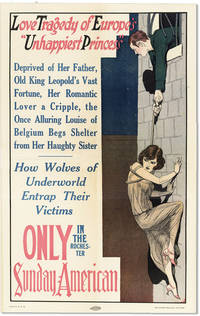
1904réf. 15411Rochester: Office of the American 1904. Broadside extra lithographed in colors; 18" x 11". Single fold else fine. Colorful graphic depicting Princess Louise escaping from her asylum cell with the help of her illegitimate lover Geza Mattattich. The caption tempts readers with a White Slavery theme suggesting that Princess Louise has been lured to her ruin by a "Wolf of the Underworld." Unlocated. Office of the American unknown
1981réf. 15264Princeton: Princeton University Press 1981. First Edition. Octavo. Cloth boards; dustjacket; 262pp; Removed from a non-circulating private library with ink ownership markings to front flyleaf and accompanying black ink elisions from de-accession on front endpaper. Very mild rubbing to jacket; else clean and unmarked copy. Princeton University Press unknown