SLAVERYBiblio.com
1 566 résultats
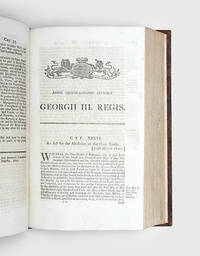
1807réf. 182125London: printed by George Eyre and Andrew Strahan 1807. The African Slave Trade. is hereby utterly abolished prohibited and declared to be unlawful First edition of one of the most consequential acts of legislation in world history abolishing the slave trade within the British Empire. The Act the culmination of many years of campaigning by British abolitionists ended two centuries in which Britain took the pre-eminent role in the transatlantic slave traffic. The act paved the way for other European empires to abolish the trade and for Britain to use its navy to intercept slave ships which effectively ended the transatlantic slave trade by the latter half of the century. However the act did not end slavery in the British Empire which did not follow until 1833. Parliamentary acts were issued individually and in collected format printed from the same type. This copy includes the full acts for 1807 comprising the only session of the Third Parliament with the first session of the Fourth the second session was held in 1808 together with the separately published report on vaccination. It was bound for use by the civic authorities of the town of Elgin in Scotland. 3 parts in 1 vol. folio 289 x 181 mm pp. 16 466 1; 14 578 2 blank; 16. Contemporary sprinkled calf twin red and green morocco labels "Town of Elgin Acts of Parliament / 1807" edges speckled blue. Pencilled notation at head of title page. Neatly restored at extremities very minor foxing and finger-soiling to contents. A very good copy. unknown
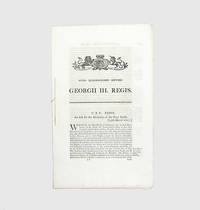
1807réf. 184142London: Printed by George Eyre and Andrew Strahan 1807. The African Slave Trade. is hereby utterly abolished prohibited and declared to be unlawful First edition of one of the most consequential acts of legislation in world history abolishing the slave trade within the British Empire. This copy is a well-preserved example of the separate folio printing. From 1807 enslaved persons could no longer be bought or sold within the British Empire while the Royal Navy was empowered to target vessels engaged in slave transportation a task it took up with vigour. Parliamentary acts were issued in collected annual volumes and as individual pamphlets all printed from the same type. As King's Printers Eyre & Strahan held the exclusive rights to publish and sell parliamentary statutes and this pamphlet would have been among those sold at their offices near Fleet Street. Folio 319 x 197 mm pp. 317-326 2. Woodcut headpiece. Stab-sewn as issued edges uncut. Minor offsetting else a near-fine copy. unknown
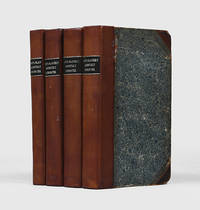
1827réf. 163198London: Printed for the London Society for the Mitigation and Abolition of Slavery in the British Dominions 1827-32. A new age of abolitionist agitation First collected editions being the full run under its original title of Zachary Macaulay's abolitionist magazine the leading organ of British abolitionist thought and campaigning. It was afterwards renamed the Anti-Slavery Reporter and has lasted under changing titles to this day. The journal "systematically collected information on the abuses of slavery" ODNB. "Highlighting the rise of abolitionist petition drives antislavery discussions in church and government venues and debates over unfree labor throughout the empire the paper celebrated a new age of abolitionist agitation" Newman pp. 44-45. The volumes collect the monthly issues from June 1825 to December 1831 with collective title pages and contents tables. 4 vols. octavo 216 x 129 mm. Contemporary half calf rebacked black morocco labels marbled sides edges speckled brown. Wear at extremities inner hinges reinforced a little browned and spotted: still very good copies. Richard S. Newman Abolitionism: A Very Short Introduction 2018. unknown
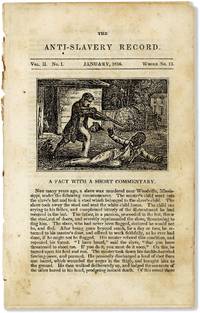
1836réf. 82919New York: American Anti-Slavery Society 1836. 12mo 19cm. Stitched self-wrappers; pp.1-12. Removed; first and final leaves detached but present; light soil scattered faint foxing; tear to bottom inch of bound edge away from text; complete and Good. Woodcut decoration at head of text a strikingly violent image depicting the murder of a Black man by his enslaver in Woolville Mississippi. Single issue of this monthly abolitionist periodical that ran from 1835 to 1837 published by the American Anti-Slavery Society under the direction of Elizur Wright. It was "a small magazine with excellent woodcuts containing principally extracts from other publications" that was "distributed freely without charge" and "found its way into the schools and colleges everywhere" Dumond p.267. Wright stated that in September 1835 the Society published 25000 copies of the Record p.267. BLOCKSON 9174. LCP AFRO-AMERICANA 622. American Anti-Slavery Society unknown
1860réf. 63532New York: Published and for sale at 5 Beekman Street 1860. First Edition. 12mo. 20th-c. binding of tan calf over paper-covered boards; marbled page edges; 951pp. About fine and complete; the pamphlet appears to have been offered without cover wrappers in any case not noted by Blanck. Uncommon first edition of this late tract by the important abolitionist and feminist Lydia Maria Child 1802-1880. Child's intention with this work was to make a direct case to southern slaveholders based not on any moral grounds but purely on business hoping that the Caribbean example would convince southerners that abolition could be achieved without wrecking their economy. "Child suggested to Samuel B. May the publisher .that the title page omit any mention of the American Anti-slavery Society giving only an address but no publisher. She even considered issuing the tract anyonymously but decided that her notoriety would probably help rather than hinder its circulation" see Karcher The First Woman in the Republic: a Cultural Biography of Lydia Maria Child. Durham 1994; p.428ff. Blanck notes two editions in 1860 as well as a reissue in 1862; this with verso of the final leaf unprinted is the first. Rarely encountered in commerce. BAL 3189. Published and for sale at 5 Beekman Street unknown
1865réf. 81012New York: American News Company 1865. First Edition. First printing. Octavo. Sewn printed wrappers; 76pp. Brief closed tear to title page margin; bit of wear at upper fore-corner of text block well away from text else a clean fresh copy in the original printed wraps; Very Good or better. Includes text of letters written to various colleagues in the antislavery ranks including Elizabeth Cady Stanton Charles Sumner and others. The first volume taking in the year 1863 was printed a year earlier. SABIN 82664. American News Company unknown
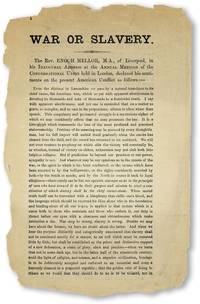
1863réf. 46597Manchester: Union and Emancipation Society n.d. ca. 1863. First Edition. Original broadsheet handbill 22x13.5cm.; extremities chipped with shallow losses not approaching text the whole rather dust-soiled and unevenly toned else Good or better overall. Text reproduces an address delivered by the Rev. Enoch Mellor of Liverpool "in his INAUGURAL ADDRESS at the ANNUAL MEETING of the CONGREGATIONAL UNION held in London" in which he "declared his sentiments on the present American Conflict." Mellor 1823-1881 was the life-long minister of the non-conformist Square Congregational Church in Halifax West Yorkshire with the exception of a five-year period coinciding with this address when he succeeded the abolitionist Congregational minister Thomas Raffles 1788-1863. Mellor's argument begins with reference to the Lancashire Cotton Panic an economic depression caused by a dearth of baled cotton imports following the start of the American Civil War. Mellr goes on to say that "War /may/ be wrong slavery /is/ wrong" comparing its presence on the American continent with that of the propagation of polygamy "carefully and resolutely laid as a foundation-stone in the territory of Utah. Union and Emancipation Society unknown
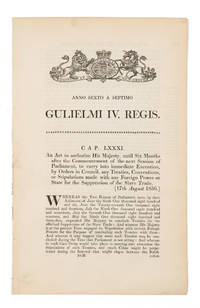
1836réf. 750641836. London: George Eyre and Andrew Spottiswoode 1836. London: George Eyre and Andrew Spottiswoode 1836. Payouts for Former British Enslavers Slavery. Great Britain. William IV 1765-1837 King of Great Britain. An Act for Carrying into Further Execution Two Acts of His Present Majesty Relating to the Compensation for Slaves Upon the Abolition of Slavery And for Facilitating the Distribution and Payment of Such Compensation. London: Printed by George Eyre and Andrew Spottiswoode 1836. 17-24 pp. Folio 11-3/4" x 7-1/2". With William IV King of Great Britain. An Act to Authorize His Majesty Until Six Months After the Commencement of the Next Session of Parliament To Carry into Immediate Execution By Orders in Council Any Treaties Conventions Or Stipulations Made with Any Foreign Power or State for the Suppression of the Slave Trade. London: Printed by George Eyre and Andrew Spottiswoode 1836. 873-876 pp. Folio 11-3/4" x 7-1/2". Disbound stab-stitched pamphlets. Light toning light foxing and soiling to a few leaves small holes to gutter of first two leaves of first act which are detached no loss to text. $950. Two acts dealing with the aftermath of the abolition of slavery in the United Kingdom. After the passage of the Slavery Abolition Act in 1833 all enslaved people in British colonies below the age of six were freed and others were redesignated as apprentices and gradually manumitted. One of the act's central provisions was a 20 million payout for "the persons hitherto entitled to the Services of such Slaves." The present act elaborates further on the logistics of the payout including the process by which former enslavers could claim "compensation" for their "great Inconvenience and Loss." The other act authorizes the king to negotiate treaties related to the end of the slave trade without Parliament when Parliament is not in session. unknown
1875réf. 61084New York: Harper and Brothers 1875. First American Edition. Octavo 24cm. Green cloth stamped in gilt; brown coated endpapers; 542pp; steel-engraved frontispiece 2 wood-enraved frontispieces 2 color maps 1 folding and 48 wood-engraved plates all with tissue guards. Inscribed "Charles V. Payne from his friend M. R. E. Christmas 1874" on front free endpaper; the same inscription is repeated with the date 1875 on a front flyleaf. A sound copy externally rubbed with superficial silverfishing to both boards internally clean with two central gatherings pulled but not fully detached short tear to folding map at gutter: just Very Good. Samuel Baker 1821-1893 was a noted British explorer of Africa. In 1860 he was appointed "governor-general of the equatorial Nile basin" by the Khedive Ismail of Egypt with duties including "annexing the equatorial Nile basin establishing Egyptian authority over the region south of Gondokoro suppressing the slave trade" and more ODNB. His success was mixed: he successfully annexed Gondokoro and did suppress the slave trade but failed to establish secure control of the region ODNB. This account published after his return to England details how he "raised and trained a fighting force.to crush" the slave trade Czech. CZECH p.11. Harper and Brothers unknown
1862réf. 61272New York: D. Appleton & Co 1862. Second Edition. Octavo 20.5cm. Green cloth titled in gilt on spine; yellow coated endpapers; 39018pp; 8 tinted lithographs. A firm copy rubbed at spine ends and bumped at corners mildly foxed: Very Good. Commander Andrew Hull Foote 1806-1963 served on the USS Perry from 1849 to 1851 suppressing the slave trade off the coast of Africa. In 1854 he published an abolitionist history of Africa describing African cultures American colonies and the slave trade. He was a noted commander for the Union Navy until his unexpected death of kidney disease in 1863. D. Appleton & Co unknown
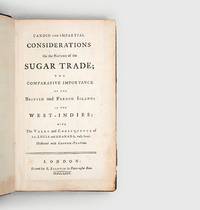
1763réf. 132583London: R. Baldwin 1763. A classic of in the field of colonial and Caribbean literature First edition of the first-named fourth of the second which was first published in Antigua 1750 under the pseudonym of "An Old Planter". John Campbell 1708-1775 was a highly successful historian and miscellaneous author Johnson thought well of him and praised the usefulness of his knowledge also describing him as "the richest author that ever grazed the common of literature" ODNB. The present work was commissioned by Lord Bute to rebut criticism of the Treaty of Paris by demonstrating "the value of colonial holdings in general and of sugar islands in particular" Ragatz. That is was felt to have done its job is perhaps confirmed by Campbell's appointment in 1765 as king's agent to Georgia. Considered by Ragatz to be a "classic of in the field of colonial and Caribbean literature embodying as it does one of the clearest statements of eighteenth-century philosophy regarding the relations that should exist between the metropole and its outlying possessions". This copy has additional material bound in: Bew's map of St Christopher's a 2-page manuscript index and bound at the rear a copy of Martin's practical essay on plantation management. Samuel Martin 1694/5-1776 had been born on Antigua but spent some considerable time thereafter in Britain on his full-time return to the island he found the family estates much run down and "embarked on a rigourous policy of reconstruction. Although he helped to pioneer improvements at most of the key stages in sugar-making and rum distillation his interests focused mainly on the non-manufacturing side of production. He was a firm advocate of crop rotation followed by marling in order to improve soil fertility. He was also instrumental in developing more effective systems of drainage and utilising windmills rather than animals for crushing the cane. By the standards of his contemporaries Martin was an enlightened slave owner. He advocated the provision of adequate supplies of food clothing shelter and medical facilities for slaves and ground for the cultivation of their own food" ODNB. His methods made him Antigua's leading and most progressive planter and during his own lifetime he certainly "succeeded in making sugar production a moderately profitable enterprise on his own estates". Both titles are moderately well-represented institutionally but neither appear with any great frequency at auction just a handful of copies of Campbell in the last fifty years and no copy of the Essay upon Plantership in any edition has passed through the rooms since 1951. Two works bound in a single vol. octavo 196 x 120 mm. Both bound without half-titles. 4 folding maps to the first-named 3 as called for; Caribbee Islands and Guyanna coloured in outline; The Harbour of Calivenie. Island of Grenada. Drawn by John Powell Topographer; and Plan of Fort Royal in the Island of Grenada and additionally a map of St. Christophers by J. Bew dated 1782 coloured. Contemporary streaked calf flat spine ruled gilt red morocco label single gilt rule to board edges Dahlia marbled endpapers. A little rubbed particularly on the joints label chipped no loss of lettering corners through small patch of insect damage to the lower board pastedowns lifting at the lower corners front free endpaper torn without loss slight erosion at the lower corner of the text-block for the first thirty pages or so mild worming to the fore-margin pp. 39-176 some small splits and closed tears to the maps no losses; overall very good. Campbell: ESTC T65879; Ragatz p. 284; Kress 6081; Sabin 10232. Martin: ESTC T81835; Sabin 44920 hardcover
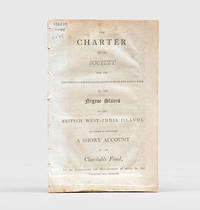
1794réf. 126550London no printer 1794 or later. First edition variously dated by ESTC and WorldCat between 1794 the date given at the end of the preliminary "Short Account of the origin and present state of the charitable fund" and 1823. The short account dated March 1794 is followed by a tipped in leaf reporting on the first meeting of the society which took place on Thursday April 3 1794 electing the Lord Bishop of London as president. The Charter of the Society 18 pages in length is dated at Westminster "this thirtieth Day of October in the thirty-fourth Year of our Reign" which again falls in 1794. Octavo 190 x 123 mm pp. ix 18. Sometime in a pamphlet vol. now disbound. Spine shows evidence of earlier binding sometime folded vertically; title lightly dust soiled page ix trimmed down and tipped onto p. viii; a good copy. Sabin 85881. unknown
1858réf. 660371858. Dividing Prize Money After the Capture of a Slave Ship Slavery. United States. In the Senate of the United States. February 21 1858-Ordered to Be Printed. Mr. Polk Made the Following Adverse Report To Accompany Bill S. C. of C. 108.: The Committee of Claims To Whom was Referred the Opinion of the Court of Claims in the Case of O.H. Berryman and Others Report: The Claimants in this Case are the Officers and Crew of the United States Schooner "On-Ka-Hy-E" drop-head title. Washington DC: S.n. 1858. 13 pp. Octavo 9" x 5-1/2". Disbound light rubbing to extremities some toning and light foxing. $100. 35th Congress 1st Session Senate Rep. Com. No. 33. This speech disputes the distribution of prize money between the Federal government and the crew that captured the slave ship Laurens. unknown
réf. DADAX030433264XUNKNO 0000-00-00. paperback. New. 5.50x0.75x8.75. Buy with confidence. Excellent Customer Service & Return policy. UNKNO paperback
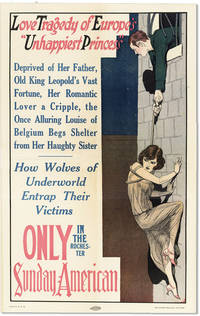
1904réf. 15411Rochester: Office of the American 1904. Broadside extra lithographed in colors; 18" x 11". Single fold else fine. Colorful graphic depicting Princess Louise escaping from her asylum cell with the help of her illegitimate lover Geza Mattattich. The caption tempts readers with a White Slavery theme suggesting that Princess Louise has been lured to her ruin by a "Wolf of the Underworld." Unlocated. Office of the American unknown
1981réf. 15264Princeton: Princeton University Press 1981. First Edition. Octavo. Cloth boards; dustjacket; 262pp; Removed from a non-circulating private library with ink ownership markings to front flyleaf and accompanying black ink elisions from de-accession on front endpaper. Very mild rubbing to jacket; else clean and unmarked copy. Princeton University Press unknown
réf. SKU0602368Rowman & Littlefield Publishers 2017-10-06. paperback. Good. 5x0x9. Textbook May Have Highlights Notes and/or Underlining BOOK ONLY-NO ACCESS CODE NO CD Ships with Tracking Rowman & Littlefield Publishers paperback
réf. SKU0649875Rowman & Littlefield Publishers 2017-10-06. paperback. New. 5x0x9. New Textbook Ships with Tracking Rowman & Littlefield Publishers paperback
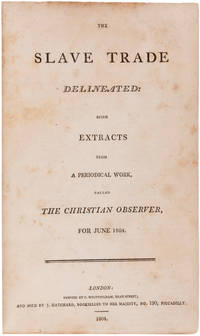
1805réf. 21055261805. London: Whittingham for Hatchard. 1805. 8vo. Recent marbled wrappers; pp. 20 printed in two columns; one corner of title-page clipped light browning; a good copy of a great rarity.This combined offprint opens with a first-hand report by 'Leo Africanus' of a journey recently made on a slave ship from West Africa to the West Indies. On board the ship the Captian told the visitors and traveller 'that a slave ship was a very different thing from what it had been represented. We should find the slaves rejoicing in their happy state' p. 3. The truth however showed the sheer horror of this crime against humanity at high sea. This is followed on page ten by a discussion of a Hatchard-published pamphlet on the abolition of the slave trade. The present pamphlet is concluded by the refutation of the printed Letter to the Right Honorable W.Pitt containing some new Arguments against the Abolition of the Slave Trade in which the author Britannicus had argued 'if we give freedom to the negroes we shall ourselves indubitable become slaves of Bonaparte' p. 13. Post-truth over two hundred years ago. unknown
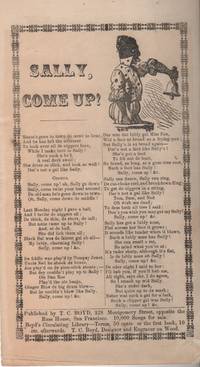
1860réf. 43380San Francisco: T.C. Boyd 1860. Near fine. Racist slavery-era broadside printed and designed by one T.C. . Boyd featuring a drawing and lyrics to a ballad which begins: "Massa's gone to town de news to hear / And he has left the overseer / To look over all de nrs here / While I make love to Sally!" Boyd notes he had 10000 such sheets for sale at his shop. Broadside 8.5" by 4.5". Printed from type and wood engraving. Very near fine with trivial crease to edges. T.C. Boyd unknown
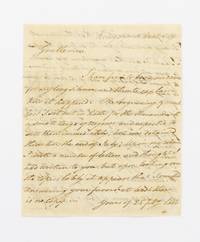
réf. 130002Very Good. Quarto 4 pages a bifolium comprising 3 pages of text with the last page used for address purposes. Creased where folded for posting; slight loss to the leading edge of the second leaf where torn open removing one word of text; overall in excellent condition. The letter dated 10 December 1791 and carried privately by ship from Kingston is addressed to 'Messrs Newton Gordon & Murdoch Merchants Madeira'. A number of lesser matters are touched upon but the letter deals primarily with the importation of wine: 'I cannot at present ascertain what quantity of wine I shall be able to dispose of next year as I have 20 pipes on hand and sales are slow from the great quantity at market; however you will please ship me twenty pipes of York market wine Barbadoes Gauge & 12 Iron hoops at first convenient opportunity'. As often with letters of any age the first paragraph contains an apology for the tardy response: 'I have first to beg your excuse for my silence and then to explain how it happen'd. The beginning of March last I set out in haste for the Havana with a small cargo of negroes and expected to sell them immediately but was detain'd there till the end of July'. unknown
réf. SONG1538102684Rowman & Littlefield Publishers 2017-10-06. Second. hardcover. Used: Good. 6.21x0.95x9.34. Buy with confidence. Excellent Customer Service & Return policy. Rowman & Littlefield Publishers hardcover
1817réf. SLAVERY005957W. Alexander York. 1817. First U.K. edition with additions to the Philadelphia printing. 12mo. 156 pages including 4 pages of adverts. Frontispiece. Original boards with paper backstrip and title label. Anthony Benezet 1713-1784 was a leading abolitionist.Early nameplates Thomas Marsh and Robert Langdon on front pastedown. Some foxing to prelims. Cup ring to front cover. Backstrip defective label rubbed. Very good. Scarce in original state. W. Alexander, York. hardcover
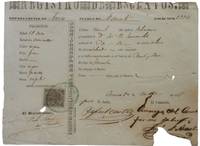
1871réf. 237101871. Slavery Black Labor Puerto Rico This official Puerto Rican slave registry document issued in Manatí in 1871 under Spanish colonial administration represents the bureaucratic infrastructure of slavery in the Caribbean at the precise moment preceding abolition. Titled within the printed form as part of the "Registro de Esclavos - Isla de Puerto Rico" the document records the forced legal identity of an identified enslaved man. Single sheet slave registry document "Empadronamiento General de esclavos" from Manatí Puerto Rico dated 20 de Mayo de 1871. Measuring 6.25" x 8.5". This document was registered by "Don Manuel María Monserrate" for the enslaved person "Feliciano." Document bears official signatures from the local authorities. The enslaved person is listed by their age stature "color" hair color beard eyes nose and mouth. The person is listed as 18 years old and the "color" of this individual is listed as "negro". The physical list of classifications functioned as mechanisms of surveillance control and verification within the colonial slave system. Inclusion of official signatures from both the "dueño" and "comisario" along with a stamped fiscal seal en verso. Produced just under two years prior to the 1873 abolition of slavery in Puerto Rico the document reflects the transitional legal environment in which enslaved individuals were increasingly catalogued in anticipation of emancipation policies that would in practice impose systems of forced apprenticeship and indemnification to former enslavers. Tape was previously applied to the bottom right of the document; some minor wormholes and occasional spotting. Overall good condition. The document stands as evidence of how emancipation in Spanish territories was mediated through administrative control prolonging coercive labor conditions even as slavery was formally dismantled. unknown
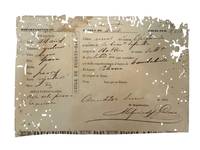
1873réf. 238001873. Puerto Rican slave registration document from January 1873 recording the legal identity ownership agricultural occupation parentage and physical classification of Epifanio a forty four year old enslaved Black man in Arecibo less than three months before slavery was abolished in Puerto Rico. Issued after Spain's 1870 Moret Law had initiated a limited process of emancipation but before the abolition law of March 22 1873 the cédula placed Epifanio within a registration system designed to record enslaved people by name family relations occupation owner residence civil status and identifying physical characteristics. The January 20 date makes the document especially closely situated to abolition recording Epifanio as legally enslaved only weeks before the Spanish National Assembly dismantled the legal institution under which the certificate had been issued. Registro de Esclavos Isla de Puerto Rico. Arecibo Puerto Rico January 20 1873. Single printed and manuscript cédula folio no. 7215. The document identifies "Epifanio" as an enslaved man "propiedad de la Sucn. Tafarella" forty four years old a native of Puerto Rico single and "de oficio labrador." He is recorded as "no está coartado" and as registered in the barrio of Cambalache with his mother identified as "Petrona." The printed "Filiacion" column subjects his body to a standardized identifying description: regular stature "Color negro" sparse hair sparse beard brown eyes and a regular nose. Under "Señas particulares" the manuscript records "Cojo de la pierna izquierda" identifying him as lame in the left leg and incorporating a physical disability into the identifying data maintained by the slave registry. The lower portion differs from the earlier 1871 forms in carrying a prominent signature beneath "El Registrador" while extensive insect damage has removed portions of the printed heading and margins. The verso bears manuscript offsetting and additional evidence of administrative handling. Epifanio's cédula was produced at the endpoint of Puerto Rico's rapidly changing legal regime. The Moret Law of 1870 had granted freedom to specified categories of enslaved people including those aged sixty and older those belonging to the state and children born after September 17 1868 while leaving a forty four year old man such as Epifanio legally enslaved. His notation as "no está coartado" further records that he had not entered coartación the mechanism through which an enslaved person could make payments toward self purchase. His recorded occupation as "labrador" placed him within Puerto Rico's agricultural labor economy while "Cojo de la pierna izquierda" shows how the registry extended beyond racial and occupational classification to bodily characteristics capable of distinguishing one enslaved person from another. On March 22 1873 only about two months after this cédula was dated the Spanish National Assembly abolished slavery in Puerto Rico compensating former enslavers while requiring the emancipated population to enter labor contracts for an additional three years. Extensive insect damage with numerous wormholes and substantial losses along the upper and side margins affecting portions of the printed heading and several fields; moderate toning and staining with principal manuscript entries and the registrar's signature remaining legible. Overall fair condition. An individually named record of the administrative system that converted Epifanio's race body physical disability agricultural labor parentage residence and legal ownership into the identifying data of slavery during the final months before abolition in Puerto Rico. unknown