4035 risultati
1932rif. 298872 THICK VOLS COMPLETE HBDJ VOL 1 #G8 STATED 1ST MODERN LIBRARY ON COPYRIGHT PG 1932 VG/VG- SOLD AS-IS SMALL EDGE TEARS CHIPS ON DJ SPINE WEAR EXTREMITIES & SCUFFING & TINY HOLE NEAR DJ SPINE DJ & MENDED TEARS BACK OF DJ SAYS 215 BOOKS SO FAR GIVES 8 POINTS SAYS AIM & SCOPE OF ML GIANTS VERSO OF DJ SAYS COMPLETE LIST OF TITLES OF ML ONE DOLLAR A COPY book is 1476 pages and otherwise in great shape. SCUFF MARK BACK DJ THICK BLUE CLOTH HARDBACK WITH BRITE GOLD GILT STREAMER MAN ON FRONT & SLIGHTLY FADED TITLE ON CVR SPINE VOL 2 #G7 VG-/VG- STATED 1ST MODERN LIBRARY ON COPYRIGHT PG 1932 SMALL EDGE TEARS WEAR EXTREMITIES & SCUFFING & TINY HOLE NEAR DJ SPINE BACK OF DJ GIVES 8 POINTS SAYS 220 BOOKS SO FAR SAYS AIM & SCOPE OF ML GIANTS VERSO OF DJ SAYS COMPLETE LIST OF TITLES OF ML ONE DOLLAR A COPY book is 1476 pages and otherwise in great shape .& MENDED DJ TEARS & SCUFF MARKS THICK BLUE CLOTH HARDBACK WITH SMALL CHIPS TOP COVER SPINE WITH BRITE GOLD GILT STREAMER MAN ON FRONT & VERY LIGHTLY FADED TITLE ON CVR SPINE STATED 1ST MODERN LIBRARY ON COPYRIGHT PG 1932 Yellow DJ with Black Lines top & btm front of DUSTJACKET Volume 2 History of empire from a.d. 476 to fall of Constintine OR covers 1000 yrs ended with acquisition of absolute dominion of Rome by the Popes in 1500 MODERN LIBRARY NY hardcover
1933rif. aly89Glasgow: The University Press 1933. 1933. 8vo. pp. xv 190. several b/w illus. biblio. index. cloth minor edge wear. dw. First Edition. 1st Edition. Hardcover. [Glasgow: The University Press, [1933]. Hardcover
1984rif. SONG3110098326De Gruyter 1984-04-01. Reprint 2011. hardcover. Used: Good. 6.50x1.00x9.25. Buy with confidence. Excellent Customer Service & Return policy. De Gruyter hardcover
1994rif. 202367Allen Lane Penguin Press 1994. Hardcover. New/New. Hardcover 3 Volume set in new dust jackets. Black cloth to boards with silver lettering to spine. 4to. 6.5 x 6 x 10.25 inches Clean text free of marks or underlining. Includes appendices 8 list of abbreviations selected further readings bibliographical index and a general index. 3360 pp. Fast shipping in a secure book box mailer with tracking. Edward Gibbon's The History of the Decline and Fall of the Roman Empire is the most celebrated historical work in the English language. First published in three instalments between 1776 and 1788 it covers a period of thirteen centuries. The first installment traces the Empire from the Age of the Antonines to the growth and establishment of Christianity and the persecution its followers received in the reigns preceding Constantine; the second begins with the reign of Julian the Apostate and continues up to the conquest of the Roman territories in the West by the Goths Huns and Vandals; the last installment follows the Empire from Justinian to the taking of Constantinople by the Turks. Throughout its length The History of the Decline and Fall of the Roman Empire is never routine always alert with humanity and intelligence and often surprising in its sympathies. Gibbon's genius as a prose stylist his breadth of knowledge his wit and energy combine to make the Decline and Fall one of the greatest narratives in European literature. This new edition provides the reader with the most accurate text of the Decline and Fall complete and unmodernized and illuminates it with an unrivalled wealth of related material. David Womersley's Introduction describes the development of the Decline and Fall as it moved from instalment to instalment and locates it in relation both to the events of Gibbon's life and to the Enlightenment culture within which it was written. The most substantial variants and the comments and notes Gibbon made in his own copies of the work are given in appendices. Also reprinted as an appendix is the famous Vindication 1779 in which Gibbon replied to the attacks on his treatment of Christianity. For the first time since Gibbon's death two hundred years ago a critical edition has been established. This third volume reprints the fifth and sixth volumes of Gibbon's work. The former is particularly concerned with the encounters between the dwindling and enfeebled Byzantine Empire and the vigorous new religion of Islam. The latter - perhaps the most varied and colourful of all - includes the Crusades the fall of Constantinople to the Turks and an overview of the medieval papacy. Allen Lane Penguin Press hardcover
1974rif. pl61-44AMS Press 1974. Hardcover. Used - Very Good. Year: 1974. Publisher:AMS Press. This preowned item is in very good condition with very minimal wear and tear visible ex. Corner dings small tears/rips bent pages scuffs/scratches etc. Additional materials such as CD's and access codes may or may not be included. If the book has a dust jacket it may not be included. Free tracking provided. International shipping available. AMS Press hardcover
1988rif. 300068London: The Folio Society 1988. Hard Cover. Near Fine binding. Sold as 8 volume set two slipcases with 4 volumes each~~Volume I: The Turn of the Tide; Volume II: Constantine and the Christian Empire; Volume III: The Revival and Collapse of Paganism; Volume IV: The End of the Western Empire; Volume V: Justinian and the Roman Law; Volume VI: Mohammed and the Rise of the Arabs; Volume VII: The Normans in Italy and the Crusades; Volume VIII: The Fall of Contantinople and the Papcy in Rome. ~ ~The two slipcases have some general wear; a bit of separation but they are both holding quite well; each book has a stick from the previous bookseller indicating they are sold as a set. Near Fine binding. The Folio Society unknown
1999rif. 1885676122The Folio Society 1999. Hardcover. Very Good. Missing dust jacket; May have limited writing in cover pages. Pages are unmarked. ~ ThriftBooks: Read More Spend Less.Wear consistent with age and use. Clean unmarked copies. Complete eight volume set in two slipcases. Light scuffing and smudging to boards and page block edges of all volumes. Slipcases lightly scuffed and bumped otherwise intact. This book shows minimal sign of wear to the cover binding or pages. No dust jacket included with this book. This book is part of a multi-volume set. Secure packaging for safe delivery.Dust jacket quality is not guaranteed. The Folio Society hardcover
1999rif. 1874051131The Folio Society 1999. Hardcover. Very Good. Missing dust jacket; May have limited writing in cover pages. Pages are unmarked. ~ ThriftBooks: Read More Spend Less.Complete eight volume set. Bindings are tight and structurally sound. Clean interior pages. Light scuffing and bumping visible to slipcases. This book shows minimal sign of wear to the cover binding or pages. No dust jacket included with this book. Secure packaging for safe delivery.Dust jacket quality is not guaranteed. The Folio Society hardcover
1988rif. 300068London: The Folio Society 1988. Hard Cover. Near Fine binding. Sold as 8 volume set two slipcases with 4 volumes each~~Volume I: The Turn of the Tide; Volume II: Constantine and the Christian Empire; Volume III: The Revival and Collapse of Paganism; Volume IV: The End of the Western Empire; Volume V: Justinian and the Roman Law; Volume VI: Mohammed and the Rise of the Arabs; Volume VII: The Normans in Italy and the Crusades; Volume VIII: The Fall of Contantinople and the Papcy in Rome. ~ ~The two slipcases have some general wear; a bit of separation but they are both holding quite well; each book has a stick from the previous bookseller indicating they are sold as a set. Near Fine binding. The Folio Society unknown books
rif. FORT989419The Folio Society. Used - Good. Decline and Fall of the Roman Empire: 8 Volume Set in Two Slipcases. The Folio Society unknown
1796rif. 17312London: A. Strahan; T. Cadell Jun. ; W. Davies. Very Good. 1796. First Edition. Hardcover. Rebound in brown cloth. Text is in English and French. Contents are "fine". ; 4to 11" - 13" tall; 703726 pages . A. Strahan; T. Cadell Jun. ; W. Davies hardcover
1796rif. 16873London:: Strahan and Cadell 1796. First edition. modern blue cloth with red leather spine labels. Ownership inscription at top of both titles; light foxing; but a very good copy in a respectable modern binding. 4to. Rothschild 948; Norton 131. U1 in Vol. I is a cancel as usual. A supplementary third volume published in 1815 is not present. Frontispiece silhouette of Gibbon bound in the second volume instead of the first. Strahan and Cadell, hardcover
1946rif. 103898Near fine overall.: Heritage Press. Near Fine. 1946. Hardcover. 4to 11" - 13" tall . Heritage Press hardcover
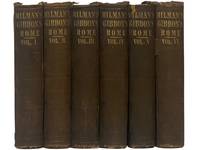
1856rif. 2354153Boston: Phillips Sampson and Company 1856. Reissue. Hard Cover. Good/No Jacket. 0x0x0. Boards lightly rubbed and soiled with some loss from corners edges and endpapers lightly foxed and smudged ink name address and date on front flyleaf of each volume pages a bit toned. Bindings tight and square. 1856 Hard Cover. An excellent edition of Edward Gibbon's magnum opus. Six hardcover volumes. 7 3/4" x 5 1/4". Original brown cloth hardcover bindings with gold spine lettering & design embossed design on front & back covers. Gibbon's complete work with notes by Rev. Milman plus a general index. "The History of The Decline and Fall of the Roman Empire a major literary achievement of the 18th century published in six volumes was written by the celebrated English historian Edward Gibbon. Volume I was published in 1776 and went through six printings a remarkable feat for its time. Volumes II and III were published in 1781; volumes IV V VI in 1788-89. The original volumes were published as quartos a common publishing practice of the time. The books cover the period of the Roman Empire after Marcus Aurelius from just before 180 to 1453 and beyond concluding in 1590. They take as their material the behaviour and decisions that led to the decay and eventual fall of the Roman Empire in the East and West offering an explanation for why the Roman Empire fell. Gibbon is sometimes called the first 'modern historian of ancient Rome.' By virtue of its mostly objective approach and highly accurate use of reference material Gibbon's work was adopted as a model for the methodologies of 19th and 20th century historians. His pessimism and detached use of irony was common to the historical genre of his era. Although he published other books Gibbon devoted much of his life 1772-1789 to this one work. His autobiography Memoirs of My Life and Writings is devoted largely to his reflections on how the book virtually became his life. He compared the publication of each succeeding volume to a newborn child. The book is famous not only because it is extraordinarily well written but also because Gibbon offers an explanation for why the Roman Empire fell. This is one of the great historical questions and because of the relative lack of written records from the time one of the most difficult to undertake. Gibbon was not the first to theorise about this. In fact most of his ideas are directly taken from Roman moralists of the 4th and 5th centuries who wrote about it at the time; nor would he be the last; see for example Henri Pirenne's Thesis of the early 20th century. According to Gibbon the Roman Empire succumbed to barbarian invasions because of a loss of civic virtue among its citizens. They had become lazy and soft outsourcing their duties to defend their Empire to barbarian mercenaries who then became so numerous and ingrained that they were able to take over the Empire. Romans he believed had become effeminate unwilling to live a tougher 'manly' military lifestyle. In addition Gibbon pointed to Christianity. Christianity he says created a belief that a better life existed after death. This fostered indifference to the present among Roman citizens thus sapping their desire to sacrifice for the Empire. He also believed its comparative pacifism tended to sap the traditional Roman martial spirit. Finally like other Enlightenment thinkers Gibbon held in contempt the Middle Ages as a priest-ridden superstitious dark age. It was not until his own age of reason and rational thought it was believed that human history could resume its progress. Gibbon provides the reader with a glimpse of his thought process with extensive notes along the body of the text a precursor to the modern use of footnotes. Gibbon's footnotes are famous for their idiosyncrasies. They provide an entertaining moral commentary on both ancient Rome and 18th-century Great Britain. This technique enabled Gibbon to compare ancient Rome to modern times. Gibbon's work advocates a rationalist and progressive view of history. Gibbon's citations provide in-depth detail regarding his use of sources for his work on ancient Rome documents dating back to ancient Rome. The detail within his asides and his care in noting the importance of each document is a precursor to modern-day h Phillips, Sampson, and Company hardcover
1856rif. 2354153Boston: Phillips Sampson and Company 1856. Reissue. Hard Cover. Good/No Jacket. 0x0x0. Boards lightly rubbed and soiled with some loss from corners edges and endpapers lightly foxed and smudged ink name address and date on front flyleaf of each volume pages a bit toned. Bindings tight and square. 1856 Hard Cover. An excellent edition of Edward Gibbon's magnum opus. Six hardcover volumes. 7 3/4" x 5 1/4". Original brown cloth hardcover bindings with gold spine lettering & design embossed design on front & back covers. Gibbon's complete work with notes by Rev. Milman plus a general index. "The History of The Decline and Fall of the Roman Empire a major literary achievement of the 18th century published in six volumes was written by the celebrated English historian Edward Gibbon. Volume I was published in 1776 and went through six printings a remarkable feat for its time. Volumes II and III were published in 1781; volumes IV V VI in 1788-89. The original volumes were published as quartos a common publishing practice of the time. The books cover the period of the Roman Empire after Marcus Aurelius from just before 180 to 1453 and beyond concluding in 1590. They take as their material the behaviour and decisions that led to the decay and eventual fall of the Roman Empire in the East and West offering an explanation for why the Roman Empire fell. Gibbon is sometimes called the first 'modern historian of ancient Rome.' By virtue of its mostly objective approach and highly accurate use of reference material Gibbon's work was adopted as a model for the methodologies of 19th and 20th century historians. His pessimism and detached use of irony was common to the historical genre of his era. Although he published other books Gibbon devoted much of his life 1772-1789 to this one work. His autobiography Memoirs of My Life and Writings is devoted largely to his reflections on how the book virtually became his life. He compared the publication of each succeeding volume to a newborn child. The book is famous not only because it is extraordinarily well written but also because Gibbon offers an explanation for why the Roman Empire fell. This is one of the great historical questions and because of the relative lack of written records from the time one of the most difficult to undertake. Gibbon was not the first to theorise about this. In fact most of his ideas are directly taken from Roman moralists of the 4th and 5th centuries who wrote about it at the time; nor would he be the last; see for example Henri Pirenne's Thesis of the early 20th century. According to Gibbon the Roman Empire succumbed to barbarian invasions because of a loss of civic virtue among its citizens. They had become lazy and soft outsourcing their duties to defend their Empire to barbarian mercenaries who then became so numerous and ingrained that they were able to take over the Empire. Romans he believed had become effeminate unwilling to live a tougher 'manly' military lifestyle. In addition Gibbon pointed to Christianity. Christianity he says created a belief that a better life existed after death. This fostered indifference to the present among Roman citizens thus sapping their desire to sacrifice for the Empire. He also believed its comparative pacifism tended to sap the traditional Roman martial spirit. Finally like other Enlightenment thinkers Gibbon held in contempt the Middle Ages as a priest-ridden superstitious dark age. It was not until his own age of reason and rational thought it was believed that human history could resume its progress. Gibbon provides the reader with a glimpse of his thought process with extensive notes along the body of the text a precursor to the modern use of footnotes. Gibbon's footnotes are famous for their idiosyncrasies. They provide an entertaining moral commentary on both ancient Rome and 18th-century Great Britain. This technique enabled Gibbon to compare ancient Rome to modern times. Gibbon's work advocates a rationalist and progressive view of history. Gibbon's citations provide in-depth detail regarding his use of sources for his work on ancient Rome documents dating back to ancient Rome. The detail within his asides and his care in noting the importance of each document is a precursor to modern-day h Phillips, Sampson, and Company hardcover books
1927rif. 33804Toronto: J.M. Dent & Sons 1927. 1st Edition. Hardcover. 1st Edition. Hardcover. Signed by Author. First Edition Inscribed by Gibbon on the first free endpaper to A. La Liberté a well known Canadian composer. A near fine copy in the publisher's 1/4 white cloth over beige paper covered boards red titles to the spine. With erratum slip tipped-in at the dedication page. 8vo. 105 pp. Harmonizations by Geoffrey O'Hara and Oscar O'Brien. Decorations by Frank H. Johnston. J.M. Dent & Sons hardcover
1853rif. 4192baWashington D.C: A. Hoen 1853. Map. Good condition. Hardcover. First Edition. Octavo 8vo. 23.3cm blind stamped brown cloth folder spine is tape repaired; no text; First map measures 16 3/4" x 20" topographical map of Andes 7 1/2" tear at fold small tear at other fold; Second map measures 18 1/2" x 28 1/2" folded map including south Peru Bolivia part of Argentina roughly folded 2 small tears at folds; also printed beside larger map 18 1/2" x 4 1/2" Brazil map showing rivers Madeira Mamone 4 1/2" tear at fold; ex libris. Exploration South America Cartography Maps. A. Hoen Hardcover
rif. 6720JOHN GIBBON 1827-1896. John Gibbon was a Major General who fought in the Indian Wars the American Civil War and the Great Sioux War. He fought in the Battle of Gettysburg and Second Battle of Bull Run. During his life he published his famous Artillerists Manual and posthumously Personal Recollections of the Civil War and Adventures on the Western Frontier along with many articles in magazines and journals. His writings typically center around his time in the West and his opinions on Native American government policies.Typescript. 5pgs. No date circa mid 1870s. No place. A typed outline of Rambles In The Rocky Mountains that was typed by either John Gibbon himself or his secretary. This series of articles was published in the American Catholic Quarterly Review in 1876 and included in a posthumously published book Adventures on the Western Front that depicts Gibbons time serving in the West during the 1870s. In this work Gibbons short and concise writing style gives the reader glimpses into his life and shows how time in the West was spent. Gibbon discusses the Pikes Peak emigrants in the second chapter of this work an event in the late 1850s where thousands of people left their homes to go to Pike Peak Colorado for the gold rush they were experiencing. Later he writes First news of the battle of Bull Run the first major battle of the Civil War. In chapter VII he references the Great Sioux War of 1876 a war between the U. S. and Native Americans as the government wanted ownership over the Black Hills a mountain range in South Dakota and Wyoming that is now home to Mount Rushmore. His depictions of these important events are dispersed throughout the script broken up with his day-to-day activities as a soldier and descriptions of the West. The typescript is in very good condition with light stains on the first page. unknown
rif. 6720JOHN GIBBON 1827-1896. John Gibbon was a Major General who fought in the Indian Wars the American Civil War and the Great Sioux War. He fought in the Battle of Gettysburg and Second Battle of Bull Run. During his life he published his famous Artillerists Manual and posthumously Personal Recollections of the Civil War and Adventures on the Western Frontier along with many articles in magazines and journals. His writings typically center around his time in the West and his opinions on Native American government policies.Typescript. 5pgs. No date circa mid 1870s. No place. A typed outline of Rambles In The Rocky Mountains that was typed by either John Gibbon himself or his secretary. This series of articles was published in the American Catholic Quarterly Review in 1876 and included in a posthumously published book Adventures on the Western Front that depicts Gibbons time serving in the West during the 1870s. In this work Gibbons short and concise writing style gives the reader glimpses into his life and shows how time in the West was spent. Gibbon discusses the Pikes Peak emigrants in the second chapter of this work an event in the late 1850s where thousands of people left their homes to go to Pike Peak Colorado for the gold rush they were experiencing. Later he writes First news of the battle of Bull Run the first major battle of the Civil War. In chapter VII he references the Great Sioux War of 1876 a war between the U. S. and Native Americans as the government wanted ownership over the Black Hills a mountain range in South Dakota and Wyoming that is now home to Mount Rushmore. His depictions of these important events are dispersed throughout the script broken up with his day-to-day activities as a soldier and descriptions of the West. The typescript is in very good condition with light stains on the first page. unknown books
1854rif. 310357Armstrong and Nicholson 1854. Hardcover. Good. Part I is the House edition Part II the Senate; the third volume is Part I of the Maps. 8vos in the publisher's brown blind-tooled cloth titles in gilt on Part II and the Maps. All 16 plates present in Part I all 36 in Part II but lacking the two maps all three as called for in the maps volume. Corners rubbed through shallow chipping at the spine ends a couple of hinges starting. Moderate foxing throughout Part I; Part II is more heavily toned and foxed. The mid-sized map has small separations at every fold intersection. The large map has some small separations but has one large hole at a fold intersection. The small map is damaged in that two edges are attached and the map cannoat be fully opened. Armstrong and Nicholson hardcover
rif. 20178924like new. unknown
1796rif. 21722Dublin: Wogan White Chambers and Others 1796. first only Dublin edition enlarged from the London edition of the same year in three volumes full calf much worn most hinges cracked vol 3 split in two in middle of binding frontispiece silhouette portrait of Gibbon in vol 1 has shadowed onto title page a little occasional foxing mostly in margins text clean and tight apart from defects mentioned bookplates and shelf marks of Carton House Library Co. Kildare in all volumes. Interesting set in need of repair. First Edition. Full-Leather. Fair/No Jacket. 8vo - over 7¾" - 9¾" tall. Wogan, White, Chambers and Others Hardcover
1796rif. 978Q1London: A. Straha T. Cadell W Davies and John Murray 1796-1815 . First edition. Leather. Good. 11.5" by 9". Not Stated. The first edition of volume I and volume III of Lord Sheffield's important collection of the works of Edward Gibbon including a memoir by Gibbon himself. First edition. Volume I 1796 and Volume III 1815. Lacking Volume II. Originally this was intended to be complete in two volumes with 'In Two Volumes' printed to the title page of the first two volumes however a third volume was added in 1815. Illustrated from his letters with occasional notes and narrative by John Lord Sheffield. With memoirs of his life and writings composed by himself. Illustrated with an silhouette portrait frontispiece to Volume I and an engraved frontispiece to Volume III. Some of the works are written in French. Shortly following Gibbon's death his good friend and literary executor John Lord Sheffield undertook to edit and in 1796 published the first of the Miscellaneous Works of Edward Gibbon in order that the reading public have an opportunity to gain a broader insight into the historian and his overall body of work. Edward Gibbon 1737 - 1794 was an English historian and Member of Parliament. His most important work The History of the Decline and Fall of the Roman Empire was published in six volumes between 1776 and 1788.With an ink inscription of J. Harlow. Bound in full calf. Externally generally smart with rubbing to the extremities and joints causing some loss to the extremities of boards and spine. Joints are cracked but hinges remain firm due to internal reinforcements. Internally firmly bound. Pages are generally bright and clean with offsetting to title page and a few marks. Endpapers have been renewed and blanks retained. No half titles as is concurrent with other copies. Good A. Straha, T. Cadell, W Davies and John Murray hardcover
rif. 6095530like new. unknown
rif. 48292Paris Chez Amable Costes et Cie, Libraires 1807 in 8 (201x13 3 volumes reliures demi basane fauve de l'époque, dos lisses ornés de caissons et de fleurons dorés, pièces de titre de cuir brique, tranches marbrées, VIII et 453 pages, 468 pages, 424 pages [1], petite restauration ancienne sur la coiffe supérieure du tome 1, ex-libris de la Bibliothèque de Mr. le Marquis de Candau, à Peyrelonguede. Edward Gibbon. Bel exemplaire, reliures décoratives