626 résultats
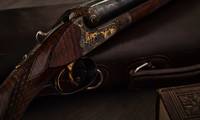
1959réf. 208191959. Perhaps the most historically important gun to reach the market; Gifts of state are themselves rare as since an Act of Congress in 1978 they have belonged to the nation and not the recipient; The magnificent shotgun another one of which was given to President Eisenhower comes with a copy of the thank you letter from McElroy to Khrushchev Khrushchev’s visit lessened Cold War tensions and was a major reason the Cold War did not turn hot ""This gun is an embodiment of Nikita Khrushchev's policies in more ways than one: the diplomatic effort to make peace with the West and the domestic reforms aimed to turn the military-industrial second into profitable enterprises operating on open civilian market” says author Aleksei Morozov https://vimeo.com/1068197728 Provenance This gift was given by the craftsmen in Izhevsk to Premier Khrushchev who brought it from Moscow and instructed his foreign policy team to present it to Secretary of Defense Neil McElroy a gift of state meant to symbolize a detente between the two nations. It was retained by McElroy and passed to his son whose heirs sold it directly to us. It has never before been offered for sale and was not known to have survived. Rarity This is perhaps the most historically significant long gun given its symbolism as a symbolic gift of state between the two dominant 20th powers at a crucial moment in the Cold War ever offered for sale. There are no comparables on the public market. Gifts of state are themselves rare as since an Act of Congress in 1978 they have belonged to the nation and not the recipient <img class=""alignnone size-post-window wp-image-20846"" src=""https://cdn.raabcollection.com/wp-content/uploads/20231204175833/rifle2-1600x600.jpg"" alt="""" width=""1600"" height=""600"" /> Historical background In September 1959 the Soviet Premier Nikita S. Khrushchev visited the United States for about two weeks. This was the first visit by a Soviet head of state to America and was seen as a momentous occasion absolutely dominating the news at the time. Khrushchev's fundamental purpose in making the trip was to gain a better understanding of what America was and to promote mutual understanding between the Soviet Union and the United States on matters of importance to both. Khrushchev hoped that mutual understanding would eventually lead to peaceful coexistence feeling his visit would be the first step on that road. Dr. Sergei Khrushchev - the son of the late Soviet Premier who made the trip with him and became a U.S. citizen in 1999 - considers this visit to be “the beginning of the mutual interaction of the two worlds."" On his trip Khrushchev wanted to talk about politics with President Eisenhower and his senior officials such as Secretary of Defense Neil McElroy: the need for a peace treaty between East Germany and the United States the mutual advantages that would result from the establishment of trade relations between the United States and the Soviet Union and most importantly the necessity of complete and universal disarmament. Even though the U-2 spy-plane incident in May 1960 and Berlin Wall and Cuban Missile Crisis in 1962 were setbacks the ultimate success of Khrushchev's trip the United States in 1959 was increased interaction a lessening of tensions the 1962 Nuclear Test Ban Treaty and a better comprehension of both nations’ core Cold War positions which was a major reason that the Cold War did not turn hot. Khrushchev’s hopes to establish a mutual understanding with the United States were embodied not merely by the exchange of views on certain issues so that the two sides understood the position of the other but also understood the reasons each had for their perspectives. In Khrushchev’s mind this mutual understanding also went beyond diplomacy and extended to seeing America's people to letting them see him to becoming familiar with American culture and to experiencing what the United States had to offer. This was the success of the visit which had a significant immediate impact on the Cold War. <img class=""alignnone size-post-window wp-image-20847"" src=""https://cdn.raabcollection.com/wp-content/uploads/20231204175829/rifle3-1600x558.jpg"" alt="""" width=""1600"" height=""558"" /> The backdrop for Khrushchev’s visit is essentially a history of the Cold War which often threatened to get hot and lead to a nuclear holocaust. Following World War II the uneasy wartime alliance between the United States and Great Britain on the one hand and the Soviet Union on the other began to unravel. By 1948 the Soviets installed communist governments in the countries of eastern Europe that had been liberated by the Red Army. The Americans and the British feared the permanent Soviet domination of eastern Europe and the threat of Soviet-influenced communist parties coming to power elsewhere. The Soviets on the other hand were determined to maintain control of eastern Europe and intent on spreading communism worldwide. The Cold War had solidified by 1947–48 when U.S. aid provided under the Marshall Plan to Western Europe had brought those countries under American influence. From 1948–53 the Soviets unsuccessfully blockaded the Western-held sectors of West Berlin; the United States and its European allies formed NATO; the Soviets exploded their first atomic warhead thus ending the American monopoly on the atomic bomb; the Chinese communists came to power in mainland China; and the Soviet-supported communist government of North Korea invaded U.S.-supported South Korea in 1950 setting off an indecisive but bloody Korean War that lasted until 1953. Josef Stalin died in 1953 triggering a power struggle in which Khrushchev emerged victorious and by 1956 he had consolidated his authority as First Secretary of the party's Central Committee. He then famously denounced the “excesses” that occurred under Stalin and declared that he sought “peaceful coexistence” with the United States. Regarding his trip Khrushchev said he was “curious to have a look at America” and he visited not only Washington D.C. but New York California Pennsylvania Camp David and even a farm in Iowa. The trip took twelve days running from September 15-27 1959. His arrival on the 15th was followed with a motorcade from the airport to downtown Washington. Spectators and several military bands lined the way as Eisenhower Khrushchev and his wife Nina all seated in a convertible waved to the crowds. At the White House they engaged in the first of several meetings both formal and informal. These ran the gamut from frigid sessions at first to - shortly before Khrushchev’s departure - ones that were infused with a spirit of compromise. At a state dinner that first night Eisenhower said “Because of our importance in the world it is vital that we understand each other better.” Khrushchev responded by observing that friendship was necessary “because our two countries are much too strong and we cannot quarrel with each other.” On the 16th in D.C. for a luncheon at the National Press Club Khrushchev declared his ""sincere desire to achieve better relations between our two countries and promote peace all over the world."" On the 18th in a speech to the United Nations General Assembly Khrushchev discussed the damaging effects of the Cold War and the critical role the United Nations must play to achieve peace among the most powerful nations in the world. ""People still live in constant anxiety about peace about their future"" he said ""And how can they not feel this anxiety when now in one part of the world now in another military conflicts flare up and human blood is shed"" He ended his speech with a plea for universal disarmament: ""Let us compete in who builds more homes schools and hospitals for the people; produces more grain milk meat clothing and other consumer goods; and not in who has more hydrogen bombs and rockets. This will be welcomed by all the peoples of the world."" Later in the trip in Pittsburgh he told a crowd “I highly value your confidence expressed in the fact that you presented me with a symbolic key of your city. I thank you and assure you that I want to be your friend and will never abuse your trust and with this key I will only open those doors which you allow me to open…” When he left on the 27th he said he has been ""enriched"" by his visit and that his talks with Eisenhower have helped both men “understand each other better."" <img class=""alignnone size-post-window wp-image-20849"" src=""https://cdn.raabcollection.com/wp-content/uploads/20231204175820/rfile5-1600x537.jpg"" alt="""" width=""1600"" height=""537"" /> During the trip the Russians presented the Americans with a small number of symbolic gifts - tokens of friendship and good will. Novosti the Russian news agency reported on ""the list of gifts taken by the USSR delegation to America.Along with the traditional names - granular caviar a set of wine and vodka products boxes and nesting dolls - it also included carpets guns sets of LPs books by Mikhail Sholokhov in English and much more."" The gems were the magnificent decorative guns shotguns from the foremost manufacturer in the Soviet Union one presented to the President and one to Secretary of Defense McElroy. An American newspaper reported on October 11 1959 under the headline ""Eisenhower and Khrushchev have successfully negotiated” that: “One of the gifts Khrushchev brought to Eisenhower was a Russian-made double-barreled shotgun. The Soviet prime minister argued that it was superior to the best British shotguns that hunters around the world have long appreciated. The President is a good shooter and each year he finds time to hunt in the fields of Georgia with former Treasury Secretary George M. Humphrey. Half humorously half solemnly Khrushchev said that this is the only weapon that should be left in the world for the pleasure of hunters…those who witnessed it hope that a small platform for mutual understanding has appeared on which to build future negotiations…” Sergei Khrushchev states of his father and Eisenhower that “these two old men without resolving a single specific question made a lot of progress in the most important area the sphere of human understanding of each other. The first glimmers of trust became visible…We had to move away from the image of an enemy. It seems that this first attempt succeeded. Father produced a rather good impression on Americans. He personally believed in the American president’s desire to achieve peace and a good-neighborly relationship. The image of Eisenhower as an evil instigator of war was finally dissipated and what remained was a clever kind somewhat tired person who had seen a great deal in his life.” The guns were the gems of all the gifts. They were a favorite of Khrushchev and he personally selected them as gifts to the two men. In February he had gone to the Izhevsk region of Russia hundreds of miles East of Moscow where they had presented him with the long arms designed by the finest gun designers. The master engraver Avel Lekomtsev ornately carved representative hunting designs. He is considered to be the finest of the period in Russia. The artifact <img class=""alignnone size-post-window wp-image-20850"" src=""https://cdn.raabcollection.com/wp-content/uploads/20231204175815/rifle6-1600x602.jpg"" alt="""" width=""1600"" height=""602"" /> When the Russians came to US for this important visit they brought to the Secretary of Defense one of these long guns made in Izhevsk by Lekomtsev. The metal and wood extensively engraved double barrel hammerless shotgun is in pristine condition. It is a IZH 57 for Izhevsk and the year it was designed. The Izhevsk Mechanical Plant which a few years later became one of the most prominent civilian arms producers in the USSR exported shotguns air rifles and pistols under the Baikal brand all over the world. And yet although the maker is better known for mass-made weapons it also turned out a number of one-off samples hand-finished to the best standard — like this Izh-57. The gun is signed by the Master Gunmakers who worked on it a sign of best quality. Those include Master Engraver Avel Lekomtsev one of the best representatives of the Izhevsk Engraving School a group of artisans who blended several decorative to create unique ornamental style and techniques. The gun lists in Russian the maker and engraver: Master Assembler - V. Nesmelov; Stocker - A. Brylov; Engraver - A. Lekomtsev. The year the gun itself was created 1959 - the year of the visit is carved into the metal. The gun also lists the bore and choke size - 17/16.5 and 17/16 millimeters - and the gauge - 16. Lekomtzev has engraved a five-pointed star in a shield the mark of Izhevsk Mechanical Plant used in the period. He has also decorated the action with images of the hunt including a gold fox with prey in its teeth scaring away in the thickets two ducks made in gold. The bird in its teeth is made in silver or white gold. On the left side of the action a gold-colored pointing dog in the thickets makes a stand above the bird and the dawn in the sky is made using a colored gold method showing the sunrise with a transition from a golden hue below to a more contrasting shade above. The different shades of plumage of the ducks and animals create the impression of a three-dimensional image. The details of the landscapes on both sides of the action are made in silver or white gold. Author Aleksei Morozov notes: ""The way Lekomtsev plays with differently colored gold alloys to make the duck stand out on the background of the equally golden fox is a forerunner of the way Leonard Vasev would create perhaps the best internationally known sample of Izhevsk gun school - the Lenin gun made for the 1967 World Expo in Montreal."" <img class=""alignnone size-post-window wp-image-20854"" src=""https://cdn.raabcollection.com/wp-content/uploads/20231204175810/Gun8-1600x1067.jpg"" alt="""" width=""1600"" height=""1067"" /> The gun comes with a copy of the letter from McElroy to Khrushchev dated September 18 1959 while Khrushchev was still in America on Secretary of Defense letterhead. It states in part: “I was pleased yesterday to receive two of your representatives who brought with them some attractive gifts as well as a message from you…Of course the shotgun is handsome indeed. It offers evidence of the quality of craftsmanship of which any country could be proud. In thanking you for the shotgun may I fully reciprocate the wish expressed to me by our representatives that the firearms used in the future by our two countries need be no longer than this shotgun for the preservation of world peace and that even the shotgun be used solely for sporting purposes.” McElroy's manuscript papers were donated but the gun was retained. The choice of this gun was no triviality. In presenting the gun to McElroy the Soviet emissaries stated it was meant to symbolize Russian hopes that firearms used in the future by our two countries need be no longer than this shotgun for the preservation of world peace and that even the shotgun be used solely for sporting purposes. This token of friendship from the Soviet Union to the United States at a key moment in the Cold War is of enormous historical importance. hardcover books