Dwight D EisenhowerBiblio.com
747 Ergebnisse
1959Best.-Nr. 208191959. Perhaps the most historically important gun to reach the market; Gifts of state are themselves rare as since an Act of Congress in 1978 they have belonged to the nation and not the recipient; The magnificent shotgun another one of which was given to President Eisenhower comes with a copy of the thank you letter from McElroy to Khrushchev Khrushchev’s visit lessened Cold War tensions and was a major reason the Cold War did not turn hot ""This gun is an embodiment of Nikita Khrushchev's policies in more ways than one: the diplomatic effort to make peace with the West and the domestic reforms aimed to turn the military-industrial second into profitable enterprises operating on open civilian market” says author Aleksei Morozov https://vimeo.com/1068197728 Provenance This gift was given by the craftsmen in Izhevsk to Premier Khrushchev who brought it from Moscow and instructed his foreign policy team to present it to Secretary of Defense Neil McElroy a gift of state meant to symbolize a detente between the two nations. It was retained by McElroy and passed to his son whose heirs sold it directly to us. It has never before been offered for sale and was not known to have survived. Rarity This is perhaps the most historically significant long gun given its symbolism as a symbolic gift of state between the two dominant 20th powers at a crucial moment in the Cold War ever offered for sale. There are no comparables on the public market. Gifts of state are themselves rare as since an Act of Congress in 1978 they have belonged to the nation and not the recipient <img class=""alignnone size-post-window wp-image-20846"" src=""https://cdn.raabcollection.com/wp-content/uploads/20231204175833/rifle2-1600x600.jpg"" alt="""" width=""1600"" height=""600"" /> Historical background In September 1959 the Soviet Premier Nikita S. Khrushchev visited the United States for about two weeks. This was the first visit by a Soviet head of state to America and was seen as a momentous occasion absolutely dominating the news at the time. Khrushchev's fundamental purpose in making the trip was to gain a better understanding of what America was and to promote mutual understanding between the Soviet Union and the United States on matters of importance to both. Khrushchev hoped that mutual understanding would eventually lead to peaceful coexistence feeling his visit would be the first step on that road. Dr. Sergei Khrushchev - the son of the late Soviet Premier who made the trip with him and became a U.S. citizen in 1999 - considers this visit to be “the beginning of the mutual interaction of the two worlds."" On his trip Khrushchev wanted to talk about politics with President Eisenhower and his senior officials such as Secretary of Defense Neil McElroy: the need for a peace treaty between East Germany and the United States the mutual advantages that would result from the establishment of trade relations between the United States and the Soviet Union and most importantly the necessity of complete and universal disarmament. Even though the U-2 spy-plane incident in May 1960 and Berlin Wall and Cuban Missile Crisis in 1962 were setbacks the ultimate success of Khrushchev's trip the United States in 1959 was increased interaction a lessening of tensions the 1962 Nuclear Test Ban Treaty and a better comprehension of both nations’ core Cold War positions which was a major reason that the Cold War did not turn hot. Khrushchev’s hopes to establish a mutual understanding with the United States were embodied not merely by the exchange of views on certain issues so that the two sides understood the position of the other but also understood the reasons each had for their perspectives. In Khrushchev’s mind this mutual understanding also went beyond diplomacy and extended to seeing America's people to letting them see him to becoming familiar with American culture and to experiencing what the United States had to offer. This was the success of the visit which had a significant immediate impact on the Cold War. <img class=""alignnone size-post-window wp-image-20847"" src=""https://cdn.raabcollection.com/wp-content/uploads/20231204175829/rifle3-1600x558.jpg"" alt="""" width=""1600"" height=""558"" /> The backdrop for Khrushchev’s visit is essentially a history of the Cold War which often threatened to get hot and lead to a nuclear holocaust. Following World War II the uneasy wartime alliance between the United States and Great Britain on the one hand and the Soviet Union on the other began to unravel. By 1948 the Soviets installed communist governments in the countries of eastern Europe that had been liberated by the Red Army. The Americans and the British feared the permanent Soviet domination of eastern Europe and the threat of Soviet-influenced communist parties coming to power elsewhere. The Soviets on the other hand were determined to maintain control of eastern Europe and intent on spreading communism worldwide. The Cold War had solidified by 1947–48 when U.S. aid provided under the Marshall Plan to Western Europe had brought those countries under American influence. From 1948–53 the Soviets unsuccessfully blockaded the Western-held sectors of West Berlin; the United States and its European allies formed NATO; the Soviets exploded their first atomic warhead thus ending the American monopoly on the atomic bomb; the Chinese communists came to power in mainland China; and the Soviet-supported communist government of North Korea invaded U.S.-supported South Korea in 1950 setting off an indecisive but bloody Korean War that lasted until 1953. Josef Stalin died in 1953 triggering a power struggle in which Khrushchev emerged victorious and by 1956 he had consolidated his authority as First Secretary of the party's Central Committee. He then famously denounced the “excesses” that occurred under Stalin and declared that he sought “peaceful coexistence” with the United States. Regarding his trip Khrushchev said he was “curious to have a look at America” and he visited not only Washington D.C. but New York California Pennsylvania Camp David and even a farm in Iowa. The trip took twelve days running from September 15-27 1959. His arrival on the 15th was followed with a motorcade from the airport to downtown Washington. Spectators and several military bands lined the way as Eisenhower Khrushchev and his wife Nina all seated in a convertible waved to the crowds. At the White House they engaged in the first of several meetings both formal and informal. These ran the gamut from frigid sessions at first to - shortly before Khrushchev’s departure - ones that were infused with a spirit of compromise. At a state dinner that first night Eisenhower said “Because of our importance in the world it is vital that we understand each other better.” Khrushchev responded by observing that friendship was necessary “because our two countries are much too strong and we cannot quarrel with each other.” On the 16th in D.C. for a luncheon at the National Press Club Khrushchev declared his ""sincere desire to achieve better relations between our two countries and promote peace all over the world."" On the 18th in a speech to the United Nations General Assembly Khrushchev discussed the damaging effects of the Cold War and the critical role the United Nations must play to achieve peace among the most powerful nations in the world. ""People still live in constant anxiety about peace about their future"" he said ""And how can they not feel this anxiety when now in one part of the world now in another military conflicts flare up and human blood is shed"" He ended his speech with a plea for universal disarmament: ""Let us compete in who builds more homes schools and hospitals for the people; produces more grain milk meat clothing and other consumer goods; and not in who has more hydrogen bombs and rockets. This will be welcomed by all the peoples of the world."" Later in the trip in Pittsburgh he told a crowd “I highly value your confidence expressed in the fact that you presented me with a symbolic key of your city. I thank you and assure you that I want to be your friend and will never abuse your trust and with this key I will only open those doors which you allow me to open…” When he left on the 27th he said he has been ""enriched"" by his visit and that his talks with Eisenhower have helped both men “understand each other better."" <img class=""alignnone size-post-window wp-image-20849"" src=""https://cdn.raabcollection.com/wp-content/uploads/20231204175820/rfile5-1600x537.jpg"" alt="""" width=""1600"" height=""537"" /> During the trip the Russians presented the Americans with a small number of symbolic gifts - tokens of friendship and good will. Novosti the Russian news agency reported on ""the list of gifts taken by the USSR delegation to America.Along with the traditional names - granular caviar a set of wine and vodka products boxes and nesting dolls - it also included carpets guns sets of LPs books by Mikhail Sholokhov in English and much more."" The gems were the magnificent decorative guns shotguns from the foremost manufacturer in the Soviet Union one presented to the President and one to Secretary of Defense McElroy. An American newspaper reported on October 11 1959 under the headline ""Eisenhower and Khrushchev have successfully negotiated” that: “One of the gifts Khrushchev brought to Eisenhower was a Russian-made double-barreled shotgun. The Soviet prime minister argued that it was superior to the best British shotguns that hunters around the world have long appreciated. The President is a good shooter and each year he finds time to hunt in the fields of Georgia with former Treasury Secretary George M. Humphrey. Half humorously half solemnly Khrushchev said that this is the only weapon that should be left in the world for the pleasure of hunters…those who witnessed it hope that a small platform for mutual understanding has appeared on which to build future negotiations…” Sergei Khrushchev states of his father and Eisenhower that “these two old men without resolving a single specific question made a lot of progress in the most important area the sphere of human understanding of each other. The first glimmers of trust became visible…We had to move away from the image of an enemy. It seems that this first attempt succeeded. Father produced a rather good impression on Americans. He personally believed in the American president’s desire to achieve peace and a good-neighborly relationship. The image of Eisenhower as an evil instigator of war was finally dissipated and what remained was a clever kind somewhat tired person who had seen a great deal in his life.” The guns were the gems of all the gifts. They were a favorite of Khrushchev and he personally selected them as gifts to the two men. In February he had gone to the Izhevsk region of Russia hundreds of miles East of Moscow where they had presented him with the long arms designed by the finest gun designers. The master engraver Avel Lekomtsev ornately carved representative hunting designs. He is considered to be the finest of the period in Russia. The artifact <img class=""alignnone size-post-window wp-image-20850"" src=""https://cdn.raabcollection.com/wp-content/uploads/20231204175815/rifle6-1600x602.jpg"" alt="""" width=""1600"" height=""602"" /> When the Russians came to US for this important visit they brought to the Secretary of Defense one of these long guns made in Izhevsk by Lekomtsev. The metal and wood extensively engraved double barrel hammerless shotgun is in pristine condition. It is a IZH 57 for Izhevsk and the year it was designed. The Izhevsk Mechanical Plant which a few years later became one of the most prominent civilian arms producers in the USSR exported shotguns air rifles and pistols under the Baikal brand all over the world. And yet although the maker is better known for mass-made weapons it also turned out a number of one-off samples hand-finished to the best standard — like this Izh-57. The gun is signed by the Master Gunmakers who worked on it a sign of best quality. Those include Master Engraver Avel Lekomtsev one of the best representatives of the Izhevsk Engraving School a group of artisans who blended several decorative to create unique ornamental style and techniques. The gun lists in Russian the maker and engraver: Master Assembler - V. Nesmelov; Stocker - A. Brylov; Engraver - A. Lekomtsev. The year the gun itself was created 1959 - the year of the visit is carved into the metal. The gun also lists the bore and choke size - 17/16.5 and 17/16 millimeters - and the gauge - 16. Lekomtzev has engraved a five-pointed star in a shield the mark of Izhevsk Mechanical Plant used in the period. He has also decorated the action with images of the hunt including a gold fox with prey in its teeth scaring away in the thickets two ducks made in gold. The bird in its teeth is made in silver or white gold. On the left side of the action a gold-colored pointing dog in the thickets makes a stand above the bird and the dawn in the sky is made using a colored gold method showing the sunrise with a transition from a golden hue below to a more contrasting shade above. The different shades of plumage of the ducks and animals create the impression of a three-dimensional image. The details of the landscapes on both sides of the action are made in silver or white gold. Author Aleksei Morozov notes: ""The way Lekomtsev plays with differently colored gold alloys to make the duck stand out on the background of the equally golden fox is a forerunner of the way Leonard Vasev would create perhaps the best internationally known sample of Izhevsk gun school - the Lenin gun made for the 1967 World Expo in Montreal."" <img class=""alignnone size-post-window wp-image-20854"" src=""https://cdn.raabcollection.com/wp-content/uploads/20231204175810/Gun8-1600x1067.jpg"" alt="""" width=""1600"" height=""1067"" /> The gun comes with a copy of the letter from McElroy to Khrushchev dated September 18 1959 while Khrushchev was still in America on Secretary of Defense letterhead. It states in part: “I was pleased yesterday to receive two of your representatives who brought with them some attractive gifts as well as a message from you…Of course the shotgun is handsome indeed. It offers evidence of the quality of craftsmanship of which any country could be proud. In thanking you for the shotgun may I fully reciprocate the wish expressed to me by our representatives that the firearms used in the future by our two countries need be no longer than this shotgun for the preservation of world peace and that even the shotgun be used solely for sporting purposes.” McElroy's manuscript papers were donated but the gun was retained. The choice of this gun was no triviality. In presenting the gun to McElroy the Soviet emissaries stated it was meant to symbolize Russian hopes that firearms used in the future by our two countries need be no longer than this shotgun for the preservation of world peace and that even the shotgun be used solely for sporting purposes. This token of friendship from the Soviet Union to the United States at a key moment in the Cold War is of enormous historical importance. hardcover
1997Best.-Nr. 000100U.S.A.: Free Press. First Printing. DJ in archival cover. Stated first editiion full number line starting with 1. . Fine. Hardcover. 1st Edition. 1997. Free Press hardcover
1963Best.-Nr. 005031Doubleday & Company Inc. DJ in archival cover rice clipped gift inscription. . Near Fine. Hardcover. 1st Edition. 1st Printing. 1963. Doubleday & Company, Inc. hardcover
1996Best.-Nr. 107391Baltimore MD and London: The Johns Hopkins University Press 1996 Book. Very Good . Hardcover. First Edition. A 17 volume set of the Papers of Dwight David Eisenhower with illustations. Volumes 1-5 The War Years; Volume 6: Occupation 1945; Volumes 7 - 9: The Chief of Staff; Volumes 10 and 11: Columbia University; Volumes 12 and 13: NATO and the Campaign of 1952; Volumes 14 -17: The Presidency - The Middle Way. These were published between 1970-1996. Very minor marks; two volumes have an inked name on the flyleafs. Note: shipping within the United States for this heavy set will be $44. . The Johns Hopkins University Press hardcover
1963Best.-Nr. GB00IGG5FNWI3N00Doubleday & Company 1963. Hardcover. Good. Pages can have notes/highlighting. Spine may show signs of wear. ~ ThriftBooks: Read More Spend Less.Dust jacket quality is not guaranteed. Doubleday & Company hardcover
Best.-Nr. B9781014151162Hardback. New. hardcover
Best.-Nr. w623-10Hardcover. Used - Very Good. Publisher: U.S. Government Printing Office 1959. Former library. Binding: Hardcover. Clean text solid binding minor wear on cover no dust jacket. Free tracking available. International shipping available. 2. hardcover
Best.-Nr. 416772London : Hodder & Stoughton Limited. 1st edition. Softcover. Poor pamphlet copy; wrappers somewhat edge-dulled. stained and edge-nicked. Pages tanned as with age. Remains well-preserved overall. Ink marks inside. Physical description; 15 p. ; 19 cm. Notes; A speech made June 12 1945 at Guildhall after receiving the freedom of the city of London. cf. p. 2. Subjects; Eisenhower Dwight David 1890-1969 US politician. Corporation of London. World War 1939-1945. World War 1939-1945 Addresses sermons etc. City of London. United States of America. Second World War 1939-1945. London : Hodder & Stoughton Limited paperback
Best.-Nr. SONG0826220002University of Missouri Press 2014-03-18. First Edition. hardcover. Used: Good. 6.13x1.00x9.25. Buy with confidence. Excellent Customer Service & Return policy. University of Missouri Press hardcover
1974Best.-Nr. 034795Doubleday and Company Inc 1974. First Edition 1974. Hardcover with dust jacket. 8vo with 598 pages. Signed on the front free endpaper" To Ellis and Zelda Riokin With best wishes Milton S. Eisenhower." The book is in very good condition with slight shelf wear. Interior is clean and tight. The dust jacket is in good condition with some shelf wear and rubbing to edges. Some toning to covers. Pictures available upon request. "Milton Eisenhower does a fantastic job in sharing his insights into several political situations he was involved in as several presidents including his brother Dwight call upon him to assist in these situations. It is obvious that he and Dwight had a close relationship.The book is very well-written and holds the reader's attention from the beginning to the end." White spine/Blue text. . Signed. 1st Edition. Hardcover. Very Good/Good. 8vo. American History. Doubleday and Company, Inc Hardcover
1969Best.-Nr. 76864London: Robert Hale 1969. First Edition. Hardcover. Good Condition/Good. This copy has an ink stamp on the endpaper saying simply 'File Copy'. Size: Octavo . Quantity Available: 1. Shipped Weight: Under 1 kilo. Category: Military & Warfare; History. Inventory No: 76864. . Robert Hale hardcover
Best.-Nr. 16-5559Los Angeles: Nash Publishing 1972. Oblong folio .17 x 11 inches. Leather binding with a few small blemishes. One of 1500 numbered copies . 160pp. and 50 color plates hors texte.LC no. 72-85342. Los Angeles: Nash Publishing, 1972 hardcover
Best.-Nr. 67-0465Los Angeles: Doris Harris Autographs 1970. Facsimile of ALS by Dwight D. Eisenhower dated August 26 1952 sent to General Zachary Taylor. Reproduced in blue ink as written on Eisenhower's letterhead. One 15 x 10-3/4 inch sheet folded once to make a four-page booklet; black and white photograph of Eisenhower on first page. A vertical crease where this has been folded and some rubbing and inkstain on last page; overall Very Good. From the collection of Frederick Gale Ruffner Jr. 1926-2014 the founder of the Detroit based reference book publisher Gale Research. Los Angeles: Doris Harris Autographs, 1970. unknown
1948Best.-Nr. 2346406Garden City New York: Doubleday & Company Inc 1948. First Trade Edition. Hard Cover. Near Fine/Very Good. 8x5x1. First trade edition following the scarce limited edition. Near fine in very good jacket. Jacket edges lightly rubbed with an 1/8 inch chip from rear edge jacket price clipped. 1948 Hard Cover. xiv 559 pp. 8vo. Map illustrated endpapers. Photographs and maps throughout. Maps by Rafael Palacios. Five-star General Dwight D. Eisenhower was arguably the single most important military figure of World War II. For many historians his memoirs of this eventful period of U.S. history have become the single most important record of the war. Crusade in Europe tells the complete story of the war as Eisenhower planned and lived it. Through his eyes the enormous scope and drama of the war - strategy battles moments of fateful decision - become fully illuminated in all their fateful glory. Yet this is also a warm and richly human account. Ike recalls the long months of waiting planning and working toward victory in Europe. His personal record of the tense first hours after he had issued the order to attack - and there was no turning back - leaves no doubt of Eisenhower's travail and reveals this great man in ways that no biographer has ever surpassed. Doubleday & Company, Inc hardcover
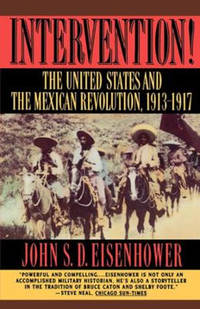
Best.-Nr. B9780393313185Paperback / softback. New. Powerful and compelling. . . . Eisenhower is not only an accomplished military historian he's also a storyteller in the tradition of Bruce Caton and Shelby Foote.—Steve Neal Chicago Sun-Times paperback
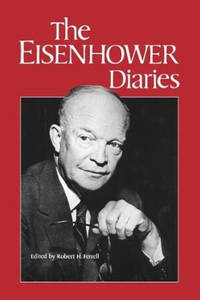
Best.-Nr. B9780393331806Paperback / softback. New. The diaries of the late Dwight D. Eisenhower are unique documents in that they alone in the mass of Ike's prose reveal the innermost thoughts of the soldier-statesman. paperback
1959Best.-Nr. 174141959. George M. Johnson White House press photograph 1959 documents President Dwight D. Eisenhower receiving African American attorney and legal educator George M. Johnson and his wife Evelyn during Johnson's selection for the United States Commission on Civil Rights. Johnson a professor of law and former dean of Howard University School of Law was nominated to the Commission in 1959 with a Senate Judiciary subcommittee holding a hearing on his nomination on April 21. Congress had created the Commission under the Civil Rights Act of 1957 the first federal civil rights legislation enacted since Reconstruction giving the federal government a new body for investigating voting rights discrimination and studying the legal status of civil rights protections. The June 1959 image places Johnson inside the White House during this early federal effort to investigate racial discrimination through a permanent national commission. Original Associated Press silver gelatin press photograph dated June 9 1959 9 x 7 inches. President Eisenhower shakes hands with Evelyn Johnson as George M. Johnson stands beside them in the White House; the three face the camera during the greeting. An AP caption appears along the right margin with an inscription on the verso. Johnson's appointment placed an African American legal scholar with experience at Howard University within the six member federal commission created two years earlier; the Commission's work during this period included investigations and reports concerning voting education housing and other areas of racial discrimination. The photograph dates from the period between Johnson's April 1959 nomination hearing and his subsequent Senate confirmation preserving the ceremonial White House dimension of a federal civil rights appointment during Eisenhower's second administration. Rather than a general presidential publicity image it identifies Johnson at the executive center of the government as the Civil Rights Commission was beginning its investigations into federally protected rights. A 2 x 1 inch area of white correction material appears adjacent to George Johnson's face; AP caption at right margin and verso inscription remain present. Overall very good condition. unknown
1969Best.-Nr. 008419Putnam 1969. Hardcover. Very Good/Good. The Bitter Woods by John S.D. Eisenhower. Signed by author on first blank page. Signature only. Hardcover published in 1969 by G.P. Putnam's Son. Glue remnants on page proceeding signature page. Jacket severely creased and chipped. Putnam hardcover
Best.-Nr. COD-04190Golden Press. hardcover. Good. Good condition. Signed by Dolores Hope. With dust jacket with wear. Golden Press hardcover
Best.-Nr. B9781258083212Hardback. New. hardcover
Best.-Nr. B9781258018788Hardback. New. hardcover
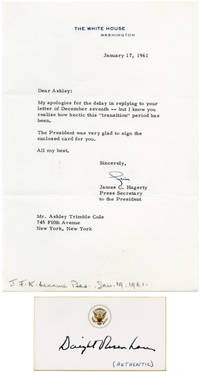
1719Best.-Nr. 43529Washington. January 17 1961. Signed During His Last Days in Office Signature of President Dwight D. Eisenhower in the last days of his administration written on a card embossed with a gold seal of the United States. The card is accompanied by an explanatory letter from the President's Press Secretary addressed to Ashley T. Cole which reads: "My apologies for the delay in replying to your letter of December seventh - but I know you realize how hectic this 'transition' period has been. The President was very glad to sign the enclosed card for you." A later hand has written the word "authentic" in ink on the card. Fine with later ink notation. unknown
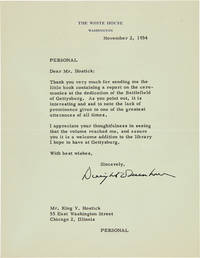
1954Best.-Nr. 42238Washington D.C. November 2 1954. Eisenhower at Home at Gettysburg It is not clear to us which book the Illinois manuscript dealer and Lincoln scholar Hostick gave Eisenhower but President Eisenhower felt moved to write: ".As you point out it is interesting and sad to note the lack of prominence given to one of the greatest utterances of all time.it is a welcome addition to the library I hope to have at Gettysburg." The Eisenhowers had a small working farm just outside of Gettysburg where the President retired in 1961 and where he died in 1969. He was an active supporter and Trustee of Gettysburg College. Fine. In cloth box gilt leather label. hardcover
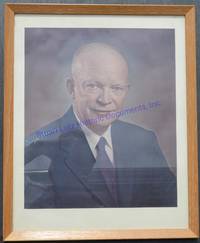
Best.-Nr. 6834DWIGHT EISENHOWER 1890-1969. Dwight Eisenhower was the Thirty-Fourth President.PS. 15 x 18. N.d. N.p. A colored photograph signed Dwight Eisenhower in white ink along his right shoulder. The photo is a bust portrait of Eisenhower. The photograph is in mint condition and is professionally framed. unknown
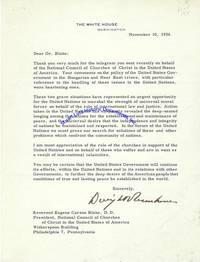
Best.-Nr. 5932DWIGHT D. EISENHOWER 1890-1969. The Thirty-Fourth President Eisenhower was an Allied commander in World War II and ordered the Normandy invasion. He was elected President in 1952 for two terms.TLS. 1 pg. 8 x 10. November 30 1956. The White House Washington. A typed letter signed by Dwight D Eisenhower to Reverend Eugene Carson Blake D.D.: Thank you very much for the telegram you sent recently on behalf of the National Council of Churches of Christ in the United States of America. Your comments on the policy of the United States Government in the Hungarian and Near East crises with particular reference to the handling of these issues in the United Nations were heartening ones. These two grave situations have represented an urgent opportunity for the United Nations to marshal the strength of universal moral forces on behalf of the rule of international law and justice. Action taken in the United Nations has eloquently revealed the deep-seated longing among the nations for an establishment and maintenance of peace and the universal desire that the independence and integrity of nations be maintained and respected. In the forum of the United Nations we must press our search for solutions of these and other problems which confront the community of nations. I am most appreciative of the role of the churches in support of the United Nations and on behalf of those who suffer and are in want as a result of international calamities. You may be certain that the United States Government will continue its efforts within the United Nations and in its relations with other Governments to further the deep desire of the American people that conditions of true and lasting peace be established in the world. President Eisenhower sent this letter to Eugene Blake the leader of the National Council of Churches of Christ in the United States of America. Blake was a prominent Presbyterian leader who served as President from 1954-1957 and later was a participant in the March on Washington. The NCC is an interdenominational partnership of Christian faith groups in the United States that often spoke forcefully about promoting peace in U.S. foreign policy. The two crises that Eisenhower refers to both in 1956 were the Hungarian Revolution which saw the Soviet Union violently invade and suppress Hungarys new reformist government and the Suez Canal Crisis which saw Great Britain France and Israel launch a joint operation to retake the Suez Canal after Egypts Nasser nationalized it. The actions by Eisenhower and the United Nations in resolving both crises were supported by many like Blake but also criticized by many in the U.S. and around the world. This was especially true as Eisenhower and the United Nations sat back while the Soviet Union killed over 6000 Hungarian soldiers and civilians and displaced over 200000 which was seen as hypocritical given American action in Korea and Vietnam. Regardless this letter is an important reminder about the influence the NCC had as a Christian advocacy body and Eisenhowers role as the leader of the internationalist and institutionalist wing of the Republican Party in the decade after World War II. unknown