626 risultati
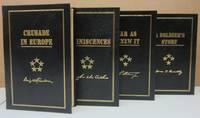
2001rif. 75837Norwalk Connecticut: Easton Press 2001. Full Leather. Fine. 24 x 16 cm. Octavo. Four volume set uniformly bound in full black leather with gilt design facsimile signature lettering and foredges. 3 raised bands to spines moire endpapers silk ribbon. A collection of Easton Press published memoirs by four USA generals active during WWII. Titles are: "Crusade in Europe" Dwight D. Eisenhower 559pp. "Reminiscences" Douglas MacArthur438pp. "War as I Knew it" George S. Patton 427pp annotated by Colonel Paul D. Harkins with a new introduciton by Rick Atkinson. "A Soldier's Story" Omar N. Bradley 618pp foreword by Bill Mauldin. Easton Press unknown
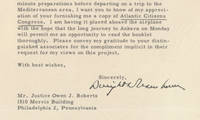
rif. 308161/3/52. Justice Owen J. Roberts resigned from the Supreme Court to advocate for a Federal Union of democracies and to unite one group favoring world government and the other favoring Union of the Democracies From 1951-52 Eisenhower was the Allied Supreme Commander in Europe which title included the post of head of NATO. In 1952 Turkey joined NATO and Ike traveled to Ankara Turkey to seal with his presence the membership of Turkey in Europe. Justice Owen J. Roberts resigned from the Supreme Court in 1945 and was afterwards instrumental in forming the Atlantic Union which would advocate for a Federal Union of Democracies but with a gradual approach to final world union by way of regional unions. Two million people signed a petition that the U.S. and Great Britain unify others wanted to start with the U.S. and Canada. Roberts said that although he approved of NATO he thought it was a fine tradition but could not prevent war and that permanent peace required a federation of likeminded peoples. Nor could the UN be relied upon with the power the Soviets had in that body. In 1952 a new group was formed whose members agreed with Roberts’ views the Atlantic Citizens Congress whose members were drawn partly from the Atlantic Union Committee and partly from outside. Typed letter signed on his letterhead Supreme Headquarters Allied Powers Europe 1 March 1952 to Justice Owen J. Roberts saying he is departing for Turkey and that he is grateful for receiving information on the new Atlantic Citizens organization. “Dear Mr. Justice: Although my schedule is extremely rushed by last minute preparations before departing on a trip to the Mediterranean area I want you to know of my appreciation of your furnishing me a copy of Atlantic Citizens Congress. I am having it placed aboard the airplane with the hope that the long journey to Ankara on Monday will permit me an opportunity to read the booklet thoroughly. Please convey my gratitude to your distinguished associates for the compliment implicit in their request for my views on this project.” Eight months later Eisenhower is elected President of the United States. <img class=""alignnone size-post-window wp-image-25018"" src=""https://cdn.raabcollection.com/wp-content/uploads/20231204144051/Folder-site-11-1600x1327.jpg"" alt="""" width=""1600"" height=""1327"" /> unknown
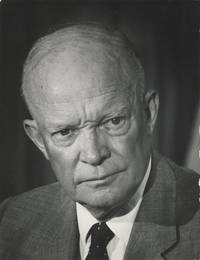
1957rif. 162948N.p.: N.p. 1957. Vintage borderless oversize portrait photograph of President Dwight D. Eisenhower 1957. Annotation in manuscript pencil on the verso noting the name of photographer Robert Phillips. Noted photojournalist Robert Phillips primarily covered US politics from the mid-1950s to the 1970s. His work is today held by the University of Texas at Austin. From the archive of the PIX Agency an American photo house that acted as an intermediary between emigre photographers as well as those still living in Europe and the American magazine and newspaper market between 1935-1969. 10.25 x 13.5 inches housed in a 20 x 16 inch 8-ply white mat. Very Good plus. N.p. unknown
rif. x-023102472XColumbia Univ Pr 1961. Hardcover. New. 273 pages. 8.66x5.84x0.99 inches. Columbia Univ Pr hardcover
rif. 033165332X.Ghardcover. Good. Access codes and supplements are not guaranteed with used items. May be an ex-library book. hardcover
rif. A9780231024723Hardback. New. hardcover
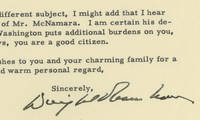
1960rif. 2101927/12/1960. “I doubt if you realize just how much you have helped me carry on the official work of government…” In the waning days of 1960 Eisenhower prepared to leave office and hand the presidency to John F. Kennedy. Henry Ford II was a close confidant of Eisenhower’s and during his presidency provided Ike with important assistance. So as he said farewell to the presidency Ike wanted to tender to Ford his heart-felt thank you. On three occasions Ford lent one of his senior executives Leo Beebe to the U.S. government to supervise the resettlement of refugees and manage similar projects. Beebe became executive vice chairman of Eisenhower’s Committee for Hungarian Refugees in 1956 a need that resulted from the Hungarian Revolution and subsequent flight from the country of many refugees. In addition to his committee work during 1956-1957 while working out of Camp Kilmer in northern New Jersey Beebe oversaw the relocation and resettlement of 35000 Hungarian refugees in the United States eventually finding them permanent residences in this country. In 1959-1960 Beebe organized the U.S. Center for Cuban Refugees in Miami Florida to help with the mass influx of Cuban refugees that fled Castro’s Cuba in 1960 and beyond. Ford backed the refugee aid effort all the way and it was of incalculable importance. In 1960 Robert McNamara was President of the Ford Motor Company. Kennedy the President-elect sought to name McNamara Secretary of Defense. Ford agreed to spare McNamara yet another example of his largess. Ford Motor Co. required its top executives to use private aircraft for business and personal travel. We see in this letter that he also served Eisenhower by providing private jet transportation to and from meetings. Typed letter signed on White House letterhead Washington December 27 1960 to Henry Ford II. “As the end of my Administration approaches I want once again to express to you and through you to your associates the appreciation I personally feel and which is shared by the members of the White House staff who normally travel with me of the many courtesies that have been extended to us not only during 1960 but through all the years here. I doubt if you realize just how much you have helped me carry on the official work of government by making transportation available to the key personnel who must be with me but are necessarily scattered during any one of the so-called ‘work-vacation’ trips I have taken. I assure you however that without your cooperation it would have been exceedingly difficult for me to carry out my responsibilities and still get some periods of relaxation. I shall be lastingly grateful to you and your officials in the various places we have visited with some regularity and at some length. “On a totally different subject I might add that I hear good reports of Mr. McNamara. I am certain his departure for Washington puts additional burdens on you but as always you are a good citizen. “With best wishes to you and your charming family for a fine 1961 and warm personal regard Sincerely Dwight D. Eisenhower.” This letter is the first valedictory of Eisenhower’s we can recall seeing and it remained in the Ford family until 2020. It has never before been offered for sale. <img class=""alignnone wp-image-25018 size-post-window"" src=""https://cdn.raabcollection.com/wp-content/uploads/20231204144051/Folder-site-11-1600x1327.jpg"" alt="""" width=""1600"" height=""1327"" /> unknown
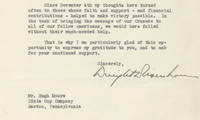
1401rif. 3045914/01/1953. “Since November 4th my thoughts have turned often to those whose faith and support - and financial contributions - helped to make victory possible. In the task of bringing the message of our Crusade to all of our follow Americans we would have failed without their much-needed help.” The 1952 United States presidential election was held on Tuesday November 4 1952. Republican Dwight D. Eisenhower won a landslide victory over Illinois Democratic Governor Adlai Stevenson becoming the first Republican president in 20 years. This was the first election since 1928 without an incumbent president on the ballot. Eisenhower was re-elected in 1956 in a rematch with Stevenson. The 1952 presidential election campaign was conducted against the backdrop of a “red scare” in which many Americans feared that foreign communist agents were attempting to infiltrate the government. Two years earlier Sen. Joseph R. McCarthy who held that the Roosevelt and Truman administrations amounted to “20 years of treason” claimed that he had a list of State Department employees who were loyal only to the Soviet Union. Though McCarthy offered no evidence to support his charges and revealed only a single name he won a large personal following. The Red Scare the stalemated Korean War and a renewal of inflation handicapped Stevenson who fought a vigorous campaign. Eisenhower campaigned tirelessly impressing millions with his warmth and sincerity. His wide friendly grin wartime heroics and middle-class pastimes—he was an avid golfer endeared him to the public and garnered him vast support. On the eve of the election there was a general opinion that the presidential race was close. The final tally however was anything but. Eisenhower won by more than six million votes capturing 39 states and 442 electoral votes to Stevenson’s 9 states and 89 electoral votes. The election was considered a great personal triumph for Eisenhower. In the wake of the election Eisenhower thanked his major contributors for their financial support which had enabled him to bring his message to the American people. Typed letter signed on his letterhead New York January 14 1953 to Hugh Moore president of the Dixie Cup Company and a supporter of his. “Dear Mr. Moore: To the thanks you have undoubtedly already received for your generous contribution during the campaign I wish to add my own. “Since November 4th my thoughts have turned often to those whose faith and support - and financial contributions - helped to make victory possible. In the task of bringing the message of our Crusade to all of our fellow Americans we would have failed without their much-needed help. That is why I am particularly glad of this opportunity to express my gratitude to you and to ask for your continued support.” It is interesting that Eisenhower saw his election as a crusade and his views as carrying a message. <img class=""alignnone size-post-window wp-image-25018"" src=""https://cdn.raabcollection.com/wp-content/uploads/20231204144051/Folder-site-11-1600x1327.jpg"" alt="""" width=""1600"" height=""1327"" /> unknown
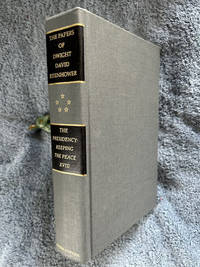
1958rif. 1012260023National Archives of the U.S 1958. Hardcover. Like New. 4to. Clean unmarked pages. Good binding and cover. Hardcover. Ships daily. National Archives of the U.S hardcover
1989rif. 260411003Easton Press 1989. Hardcover. New. still in shrink wrap full light brown decorated gold leather Easton Press hardcover
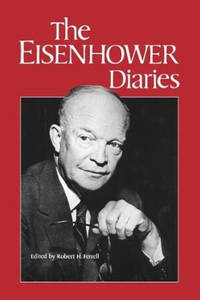
rif. B9780393331806Paperback / softback. New. The diaries of the late Dwight D. Eisenhower are unique documents in that they alone in the mass of Ike's prose reveal the innermost thoughts of the soldier-statesman. paperback
1989rif. 85676Norwalk Connecticut: Easton Press 1989. First Edition; First Printing. Hardcover. Fine. Accented in 22kt gold printed on archival paper with gilded edges smyth sewing & concealed muslin joints. Bound In full leather with hubbed spines. A Limited Edition.; First Easton Press Edition.; 8vo 8" - 9" tall. Easton Press hardcover
1989rif. 86143Norwalk Connecticut: Easton Press 1989. First Edition; First Printing. Hardcover. Fine. Accented in 22kt gold printed on archival paper with gilded edges smyth sewing & concealed muslin joints. Bound In full leather with hubbed spines. A Limited Edition.; First Easton Press Edition.; 8vo 8" - 9" tall. Easton Press hardcover
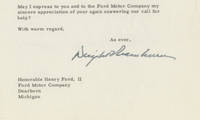
1601rif. 2121416/01/1961. Ike wrote that asked “for help in dealing with this crisis your company at once furnished…the same team - Mr. Leo C. Beebe and Mr. Charles A. Pink - who did so much to make a success of our work…for the Hungarian refugees four years ago.” In the wake of the Cuban Revolution in 1959 a Cuban exodus began as the new government allied itself with the Soviet Union and began to introduce communism. Tens of thousands of Cubans left Cuba starting in late 1959 and picking up in 1960 and the United States became the country of first asylum as the Cuban refugees sought and found political refuge here. For the first time the United States Government found it necessary to develop a program to help refugees from another nation in this hemisphere. In the forefront of this effort was President Dwight D. Eisenhower who was in the waning days of his administration. In November 1960 Eisenhower directed Tracy S. Voorhees a former Undersecretary of the Army to act as the President's Personal Representative for Cuban Refugees to look into the Cuban refugee situation. To do this and deal with the broader challenges the refugees presented Voorhees reached out for assistance to Henry Ford II of the Ford Motor Company who had been of great help on a similar occasion in the past. In 1956 Ford lent one of his senior executives Leo Beebe to the U.S. government to supervise the resettlement in the U.S. of refugees fleeing Hungary after the failure of the revolution there. Beebe became executive vice chairman of Eisenhower’s Committee for Hungarian Refugees. In addition to his committee work during 1956-1957 while working out of Camp Kilmer in northern New Jersey Beebe and his aide Charles A. Pink a Ford staff member oversaw the relocation and resettlement of 35000 Hungarian refugees in the United States eventually finding them permanent residences in this country. In 1960 Ford came through again and provided the services of the experienced Beebe and Pink for the Cuban refugee effort. The Cuban Refugee Emergency Center was established in Miami and became the focal point of refugee registration assistance relief and resettlement as well as coordination of government and independent agencies’ programs. Federal funding provided for the center’s operations record keeping publications coordination of agencies and research on different aspects of the refugee situation as well as for programs. The latter included financial assistance educational loans health care adult education and re-training resettlement and care of unaccompanied children. To understand the scope of the effort in the first two years after the Cuban Revolution over 50000 Cubans fled and established new homes in the United States. Typed letter signed on White House letterhead Washington January 16 1961 to Henry Ford II thanking him for again lending a much-needed hand in this critical venture. This letter was written a mere four days before Ike left office and was succeeded by John F. Kennedy. “Tracy Voorhees my representative for the Cuban refugee problem has told me that in response to his request to the Ford Motor Company for help in dealing with this crisis your company at once furnished to him the same team - Mr. Leo C. Beebe and Mr. Charles A. Pink - who did so much to make a success of our work at Camp Kilmer for the Hungarian refugees four years ago. “With their unique experience gained at Kilmer these men have been largely responsible for setting up our Cuban Refugee Emergency Center in Miami and making its work a success. May I express to you and to the Ford Motor Company my sincere appreciation of your again answering our call for help” This letter remained in the Ford family until recently and it has never before been offered for sale. unknown
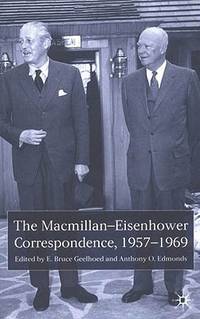
rif. 6514599MacMillan . Hardback. New. pp. ix 436 MacMillan hardcover
1996rif. 1240309.26Johns Hopkins University Press 1996. Hardcover. As New. 8vo hardcover. No dj grey cloth. Fine condition. Covers and contents crisp clean unworn no marking or writing. Binding square and tight. Johns Hopkins University Press hardcover
1996rif. 1240309.28Johns Hopkins University Press 1996. Hardcover. As New. 8vo hardcover. No dj grey cloth. Fine condition. Covers and contents crisp clean unworn no marking or writing. Binding square and tight. Johns Hopkins University Press hardcover
2001rif. 1240309.30Johns Hopkins University Press 2001. Hardcover. As New. 8vo hardcover. No dj grey cloth. Fine condition. Covers and contents crisp clean unworn no marking or writing. Binding square and tight. Johns Hopkins University Press hardcover
1996rif. 1240309.27Johns Hopkins University Press 1996. Hardcover. As New. 8vo hardcover. No dj grey cloth. Fine condition. Covers and contents crisp clean unworn no marking or writing. Binding square and tight. Johns Hopkins University Press hardcover
1963rif. 183989New York: Doubleday 1963. First Edition; First Printing. Hardcover. Very Good in a Very Good dust jacket. Owner imprint on title page. Chip at spine crown. Doubleday hardcover
rif. 0962733008.Gunknown_binding. Good. Access codes and supplements are not guaranteed with used items. May be an ex-library book. unknown
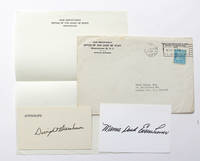
1947rif. 031091UK 1947. First Edition . Paper. Good. 48mo - over 3 - 4" tall. Two Original Autographed Index Cards of US President Dwight D. Eisenhower and his wife Marnie Doud Eisenhower with the Original Envelope from the War Department Office of the Chief of Staff Washington letterhead and postmarked envelope. Dated 1947. Dwight David "Ike" Eisenhower 1890 - 1969 was the 34th president of the United States serving from 1953 to 1961. During World War II he was Supreme Commander of the Allied Expeditionary Force in Europe and achieved the five-star rank as General of the Army. Eisenhower planned and supervised two of the most consequential military campaigns of World War II: Operation Torch in the North Africa campaign in 1942-1943 and the invasion of Normandy in 1944. Mary Geneva "Mamie" Eisenhower 1896 -1979 was First Lady of the United States from 1953 to 1961 as the wife of President Dwight D. Eisenhower. Card sizes are 115mm x 65mm and 115mm x 75mm. Condition is good. From the collection of autograph collector Peter Bland. £450 Ref 19234 unknown
rif. 250444/4/52. Ike signed this as president and sent it to a Navy veteran On April 4 1949 twelve nations from Western Europe and North America signed the North Atlantic Treaty in Washington D.C. A key feature of this treaty is Article 5 in which the signatory members agreed that ""an armed attack against one or more of them in Europe or North America shall be considered an attack against them all.” Initially however the alliance was not very well prepared to carry out the mission of defending its territory. In addition to grave shortages of troops and equipment there was no command structure to direct the overall defense of Western Europe just committees - known as ""Regional Planning Groups"" - that were charged with drawing up plans for the defense of their regions. The 12 original members were the United States Canada Britain Belgium Denmark France Iceland Italy Luxembourg the Netherlands Norway and Portugal. All this changed after the outbreak of the Korean War in June 1950 which raised fears that Europe could face a similar threat over divided Germany. The nations of the alliance agreed to increase their defence efforts and began working on the creation of an integrated military command structure with an overall commander for NATO forces in Europe. Selecting the first Supreme Allied Commander Europe SACEUR was easy since everyone's first choice was the popular and respected U.S. Army Gen. Dwight D. Eisenhower who had led allied forces in Europe during World War II. On December 19 1950 the North Atlantic Council announced the appointment of General Eisenhower as the first Supreme Allied Commander. In 1952 Greece and Turkey joined in the alliance's first expansion. Document signed by Dwight D. Eisenhower first Supreme Allied Commander of Nato stamped April 4 1952 signed as President in February 1957 the first day cover honoring NATO along with the first NATO stamp honoring NATO. Comes with two letters relating to the cover sent to its owner L. Dean Powell a Navy veteran. We have found no other signed examples of this cover having reached the market. <img class=""alignnone wp-image-25018 size-post-window"" src=""https://cdn.raabcollection.com/wp-content/uploads/20231204144051/Folder-site-11-1600x1327.jpg"" alt="""" width=""1600"" height=""1327"" /> unknown books
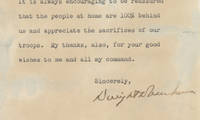
rif. 344736/4/45. “It is always encouraging to be reassured that the people at home are 100% behind us and appreciate the sacrifices of our troops.” General Dwight D. Eisenhower the Supreme Commander of the Allied Expeditionary Force in Europe orchestrated the defeat of Germany’s Third Reich during World War II. He could only have done so with the support of the American people for which he was eternally grateful and of his courageous soldiers many of whom were killed in action. April 1945 saw the war in Europe in its final weeks with intense fighting and many significant events. These included the continuing bloody Allied invasion of Germany and the Battle of Berlin and Soviet advance into that city. As Allied forces in the West closed in they liberated concentration camps like Bergen-Belsen. April was also marked by the execution of Benito Mussolini suicide of Adolf Hitler and on April 12 the death of President Franklin D. Roosevelt. On May 8 V-E Day the war in Europe would come to an end. While his role as a military leader was crucial to the war’s outcome Eisenhower was equally important in the documentation of Nazi brutality and the truth of the Holocaust. This was an important aspect of April 1945 for him. On April 4 the Third United States Army liberated the Ohrdruf camp. That camp was an extension of the Buchenwald Concentration Camp. On the day of liberation the SS members of Ohrdruf evacuated many of the prisoners on death marches. As U.S. troops arrived they found scenes of mass murder while also coming into contact with the camp’s surviving prisoners. The living prisoners were starving emaciated and desperately needed medical attention. Eisenhower along with Generals George Patton and Omar Bradley visited the Ohrdruf concentration camp personally on April 12 1945. While driving towards the camp the smell of decaying flesh was present and dead bodies littered the streets. Eisenhower was “never so angry in my life” stating that the “English language didn’t even have words that could describe” what he saw. Eisenhower wrote to Winston Churchill following his time at Ohrdruf stating that “everything you read in the paper does not adequately describe what has really happened here.” Thus in April 1945 Eisenhower was profoundly impacted by the horrors that he witnessed and demanded that newspaper editors representative groups German civilians and Allied soldiers bear witness. Typed letter signed on his Supreme Headquarters Allied Expeditionary Force letterhead Germany April 6 1945 just two days after the taking of Ohrdruf and six days before his famous visit there to Mrs. Mamie Metz thanking her and the American people for their support of the army in the field and appreciation of its sacrifices. “Many thanks for your interesting letter. It is always encouraging to be reassured that the people at home are 100% behind us and appreciate the sacrifices of our troops. My thanks also for your good wishes to me and all my command.” An important statement showing Eisenhower’s feelings about the American people’s sustaining and backing the army and gratitude for the sacrifices of the soldiers issued right near the end of World War II in Europe. Some trimming and evidence of past mounting on verso. <img class=""alignnone wp-image-25018 size-post-window"" src=""https://cdn.raabcollection.com/wp-content/uploads/20231204144051/Folder-site-11-1600x1327.jpg"" alt="""" width=""1600"" height=""1327"" /> unknown books
1948rif. 018268Doubleday & CompanyInc 1948. Book. Fine. Hardcover. 1st Edition. 8vo - over 7¾ - 9¾" tall. Fine Copy On Very Good Plus Jacket. First Edition $5.00 On Flap. President Eisenhower Autobiography of The French Invasion Ending WW !1. Doubleday & Company,Inc Hardcover books