734 résultats
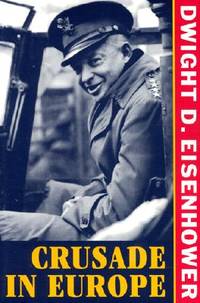
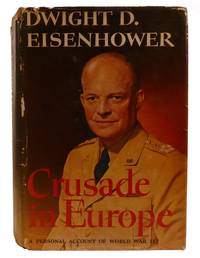
1963réf. 018158Doubleday & CompanyInc 1963. Book. Fine. Cloth in Box. Signed by Authors. Limited Edition. 8vo - over 7¾ - 9¾" tall. Fine Copy Limited Edition Signed.1/1500 Copies.#1598 Signed By The Author. As New Beautiful Copy In Matching Box. Doubleday & Company,Inc Hardcover books
réf. 308161/3/52. Justice Owen J. Roberts resigned from the Supreme Court to advocate for a Federal Union of democracies and to unite one group favoring world government and the other favoring Union of the Democracies From 1951-52 Eisenhower was the Allied Supreme Commander in Europe which title included the post of head of NATO. In 1952 Turkey joined NATO and Ike traveled to Ankara Turkey to seal with his presence the membership of Turkey in Europe. Justice Owen J. Roberts resigned from the Supreme Court in 1945 and was afterwards instrumental in forming the Atlantic Union which would advocate for a Federal Union of Democracies but with a gradual approach to final world union by way of regional unions. Two million people signed a petition that the U.S. and Great Britain unify others wanted to start with the U.S. and Canada. Roberts said that although he approved of NATO he thought it was a fine tradition but could not prevent war and that permanent peace required a federation of likeminded peoples. Nor could the UN be relied upon with the power the Soviets had in that body. In 1952 a new group was formed whose members agreed with Roberts’ views the Atlantic Citizens Congress whose members were drawn partly from the Atlantic Union Committee and partly from outside. Typed letter signed on his letterhead Supreme Headquarters Allied Powers Europe 1 March 1952 to Justice Owen J. Roberts saying he is departing for Turkey and that he is grateful for receiving information on the new Atlantic Citizens organization. “Dear Mr. Justice: Although my schedule is extremely rushed by last minute preparations before departing on a trip to the Mediterranean area I want you to know of my appreciation of your furnishing me a copy of Atlantic Citizens Congress. I am having it placed aboard the airplane with the hope that the long journey to Ankara on Monday will permit me an opportunity to read the booklet thoroughly. Please convey my gratitude to your distinguished associates for the compliment implicit in their request for my views on this project.” Eight months later Eisenhower is elected President of the United States. <img class=""alignnone size-post-window wp-image-25018"" src=""https://cdn.raabcollection.com/wp-content/uploads/20231204144051/Folder-site-11-1600x1327.jpg"" alt="""" width=""1600"" height=""1327"" /> unknown books
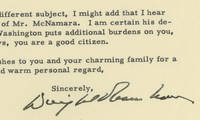
1960réf. 2101927/12/1960. “I doubt if you realize just how much you have helped me carry on the official work of government…” In the waning days of 1960 Eisenhower prepared to leave office and hand the presidency to John F. Kennedy. Henry Ford II was a close confidant of Eisenhower’s and during his presidency provided Ike with important assistance. So as he said farewell to the presidency Ike wanted to tender to Ford his heart-felt thank you. On three occasions Ford lent one of his senior executives Leo Beebe to the U.S. government to supervise the resettlement of refugees and manage similar projects. Beebe became executive vice chairman of Eisenhower’s Committee for Hungarian Refugees in 1956 a need that resulted from the Hungarian Revolution and subsequent flight from the country of many refugees. In addition to his committee work during 1956-1957 while working out of Camp Kilmer in northern New Jersey Beebe oversaw the relocation and resettlement of 35000 Hungarian refugees in the United States eventually finding them permanent residences in this country. In 1959-1960 Beebe organized the U.S. Center for Cuban Refugees in Miami Florida to help with the mass influx of Cuban refugees that fled Castro’s Cuba in 1960 and beyond. Ford backed the refugee aid effort all the way and it was of incalculable importance. In 1960 Robert McNamara was President of the Ford Motor Company. Kennedy the President-elect sought to name McNamara Secretary of Defense. Ford agreed to spare McNamara yet another example of his largess. Ford Motor Co. required its top executives to use private aircraft for business and personal travel. We see in this letter that he also served Eisenhower by providing private jet transportation to and from meetings. Typed letter signed on White House letterhead Washington December 27 1960 to Henry Ford II. “As the end of my Administration approaches I want once again to express to you and through you to your associates the appreciation I personally feel and which is shared by the members of the White House staff who normally travel with me of the many courtesies that have been extended to us not only during 1960 but through all the years here. I doubt if you realize just how much you have helped me carry on the official work of government by making transportation available to the key personnel who must be with me but are necessarily scattered during any one of the so-called ‘work-vacation’ trips I have taken. I assure you however that without your cooperation it would have been exceedingly difficult for me to carry out my responsibilities and still get some periods of relaxation. I shall be lastingly grateful to you and your officials in the various places we have visited with some regularity and at some length. “On a totally different subject I might add that I hear good reports of Mr. McNamara. I am certain his departure for Washington puts additional burdens on you but as always you are a good citizen. “With best wishes to you and your charming family for a fine 1961 and warm personal regard Sincerely Dwight D. Eisenhower.” This letter is the first valedictory of Eisenhower’s we can recall seeing and it remained in the Ford family until 2020. It has never before been offered for sale. <img class=""alignnone wp-image-25018 size-post-window"" src=""https://cdn.raabcollection.com/wp-content/uploads/20231204144051/Folder-site-11-1600x1327.jpg"" alt="""" width=""1600"" height=""1327"" /> unknown books
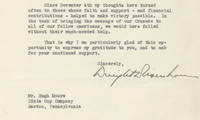
1401réf. 3045914/01/1953. “Since November 4th my thoughts have turned often to those whose faith and support - and financial contributions - helped to make victory possible. In the task of bringing the message of our Crusade to all of our follow Americans we would have failed without their much-needed help.” The 1952 United States presidential election was held on Tuesday November 4 1952. Republican Dwight D. Eisenhower won a landslide victory over Illinois Democratic Governor Adlai Stevenson becoming the first Republican president in 20 years. This was the first election since 1928 without an incumbent president on the ballot. Eisenhower was re-elected in 1956 in a rematch with Stevenson. The 1952 presidential election campaign was conducted against the backdrop of a “red scare” in which many Americans feared that foreign communist agents were attempting to infiltrate the government. Two years earlier Sen. Joseph R. McCarthy who held that the Roosevelt and Truman administrations amounted to “20 years of treason” claimed that he had a list of State Department employees who were loyal only to the Soviet Union. Though McCarthy offered no evidence to support his charges and revealed only a single name he won a large personal following. The Red Scare the stalemated Korean War and a renewal of inflation handicapped Stevenson who fought a vigorous campaign. Eisenhower campaigned tirelessly impressing millions with his warmth and sincerity. His wide friendly grin wartime heroics and middle-class pastimes—he was an avid golfer endeared him to the public and garnered him vast support. On the eve of the election there was a general opinion that the presidential race was close. The final tally however was anything but. Eisenhower won by more than six million votes capturing 39 states and 442 electoral votes to Stevenson’s 9 states and 89 electoral votes. The election was considered a great personal triumph for Eisenhower. In the wake of the election Eisenhower thanked his major contributors for their financial support which had enabled him to bring his message to the American people. Typed letter signed on his letterhead New York January 14 1953 to Hugh Moore president of the Dixie Cup Company and a supporter of his. “Dear Mr. Moore: To the thanks you have undoubtedly already received for your generous contribution during the campaign I wish to add my own. “Since November 4th my thoughts have turned often to those whose faith and support - and financial contributions - helped to make victory possible. In the task of bringing the message of our Crusade to all of our fellow Americans we would have failed without their much-needed help. That is why I am particularly glad of this opportunity to express my gratitude to you and to ask for your continued support.” It is interesting that Eisenhower saw his election as a crusade and his views as carrying a message. <img class=""alignnone size-post-window wp-image-25018"" src=""https://cdn.raabcollection.com/wp-content/uploads/20231204144051/Folder-site-11-1600x1327.jpg"" alt="""" width=""1600"" height=""1327"" /> unknown books
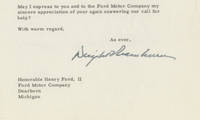
1601réf. 2121416/01/1961. Ike wrote that asked “for help in dealing with this crisis your company at once furnished…the same team - Mr. Leo C. Beebe and Mr. Charles A. Pink - who did so much to make a success of our work…for the Hungarian refugees four years ago.” In the wake of the Cuban Revolution in 1959 a Cuban exodus began as the new government allied itself with the Soviet Union and began to introduce communism. Tens of thousands of Cubans left Cuba starting in late 1959 and picking up in 1960 and the United States became the country of first asylum as the Cuban refugees sought and found political refuge here. For the first time the United States Government found it necessary to develop a program to help refugees from another nation in this hemisphere. In the forefront of this effort was President Dwight D. Eisenhower who was in the waning days of his administration. In November 1960 Eisenhower directed Tracy S. Voorhees a former Undersecretary of the Army to act as the President's Personal Representative for Cuban Refugees to look into the Cuban refugee situation. To do this and deal with the broader challenges the refugees presented Voorhees reached out for assistance to Henry Ford II of the Ford Motor Company who had been of great help on a similar occasion in the past. In 1956 Ford lent one of his senior executives Leo Beebe to the U.S. government to supervise the resettlement in the U.S. of refugees fleeing Hungary after the failure of the revolution there. Beebe became executive vice chairman of Eisenhower’s Committee for Hungarian Refugees. In addition to his committee work during 1956-1957 while working out of Camp Kilmer in northern New Jersey Beebe and his aide Charles A. Pink a Ford staff member oversaw the relocation and resettlement of 35000 Hungarian refugees in the United States eventually finding them permanent residences in this country. In 1960 Ford came through again and provided the services of the experienced Beebe and Pink for the Cuban refugee effort. The Cuban Refugee Emergency Center was established in Miami and became the focal point of refugee registration assistance relief and resettlement as well as coordination of government and independent agencies’ programs. Federal funding provided for the center’s operations record keeping publications coordination of agencies and research on different aspects of the refugee situation as well as for programs. The latter included financial assistance educational loans health care adult education and re-training resettlement and care of unaccompanied children. To understand the scope of the effort in the first two years after the Cuban Revolution over 50000 Cubans fled and established new homes in the United States. Typed letter signed on White House letterhead Washington January 16 1961 to Henry Ford II thanking him for again lending a much-needed hand in this critical venture. This letter was written a mere four days before Ike left office and was succeeded by John F. Kennedy. “Tracy Voorhees my representative for the Cuban refugee problem has told me that in response to his request to the Ford Motor Company for help in dealing with this crisis your company at once furnished to him the same team - Mr. Leo C. Beebe and Mr. Charles A. Pink - who did so much to make a success of our work at Camp Kilmer for the Hungarian refugees four years ago. “With their unique experience gained at Kilmer these men have been largely responsible for setting up our Cuban Refugee Emergency Center in Miami and making its work a success. May I express to you and to the Ford Motor Company my sincere appreciation of your again answering our call for help” This letter remained in the Ford family until recently and it has never before been offered for sale. unknown books
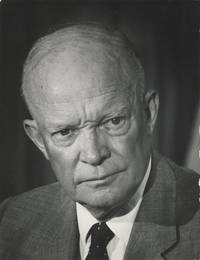
1957réf. 162948N.p.: N.p. 1957. Vintage borderless oversize portrait photograph of President Dwight D. Eisenhower 1957. Annotation in manuscript pencil on the verso noting the name of photographer Robert Phillips. Noted photojournalist Robert Phillips primarily covered US politics from the mid-1950s to the 1970s. His work is today held by the University of Texas at Austin. From the archive of the PIX Agency an American photo house that acted as an intermediary between emigre photographers as well as those still living in Europe and the American magazine and newspaper market between 1935-1969. 10.25 x 13.5 inches housed in a 20 x 16 inch 8-ply white mat. Very Good plus. N.p. unknown books
1974réf. NF3783ESPRIT DE CORPS 1974 Dwight D. Eisenhower High School Shelby Township Michigan first edition vg in pictorial cloth. Illustrated in color or black and white on every page. EDUCATION YEARBOOK MICHIGAN hardcover books
réf. AWE36AP
1968réf. R100060520Editions de Trévise. 1968. In-8. Broché. Etat d'usage, Couv. légèrement passée, Dos plié, Papier jauni. 603 pages - couverture contrepliée - quelques planches en noir t blanc - coins frottés.. . . . Classification Dewey : 973-Etats-Unis
1997réf. 1-080185668XJohns Hopkins Univ Pr 1997. Paperback. New. reprint edition. 559 pages. 8.75x5.75x1.50 inches. Johns Hopkins Univ Pr paperback
réf. ria9780801867187_inpHardback. New. New Book; Fast Shipping from UK; Not signed; Not First Edition; Taken as a whole the Eisenhower papers from 1957-61 provide firm documentary evidence of the manner in which Eisenhower dealt with the complex internal and external problems faced by all of our modern political leaders. hardcover
réf. ria9780801866999_inpHardback. New. New Book; Fast Shipping from UK; Not signed; Not First Edition; Taken as a whole the Eisenhower papers from 1957-61 provide firm documentary evidence of the manner in which Eisenhower dealt with the complex internal and external problems faced by all of our modern political leaders. hardcover
réf. A9780801866999Hardback. New. Taken as a whole the Eisenhower papers from 1957-61 provide firm documentary evidence of the manner in which Eisenhower dealt with the complex internal and external problems faced by all of our modern political leaders. hardcover
1970réf. 2511040110The Johns Hopkins University Press Baltimore 1970. Hardcover. Very Good. 18 volume set. Bound in publisher's cloth. Hardcover. No dust jacket. Good binding and cover. Clean unmarked pages. Contents:V. 1-5. The war years; v. 6. Occupation 1945; v. 7-9. The Chief of Staff; v. 10-11. Columbia University; v. 12 NATO and the campaign of 1952; v. 13. NATO and the campaign of 1952; v. 14-17. The presidency : the middle way. This is an oversized or heavy book which requires additional postage for international delivery outside the US. The Johns Hopkins University Press, Baltimore hardcover
1996réf. 107391Baltimore MD and London: The Johns Hopkins University Press 1996 Book. Very Good . Hardcover. First Edition. A 17 volume set of the Papers of Dwight David Eisenhower with illustations. Volumes 1-5 The War Years; Volume 6: Occupation 1945; Volumes 7 - 9: The Chief of Staff; Volumes 10 and 11: Columbia University; Volumes 12 and 13: NATO and the Campaign of 1952; Volumes 14 -17: The Presidency - The Middle Way. These were published between 1970-1996. Very minor marks; two volumes have an inked name on the flyleafs. Note: shipping within the United States for this heavy set will be $44. . The Johns Hopkins University Press hardcover
1970réf. mon0003492855The Johns Hopkins University Pre 1970-05-01. Hardcover. Good. 1.6535 9.2520 6.1024. Five volume set. In good condition. The Johns Hopkins University Pre hardcover
1971réf. 166610Maryland: Johns Hopkins University Press 1971. First Edition; Second Printing. Hardcover. Near Fine in a Near Fine dust jacket. Very Good in a Very Good dust jacket.; 9.3 X 7.0 X 6.9 inches; 1664 pages. Johns Hopkins University Press hardcover
1984réf. 43831The Johns Hopkins University Press 1984. Hardcover. vg. Volume X and Volume XI. Nice copies. No jackets as issued. The Johns Hopkins University Press hardcover
1970réf. 2750A5 blue and black garage: The Johns Hopkins University Press 1970. Hardcover. Used: Acceptable. Condition good. THIS IS VOLUME III THE WAR YEARS. No dust jacket. This book would cost extra to post outside of the UK due to weight The Johns Hopkins University Press hardcover
réf. 654379494Johns Hopkins University Press . Hardback. New. pp. 656 Johns Hopkins University Press hardcover
réf. 654379393Johns Hopkins University Press . Hardback. New. pp. 768 Johns Hopkins University Press hardcover
1959réf. 174141959. George M. Johnson White House press photograph 1959 documents President Dwight D. Eisenhower receiving African American attorney and legal educator George M. Johnson and his wife Evelyn during Johnson's selection for the United States Commission on Civil Rights. Johnson a professor of law and former dean of Howard University School of Law was nominated to the Commission in 1959 with a Senate Judiciary subcommittee holding a hearing on his nomination on April 21. Congress had created the Commission under the Civil Rights Act of 1957 the first federal civil rights legislation enacted since Reconstruction giving the federal government a new body for investigating voting rights discrimination and studying the legal status of civil rights protections. The June 1959 image places Johnson inside the White House during this early federal effort to investigate racial discrimination through a permanent national commission. Original Associated Press silver gelatin press photograph dated June 9 1959 9 x 7 inches. President Eisenhower shakes hands with Evelyn Johnson as George M. Johnson stands beside them in the White House; the three face the camera during the greeting. An AP caption appears along the right margin with an inscription on the verso. Johnson's appointment placed an African American legal scholar with experience at Howard University within the six member federal commission created two years earlier; the Commission's work during this period included investigations and reports concerning voting education housing and other areas of racial discrimination. The photograph dates from the period between Johnson's April 1959 nomination hearing and his subsequent Senate confirmation preserving the ceremonial White House dimension of a federal civil rights appointment during Eisenhower's second administration. Rather than a general presidential publicity image it identifies Johnson at the executive center of the government as the Civil Rights Commission was beginning its investigations into federally protected rights. A 2 x 1 inch area of white correction material appears adjacent to George Johnson's face; AP caption at right margin and verso inscription remain present. Overall very good condition. unknown
réf. feb95359Used. For more details please contact me unknown
1948réf. 603132New York: Doubleday 1948. First Edition; early printing. Hardcover. Very Good in a Good dust jacket. Foxing along text block edges. Rubbing and chipping along dust jacekt edges. Staining at spine heel.; 8vo 8" - 9" tall; 559 pages. Doubleday hardcover
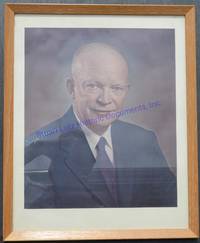
réf. 6834DWIGHT EISENHOWER 1890-1969. Dwight Eisenhower was the Thirty-Fourth President.PS. 15 x 18. N.d. N.p. A colored photograph signed Dwight Eisenhower in white ink along his right shoulder. The photo is a bust portrait of Eisenhower. The photograph is in mint condition and is professionally framed. unknown