734 résultats
2014réf. x-0739189298Lexington Books 2014. Hardcover. New. 169 pages. 9.50x6.25x1.00 inches. Lexington Books hardcover
2016réf. x-1498505880Lexington Books 2016. Paperback. New. reprint edition. 204 pages. 9.00x6.00x0.75 inches. Lexington Books paperback
1945Paris, Hachette 1945. In-4 plein cartonnage éditeur illustré de 63 pages. Nombreuses photos. Bel exemplaire.
19591st UK edition. Hardback in dustjacket. VG/VG.14301. eng
1974991p. Hardcover Very good condition
20108vo., First Edition, with plates and maps; cloth, a near fine copy in dustwrapper. The untold story of Allied discord at the Falaise Gap. The fourteen miles between Falaise and Argentan have come to be known simply as the Falaise Gap. Because Eisenhower was unable to maintain Allied military solidarity, between 12 and 21 August 1944 it became the escape route for over 100,000 German troops fleeing the Normandy battlefields. A valuable addition to the literature of the aftermath of Overlord.
19731st edition. 8vo, 248 pages, illustrated. Former public library hardback in very good condition in good condition sleeved dust jacket. 50320. eng
19738vo., First Edition, with portrait frontispiece, and numerous plates and maps, inscription on front free endpaper; orange cloth, gilt back, a near fine copy in unclipped dustwrapper. Enser, p.146.
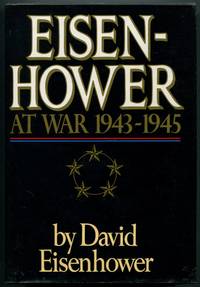
1986réf. 19104New York: Random House 1986. First Edition First Printing. Cloth. Fine/fine. The first edition first printing of Eisenhower at War 1943-1945 signed by David Eisenhower. Octavo xxvii 977pp 2. Black cloth title in gilt on spine blind-stamped medallion on front cover. Stated "First Edition" on copyright page with full number line. In the publisher's fine dust jacket $29.95 retail price on front flap. Includes the belly band from Kroch & Brentano's of Chicago with "Autographed by the Author" noted. Signed by David Eisenhower on the front free endpaper. A detailed study of Dwight D. Eisenhower's wartime leadership from 1943 to 1945 focusing on his command of Allied forces in Europe the politics of coalition warfare the planning of the Normandy invasion and the military and diplomatic decisions that shaped the final years of World War II. Random House unknown books
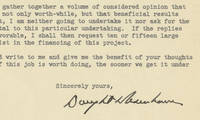
1812réf. 2102918/12/1948. The Founding Letter of the Renowned Eisenhower Center for the Conservation of Human Resources Yet during the war rejections and discharges of men for mental defects reached a total of more than two million. This type of problem would affect industry as well and Ike sought to establish an entity to research causes and solutions In December 1948 Eisenhower was called to Washington where he met with Averill Harriman Omar Bradley and Harry Truman. The leadership of the military had not settled on a plan to counter the rising Soviet threat and wanted Ike's opinion on fighting force preparedness. He remained in Washington for these meetings in the first two weeks of December. The immediate threat was Russia and a possible attack. The long term threat was to create a more efficient military. He had been assured that such a job should it require long hours would be compatible with his new job at Columbia University and so he made that real. Eisenhower gave thought and consideration on how to present the needs and issues and introduce the concept and program director. This letter/presentation is a product of that and in it Eisenhower also speculates on the role played by education and poverty and ponders whether “industry trade unions the school the church do to help reduce the volume of loss”. The recipient was Henry Ford II president of the Ford Motor Company who was one of America’s top industry leaders and well as a personal acquaintance who would become a friend. The letter is at its essence how to learn from the failures of fighting force recruitment and support during World War II apply it to the next combat and see how far that lesson could be taken to workplace life and the reintegration. Typed letter signed on his Columbia University letterhead New York December 18 1948 to Ford. “It seems to me that the time has come when the wastage of American resources must be combated along all fronts. There are numbers of organizations directing their efforts toward conservation of natural resources including the soil. Our future prosperity is going to depend directly upon the success of their achievements. There is another sector of the conservation problem however that deserves immediate attention and that so far has not been made the subject of widespread intelligent attack. It is the wastage of manpower through mental and emotional failures. “My own attention was drawn forcibly to the matter during the war particularly in the late months of 1944 when the country found that its ability to supply replacements for the battleline was badly strained. Units had to fight under truly desperate handicaps by reason of lack of manpower. Yet during the war rejections and discharges of men for mental defects reached a total of more than two million. One of the numerous reasons that finally decided me to come to Columbia was the hope of assisting in finding some kind of an answer to this national problem. Obviously in the event of great emergency our manpower will be in limited supply but the basic problem is far broader in scope. Manpower losses of this kind imply tremendous costs and inefficiencies for our economy. “This I believe is a particularly propitious time to begin a down-to-earth study of the matter. There exist today the rejection records of the two million men lost in World War II. Most of them are still alive and they provide therefore a great body of factual information for any group that can organize itself sufficiently well to dig out and correlate the facts. In addition there is available in business corporations an important body of personnel information bearing on civilian maladjustments which invites exploration and evaluation. “It would seem particularly important to find out whether there are common causative factors responsible for these human failures. Numerous questions immediately suggest themselves. Among these are: 1. Are these men generally from the undereducated groups 2. Are they generally urban or rural in origin 3. How do these men spend their leisure time 4 Are they underfed or otherwise definitely underprivileged 5. Do they show a long history of emotional instability or do these defects come out only under fear or other stress 6. What has happened to them Are they now a charge upon society or are they leading useful lives 7. How accurate were our war-time yardsticks for measuring ""mental deficiency"" 8 What can industry trade unions the school the church do to help reduce the volume of loss Dozens of other questions suggest themselves but the foregoing will indicate some of the specific points I have in mind. “Shortly after coming to Columbia University I detailed a very able young professor Eli Ginzberg to prepare a memorandum which would show the capacity and qualifications of this institution for undertaking a significant study in this area. His report is attached. Although the study of human resources is so important that it would warrant continuing support I have thought it best to propose a limit of five years on this investigation. My thought is that regardless of continuing scientific research into the various aspects of the question we need to develop at an early date helpful practical methods that will contribute much more than past procedures to the efficient utilization of human resources. “The Columbia Deans commented on the enclosed proposal and they were unanimously of the belief that the investigation should be undertaken. Now I am particularly anxious to get the opinions of men who are experienced in business labor agriculture finance the church etc. and I should therefore like to have your reactions to the above suggestions which are amplified in the accompanying memorandum. It might be that a large percentage of mentally ineffective manpower is inescapable and is a natural result of our particular civilization. This I do not believe and certainly I will not accept such a conclusion until we have done our best to prove or disprove the case “However until I can gather together a volume of considered opinion that the proposed task is not only worth-while but that beneficial results should flow out of it I am neither going to undertake it nor ask for the financial support vital to this particular undertaking. If the replies are predominantly favorable I shall then request ten or fifteen large organizations to assist in the financing of this project. I wish that you would write to me and give me the benefit of your thoughts on this proposal. If this job is worth doing the sooner we get it under way the better.” It comes with the retained response from Ford and the copy of the report sent by Eisenhower to Ford being Ford's copy. A few of these letters were sent out and the response was positive so these words heralded the establishment at Columbia of a project originally called The Conservation of Human Resources and later renamed The Eisenhower Center for the Conservation of Human Resources. Dr. Ginzberg ran the project while Eisenhower invigorated it with energy and direction until he left Columbia to run for president. The work provided for a three-pronged approach: 1 a study of inadequacy and maladjustment in civilian and military life 2 a study of the factors contributing to the development of talent and superior performance and 3 changing patterns of work in a dynamic economy. Over the years it has published numerous works a few of which are “The Ineffective Soldier: Lessons for Management and the Nation” “The Changing U.S. Labor Market” “The New Suburbanization: Challenge To The Central City” and “The physician and the poor”. The Center remains active today. unknown books
1952piccoli danni e appunto a penna al frontespizio
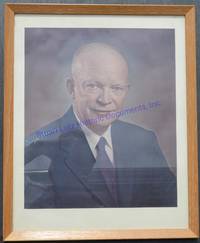
réf. 6834DWIGHT EISENHOWER 1890-1969. Dwight Eisenhower was the Thirty-Fourth President.PS. 15 x 18. N.d. N.p. A colored photograph signed Dwight Eisenhower in white ink along his right shoulder. The photo is a bust portrait of Eisenhower. The photograph is in mint condition and is professionally framed. unknown books
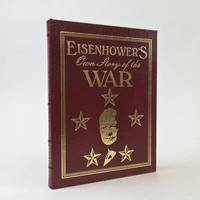
2014réf. 1405515Norwalk: Easton Press 2014. Collector's Edition. Hardcover. Quarto 122 pages. In Very Good condition. Bound in publisher's full red leather with gilt ornamentation. Paneled spine with gilt titling. Boards have light shelf wear. Textblock has silk moiré end pages silk page ribbon and gilt edges. Shelved in Room A. 1405515. Special Collections. Easton Press hardcover books
réf. 85491Flammarion, 1986, 608 p., broché, bords de la couverture frottés par endroits, coins des plats cornés, intérieur propre.
1986réf. UEISEIS00fpRandom House 1986. Very Good. Eisenhower David. Eisenhower: At War 1943-1945. New York: Random House 1986. 977pp. Indexed. Illustrated. Bibliography. Glossary. 8vo. Cloth. Book condition: Very good. Red remainder dot on bottom of text. Dust Jacket Condition: Very good. Light rubbing to extremities. Random House hardcover books
1986réf. 461524New York: Random House 1986. Hardcover. Very Good/Near Fine. First edition. Thick octavo. xxvii 977pp. Illustrated. A bit cocked foxing on the foredge very good in near fine dustwrapper. Inscribed by the author Dwight Eisenhower's grandson to Bill Boggs four-time Emmy Award-winning New York television talk show host who interviewed the author on his show: "To Bill Boggs - with thanks for his hospitality and best wishes - David Eisenhower. Sept. 29 1986. Random House hardcover books
1986réf. 277319New York: Random House 1986. Hardcover. Near Fine/Near Fine. First edition. Illustrated. Minor soiling to the bottom edge thus near fine in a near fine glossy dustwrapper with minimal wear. Written by Eisenhower's grandson. Random House hardcover books
1953réf. ABE-165668337461252 PAGES-EN COUVERTURE MODÈLE HABILLÉ PAR CHRISTIAN DIOR-ELLE LE CINÉMA ET LA DANSE, GARBO, CHARLOT, MARLÈNE ENTRENT À L'OPÉRA-GRÂCE À DIOR , LE PRINTEMPS EST ARRIVÉ À LONDRES-50 000 ÉLECTROPHONES "MICROSILLONS" ONT ÉTÉ VENDUS EN FRANCE DANS LA SEMAINE DE NOËL-PUISSANCE USA N°1: LES FEMMES, CONCLUSION D'UNE SÉRIE D'ARTICLES DE FRANÇOISE GIROUD AU RETOUR D'UN SÉJOUR À NEW YORK-LE LAPIN DE CAMARGUE PAR EMMANUEL ARÈNE-QUELLE RICHESSE CE TISSU! 2P-L'HOMME AUX YEUX D'OR PAR ANYA SETON-PETIT DICTIONNAIRE DES GRANDS AMOUREUX; TINO ROSSI, EDMOND ROSTAND, HENRI ROUSSEAU, JEAN JACQUES ROUSSEAU, ROXELANE,RUBEMPRE-MARGARET A TROUVÉ LE "STYLE" DE LA PRINCESSE MODERNE, LES SOUVENIRS DE MARION CRAWFORD GOUVERNANTE DES PRINCESSES D'ANGLETERRE-LA SCIENCE SE PENCHE SUR LES BAISERS-LÉGÈRES DÉCHIRURES EN MARGE DR DE DOS-
réf. 3871Revue de l'Institut Charles de Gaulle, N° 15, juin 1976. In-8, broché, 76 pages.
1974réf. NF3783ESPRIT DE CORPS 1974 Dwight D. Eisenhower High School Shelby Township Michigan first edition vg in pictorial cloth. Illustrated in color or black and white on every page. EDUCATION YEARBOOK MICHIGAN hardcover books
réf. 9781536110753NOVA SCIENCE PUBLISHERS INC
réf. 67-0465Los Angeles: Doris Harris Autographs 1970. Facsimile of ALS by Dwight D. Eisenhower dated August 26 1952 sent to General Zachary Taylor. Reproduced in blue ink as written on Eisenhower's letterhead. One 15 x 10-3/4 inch sheet folded once to make a four-page booklet; black and white photograph of Eisenhower on first page. A vertical crease where this has been folded and some rubbing and inkstain on last page; overall Very Good. From the collection of Frederick Gale Ruffner Jr. 1926-2014 the founder of the Detroit based reference book publisher Gale Research. Los Angeles: Doris Harris Autographs, 1970. unknown
réf. 0260897116.Ghardcover. Good. Access codes and supplements are not guaranteed with used items. May be an ex-library book. hardcover
réf. 40092showing him seated in the front row of three rows of formally dressed men wearing bow ties at a conference the layers are decorated with flowers and foliage signed by Eisenhower and U Thant and one other unidentified man 6¾" x 4½" in mount 8½" x 7½" no place no date circa unknown
réf. 36269on the lower white border showing him seated in a chair that is turned away from the camera but he is looking round to face it with one hand on his knee and the other holding his glasses the border has a printed inscription 'For: The Students of Redrice School Andover England' 14" x 11" Andover no date circa Red Rice House near Andover in Hampshire was used by the military during World War II and was visited by Eisenhower in the run-up to D-Day. After the war it became home to Redrice School and Eisenhower again visited when he was in England for the funeral of Sir Winston Churchill in 1965 presenting the current photograph to the school. unknown