1279 risultati
1902rif. 0028941902 Sans lieu ni éditeur , 1 volume grand in-12 broché de 172 pages non coupées , bon exemplaire Bon Couverture souple
1914rif. 43558Warsaw: S. Krakowskiego 1914. First edition. Softcover. vg. Octavo. 8pp incl. covers. Original covers with Art Nouveau illustration framing black lettering protected by modern mylar. Extremely scarce Polish anti-Semitic pamphlet related to the 1911 murder of the 13-year-old Ukrainian boy Andrei Yushchinsky and the subsequent trial and political scandal that resulted known as the Beilis trail or the Beilis affair. The case is considered a infamous example of the Blood libel and evidence of rampant anti-Semitism in Russia during the period. The identity of the author is not known but is credited under the likely psuedonym "Alm Fuw" on the last page. The pre-trial investigation of the case accusing Menahem Mendel Beilis Beilis Affair of the ritual murder was conducted by the foremost investigator of the Kiev Police Department Nikolay Krasovsky. Beilis a Jewish brick-factory worker was accused of the murder based on the testimony of a lamplighter who claimed he had witnessed Beilis kidnapping of Yushchinsky. Under horrific conditions Beilis spent more than two years in prison awaiting his trial which took place from September 25th through October 28 1913. The Russian right-wing press and politicians started a campaign throughout Russia against Jewish communities with accusations of the ritual murder. Despite the investigation by the local police which clearly linked the murder to a criminal gang killing Yushchinsky because he most likely had overheard conversations revealing information relating to crimes the gang committed the investigators in charge were dismissed. Evidence and many other aspects of the trial were manipulated by government officials at the highest level. Archival documents prove that the jury was rigged and monitored and witnesses were bribed or threatened. The trial sparked international criticism both from Jewish and non-Jewish intellectuals among them Maxim Gorky Vladimir Korolenko Alexander Blok and Alexander Kurpin. Yushchinsky was abducted on a Saturday morning while Beilis was at work. Ironically the alibi was the result of Beilis' unusual habit of working on the Jewish Sabbath and eventually the lamplighter confessed that he had been confused by the secret police. The prosecution's case was further undermined when it became clear that the body of the boy showed 14 wounds rather than 13 which was deemed to be in accordance with the "Jewish Ritual" a fact the prosecution had spent a great deal of effort to establish. However after several hours of deliberation the jury acquitted Beilis. After his acquittal Beilis left Kiev for Palestine and later settled in the United States. There he published his memoir under the title "The Story of My Sufferings" in Yiddish 1925 and a year later in English. Beilis story became the basis for Bernard Malamud's novel "The Fixer" which won the Pulitzer Prize and the National Book Award. Text in Polish. Very light wear along edges of pamphlet. Contemporary price stamp on cover and year penciled to bottom. Pamphlet in overall very good condition. One one Polish institutional holding worldwide based on OCLC records. S. Krakowskiego unknown books
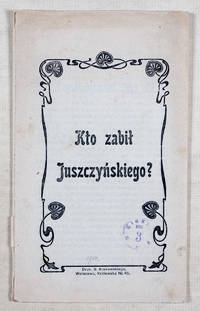
1914rif. 43558Warsaw: S. Krakowskiego 1914. First edition. Softcover. vg. Octavo. 8pp incl. covers. Original covers with Art Nouveau illustration framing black lettering protected by modern mylar. Extremely scarce Polish anti-Semitic pamphlet related to the 1911 murder of the 13-year-old Ukrainian boy Andrei Yushchinsky and the subsequent trial and political scandal that resulted known as the Beilis trail or the Beilis affair. The case is considered a infamous example of the Blood libel and evidence of rampant anti-Semitism in Russia during the period. The identity of the author is not known but is credited under the likely psuedonym "Alm Fuw" on the last page. The pre-trial investigation of the case accusing Menahem Mendel Beilis Beilis Affair of the ritual murder was conducted by the foremost investigator of the Kiev Police Department Nikolay Krasovsky. Beilis a Jewish brick-factory worker was accused of the murder based on the testimony of a lamplighter who claimed he had witnessed Beilis kidnapping of Yushchinsky. Under horrific conditions Beilis spent more than two years in prison awaiting his trial which took place from September 25th through October 28 1913. The Russian right-wing press and politicians started a campaign throughout Russia against Jewish communities with accusations of the ritual murder. Despite the investigation by the local police which clearly linked the murder to a criminal gang killing Yushchinsky because he most likely had overheard conversations revealing information relating to crimes the gang committed the investigators in charge were dismissed. Evidence and many other aspects of the trial were manipulated by government officials at the highest level. Archival documents prove that the jury was rigged and monitored and witnesses were bribed or threatened. The trial sparked international criticism both from Jewish and non-Jewish intellectuals among them Maxim Gorky Vladimir Korolenko Alexander Blok and Alexander Kurpin. Yushchinsky was abducted on a Saturday morning while Beilis was at work. Ironically the alibi was the result of Beilis' unusual habit of working on the Jewish Sabbath and eventually the lamplighter confessed that he had been confused by the secret police. The prosecution's case was further undermined when it became clear that the body of the boy showed 14 wounds rather than 13 which was deemed to be in accordance with the "Jewish Ritual" a fact the prosecution had spent a great deal of effort to establish. However after several hours of deliberation the jury acquitted Beilis. After his acquittal Beilis left Kiev for Palestine and later settled in the United States. There he published his memoir under the title "The Story of My Sufferings" in Yiddish 1925 and a year later in English. Beilis story became the basis for Bernard Malamud's novel "The Fixer" which won the Pulitzer Prize and the National Book Award. Text in Polish. Very light wear along edges of pamphlet. Contemporary price stamp on cover and year penciled to bottom. Pamphlet in overall very good condition. One one Polish institutional holding worldwide based on OCLC records. S. Krakowskiego unknown
1983rif. 65890Selma. University Press. 1983. 192 Seiten. Als Manuskript gedruckt. Mit Abbildungen auf 16 Tafeln. Ill. Originalbroschur.(Etwas fleckig). 21x15 cm
2002rif. 107091Berlin. 2002. Zwei Bände. 545 Bläter. Mit Folienumschlägen. 30x21 cm
1964IN HEBREW. SIGNED BY AUTHOR. 160x225 mm. 258 pages. Hardcover with dust jacket. Dust jacket edges worn. Cover corners slightly bumped. Spine edges slightly bumped. Slightly yellowing pages. Else in good condition.
1968Milano, Epoca, 1988, 16° brossura con copertina illustrata a colori, pp. VII-170. Presentazione di Giuliano Ferrara.
1997Mm 140x220 Brossura cucita di pp. XLV-81, testo originale a fronte. In perfetto stato. Introduzione di Elena Lowenthal. SPEDIZIONE IN 24 ORE DALL'ORDINE.
1983230x155mm. 272+23 pages. Softcover. Cover slightly yellowing. Cover edges slightly rubbed. Else in good condition.
1983230x155 mm. 23+272 pages. Softcover. Cover and spine yellowing. Spine slightly wrinkled. Else in good condition.
1983Book on French. 15X23 cm. ë"â+272 Pages. Softcover. As New.
1989Catalogue proposant de longues notices explicatives qui en font un bon outil de travail.
1977215x140 mm. 287 pages. Softcover. Cover yellowing, stained and slightly rubbed. Cover corners slightly worn. Spine yellowing. Sticker on spine. Spine edges worn. Pencil inscription on last whitepage. First whitepage slightly stained. Pages yellowing. Else in good condition.
1942rif. 97125Paris, C.P.R.N. 1942 In-8 22 x 14 cm. Broché, couverture beige, titre en bleu sur le premier plat, 222 pp., 1 carte repliée in fine. Exemplaire en très bon état, pages non coupées.
1942rif. 119443Paris, C.P.R.N. 1942 In-8 22 x 14 cm. Broché, couverture beige, titre en bleu sur le premier plat, 222 pp., 1 carte repliée in fine. Dos réparé, couverture effrangée, intérieur uniformément et légèrement jauni.
1942rif. 129051942 Editions C.P.R.N. 1942. Grand in-8° broché. 2 planches dépliantes. 222 pages. E.O. sur papier ordinaire. [100 numérotés].
1993rif. GITe184Paris La Découverte 1993. In-8 broché couverture illustrée 414pp. 1 carte en frontispice. Bel exemplaire, complet.
1942rif. LFA-126723296Un ouvrage de 222 pages, format 140 x 220 mm, illustré d'une carte dépliable, broché, publié en 1942, Editions C.P.R.N, bon état
1926rif. 98330Paris, Ernest Gründ 1926 In-8 22,5 x 14,5 cm. Broché, titre marron sur le dos et le premier plat, XV-253 pp., 10 illustrations hors-texte, table des illustrations, table des matières. Exemplaire en bon état, enrichi d’un bel envoi autographe de l’auteur.
rif. ORD-14232Editions C.P.R.N. 1942. In-8 (142 x 222mm) broché, couverture jaune imprimée en vert, 222 pages et 2 cartes repliées. Bords de feuilles insolés sinon bon état.
rif. 13979591Paris: Editions C. P. R. N., 1942 in-8, 222 pages, 2 cartes se dépliant. Broché, couv. lég. défr., 2 taches sur le 1er plat de la couverture, manque de papier au 2è plat, bon état intérieur.
1936rif. 62221936 Edition CPRN sans date (vers 1936) In8 broché 219 pages 2 cartes dépliantes hors texte en fin de volume
rif. 701137Editions C. P. R. N. Paris 1942 In-8 ( 220 X 140 mm ) de 222 pages, broché. Préface de Xavier VALLAT , commissaire aux questions juives. 2 cartes dépliantes in fine : Centres Juifs en Europe en 1933 - Répartition des Juifs dans le monde en 1936. Bon exemplaire.
2003rif. 1193812003 Editions Ligne à Suivre, Collection "Terres d'Ombres" - 2003 - In-8, cartonnage illustré en couleurs de l'éditeur - 189 p. - Riche iconographie hors texte et pleine page en couleurs et en N&B
1939rif. 183237Grasset Paris, Grasset, 1939. In-12 broché de 223 pages; Couverture renforcée par l'intérieur sinon Bon état