CAMUS, AlbertLivre Rare Book
485 resultados
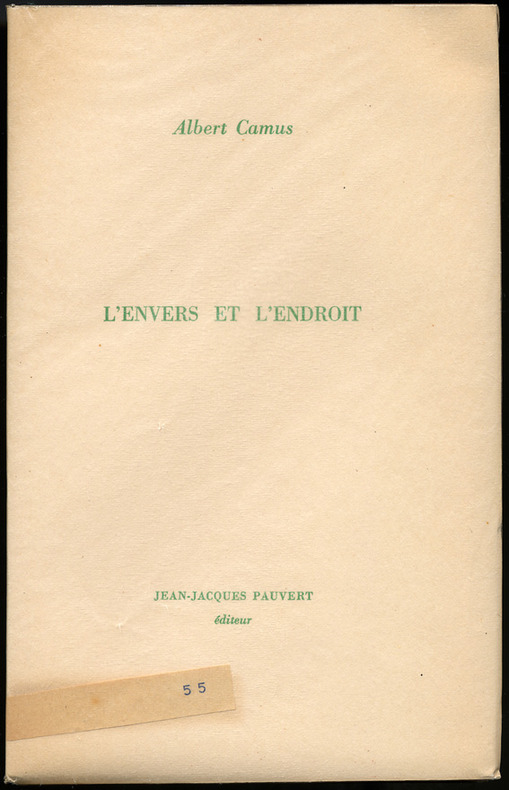
1956ref. 980Jean-Jacques Pauvert Éditeur, Paris 1956. 1 volume in-8 (225 X 142 mm) broché, 107 pp+fnch. sous couverture rempliée ivoire imprimée en vert, rhodoïd de l'éditeur. Seconde édition illustrée d'UNE POINTE-SÈCHE ORIGINALE DE HANS BELLMER, portrait de Camus. La préface de 23 pages a été spécialement écrite par l'auteur pour cette édition. Tirage : 100 exemplaires sur vélin de Rives ivoire numérotés en chiffres romains. Celui-ci, le n° LV, est entièrement non coupé et conservé à l'état de neuf.
1 épreuve gélatino argentique [120 x 172 mm] contrecollée sur carton fort de l'époque , , in-8, 1 épreuve gélatino argentique [120 x 172 mm] contrecollée sur carton fort de l'époque, , Portrait de Louis Pasteur sur son lit mortuaire. Étant donné son cadrage et sa proximité, ce portrait mortuaire a sans doute été effectué par un proche de Pasteur; il ne s'agit pas d'une prise de vue officielle. Louis Pasteur, né le 27 décembre 1822, meurt le 28 septembre 1895 à 16h40 à Villeneuve-l'Étang, dans l'annexe dite « de Garches » de l'Institut Pasteur, où il s'installait souvent l'été. Sa chambre y est toujours conservée. Des funérailles nationales lui sont réservées le 5 octobre suivant, au cours desquelles son corps, préalablement embaumé, est déposé dans la crypte de Notre-Dame de Paris. En 1896, à la demande de son épouse, son corps fut placé dans la crypte de l'Institut où il repose au milieu de ses disciples. Un masque mortuaire est visible dans la crypte. Un négatif sur plaque de verre montrant la chambre mortuaire prise en 1926 est conservé au Département Estampes et photographie à la BnF (8/5/26, la chambre mortuaire de Pasteur à Garches : photographie de presse / Agence Rol.) Un cliché mortuaire montrant Pasteur sur son lit de mort en présence de ses petits enfants a été publié en 1956 par sa petite-fille Camille: Pasteur Vallery-Radot, Images de la vie et de l'oeuvre, p. 158 (document photographique provenant de la collection Pasteur Vallery-Radot). Le carton sur lequel est contrecollé le portrait de Pasteur porte un fin liseret rouge d'encadrement, le bord supérieur du tirage est accidenté. Documents annexes joints : 1 tirage argentique contrecollé sur carton [165 x 110 mm] légendé : Portrait de Pasteur avec sa petite-fille Camille Vallery-Radot par Léon Bonnat (1886) / 4 tirages argentiques [170 x 220 mm] de portraits réalisés aux pastels par le jeune Louis Pasteur entre 1835 et 1842 : portrait de sa mère, de Claudine Benoiste Parpandet dite soeur Constance, portrait d'une jeune fille et portrait de son père / 1 gravure du XIXe siècle : portrait âgé de Louis Pasteur par Roussel
1661In-4°; antiporta calcografica incisa da Thiboust su disegno di Peuget (leggermente rifilata al margine inferiore), e pp. (16), 134, 1 cb, pp. (4); pp. 128, (7), un legno al frontespizio, nel testo capilettera e legni tipografici. legatura in pergamena coeva con dorso in cartonato. timbro a inchiostro all’occhiello. Sebbene apparentemente tradotto dal francese, come si legge al frontespizio, è la prima edizione di quest’opera del padre cappuccino Maurice de Toulon sui metodi di utilizzo dei profumi per allontanare la peste, una pratica che era assai comune fina dai tempi antichi, come si pensava anche che i profumi proteggessero dall’inalazione delle particelle infette presenti nell’aria. L’opera è basata sull’esperienza di Maurice de Toulon durante la peste a Genova nel 1656-57. La prima edizione francese appare un anno più tardi nel 1662, con un altro titolo. Krivatsy 7587.
ref. 52401Gallimard.1947.In-8 toilé avec pièce de titre sous étui muet.Couvs.et dos conservés.E.O.Ouvrage restauré avec pages brunes.Dédicace de l'Auteur à Roger Caillois.( écrivain, sociologue, traducteur de Brgès.1913-1978).Complet malgré interversions des pages 23-27. Rare.
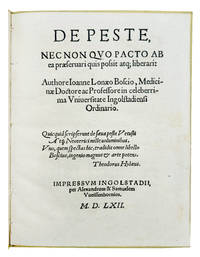
ref. 202654to 200 × 153 mm 12 ff. woodcut initial. Modern board of vellum remnants of red label to spine. Rare plague treatise by J. L. van den Bosch professor of rhetoric at the University of Ingolstadt in 1558 after teaching in Louvain he was transferred to the medical faculty in 1560. A German edition was also published by Weißenhorn in Ingolstadt the same year under the title: Rathschlag Wie man sich zu disen gefährlichen zeiten vor der Pestilentz hütten und Wie dieselbig so sie eingerissen wider zu vertreiben und zu curieren sey Advice. How to protect oneself from the plague in these dangerous times and how to drive it away once it has broken out. The publication coincides with one of the recurrent waves of plague that struck southern Germany in the early 1560s notably the severe epidemic recorded in Nuremberg in 1562. The pamphlet offers practical guidance for conduct during outbreaks of plague. The author recommends protective powders compounded from fragrant and medicinal substances: amber camphor myrrh rose violet lily mint cinnamon cardamom etc. as well as precious stones such as diamond emerald and topaz intended to counteract contagion. Further sections address the treatment of plague swellings buboes recommending careful management cauterisation and the application of cupping vessels or caustic substances including quicklime cantharides arum celandine lily root radish aqua fortis and mercury. This pamphlet was issued in two latin printings in 1562; the second is without the four-line distich composed by Theodor Hylaeus which appears on the title page in this copy. PROVENANCE: Remnants of a metallic page marker on the final leaf. "Comte E. du Tertre" engraved armorial bookplate. REFERENCES: USTC 630956; VD16 B 6767. . Ingolstadt, Alexander and Samuel Weißenhorn, 1562. hardcover
1612ref. 31853Ingolstadt, Angermayr, 1612. 8° 2 Teile in 1 Band. 203 Seiten, siehe Erläuterungen. GanzPergament, der Zeit. Erstausgabe. [5 Warenabbildungen]
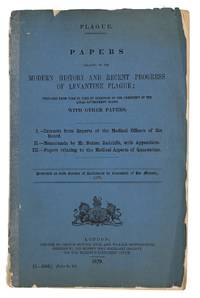
1879ref. L4NBANWANWJDLondon: George Edward Eyre & William Spottiswoode 1879. Original publishers blue printed paper wrappers. Folio. With two folding lithographed maps one centered on the Middle East and the other detailing the seats of the plague in Mesopotamia and south-west Persia. Compilation of observational governmental reports on various outbreaks of the bubonic plague in the Middle East Persia and Egypt between 1853 and 1877. As stated in the introduction this publication was compiled to study the epidemic in detail in the hope that such learning might benefit Great Britain in the event of an outbreak of the plague in its own territories. The information in these reports proved to be of value during the intense study of the plague in the 1890s which led to the identification of the diseases origin in 1894. The compilation comprises three parts: the first contains extracts from reports of the medical officers of the local government board the second is a memorandum by Mr. Netten Radcliffe and the last contains a few papers considering the medical aspects of quarantine.Binding worn at the edges and the paper spine damaged at the head and foot. With the upper corner of the first few pages slightly soiled but still in good condition.l Creighton A history of epidemics in Britain 1965 I p. 162; Ethnographic plague: configuring disease on the Chinese-Russian frontier p. 166; Histories of post-mortem contagion: infectious corpses and contested burials p. 25; WorldCat 66370645 29739922 249535263 460669494 29166725 8 copies. George Edward Eyre & William Spottiswoode, unknown
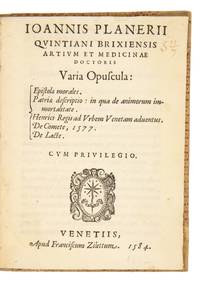
1584ref. 4759Venice: apud Franciscum Zilettum 1584. SOLE EDITION. Hardcover. Fine. Bound in 18th c. quarter vellum and patterned paste-paper. A fine copy. Small stain to leaf H4 and margin of b3 very pale dampstain to two gatherings. Woodcut printer's devices on main and divisional title page. Rare. 5 copies traced in North America: Hagley Museum Michigan Newberry NLM Columbia. A very rare compilation of works by the Brescian physician and scientist Giovanni Planerio of Quinzano d'Oglio. Included are treatises on the medicinal benefits of milk including for the treatment of tuberculosis herbal remedies for constipation and urinary complaints a description of the plague outbreak that afflicted his home town in 1529 and a discussion of the adverse health effects purported to have been brought on by the appearance of the comet of 1577. Planerio regards milk as both nourishment and medicine. He compares the relative nutritional and medicinal properties of the milk of humans and various animals establishing the following ranking: human milk first ass's milk second and goat's milk third while rejecting cow's and sheep's milk as having little medicinal value. Human milk he notes is preferably taken directly from the breast. In his "Letters on Morals and Conduct" Planerio recommends a number of remedies for urinary complaints including preparations using sheep's milk asparagus fennel and parsley; and a popular drink made with honey. For constipation he recommends barley infusions and laxative pastes as well as daily exercise. Planerio next gives a thorough account of the plague outbreak in his hometown of Quinzano d'Oglio in 1529. "He described the wailing and moaning and finally how people became accustomed to ever-present death the absence of funerals as people were buried in mass graves that were covered by so little earth that the stench of the corpses seemed to be quite literally poisoning the air." Stolberg Learned Physicians and Everyday Medical Practice in the Renaissance p. 100 Pianeri also offers a detailed examination of the Great Comet of 1577 a significant astronomical event that captivated observers across Europe and beyond and considers its role as a portent of disruption. This comet was notable not only for its brightness but also for the role it played in challenging prevailing astronomical theories of the time. Planerio discusses the calamities believed to follow from such celestial configurations including war famine political upheaval mortality and disease. Among the specifically medical effects attributed to comets are acute fevers and bodily pains sometimes so severe as to lead to death. The Great Comet of 1577 appeared unexpectedly and was visible to the naked eye prompting widespread observation and documentation. Its sudden appearance and striking presence spurred debates among astronomers and philosophers regarding the nature and origin of comets. Prior to this event the Aristotelian view predominated positing that comets were atmospheric phenomena occurring within the Earth's atmosphere. The observations of the 1577 comet however provided evidence that challenged this perspective suggesting that comets were celestial bodies located beyond the Moon. The Great Comet of 1577 was first observed on November 1 1577 in Peru. In Europe sightings began around November 7 1577 with notable observations by Tycho Brahe starting on November 13 1577. The comet remained visible to the naked eye until March 1578. In his treatise Pianeri meticulously documents the comet's appearance trajectory and duration. Based on his own data and observations made by Tycho Brahe Michael Maestlin and Cornelius Gemma Pianeri assesses the comet to be a supralunary phenomenon occurring in the celestial rather than atmospheric realm. Pianeri records that he first observed the comet on November 10 1577 in the constellation of Sagittarius. His observations continued through early December. From its initial observed position in Sagittarius the comet moved through Capricorn and Aquarius approaching Pisces around December 1. He provides detailed observations of its brightness and the length of its tail. The comet was exceptionally bright comparable to Venus with a well-defined nucleus exhibiting a slightly reddish hue. The comet's tail extended up to 30 degrees across the sky on November 15 slightly curved with a pale yellowish color gradually decreasing to about 15 degrees by December 1. The comet remained visible from Pianeri's vantage until December 5 1577 with its brightness diminishing over time. The Arrival of Henry III at Venice Planerio gives a detailed account of Henry III's passage through Venice in July 1574 on his return from Poland to assume the French crown. He describes the elaborate Venetian reception including the king's ceremonial entry triumphal architecture processions in the Bucentaur religious observances banquets illuminations musical performances glassmaking demonstrations visits to the Arsenal and other civic institutions dances and public entertainments. The work is particularly rich in descriptions of Venetian pageantry architecture material display and civic ceremony culminating in Henry's departure from the city on 27 July. apud Franciscum Zilettum hardcover
1576in 4, pp. (6), 312, (38), 205, (14), leg. poster. m.perg. e ang. Illustr. da 3 tav. inc. in rame, una f.t. raffig. l'autore che offre il volume a Filippo d'Austria e 2 n.t. raffig. il lazzareto di Palermo; al titolo grande silografia da 4 legni raffig. rimedi contro la peste, ripetuta fra la seconda e la terza parte, impresa dello stampatore al colophon. Uno dei più celebri trattati sulla peste del Cinquecento, importante nella storia della medicina per la posizione di rifiuto da parte dell'Autore della teoria della peste ''manufatta''. Il fenomeno della peste viene analizzato con grande rigore scientifico da quattro angolazioni (corrispondenti ad altrettante parti dell'opera): che cosa sia la peste e la sua sintomatologia, le norme di igiene e di organizzazione sanitaria per i malati, la prevenzione per la popolazione della città non ancora contagiata, la prassi terapeutica per gli appestati. G. F. Ingrassia, dopo essersi laureato a Padova, dove era stato allievo di Falloppio e Vesalio, si stabilì a Napoli. Era protomedico in Sicilia - incarico che aveva ricevuto da Filippo II nel 1563- durante il contagio di peste nel 1575; il suo contributo fu allora importante e il suo rifiuto di ipotesi fantasiose di peste manufatta segnò un passo avanti determinante nell'epidemiologia. Nel 1577 fu pubblicata una ''Parte quinta'' dallo stesso stampatore. Il capitolo 3. della quarta parte fu tradotto in latino ed inserito in una raccolta di scritti curata da J. Camerarius (Synopsis commenatriorum de peste, Norimberga 1583). Rarissima cinquecentina palermitana illustrata, di notevole interesse medico. Buon esempl., con rari aloni.. Adams I-120. BMC p. 339. Castiglioni, Storia della medicina, pp. 428-429. Durling, 2547. Mortimer, Harvard, I, 241. Mira III, 202: ''La quinta parte di quest'opera fu riprodotta nel 1624, quando la peste devastò quest'isola''. Bird, Medical Edinburgh 1314-15..
"In-4°; cc. (28), 162, (1), 1 cb. Il frontespizio è entro cornice xilografica a grottesche, sul verso del frontespizio una vignetta incisa su legno raffigura l’autore che consegna il libro al dedicatario dell’opera; prima del ricchissimo Indice degi argomenti, un editto editoriale in cornice alle armi del cardinale Francesco di Chiaromonte; la stessa cornice si ripete nel testo con lo stemma della città di Avignone e la dedica dell’autore che precede la “prefatiuncula”. Inizia poi lo “Iuridicus de peste tractatus editus per excellente iureconsultum Io. franciscum de Sanctonazario cognominatum De Ripa civem papiensem...”. Alcune note manoscritte ai margini. Legatura in piena pergamena coeva, tagli in rosso. prima edizione, con ancora aldina al colophon. De Channey è considerato uno tra i più celebri tipografi avignonesi; la sua marca tipografica riprende esattamente quella di Aldo. De Channey per proteggere il proprio lavoro include, come detto, un privilegio del cardinale legato di Avignone, in cui si prevede la multa di 100 monete d’oro in difesa della non riproducibilità del testo, assieme con la confisca delle copie e la scomunica; il libro fu immediatamente ristampato da Vincent de Portonariis a Lione, il tipografo tentò di perseguire questa violazione ma non vi riuscì perché in Francia il privilegio con la sola autorità papale non era riconosciuto completamente valido (E. Armstrong, Before copyright, the French book privilege system). Edizione originale, dello stesso anno ma precedente quella di Lione, di quello che può essere considerato il primo trattato giuridico sull’igiene pubblica e la prevenzione. L’autore dichiara che spiegare le cause della peste è una questione fisica, e che lui intende esprimersi, da giureconsulto, sulla materia legale relativa alla gestione dello stato di calamità e della prevenzione. Si riconosce che la peste insorge da acque putride, dall’aria insalubre, dall’immondizia delle cloache; la trattazione riguarda quindi l’aspetto legislativo relativo alla gestione del contagio, i rimedi relativi alla salute pubblica in particolare appunto rispetto agli acquedotti e alle cloache pubbliche e private. I risvolti sociali e economici di uno stato di calamità si evidenziano qui numerosi, con le relative indicazioni su come affrontarli: si parla ad esempio della funzione della carità, del ruolo dei dottori, del comportamento che devono tenere i malati e di quello dei “rustici”o, della necessità di costruire ospedali fuori dalle mura della città, sull’uso dei bollettini per informare i cittadini, sull’uso benefico dei giochi per combattere la depressione, da evitare però in tempo di peste per non affaticare il corpo. Francesco Riva di San Nazzaro (1480-1535) fu giureconsulto illustre nato appunto a Rivanazzano, nel pavese; dal 1518 fu professore all’Università di Avignone e dal 1533 a Pavia. Harvard French, 461. In-4 °; cc. (28), 162, (1), 1 cb. First edition with aldine anchor at the colophon.The title page is within a grotesque woodcut frame, on the back of the title page a vignette engraved on wood depicts the author delivering the book to the dedicatee of the work; before the very rich Index of topics, an editorial edict with the coat of arms of Cardinal Francesco di Chiaromonte; the same frame is repeated in the text with the coat of arms of the city of Avignon and the dedication of the author preceding the ""prefatiuncula"". Then begins the “Iuridicus de peste tractatus editus per excellente iureconsultum Io. franciscum de Sanctonazario cognominatum De Ripa civem papiensem ... "". Some handwritten notes in the margins. Full contemporary vellum binding, red edges. De Channey is considered one of the most famous Avignon printers; its typographic brand exactly matches Aldo's. De Channey to protect his work includes, as mentioned, a privilege of the cardinal legate of Avignon, which provides for the fine of 100 gold coins in defense of the non-reproducibility of the text, together with the confiscation of copies and excommunication; the book was immediately reprinted by Vincent de Portonariis in Lyon, the printer tried to prosecute this violation but failed because in France the privilege with the Papal authority alone was not recognized completely valid (E. Armstrong, Before copyright, the French book privilege system). Original edition, from the same year but preceding that of Lyon, of what can be considered the first legal treaty on public hygiene and prevention. The author declares that explaining the causes of the plague is a physical matter, and that he intends to express himself, as a jurist, on the legal matter relating to the management of the state of calamity and prevention. It is recognized that the plague arises from putrid waters, from unhealthy air, from the garbage of the sewers; the discussion therefore concerns the legislative aspect relating to the management of the contagion, the remedies relating to public health, in particular precisely with respect to aqueducts and public and private sewers. The social and economic implications of a state of calamity are highlighted here numerous, with the relative indications on how to deal with them: for example, the function of charity, the role of doctors, the behavior that the sick must have and that of ""rustic ”Or, of the need to build hospitals outside the city walls, on the use of bulletins to inform citizens, on the beneficial use of games to combat depression, to be avoided in times of plague so as not to tire the body. Francesco Riva di San Nazzaro (1480-1535) was an illustrious jurist born in Rivanazzano, in the Pavia area; from 1518 he was professor at the University of Avignon and from 1533 in Pavia. Harvard French, 461. "