477 Ergebnisse
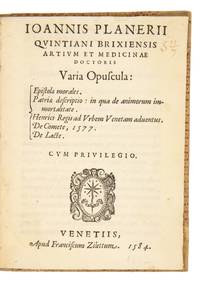
1584Best.-Nr. 4759Venice: apud Franciscum Zilettum 1584. SOLE EDITION. Hardcover. Fine. Bound in 18th c. quarter vellum and patterned paste-paper. A fine copy. Small stain to leaf H4 and margin of b3 very pale dampstain to two gatherings. Woodcut printer's devices on main and divisional title page. Rare. 5 copies traced in North America: Hagley Museum Michigan Newberry NLM Columbia. A very rare compilation of works by the Brescian physician and scientist Giovanni Planerio of Quinzano d'Oglio. Included are treatises on the medicinal benefits of milk including for the treatment of tuberculosis herbal remedies for constipation and urinary complaints a description of the plague outbreak that afflicted his home town in 1529 and a discussion of the adverse health effects purported to have been brought on by the appearance of the comet of 1577. Planerio regards milk as both nourishment and medicine. He compares the relative nutritional and medicinal properties of the milk of humans and various animals establishing the following ranking: human milk first ass's milk second and goat's milk third while rejecting cow's and sheep's milk as having little medicinal value. Human milk he notes is preferably taken directly from the breast. In his "Letters on Morals and Conduct" Planerio recommends a number of remedies for urinary complaints including preparations using sheep's milk asparagus fennel and parsley; and a popular drink made with honey. For constipation he recommends barley infusions and laxative pastes as well as daily exercise. Planerio next gives a thorough account of the plague outbreak in his hometown of Quinzano d'Oglio in 1529. "He described the wailing and moaning and finally how people became accustomed to ever-present death the absence of funerals as people were buried in mass graves that were covered by so little earth that the stench of the corpses seemed to be quite literally poisoning the air." Stolberg Learned Physicians and Everyday Medical Practice in the Renaissance p. 100 Pianeri also offers a detailed examination of the Great Comet of 1577 a significant astronomical event that captivated observers across Europe and beyond and considers its role as a portent of disruption. This comet was notable not only for its brightness but also for the role it played in challenging prevailing astronomical theories of the time. Planerio discusses the calamities believed to follow from such celestial configurations including war famine political upheaval mortality and disease. Among the specifically medical effects attributed to comets are acute fevers and bodily pains sometimes so severe as to lead to death. The Great Comet of 1577 appeared unexpectedly and was visible to the naked eye prompting widespread observation and documentation. Its sudden appearance and striking presence spurred debates among astronomers and philosophers regarding the nature and origin of comets. Prior to this event the Aristotelian view predominated positing that comets were atmospheric phenomena occurring within the Earth's atmosphere. The observations of the 1577 comet however provided evidence that challenged this perspective suggesting that comets were celestial bodies located beyond the Moon. The Great Comet of 1577 was first observed on November 1 1577 in Peru. In Europe sightings began around November 7 1577 with notable observations by Tycho Brahe starting on November 13 1577. The comet remained visible to the naked eye until March 1578. In his treatise Pianeri meticulously documents the comet's appearance trajectory and duration. Based on his own data and observations made by Tycho Brahe Michael Maestlin and Cornelius Gemma Pianeri assesses the comet to be a supralunary phenomenon occurring in the celestial rather than atmospheric realm. Pianeri records that he first observed the comet on November 10 1577 in the constellation of Sagittarius. His observations continued through early December. From its initial observed position in Sagittarius the comet moved through Capricorn and Aquarius approaching Pisces around December 1. He provides detailed observations of its brightness and the length of its tail. The comet was exceptionally bright comparable to Venus with a well-defined nucleus exhibiting a slightly reddish hue. The comet's tail extended up to 30 degrees across the sky on November 15 slightly curved with a pale yellowish color gradually decreasing to about 15 degrees by December 1. The comet remained visible from Pianeri's vantage until December 5 1577 with its brightness diminishing over time. The Arrival of Henry III at Venice Planerio gives a detailed account of Henry III's passage through Venice in July 1574 on his return from Poland to assume the French crown. He describes the elaborate Venetian reception including the king's ceremonial entry triumphal architecture processions in the Bucentaur religious observances banquets illuminations musical performances glassmaking demonstrations visits to the Arsenal and other civic institutions dances and public entertainments. The work is particularly rich in descriptions of Venetian pageantry architecture material display and civic ceremony culminating in Henry's departure from the city on 27 July. apud Franciscum Zilettum hardcover books
1902Best.-Nr. M10230Berlin:: Julius Springer 1902. 1902. LATER EDITION. 8vo. 74 pp. Self-wraps. Library rubber stamp on front cover. Good. On fighting the plague. Julius Springer, 1902. paperback books
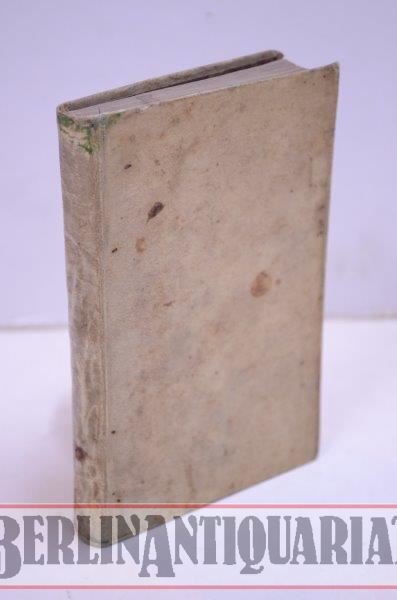
1612Best.-Nr. 31853Ingolstadt, Angermayr, 1612. 8° 2 Teile in 1 Band. 203 Seiten, siehe Erläuterungen. GanzPergament, der Zeit. Erstausgabe. [5 Warenabbildungen]
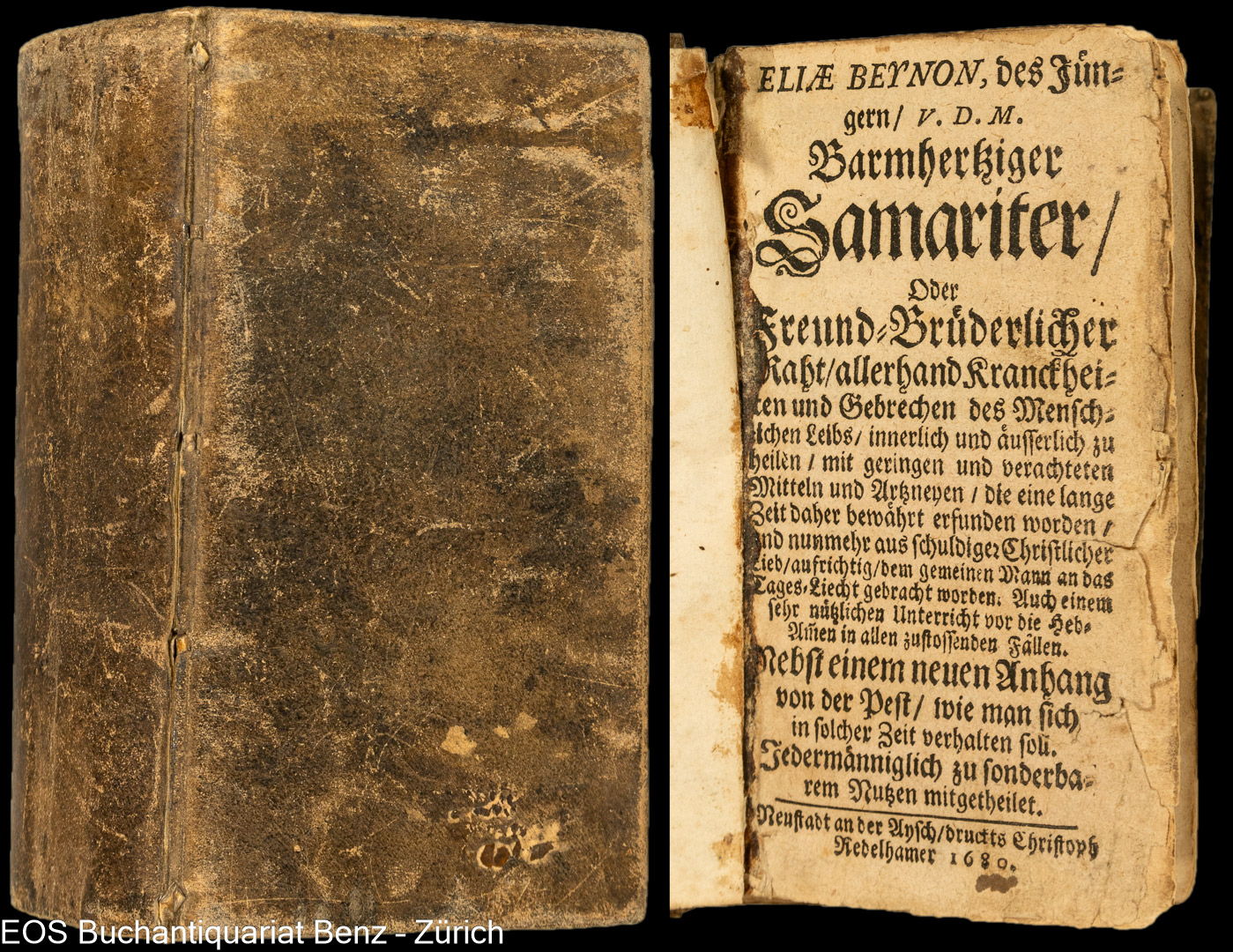
1680Best.-Nr. 7624CBNeustadt an der Aysch, Redelhamer, 1680?1682. 8°. 353 S; 51 S., (12) S. (Register); (10), 360 S., (11) S. (Register); 54 S. Pergamentband der Zeit. + Wichtig: Für unsere Kunden in der EU erfolgt der Versand alle 14 Tage verzollt ab Deutschland / Postbank-Konto in Deutschland vorhanden +, 7624CB|7624CB_2 4 Teile in einem Band. [2 Warenabbildungen]
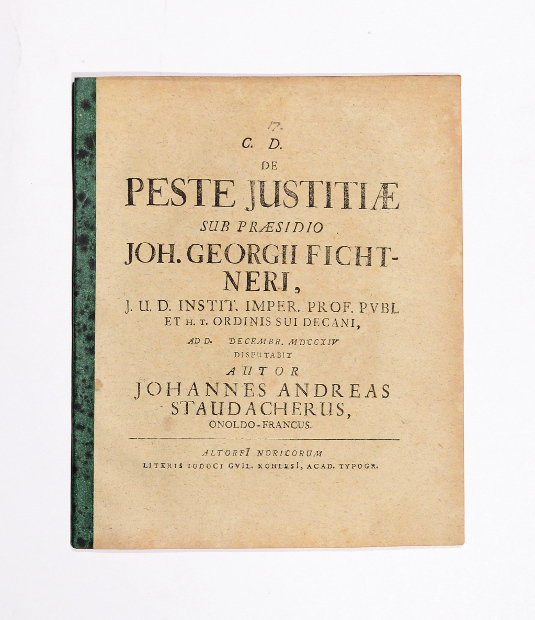
1714Best.-Nr. 36908Altdorf bei Nürnberg, Kohl, 1714. 8°. 28 S., Heftstreifen.
1910Best.-Nr. 014104University Press, Bernard Quaritch, Manchester, London 1910. Hardcover Sehr gut
Best.-Nr. 24716Couverture rigide. Bon/1932. in-4. Paris Vigot frères 1932 in-4 650pp exemplaire broché couverture imprimée en rouge et noir mors légèrement déchirés en haut et bas du brochage Unique édition illustrée d'une trentaine de figures et reproductions photographiques dans le texte. Ce recueil se divise en 7 grandes parties : ""Communications et rapports sur les colonies françaises"" ""Le problème du rat et de la peste en Afrique du Nord"" ""Rapports sur l'Italie la Pologne le Mexique la République Argentine et l'Egypte"" ""La peste en général et la vaccination antipesteuse"" ""Le rat dans la transmission du typhus de la lèpre des maladies infectieuses équines"" ""La lutte contre les rats"" et ""Les rats et l'agriculture"". Quelques rousseurs dans les marges extérieures unknown
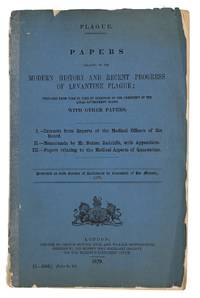
1879Best.-Nr. L4NBANWANWJDLondon: George Edward Eyre & William Spottiswoode 1879. Original publishers blue printed paper wrappers. Folio. With two folding lithographed maps one centered on the Middle East and the other detailing the seats of the plague in Mesopotamia and south-west Persia. Compilation of observational governmental reports on various outbreaks of the bubonic plague in the Middle East Persia and Egypt between 1853 and 1877. As stated in the introduction this publication was compiled to study the epidemic in detail in the hope that such learning might benefit Great Britain in the event of an outbreak of the plague in its own territories. The information in these reports proved to be of value during the intense study of the plague in the 1890s which led to the identification of the diseases origin in 1894. The compilation comprises three parts: the first contains extracts from reports of the medical officers of the local government board the second is a memorandum by Mr. Netten Radcliffe and the last contains a few papers considering the medical aspects of quarantine.Binding worn at the edges and the paper spine damaged at the head and foot. With the upper corner of the first few pages slightly soiled but still in good condition.l Creighton A history of epidemics in Britain 1965 I p. 162; Ethnographic plague: configuring disease on the Chinese-Russian frontier p. 166; Histories of post-mortem contagion: infectious corpses and contested burials p. 25; WorldCat 66370645 29739922 249535263 460669494 29166725 8 copies. George Edward Eyre & William Spottiswoode, unknown
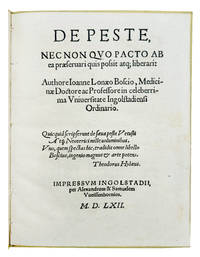
Best.-Nr. 202654to 200 × 153 mm 12 ff. woodcut initial. Modern board of vellum remnants of red label to spine. Rare plague treatise by J. L. van den Bosch professor of rhetoric at the University of Ingolstadt in 1558 after teaching in Louvain he was transferred to the medical faculty in 1560. A German edition was also published by Weißenhorn in Ingolstadt the same year under the title: Rathschlag Wie man sich zu disen gefährlichen zeiten vor der Pestilentz hütten und Wie dieselbig so sie eingerissen wider zu vertreiben und zu curieren sey Advice. How to protect oneself from the plague in these dangerous times and how to drive it away once it has broken out. The publication coincides with one of the recurrent waves of plague that struck southern Germany in the early 1560s notably the severe epidemic recorded in Nuremberg in 1562. The pamphlet offers practical guidance for conduct during outbreaks of plague. The author recommends protective powders compounded from fragrant and medicinal substances: amber camphor myrrh rose violet lily mint cinnamon cardamom etc. as well as precious stones such as diamond emerald and topaz intended to counteract contagion. Further sections address the treatment of plague swellings buboes recommending careful management cauterisation and the application of cupping vessels or caustic substances including quicklime cantharides arum celandine lily root radish aqua fortis and mercury. This pamphlet was issued in two latin printings in 1562; the second is without the four-line distich composed by Theodor Hylaeus which appears on the title page in this copy. PROVENANCE: Remnants of a metallic page marker on the final leaf. "Comte E. du Tertre" engraved armorial bookplate. REFERENCES: USTC 630956; VD16 B 6767. . Ingolstadt, Alexander and Samuel Weißenhorn, 1562. hardcover
1584Best.-Nr. 4759Venice: apud Franciscum Zilettum 1584. SOLE EDITION. Hardcover. Fine. Bound in 18th c. quarter vellum and patterned paste-paper. A fine copy. Small stain to leaf H4 and margin of b3 very pale dampstain to two gatherings. Woodcut printer's devices on main and divisional title page. Rare. 5 copies traced in North America: Hagley Museum Michigan Newberry NLM Columbia. A very rare compilation of works by the Brescian physician and scientist Giovanni Planerio of Quinzano d'Oglio. Included are treatises on the medicinal benefits of milk including for the treatment of tuberculosis herbal remedies for constipation and urinary complaints a description of the plague outbreak that afflicted his home town in 1529 and a discussion of the adverse health effects purported to have been brought on by the appearance of the comet of 1577. Planerio regards milk as both nourishment and medicine. He compares the relative nutritional and medicinal properties of the milk of humans and various animals establishing the following ranking: human milk first ass's milk second and goat's milk third while rejecting cow's and sheep's milk as having little medicinal value. Human milk he notes is preferably taken directly from the breast. In his "Letters on Morals and Conduct" Planerio recommends a number of remedies for urinary complaints including preparations using sheep's milk asparagus fennel and parsley; and a popular drink made with honey. For constipation he recommends barley infusions and laxative pastes as well as daily exercise. Planerio next gives a thorough account of the plague outbreak in his hometown of Quinzano d'Oglio in 1529. "He described the wailing and moaning and finally how people became accustomed to ever-present death the absence of funerals as people were buried in mass graves that were covered by so little earth that the stench of the corpses seemed to be quite literally poisoning the air." Stolberg Learned Physicians and Everyday Medical Practice in the Renaissance p. 100 Pianeri also offers a detailed examination of the Great Comet of 1577 a significant astronomical event that captivated observers across Europe and beyond and considers its role as a portent of disruption. This comet was notable not only for its brightness but also for the role it played in challenging prevailing astronomical theories of the time. Planerio discusses the calamities believed to follow from such celestial configurations including war famine political upheaval mortality and disease. Among the specifically medical effects attributed to comets are acute fevers and bodily pains sometimes so severe as to lead to death. The Great Comet of 1577 appeared unexpectedly and was visible to the naked eye prompting widespread observation and documentation. Its sudden appearance and striking presence spurred debates among astronomers and philosophers regarding the nature and origin of comets. Prior to this event the Aristotelian view predominated positing that comets were atmospheric phenomena occurring within the Earth's atmosphere. The observations of the 1577 comet however provided evidence that challenged this perspective suggesting that comets were celestial bodies located beyond the Moon. The Great Comet of 1577 was first observed on November 1 1577 in Peru. In Europe sightings began around November 7 1577 with notable observations by Tycho Brahe starting on November 13 1577. The comet remained visible to the naked eye until March 1578. In his treatise Pianeri meticulously documents the comet's appearance trajectory and duration. Based on his own data and observations made by Tycho Brahe Michael Maestlin and Cornelius Gemma Pianeri assesses the comet to be a supralunary phenomenon occurring in the celestial rather than atmospheric realm. Pianeri records that he first observed the comet on November 10 1577 in the constellation of Sagittarius. His observations continued through early December. From its initial observed position in Sagittarius the comet moved through Capricorn and Aquarius approaching Pisces around December 1. He provides detailed observations of its brightness and the length of its tail. The comet was exceptionally bright comparable to Venus with a well-defined nucleus exhibiting a slightly reddish hue. The comet's tail extended up to 30 degrees across the sky on November 15 slightly curved with a pale yellowish color gradually decreasing to about 15 degrees by December 1. The comet remained visible from Pianeri's vantage until December 5 1577 with its brightness diminishing over time. The Arrival of Henry III at Venice Planerio gives a detailed account of Henry III's passage through Venice in July 1574 on his return from Poland to assume the French crown. He describes the elaborate Venetian reception including the king's ceremonial entry triumphal architecture processions in the Bucentaur religious observances banquets illuminations musical performances glassmaking demonstrations visits to the Arsenal and other civic institutions dances and public entertainments. The work is particularly rich in descriptions of Venetian pageantry architecture material display and civic ceremony culminating in Henry's departure from the city on 27 July. apud Franciscum Zilettum hardcover
1865Best.-Nr. 373230Richard Keene Derby Undated c.1865. 6th Edition. Hardcover. Very Good Condition. Eyam is best known for its remarkable decision to isolate itself in order to stop the spread of the bubonic plague after it was detected in the village. This tragic chapter in Eyam's history started in 1665 when a bundle of cloth infested with fleas was delivered from London to Alexander Hadfield the village tailor. The plague lasted for a duration of 14 months during which one report indicates that it claimed the lives of at least 260 villagers leaving only 83 survivors from an original population of 350. However this number has been disputed with some sources suggesting that there were 430 survivors from a total population of approximately 800. Additionally the church in Eyam maintains a record of 273 individuals who fell victim to the plague. Bound in blue contemporary cloth gilt lettered spine and gilt lettered & decorated upper board. A little wear at head of spine and a tiny piece missing from near foot. Colour photograph of Eyam Hall & Village Stocks to the reverse of the frontis engraving. Contents clean throughout and an attractive volume in the hand. Size: 12 x 18.5 cms. Category: Antiquarian & Rare; Hardback Books; This item may require more postage than the rates shown for delivery outside the UK. If extra postage is required we will contact you before processing your order and you will be given the details and option to decline the extra cost. Richard Keene hardcover
1994Best.-Nr. 123182Roma 1994. Formato quotidiano piegati al mezzo pp. 16 ogni fascicolo. Disponiamo dei seguenti numeri dell'Anno primo: 1 del 30 aprile- 3 - 4 - 5 - 6 - 7 - 8 - 9 - 10 -11 con questo numero il periodico viene stampato su carta azzurrina - ancora 11 ma corretto con 12 - 13 - 14 - 15 - 16 - 24 - 29 - 31 del 3 dicembre. In totale 18 numeri tutti del primo anno del periodico molte illustrazioni di Fremura Kranich J. Betti Martino Morbillo. Fra i collaboratori Niky Marcelli cronista investigativo e critico di spettacolo che ne fu uno dei "padri fondatori" e caporedattore e che firmo' numerose inchieste. Natalina Aspidi Annamaria Borello Dimitri Buffa Domenico Marcelli. Molti gli pseudonimi molte le donne in redazione per questo periodico definito dalla stampa "di controinformazione di destra". Tutti in perfetto stato di conservazione. TUTTI unknown
1631Best.-Nr. AQ31790Napoli i.e. Naples: Appresso Ottavio Beltrano 1631. 8 83pp 1. Contemporary limp vellum. Extremities worn marked and discoloured. Leaves browned and dampstained small hole to title page not touching text marginal worming to later half of text-block. The first Neapolitan edition of a treatise on diagnosis prognosis and treatment of bubonic plague published in the midst of the epidemic that ravaged Northern Italy between 1629 and 1631 claiming the lives of some 280000 people. Initially printed at Venice in 1631 under the title Raccolta di avvertimenti per conoscer la Peste the work describes in detail the symptoms of plague before providing remedies and preventative measures both pharmaceutical and esoteric in nature. OCLC records copies at just seven locations worldwide Aberdeen BNF BNCR BL BSG NLM and Wellcome. . Quarto. Appresso Ottavio Beltrano hardcover
Best.-Nr. 0243380143.Gpaperback. Good. Access codes and supplements are not guaranteed with used items. May be an ex-library book. paperback
1701Best.-Nr. 260430053CUNEIFORM 2017-01-16. audioCD. Very Good. 5x4x0. rune 180; a couple of tiny dings to booklet booklet includes the lyrics!; otherwise jewel case and rear cover art are in excellent condition; disc is mint; because we care that your order arrives in the condition stated we have additionally sealed the case in bubblewrap for added protection during shipment CUNEIFORM unknown
Best.-Nr. 1527809013.Gpaperback. Good. Access codes and supplements are not guaranteed with used items. May be an ex-library book. paperback
Best.-Nr. 0265550483.Ghardcover. Good. Access codes and supplements are not guaranteed with used items. May be an ex-library book. hardcover
1919Best.-Nr. DL-EU6O-XPRU1919. Hardcover. Good. The Stratford Co. title page states 1919 copyright page states 1920. Near VG. Bottom corners worn through a couple of edge chips otherwise moderate wear. Pages yellowed with an occasional bit of foxing or minor blemish binding intact. hardcover
1993Best.-Nr. 002223Easton Press 1993. First Edition. leather_bound. Fine/No Jacket. Signed. As New sealed in publisher's original shrinkwrap. A collector grade copy. 1992. Part of the Easton Press Signed First Edition series. Personally signed by Sherri Tepper. Full color illustration by Kelly Freas. Introduction by James Gunn. Full bound in brown leather. 22kt gold designs and lettering on the hubbed spine and both boards. Smyth sewn pages with bound satin-ribbon page marker. All edges gilt. Printed on archival quality paper especially milled for this edition. It is acid-neutral and conforms to all guidelines established for permanence and durability by the Council of Library Resources and the American National Standards Institute. No jacket as issued. Easton Press hardcover
Best.-Nr. 16733Paris, Ramsay, 1997. 15 x 24, 285 pp., broché, très bon état.
1996Best.-Nr. 12180Éditions Jeanne Laffitte 1996 798 pages in8. 1996. Reliure editeur cartonnée. 798 pages. Cet ouvrage de Georges Serratrice retrace l'évolution de la pratique médicale à Marseille sur vingt-six siècles en mettant en lumière les grands noms qui ont marqué cette histoire. Il aborde notamment les grandes épidémies comme la peste de 1720 et le dévouement des praticiens et des autorités face à ces fléaux
1999Best.-Nr. 12987Jeanne Laffitte (Editions) 1999 798 pages 24x18x6cm. 1999. Cartonné jaquette. 798 pages. Cet ouvrage dirigé par Georges Serratrice retrace l'évolution de la pratique médicale à Marseille sur vingt-six siècles en mettant en lumière les grands noms et les événements marquants comme la peste de 1720
Best.-Nr. 69163Coll. "Floréal", Paris, éd. Aubier, février 1985, EDITION ORIGINALE sur papier ordinaire, pt. in-8, cartonnage souple, couv. ill. en noir sur fond gris foncé éd., 288 pp., nb. photos et reproductions de documents anciens en noir, cartes en noir, table des illustrations, table des matières, La peste, mal absolu, demeure un mythe dans l’imaginaire collectif. Elle a provoqué, jadis, un tel traumatisme que la mémoire occidentale en garde encore le souvenir. Introduite en France au milieu du XIVe siècle, ce "fléau des dieux" ne cessa ensuite d’errer sur le territoire, en se manifestant régulièrement : après le choc de la peste noire, qui ébranla toute la chrétienté latine, l’âge des pestes, en France, coïncida avec l’Ancien Régime. On vécut alors dans la hantise de "la contagion". L’art, la littérature, la poésie devinrent, avec la prière, des exorcismes à la peur et à la douleur. La médecine épuisa son latin à tenter d’enrayer une plaie considérée comme un châtiment divin ou l’ultime manifestation de Satan. Par empirisme, les hommes obtinrent de meilleurs résultats ; les progrès de la lutte contre la peste allèrent de pair avec ceux de l’hygiène et de la salubrité publiques. Ce mal universel joua un rôle essentiel dans les déséquilibres démographiques, sociaux et économiques du passé. Tandis qu’on le croyait définitivement vaincu, l’ennemi surgit de nouveau à Marseille en 1720. L’État prit la situation en main : cordons sanitaires et murs de la peste protégèrent le pays. Mais, avant de disparaître, le monstre donna une dernière preuve de sa puissance destructrice. Avant de devenir l’arme bactériologique par excellence, la peste fut bien une réalité. Très bon état; la couverture est très légèrement défraîchie
1975Best.-Nr. vf385The John Hopkins University Press Cartonné 1975 In-8 (16 x 23,5 cm), cartonné, x-205 pages, texte en anglais, envoi de l'auteur à Jean Meyer ; quelques marques d'usage sur les plats, bon état général. Livraison a domicile (La Poste) ou en Mondial Relay sur simple demande.
1988Best.-Nr. sa1002Jean-Michel Garçon Dos carré collé 1988 In-8 (14,7 x 21,1 cm), dos carré collé, 352 pages ; premier plat de frottement , traces au quatrième plat, par ailleurs intérieur frais, assez bon état. Livraison a domicile (La Poste) ou en Mondial Relay sur simple demande.