527 résultats
1836In 8° (21,5x14,2 cm); 32 pp. Senza brossura ma non slegato. Prima edizione di questo scritto del celebre medico mantovano Giuseppe Montesanto che fu professore di storia e letteratura medica, di clinica e terapia all'Università di Padova, membro degli Atenei di Venezia, Treviso e Brescia. Lo scritto ripercorre alcune teorie mediche recuperate nel XIX° secolo di alcuni celeberrimi medici italiani come Fracastoro, Mercuriale ed in particolare del celebre medico vicentino Alessandro Massaria. Raro ed in buone ottime condizioni di conservazione.
réf. 140238aafBerolini, (Berlin) Apud Ambrosium Haude, MDCCXLIV, (1744,) in-8vo, 80 p. (feuille de titre avec vignette gravée inclus), légères rousseurs, ex. non rogné, brochure originale muet d’époque.
1584réf. 4759Venice: apud Franciscum Zilettum 1584. SOLE EDITION. Hardcover. Fine. Bound in 18th c. quarter vellum and patterned paste-paper. A fine copy. Small stain to leaf H4 and margin of b3 very pale dampstain to two gatherings. Woodcut printer's devices on main and divisional title page. Rare. 5 copies traced in North America: Hagley Museum Michigan Newberry NLM Columbia. A very rare compilation of works by the Brescian physician and scientist Giovanni Planerio of Quinzano d'Oglio. Included are treatises on the medicinal benefits of milk including for the treatment of tuberculosis herbal remedies for constipation and urinary complaints a description of the plague outbreak that afflicted his home town in 1529 and a discussion of the adverse health effects purported to have been brought on by the appearance of the comet of 1577. Planerio regards milk as both nourishment and medicine. He compares the relative nutritional and medicinal properties of the milk of humans and various animals establishing the following ranking: human milk first ass's milk second and goat's milk third while rejecting cow's and sheep's milk as having little medicinal value. Human milk he notes is preferably taken directly from the breast. In his "Letters on Morals and Conduct" Planerio recommends a number of remedies for urinary complaints including preparations using sheep's milk asparagus fennel and parsley; and a popular drink made with honey. For constipation he recommends barley infusions and laxative pastes as well as daily exercise. Planerio next gives a thorough account of the plague outbreak in his hometown of Quinzano d'Oglio in 1529. "He described the wailing and moaning and finally how people became accustomed to ever-present death the absence of funerals as people were buried in mass graves that were covered by so little earth that the stench of the corpses seemed to be quite literally poisoning the air." Stolberg Learned Physicians and Everyday Medical Practice in the Renaissance p. 100 Pianeri also offers a detailed examination of the Great Comet of 1577 a significant astronomical event that captivated observers across Europe and beyond and considers its role as a portent of disruption. This comet was notable not only for its brightness but also for the role it played in challenging prevailing astronomical theories of the time. Planerio discusses the calamities believed to follow from such celestial configurations including war famine political upheaval mortality and disease. Among the specifically medical effects attributed to comets are acute fevers and bodily pains sometimes so severe as to lead to death. The Great Comet of 1577 appeared unexpectedly and was visible to the naked eye prompting widespread observation and documentation. Its sudden appearance and striking presence spurred debates among astronomers and philosophers regarding the nature and origin of comets. Prior to this event the Aristotelian view predominated positing that comets were atmospheric phenomena occurring within the Earth's atmosphere. The observations of the 1577 comet however provided evidence that challenged this perspective suggesting that comets were celestial bodies located beyond the Moon. The Great Comet of 1577 was first observed on November 1 1577 in Peru. In Europe sightings began around November 7 1577 with notable observations by Tycho Brahe starting on November 13 1577. The comet remained visible to the naked eye until March 1578. In his treatise Pianeri meticulously documents the comet's appearance trajectory and duration. Based on his own data and observations made by Tycho Brahe Michael Maestlin and Cornelius Gemma Pianeri assesses the comet to be a supralunary phenomenon occurring in the celestial rather than atmospheric realm. Pianeri records that he first observed the comet on November 10 1577 in the constellation of Sagittarius. His observations continued through early December. From its initial observed position in Sagittarius the comet moved through Capricorn and Aquarius approaching Pisces around December 1. He provides detailed observations of its brightness and the length of its tail. The comet was exceptionally bright comparable to Venus with a well-defined nucleus exhibiting a slightly reddish hue. The comet's tail extended up to 30 degrees across the sky on November 15 slightly curved with a pale yellowish color gradually decreasing to about 15 degrees by December 1. The comet remained visible from Pianeri's vantage until December 5 1577 with its brightness diminishing over time. The Arrival of Henry III at Venice Planerio gives a detailed account of Henry III's passage through Venice in July 1574 on his return from Poland to assume the French crown. He describes the elaborate Venetian reception including the king's ceremonial entry triumphal architecture processions in the Bucentaur religious observances banquets illuminations musical performances glassmaking demonstrations visits to the Arsenal and other civic institutions dances and public entertainments. The work is particularly rich in descriptions of Venetian pageantry architecture material display and civic ceremony culminating in Henry's departure from the city on 27 July. apud Franciscum Zilettum hardcover
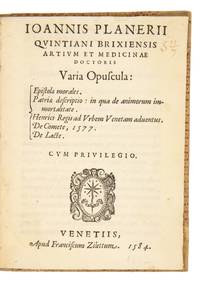
1584réf. 4759Venice: apud Franciscum Zilettum 1584. SOLE EDITION. Hardcover. Fine. Bound in 18th c. quarter vellum and patterned paste-paper. A fine copy. Small stain to leaf H4 and margin of b3 very pale dampstain to two gatherings. Woodcut printer's devices on main and divisional title page. Rare. 5 copies traced in North America: Hagley Museum Michigan Newberry NLM Columbia. A very rare compilation of works by the Brescian physician and scientist Giovanni Planerio of Quinzano d'Oglio. Included are treatises on the medicinal benefits of milk including for the treatment of tuberculosis herbal remedies for constipation and urinary complaints a description of the plague outbreak that afflicted his home town in 1529 and a discussion of the adverse health effects purported to have been brought on by the appearance of the comet of 1577. Planerio regards milk as both nourishment and medicine. He compares the relative nutritional and medicinal properties of the milk of humans and various animals establishing the following ranking: human milk first ass's milk second and goat's milk third while rejecting cow's and sheep's milk as having little medicinal value. Human milk he notes is preferably taken directly from the breast. In his "Letters on Morals and Conduct" Planerio recommends a number of remedies for urinary complaints including preparations using sheep's milk asparagus fennel and parsley; and a popular drink made with honey. For constipation he recommends barley infusions and laxative pastes as well as daily exercise. Planerio next gives a thorough account of the plague outbreak in his hometown of Quinzano d'Oglio in 1529. "He described the wailing and moaning and finally how people became accustomed to ever-present death the absence of funerals as people were buried in mass graves that were covered by so little earth that the stench of the corpses seemed to be quite literally poisoning the air." Stolberg Learned Physicians and Everyday Medical Practice in the Renaissance p. 100 Pianeri also offers a detailed examination of the Great Comet of 1577 a significant astronomical event that captivated observers across Europe and beyond and considers its role as a portent of disruption. This comet was notable not only for its brightness but also for the role it played in challenging prevailing astronomical theories of the time. Planerio discusses the calamities believed to follow from such celestial configurations including war famine political upheaval mortality and disease. Among the specifically medical effects attributed to comets are acute fevers and bodily pains sometimes so severe as to lead to death. The Great Comet of 1577 appeared unexpectedly and was visible to the naked eye prompting widespread observation and documentation. Its sudden appearance and striking presence spurred debates among astronomers and philosophers regarding the nature and origin of comets. Prior to this event the Aristotelian view predominated positing that comets were atmospheric phenomena occurring within the Earth's atmosphere. The observations of the 1577 comet however provided evidence that challenged this perspective suggesting that comets were celestial bodies located beyond the Moon. The Great Comet of 1577 was first observed on November 1 1577 in Peru. In Europe sightings began around November 7 1577 with notable observations by Tycho Brahe starting on November 13 1577. The comet remained visible to the naked eye until March 1578. In his treatise Pianeri meticulously documents the comet's appearance trajectory and duration. Based on his own data and observations made by Tycho Brahe Michael Maestlin and Cornelius Gemma Pianeri assesses the comet to be a supralunary phenomenon occurring in the celestial rather than atmospheric realm. Pianeri records that he first observed the comet on November 10 1577 in the constellation of Sagittarius. His observations continued through early December. From its initial observed position in Sagittarius the comet moved through Capricorn and Aquarius approaching Pisces around December 1. He provides detailed observations of its brightness and the length of its tail. The comet was exceptionally bright comparable to Venus with a well-defined nucleus exhibiting a slightly reddish hue. The comet's tail extended up to 30 degrees across the sky on November 15 slightly curved with a pale yellowish color gradually decreasing to about 15 degrees by December 1. The comet remained visible from Pianeri's vantage until December 5 1577 with its brightness diminishing over time. The Arrival of Henry III at Venice Planerio gives a detailed account of Henry III's passage through Venice in July 1574 on his return from Poland to assume the French crown. He describes the elaborate Venetian reception including the king's ceremonial entry triumphal architecture processions in the Bucentaur religious observances banquets illuminations musical performances glassmaking demonstrations visits to the Arsenal and other civic institutions dances and public entertainments. The work is particularly rich in descriptions of Venetian pageantry architecture material display and civic ceremony culminating in Henry's departure from the city on 27 July. apud Franciscum Zilettum hardcover books
[Roma?, s.n., c. 1736], manoscritto su carta, steso da una sola mano, in chiara grafia, in-folio piccolo, nato senza brossura, a fogli sciolti, pp. [8]. Compilato su colonne della larghezza di metà del foglio (l'altra metà lasciata bianca). Si tratta dell'incarico a quattro deputati di vigilare sull'epidemia, con la suddivisione delle aree da controllare e le regole di comportamento da far seguire. Ottime condizioni.
1899Roma, Tipografia delle Mantellate. 1899, in-8, br. edit., pp. 20.
réf. 109658Parisiis, Apud Dionysium Du-Val, sub Pegaso, in vico Bellouaco, 1578, Cum Privileio Regis, 1 volume in-8 de 225x160x30 mm environ, 4ff. (titre avec vignette, Epistola, Index), 443 pages, 1f.blanc, parchemin à recouvrements crème avec traces de liens sur les plats, dos à nerfs portant titre doré sur pièce de titre fauve, orné de filets horizontaux et fers dorés (en partie effacés), texte en latin agrémenté de bandeaux et lettrines. Quelques passages soulignés au crayon à papier, des pages brunies avec mouillure claire dans la marge supérieure, notes manuscrites sur la page de titre. Première édition de cet important traité sur les maladies contagieuses (vénériennes, rage, peste).
réf. 451666Librairie Lacoustene Marseille 1976 In-8 carré ( 215 X 150 mm ) de 152 pages, broché sous couverture illustrée. EDITION ORIGINALE. Très bel exemplaire enrichi d'un envoi autographe signé de l'auteur.Un Grand Médecin d'autrefois. Jean-Baptiste BERTRAND 1670-1752 et La Peste de Marseille en 1720.
1739In 2° (34,4x22 cm); due tomi in un volume: XXXVI, 260 pp. e una carta geografica più volte ripiegata, XII, 265, (27), (3) pp. e 10 c. di tav. fuori testo più una carta geografica più volte ripiegata. Completo. Legatura coeva in piena pergamena molle. Qualche lieve foxing al margine esterno di poche pagine, ininfluenti e nel complesso esemplare in buone condizioni di conservazione. Xilografia ai frontespizi. Primo frontespizio stampato in rosso e nero. Testane e finalini xilografici. dsc_0378_clipped_rev_1Prima edizione dell’opera “varia” del grande medico romano Giovanni Maria Lancisi (Roma, 26 ottobre 1654 – Roma, 20 gennaio 1720). Anatomista, fisiologo, botanico, fu anche un valente studioso di letteratura e conoscitore di antiquariato. In campo anatomico descrisse per le strie longitudinali mediali del corpo calloso, i così detti “nervi di Lancisi”, al “segno di Lancisi”, ed un particolare tipo di pulsazione nel polso giugulare, presente in casi di attacco cardiaco. A lui si deve l’intuizione della trasmissione della malaria attraverso il morso delle zanzare ed il consiglio di bonificare le paludi dell’Agro Pontino. Intuì che la malaria era un vera e propria forma di “pestem”, un’infezione che veniva trasmessa attraverso il contagio, scontrandosi così con i fautori dell’antico umoralismo. Arrivò ad ipotizzare che gli insetti depositassero organismi nei cibi che poi venivano assunti dagli uomini o che gli insetti iniettassero direttamente nelle ferite la loro saliva che secondo Lancisi, conteeva un “venifico liquido”.Tra le opere di medicina di Lancisi si ricordano il De subitaneis mortibus (1707), la Dissertatio de recta medicorum studiorum ratione instituenda (1715), e il postumo De motu cordis et aneurysmatibus (1728), con il quale contribuì allo sviluppo della fisiopatologia cardiocircolatoria. Fra le opere qui contenute: Dissertatio historica de Bovilla Peste; De recta studio rum Medicorum; De subitaneis morti bus; Dissertatio de nativis; De Noxiis Paludum Effluviis Libri (nella quale si preoccupò di problemi legati alla salute pubblica); Humani Corporis Anatomica Synopsis; De humorum secretionibus in genere; An acidum ex sanguine extrahi; De triplici interstinorum Polypo; De Physiognomia; De ortu, vegetaztioneac textura fungo rum; De Plinianae Viallae Ruderibus; De motu cordis & aneurysmatibus. "Lancisi, great Italian clinician, was the first to describe cardiac syphilis; he was also notable as an epidemiologist, with a clear insight into the theory of contagion. He was physician to Pope Clement XI, who turned over to him the forgotten copper plates executed by Eustachius in 1552. Lancisi published these with his own notes in 1714. [...] Lancisi's posthumous De aneurysmatibus published in 1728 appears only in later collected editions" (Garrison Morton). Opera non comune da reperirsi completa, nella sua legatura coeva ed in buone condizioni di conservazione.
1940réf. 2897Paris Gallimard 1940 Deux tomes en un volume in-8 demi basane noisette, dos à nerfs sobre, titre doré, 316 et 269 pages. Charnières faibles, néanmoins bon exemplaire.
1794réf. 23553(Marseille) (Auguste Mossy) (An II 1794) In-4 (21 x 26,5 cm) demi basane havane moderne 63 pp. (Manque la page de titre et le dernier feuillet, premier feuillet taché en marge, petit manque de papier au feuillet 61/ 62 avec une petite restauration en marge).
réf. 4990Préface d'Henri Mollaret, traduction et notes de François Ledoux. Paris. Gallimard collection folio. 1982. In-8 (18x11). 378 pages. Broché, couverture illustrée.
1923réf. 23365Paris Denoël 1923 In-12 280 pp
réf. 20817Paris, Aubier / Editions Montaigne, 1943 1 volume In-8° (12 x 18,9cm) Broché. 204p., 2 feuillets.
1923réf. AUB-5423Paris, éd. G. Crès et Cie 1923. Bon exemplaire broché, couverture ornée d'éd., in-8, 280 pages.
réf. 201906420Paris, Plon, 1997 ; in-8, 417 pp., br.
2008In the middle of the sixth century, the world's smallest organism collided with the world's mightiest empire. Weaving together evolutionary microbiology, economics, military strategy, ecology, and ancient and modern medicine, author Rosen tells of history's first pandemic--a plague seven centuries before the Black Death that killed tens of millions, devastated the empires of Persia and Rome, left victims from Ireland to Iraq, and opened the way for the armies of Islam. Emperor Justinian had reunified Rome's fractured empire by defeating the Goths and Vandals who had separated Italy, Spain, and North Africa from imperial rule. In his capital at Constantinople he built the world's most beautiful building, married its most powerful empress, and wrote its most enduring legal code, seemingly restoring Rome's fortunes. Then, in the summer of 542, he encountered a flea. The ensuing outbreak of bubonic plague killed five thousand people a day in Constantinople and nearly killed Justinian himself, bringing about one of the great hinge moments in history 367p.maps notes index. Book
réf. 127972aafGetruckt zu Basel bey Jacob Bertsche, Im Jahr Christi 1667, in-4to (21x18 cm), 23 S. + 1 leer, unbeschnitten, (Titelbl. mit Holzschnitt ‘Basler Wappen’, Aus Sammnelband ausgebunden, ohne Umschlag.
2002réf. LFA-126746754N° 63 - Décembre 2002-Janvier 2003) : revue de 66 pages, format 215 x 285 mm, illustrée, brochée couverture couleurs, bon état
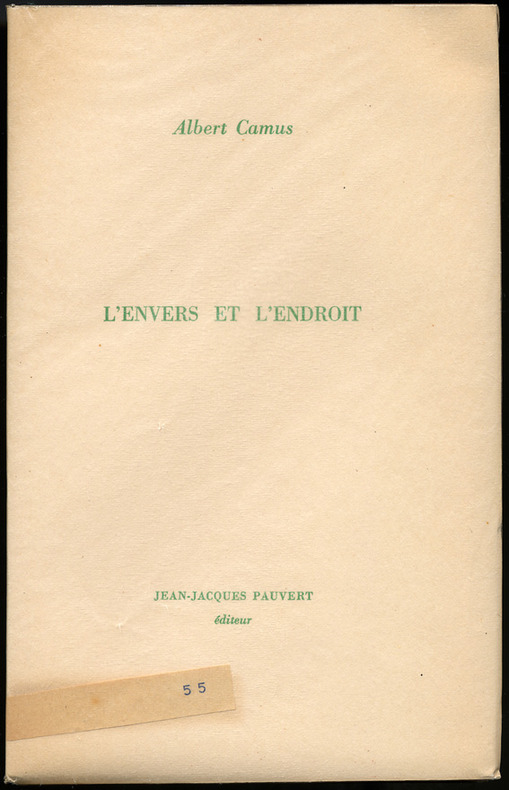
1956réf. 980Jean-Jacques Pauvert Éditeur, Paris 1956. 1 volume in-8 (225 X 142 mm) broché, 107 pp+fnch. sous couverture rempliée ivoire imprimée en vert, rhodoïd de l'éditeur. Seconde édition illustrée d'UNE POINTE-SÈCHE ORIGINALE DE HANS BELLMER, portrait de Camus. La préface de 23 pages a été spécialement écrite par l'auteur pour cette édition. Tirage : 100 exemplaires sur vélin de Rives ivoire numérotés en chiffres romains. Celui-ci, le n° LV, est entièrement non coupé et conservé à l'état de neuf.
1963Mm 175x250 Ministero degli Affari Esteri, Comitato per la Documentazione dell'opera Dell'Italia in Africa. Brossura editoriale di XIII-196 pagine. Lievi fioriture alle copertine, per il resto buona copia. SPEDIZIONE IN 24 ORE DALLA CONFERMA DELL'ORDINE.
2020ill. La peste ha tragicamente accompagnato per secoli la storia dell'umanità lasciando segni profondi nel tessuto demografico, nell'immaginario collettivo e nella scienza medica nonché nelle arti figurative e nella devozione popolare. E non ha mancato di "contaminare" anche la letteratura antica e moderna: da Omero a Lucrezio, da Boccaccio a Manzoni, da Defoe a Camus. Gli Atti del convegno di studio "Noja 1816: l'ultima peste", organizzato nella cittadina barese di Noicàttaro in occasione del bicentenario del contagio, permettono di ricostruire aspetti noti e meno noti di un evento fatto di veri e propri "muri della peste", nonché di provvedimenti sanitari inadeguati, se non dannosi. Viene così restituita l'immagine di una comunità cittadina costretta a subire le prescrizioni di una scienza medica non ancora capace di individuare le reali cause del contagio e i provvedimenti di autorità politico-amministrative impreparate di fronte alla drammatica eccezionalità dell'evento. Grazie ai contributi di studiosi di diversa formazione e a un approccio evidentemente interdisciplinare, queste pagine offrono un quadro convincente dell'ultima, grande peste bubbonica del continente europeo.
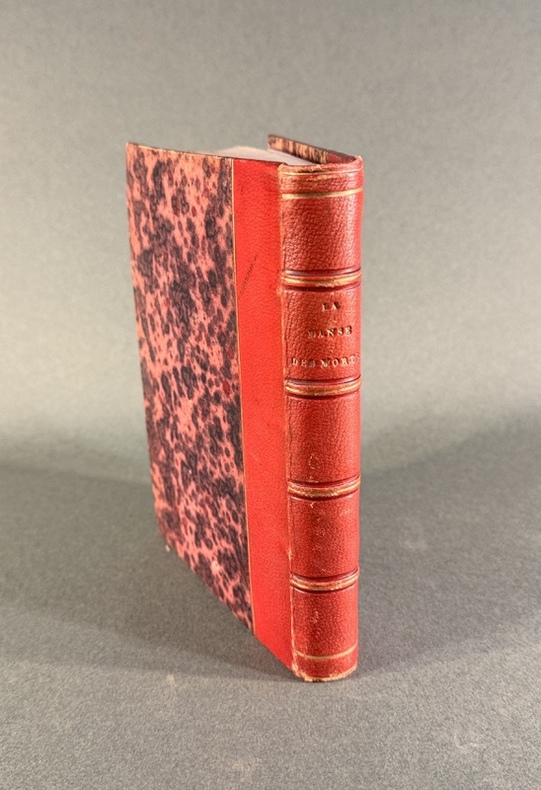
1842réf. 3384Paris P. Labitte, s.d. 1842 Exemplaire non ébarbé. Relié en demi maroquin rouge. In-12, 252 p., 1 feuillet errata. La réimpression des Simulachres de la Mort est d'après la première édition donnée à Lyon en 1538. Dos à quatre nerfs. Étude érudité et très complète sur les danses des morts. Il reprend les origines européennes du thème et les recontextualise :- De la critique en matière de beaux-arts- Première idée de la danse des morts- Triofo della morte par Orcagna et Pétraque- La danza generale de la muerta, Rabbi Santo- De la danse- Les danses ecclésiastiques- La danse macabre- Les peintures gothiques de la danse macabre- Édition gothique de la danse macabre- Hans Holbein le jeune- les Simulachres de la Mort Illustrée de remarquables et très fidèles reprises des estampes de Hanz Holbein, tirées sur chine, montées sur papier teinté.
1987EDITORI RIUNITI 1987 PREFAZIONE DI EMANUELE DJALMA VITALI FONDO DI MAGAZZINO: LIEVI SEGNI DEL TEMPO, VOLUME INTONSO.
2019réf. 32726Perrin 2019 un cahier central de reproductions de portraits et tableaux en couleurs