10.770 Ergebnisse
1948Best.-Nr. 031598San Francisco CA: Kappa Sigma 1948. Hardcover. Very Good. Four issues for 1945-46 bound in a hardcover. The cover shows light wear with spotting. Kappa Sigma hardcover
1945Best.-Nr. 4183LA DEVORSS 1945 1945. INSCRIBED BY LA VIDLETTE TO A SCREENWRITER FIRST EDITION 2ND PRINTING VERY GOOD. Signed by Authors. F. LA, DEVORSS, 1945 unknown
1945Best.-Nr. 4183LA DEVORSS 1945 1945. INSCRIBED BY LA VIDLETTE TO A SCREENWRITER FIRST EDITION 2ND PRINTING VERY GOOD. Signed by Authors. F. LA, DEVORSS, 1945 unknown books
1971Best.-Nr. 060749Los Angeles: DeVorss & Co. 1971. First Edition . Hardcover. Very Good/No Dust Jacket. A Very Good copy gift inscription in purple cloth lettered in gold. Light sun-fading at the spine and at the outer edges of the front cover. The binding is sound the text is clean/unmarked and not ex-library. No dust jacket. DeVorss & Co. hardcover
1964Best.-Nr. 1167007Pioneer Press 1964. Dust jacket is price clipped with a heavy rub on front panel. 1st Edition. Hardcover. Near Fine/DJ Very Good fault. Large Octavo. Book. Pioneer Press Hardcover
Best.-Nr. 69668ARKANSAS REGIMENTAL. LEEPER Wesley Thurman. Rebels Valiant: Second Arkansas Mounted Rifles Dismounted. Little Rock AR: Pioneer Press 1964. 1st ed. xii 328pp. Portrait. Orig. cloth priceclipped d/j. Spine panel of d/j lightly sunned front outer hinge starting else very good. Dornbusch II 106A. Offers close-up views of Murfreesboro Chickamauga Franklin Nashville and Bentonville. Also included rosters of the regiment. . unknown
1958Best.-Nr. 012736New York: Harcourt Brace & Company 1958. Dark orange hardcover cloth binding clean square and tight - no writing tears or marks. Originally published 1953 this has the notation C-10-58 on copyright page. DJ price-clipped although there is an inked price of $3.25 on flap. Otherwise clean and crisp. 244 pages. An old man with a bad heart who is not good at paying his bill is Andy's first boarder but his Quarter Horse stallion Blue Smoke is worth it. When he dies with the promise that Blue Smoke is hers she is thrilled to own the horse but concerned because she is not really sure of his true ownership. Size: 8vo - over 7¾" - 9¾" tall 3rd Printing. Illus. by Dennis Wesley. Hardcover. Very Good/Very Good. Harcourt, Brace & Company Hardcover
1946Best.-Nr. 014253New York: Harcourt Brace & Company 1946. Dark brown hardcover binding clean square and tight. Endpapers a bit yellowed. Price-clipped dustjacket has minor shelfwear. 1946 on copyright page and has the letter I indicating first printing. Midnight Moon featured on back dj flap. Back of DJ lists Harcourt Stories for Girls . 259 pages. This title follows Silver Birch and Midnight Moon in a series featuring Connie McGuire. Connie wants to start her Shamrock Stables breeding farm with the wonderful Palomino Golden Sovereign - son of Silver Birch - as her foundation sire. But his occasional fits of temper makes everyone wonder if the stallion isn't vicious. Illus. by Dennis Wesley. 8vo - over 7¾" - 9¾" tall. 1st Edition. Hardcover. Very Good/Good. Harcourt, Brace & Company Hardcover
1997Best.-Nr. 331795Newcastle Co. Down: Mourne Observer Ltd 1997. Reprint. Hardcover. Inscription from previous owner. Near fine cloth copy in a very good if slightly edge-nicked and dust-dulled dust-wrapper. Remains particularly well-preserved overall; tight bright clean and strong. Physical description; 191 p.: ill.; 22 cm. Subjects; Ireland History Rebellion of 1798. Fiction. Ireland History Literature. Newcastle, Co. Down: Mourne Observer Ltd hardcover
1983Best.-Nr. 0620L929572New York Graphic Society. Very Good. 1983. Hardcover. 0316792306 . 1st. IINSCRIBED by author along with long ink gift inscription by prev. owner. VG dj with some wrinkling to top esp. spine. . New York Graphic Society hardcover
1994Best.-Nr. 7789Salt Lake City: Smith Research Associates Signature Books 1994. First Edition. 244pp. Octavo 23.5 cm Dark brown cloth with the titles gilt stamped on the front board and backstrip. Fine/Fine. Signed by Marquardt on the title page. For more than 150 years the story of Mormon origins has been rewritten to a point where only fragments remain of the original. This book restores much of the human drama and detail. Moving from village to village the Joseph Smith Sr. family lived in constant poverty. When in 1825 Joseph Sr. a cooper defaulted on the family's final mortgage payment he and his nineteen-year-old son Joseph Jr. traveled one hundred miles south to Pennsylvania to join a band of money diggers on a desperate hunt for buried Spanish treasure. Following this ill-fated quest father and son returned near-penniless to New York to face eviction. They resettled in a small Manchester cabin where young Joseph later saw angels-not unlike his father and other contemporaries-and eventually found hieroglyph-inscribed sheets of gold which his former money-digging associates repeatedly tried to steal. During this turbulent time Joseph Smith was brought to court three times for crystal gazing eloped with a former landlord's daughter watched as his mother and siblings were excommunicated from the Presbyterian church published his translation of the hieroglyphs founded the Church of Christ saw a potential convert forcibly abducted by her minister and eventually sought refuge in Ohio where he changed the name of his church and its place of origin. Smith Research Associates [Signature Books] unknown
1994Best.-Nr. 7789Salt Lake City: Smith Research Associates Signature Books 1994. First Edition. 244pp. Octavo 23.5 cm Dark brown cloth with the titles gilt stamped on the front board and backstrip. Fine/Fine. Signed by Marquardt on the title page. For more than 150 years the story of Mormon origins has been rewritten to a point where only fragments remain of the original. This book restores much of the human drama and detail. Moving from village to village the Joseph Smith Sr. family lived in constant poverty. When in 1825 Joseph Sr. a cooper defaulted on the family's final mortgage payment he and his nineteen-year-old son Joseph Jr. traveled one hundred miles south to Pennsylvania to join a band of money diggers on a desperate hunt for buried Spanish treasure. Following this ill-fated quest father and son returned near-penniless to New York to face eviction. They resettled in a small Manchester cabin where young Joseph later saw angels-not unlike his father and other contemporaries-and eventually found hieroglyph-inscribed sheets of gold which his former money-digging associates repeatedly tried to steal. During this turbulent time Joseph Smith was brought to court three times for crystal gazing eloped with a former landlord's daughter watched as his mother and siblings were excommunicated from the Presbyterian church published his translation of the hieroglyphs founded the Church of Christ saw a potential convert forcibly abducted by her minister and eventually sought refuge in Ohio where he changed the name of his church and its place of origin. Smith Research Associates [Signature Books] unknown books
1989Best.-Nr. 48274Boston: David R. Godine 1989. Hardcover. Very good. Hardcover. First Edition. Very good hardback in a very good dustjacket. Inscribed and signed by McNair to author Terry Kay on the title page. David R. Godine hardcover
1989Best.-Nr. 48274Boston: David R. Godine 1989. Hardcover. Very good. Hardcover. First Edition. Very good hardback in a very good dustjacket. Inscribed and signed by McNair to author Terry Kay on the title page. David R. Godine hardcover books
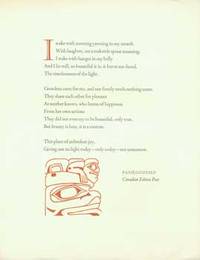
Best.-Nr. 63-0825Berkeley CA: Wesley Tanner 1973. Broadside 22 x 29 cm. Letterpress On Beige Wove Paper Black Ink for text Red Ochre Inked Illustration Good with creasing minor staining. Watermark: Artone Text. A Moe's Books Free Poem. Panegoosho Canadian Eskimo Poet. Berkeley, CA: Wesley Tanner, [1973]. unknown
2019Best.-Nr. 15351New York: Penguin Press 2019. First edition. Hardcover. A near fine copy in a nearly fine dust jacket. This copy is inscribed on the title page by Mark Morris. From the most brilliant and audacious choreographer of our time the exuberant tale of a young dancer’s rise to the pinnacle of the performing arts world and the triumphs and perils of creating work on his own terms—and staying true to himself. Before Mark Morris became “the most successful and influential choreographer alive” The New York Times he was a six year-old in Seattle cramming his feet into Tupperware glasses so that he could practice walking on pointe. Often the only boy in the dance studio he was called a sissy a term he wore like a badge of honor. He was unlike anyone else deeply gifted and spirited. Moving to New York at nineteen he arrived to one of the great booms of dance in America. Audiences in 1976 had the luxury of Merce Cunningham’s finest experiments with time and space of Twyla Tharp’s virtuosity and Lucinda Childs’s genius. Morris was flat broke but found a group of likeminded artists that danced together travelled together slept together. No one wanted to break the spell or miss a thing because “if you missed anything you missed everything.” This collective led by Morris’s fiercely original vision became the famed Mark Morris Dance Group. Suddenly Morris was making a fast ascent. Celebrated by The New Yorker’s critic as one of the great young talents an androgynous beauty in the vein of Michelangelo’s David he and his company had arrived. Collaborations with the likes of Mikhail Baryshnikov Yo-Yo Ma Lou Harrison and Howard Hodgkin followed. And so did controversy: from the circus of his tenure at La Monnaie in Belgium to his work on the biggest flop in Broadway history. But through the Reagan-Bush era the worst of the AIDS epidemic through rehearsal squabbles and backstage intrigues Morris emerged as one of the great visionaries of modern dance a force of nature with a dedication to beauty and a love of the body an artist as joyful as he is provocative. This is the bighearted and outspoken story of a man as formidable on the page as he is on the boards. With unusual candor and disarming wit Morris’s memoir captures the life of a performer who broke the mold a brilliant maverick who found his home in the collective and liberating world of music and dance. Illustrated from photographs. 374 pages with index. Penguin Press hardcover
2019Best.-Nr. 15351New York: Penguin Press 2019. First edition. Hardcover. A near fine copy in a nearly fine dust jacket. This copy is inscribed on the title page by Mark Morris. From the most brilliant and audacious choreographer of our time the exuberant tale of a young dancer’s rise to the pinnacle of the performing arts world and the triumphs and perils of creating work on his own terms—and staying true to himself. Before Mark Morris became “the most successful and influential choreographer alive” The New York Times he was a six year-old in Seattle cramming his feet into Tupperware glasses so that he could practice walking on pointe. Often the only boy in the dance studio he was called a sissy a term he wore like a badge of honor. He was unlike anyone else deeply gifted and spirited. Moving to New York at nineteen he arrived to one of the great booms of dance in America. Audiences in 1976 had the luxury of Merce Cunningham’s finest experiments with time and space of Twyla Tharp’s virtuosity and Lucinda Childs’s genius. Morris was flat broke but found a group of likeminded artists that danced together travelled together slept together. No one wanted to break the spell or miss a thing because “if you missed anything you missed everything.” This collective led by Morris’s fiercely original vision became the famed Mark Morris Dance Group. Suddenly Morris was making a fast ascent. Celebrated by The New Yorker’s critic as one of the great young talents an androgynous beauty in the vein of Michelangelo’s David he and his company had arrived. Collaborations with the likes of Mikhail Baryshnikov Yo-Yo Ma Lou Harrison and Howard Hodgkin followed. And so did controversy: from the circus of his tenure at La Monnaie in Belgium to his work on the biggest flop in Broadway history. But through the Reagan-Bush era the worst of the AIDS epidemic through rehearsal squabbles and backstage intrigues Morris emerged as one of the great visionaries of modern dance a force of nature with a dedication to beauty and a love of the body an artist as joyful as he is provocative. This is the bighearted and outspoken story of a man as formidable on the page as he is on the boards. With unusual candor and disarming wit Morris’s memoir captures the life of a performer who broke the mold a brilliant maverick who found his home in the collective and liberating world of music and dance. Illustrated from photographs. 374 pages with index. Penguin Press hardcover books
1996Best.-Nr. 25375Greenwood Westport CT 1996. 1st Edition. Hardcover Original Cloth. Fine Condition. Quantity Available: 1. Category: Literature & Literary; ISBN: 0313299242. ISBN/EAN: 9780313299247. Pictures of this item not already displayed here available upon request. Inventory No: 25375. . 9780313299247 Greenwood hardcover
Best.-Nr. 15-5747Ann Arbor MI.: Passim Editions 1998. 12mo. Thirteen Book Marks Very Good with some creasing. Envelope addressed to Peter Howard & of Serendipity Books present. Thirteen bookmarks letterpressed on handmade paper with wood-engravings. Ann Arbor, MI.: Passim Editions, 1998. unknown
2003Best.-Nr. Bing39SD025Jossey-Bass 2003. Hardcover w/ DJ. Very Good. Prompt shipment with tracking. we ship in CLEAN SECURE NEW boxes : Very good hardcover with dust jacket. Clean pages. Sm4to 320pp. Jossey-Bass hardcover
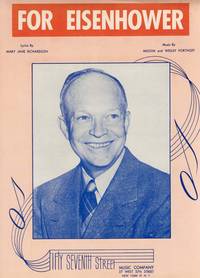
1952Best.-Nr. 101364New York: Fifty Seventh Street Music Company 1952. 1952. Very good. - Quarto 12-1/8 inches high by 9 inches wide. Softcover original sheet music bound in pictorial peach self-wraps. 4 pages including the covers. The corners are lightly bumped with light creasing to the top edge. The bottom edge of the last page is lightly foxed. Very good. RARE. Only one copy located in WorldCat. A presidential campaign song composed by Mischa & Wesley Portnoff with lyrics by Mary Jane Richardson supporting Dwight D. Eisenhower's presidential campaign. The American composer and teacher Mischa Portnoff 1901-1979 composed works for the solo piano and for the symphony orchestra. He also composed lighter works which were performed on Broadway and in Hollywood movies. Mischa was the son of the violinist and composer Leo Portnoff and Wesley was his brother. New York: Fifty Seventh Street Music Company, (1952). paperback
1904Best.-Nr. 30096Washington D. C.: Government Printing Office 1904. First Impression. Hardcover. In exceptionally good condition/No dust jacket. Demy folio 27.75cm/11inches full gilt-embossed olive-coloured cloth sans dust jacket pp. xliv 320 indexed. Illustrated with LXXXII b-w halftone and colour plates and 170 sketches incorporated within the text. Please feel free to inquire as to particulars and/or additional photographs. . Features: Two Summers' Workin Pueblo Ruins by Jesse Walter Fewkes and Mayan Calender Systems by Cyrus Thomas. .Fewkes surveyed the ruins of a number of cultures in the American Southwest and wrote many well received articles and books.citation needed He supervised the excavation of the Casa Grande ruins in southern Arizona a Hohokam site and the Mesa Verde ruins in southern Colorado an Ancient Pueblo site. He particularly focused on the variants and styles of prehistoric Southwest Indian pottery producing a number of volumes with carefully drawn illustrations. His work on the Mimbres and Sikyátki pottery styles eventually led to the reproduction of many of these traditional forms and images. The Hopi potter Nampeyo became his friend and reproduced the newly documented traditional designs in her own work. . In 1858Thomas founded the Illinois Natural History Society. In 1869 he was apponted the United States Geological and Geographical Survey of the Territories under Professor Ferdinand Vandeveer Hayden. Thomas was also the agricultural statistician and entomologist on the Hayden Geological Survey of 1871 whose work supported the creation of Yellowstone National Park in 1872. Government Printing Office hardcover
1969Best.-Nr. 1402523New York: E.P. Dutton & Co 1969. First edition. Hardcover. Quarto 168 pages. In Very Good condition with a Good minus dust jacket. Spine is black with white print. Dust jacket in mylar; light edge wear with tear to top edge of rear panel. Price unclipped: “$25.00”. Boards in orange cloth. Illustrated: color photographs. Oversized books. Additional postage necessary for expedited/international orders. Economy International shipping unavailable due to size/weight restrictions. For international/expedited customers please inquire for rates. NOTE: Shelved in Locked Annex in column ND-QC. 1402523. FP New Rockville Stock. E.P. Dutton & Co hardcover
1969Best.-Nr. 24097New York: Dutton 1969. First edition. Porter Eliot. Folio cloth fine in dust jacket. 48 color photographs by Porter. Dutton unknown
1897Best.-Nr. A0060cxxi366 pages with frontispiece 125 plates 49 figures and index. Quarto 11 1/2" x 8 1/4" bound in original publisher's olive green cloth with gilt lettering to spine and pictorial to cover. Papers by William Henry Holmes Stone implements of the Potomac-Chesapeake tidewater province page 3-152 plates I-CIII and frontispiece figures 1-29a; W J McGeen The Siouxan Indians: A preliminary sketch pages 153-204; James Owen Dorsey Siouxan sociology: A posthumous paper pages 205-244 and figures 30-38; Jesse Walter Fewkes Tusayan katcinas pages 245-313 plates CIV-CXI and figures 39-48; Cosmos Mindeleff The repair of Casa Grande ruin Arizona in 1891 pages 315-349 and plates CXII-CXXV. Edited by J W Powell. List of Publications of the Bureau of American Ethnology pgs 5-6 From the library of David H Snow. First edition. Although classified by most conventional texts John Wesley Powell always maintained that he was not an adventure or an explorer. He considered himself a scientist motivated by a desire for knowledge and to further the progress of human kind. However Powell did live a busy and active life as a military leader the first navigator of the Colorado River and director of the United States Geological Survey. His accounts from navigating the Colorado River earned him early fame. Due to his compassion toward Native Americans he was elevated to director of the Smithsonian Institution's Bureau of Ethnology in which he continued until his death. His work on the Irrigation Survey for the western United States although never fully realized lead to the establishment of river gauging stations and preliminary work toward storage and utilization of river water for irrigation and prevention of floods and overflows. In 1979 the highway salvage program of the Laboratory of Anthropology expanded beyond highway salvage projects. Under the direction of David H. Snow it was reorganized as the Research Section of the Laboratory of Anthropology. The change guaranteed that the program had a dynamic role in the active profession of archaeology that it continued to add to the Lab's research collections and that publications on projects continued to be produced. By 1984 the Research Section staff had outgrown its location in the Laboratory of Anthropology. Along with the Laboratory's archaeological research collection of almost ten million artifacts the Research Section moved to new offices in downtown Santa Fe. Condition: David Snow's signature on front end paper light rubbing to back hinge corners bumped else a very good. Government Printing Office hardcover