6.865 Ergebnisse
1946Best.-Nr. 96045Playbill Incorporated 1946. Rare original playbill from the 1946 production of George Bernard Shaw's Candida starring Marlon Brando and Katharine Cornell. Octavo original wrappers illustrated. Boldly signed on the front panel by Marlon Brando Katharine Cornell Cedric Hardwicke Oliver Cliff Wesley Addy and Mildred Natwick. In near fine condition. Rare and desirable signed by the entire cast of this important production. Katharine Cornell played the lead role of Candida on Broadway in five different productions the last four of which were for her own production company. She became the actress most closely associated with the role and became so acclaimed that the Actor's Guild forbade any other actress from playing the role while Cornell was still alive. In her final production of 1946 a young Marlon Brando played the role of Eugene Marchbanks. Playbill Incorporated unknown books
1946Best.-Nr. 96045Playbill Incorporated 1946. Rare original playbill from the 1946 production of George Bernard Shaw's Candida starring Marlon Brando and Katharine Cornell. Octavo original wrappers illustrated. Boldly signed on the front panel by Marlon Brando Katharine Cornell Cedric Hardwicke Oliver Cliff Wesley Addy and Mildred Natwick. In near fine condition. Rare and desirable signed by the entire cast of this important production. Katharine Cornell played the lead role of Candida on Broadway in five different productions the last four of which were for her own production company. She became the actress most closely associated with the role and became so acclaimed that the Actor's Guild forbade any other actress from playing the role while Cornell was still alive. In her final production of 1946 a young Marlon Brando played the role of Eugene Marchbanks. Playbill Incorporated unknown
1912Best.-Nr. 0008211BOSTON MASSACHUSETTS. Good. 1912. On offer is a small original diary of a young man in the early years of the 20th Century. Measuring 4.75 inches by 3 inches it contains 365 pages. It is approximately 33% complete. The cover binding and pages are all in good condition. The handwriting is legible. EDITOR'S NOTE: While there is nothing in this diary to identify the author the item came from an archive related to Wesley Abell who graduated from the University of Vermont was inducted into their Football Hall of Fame and after graduating built a career in the municipal service of Burlington VT eventually becoming City Clerk. In 1912 he is a young man living with relatives and working in Boston MA in 1912. He has secured work as a driver/conductor for the Boston Elevated Street Railway. This is not his long term future goal for in September of 1912 he leaves home to attend the University of Vermont. The entries are fairly straightforward: "Jan 1 '12 finds me working for the Boston Elevated Street Railroad Co. I am staying with Uncle .wn in morning and done my a/ 521 .45 530 .30 Total .75 Excused until 4 o'clock b/ done a 531 .45 & 525 .30 Total .75 c met cars from 6 o'c til 7 o'c Total for day $1.80" Jan 1 1912; "For my A.M. this morn I had 2 534 .60. Was then excused until 4 o'c when I went and done a half for 4 th consisting of 504 and 520 Pay for the day - $1.75" Feb 24 1912; "Today I had a swing beginning at 8:27. Done four trips and then layed off til 6:07. Earl Sunderl was over to see me. Total $2.30 Paid." Mar 3 1913; "After April 5th there are no entries until June. On June 7th it apears that he is running a union picket line - with expected consequences! This morn I went down to run a trip at 5 o'c. On starting out on trip I was met by a bunch of strikers who threw eggs at me. Worked all day mid yells of scab and all sorts of other names. The strikers tried their best to get me to leave my car but I stuck it out". June 7 1912; This entry is significant because it refers to the Boston Elevated Street Railway strike of 1912. This was a serious labour dispute over the organizing of a union there and the demand for better wages. The strike began on June 7th and soon spiraled into violence. Court crack downs were draconian and the strike seemed poised to spread to other cities. The major turning point in the strike however came as a result of charges filed with the State Board of Conciliation and Arbitration. The Board released a report which upheld the Union's charges and placed the blame for the strike on the Management. The Board found that the Management had discharged employees solely for their Union activities had brought in strike breakers such as our author and convicted felons who were employed as strong-arm men and had coerced employees against joining the Union. After the Board's report The Governor and the Mayor of Boston became actively involved in settling the strike. The Mayor of Boston in 1912 was John F. Fitzgerald affectionately referred to as "Honey Fitz". Fitzgerald was the maternal grandfather of President John F. Kennedy and Senator Edward M. Kennedy and great grandfather of Congressman Joe Kennedy. In September he is off to university: "This morn I packed my trunks and papa carried me to St. A to take train for college. Earle A and F Stevens went down with me. Met lots of nice fellows in B and spent time with Hayden and Wesley Sturgis at Converse Hall". Sept 24. This diary offers an interesting look into one of the urban transport companies from the point of view of an ordinary worker. For a social historian it provides a flavour and a sense of what work was like in industrialized Boston at the turn of the last century. It also touches on a very key time in labour organizing in the United States. ; Manuscript; 32mo - over 4" - 5" tall; KEYWORDS: HISTORY OF; 20TH CENTURY; 1910S; PROGRESSIVE ERA; UNITED STATES; BOSTON; MASSACHUSETTS; VERMONT; BOSTON ELEVATED STREET RAILROAD; UNIVERSITY OF VERMONT; CONVERSE HALL; JOHN F. FITZGERALD; HONEY FITZ; JOHN F. KENNEDY; EDWARD M KENNEDY; STRIKES IN BOSTON; CONDUCTORS AND MOTORMEN IN THE EARLY 20TH CENTURY; STRIKES IN 1912; BOSTON ELEVATED COMPANY EMPLOYEES; CARMEN STRIKE IN BOSTON; LABOR ORGANIZATIONS; UNIONS IN 1910S AMERICA; UNION VIOLENCE IN 1910S; UVM ALUMNI; BOULDER SOCIETY MEMBERS; AMERICANA HANDWRITTEN MANUSCRIPT DOCUMENT LETTER AUTOGRAPH WRITER HAND WRITTEN DOCUMENTS SIGNED LETTERS MANUSCRIPTS DIARY DIARIES JOURNALS PERSONAL HISTORY SOCIAL HISTORY HISTORICAL HOLOGRAPH WRITERS AUTOGRAPHS PERSONAL MEMOIR MEMORIAL ANTIQUITÉ CONTRAT VÉLIN DOCUMENT MANUSCRIT PAPIER ANTIKE BRIEF PERGAMENT DOKUMENT MANUSKRIPT PAPIER OGGETTO D'ANTIQUARIATO ATTO VELINA DOCUMENTO MANOSCRITTO CARTA ANTIGÜEDAD HECHO VITELA DOCUMENTO MANUSCRITO PAPEL . unknown
Best.-Nr. 2493Archive of Diaries Original Writing Original Manuscript Comics Scripts Letters and Ephemera from Actor Wesley Lau 1921-1984 Archive fits into one banker box. Material primarily dates from Wesley Lau's high school years through college and military service into his early career as actor and screenwriter. Most of the material especially the four diaries and original comics are in very good to fine condition. The small collection of letters and screenplays overall are in good condition with some soiling and overall wear. Ephemeral material from high school report cards certificates etc. in fair to good condition. Other ephemera in generally good condition. Tremendous archive of film and television star Wesley Lau from his high school years to early into his film and television career. Anyone who watched television or went to the movies in the 1960's through mid 1970's would recognize Lau for his hundreds of roles. He was probably most recognized for his role as Lt. Andy Anderson in the TV series Perry Mason where he appeared in 81 episodes of the show from 1961 to 1965. One on-line source credits Lau with 91 different television roles often with multiple episodes of each show including Alfred Hitchcock Presents Gunsmoke Bonanza Peter Gunn Twilight Zone Mission Impossible Mod Squad Cannon and Six Million Dollar Man. Lau often was cast as a 'tough guy' or villain. His movie credits include I Want to Live! The Alamo The Venetian Affair The Ride to Hangman's Tree Panic in the City Journey to Shiloh The Sweet Ride Airport Green Berets Crosscurrent/The Cable Car Murders Call to Danger Skyjacked Incident on a Dark Street Homebodies and Cry Panic. Lau often remarked that he really wanted to be a writer/screenwriter. He is credited with writing scripts for episodes of Perry Mason Ironside Mannix Barnaby Jones Quincy M.E. and Magnum P.I. yet never found steady work in screenwriting relying on his acting skills for his livelihood. Wesley Lau was born and raised in Sheboygan Wisconsin where he went to high school graduating from Central High in 1939. High school and college diploma included in archive. Lau was Vice-president of his student body senior year and active in football basketball and acting. The archive includes Lau's personal diaries for 1938 thru September 21 1941 when he leaves for college at Madison Wisconsin "here endeth my diary-writing I am not taking it along to Madison; perhaps I'll never write in a diary again." In reading the diaries I am struck by what a prolific reader Lau was probably a book a day usually noting what he was reading and the fact he saw multiple movies weekly again noting titles. There is no question that Wesley Lau in his youth was a fanatical reader and movie buff; we do not recall reading that he watched much television however. Lau had a cadre of friends he hung out with but by 1938 we find him spending a lot of time with "Elouise". Many movies walks making out and telephone calls. Still Lau reads prolifically and begins to mention writing short stories and perhaps working on a novel. "This morning I write and rewrite a few of my stories. Geez I wish I could get a real good idea some time and write something of note. I guess I'll just have to keep on writing and maybe someday." Acting also begins to take more of his time with rehearsals and performances. As early as January 1939 Lau writes "A girl in Psychology told me I looked and acted like Gary Cooper. Gee a lot of people have told me that. Don't let it go to your head though Bud." In 1941 he is offered a role "with all the work I have to do I am undecided.but I finally can't resist--I take a part.it's just in my blood I guess!!" Wesley Lau studied playwriting at the University of Wisconsin received a Master of Arts degree at Yale Drama School and continued his acting studies in New York at the Actor Studio. Lau served in the United States Army Air Forces in World War II 1943-1945; the archive includes his Honorable Discharge papers where it notes he received the Victory Medal a European Africa Middle Eastern Theater Ribbon 4 Overseas Bars 1 Service Stripe and a Good Conduct Medal. In reviewing Wesley Lau's course records from University of Wisconsin he recorded A's and B's in English Speech and Comparative Literature but received a D and F in Zoology. In two semesters of Philosophy he received a C and D. Another fascinating subset in the archive are hundreds of manuscript comic strips and single panel comics/study sketches. Many of them are signed and a few are dated 1937. We find no reference in the diaries although we did not read them completely of this hobby but it certainly received a lot of his time and attention. Many of the sketches are on receipts/paper from several Sheboygan businesses. Thematically many of the sketches portray a heroic chiseled man ala Dick Tracy. Lau does mention reading the Sunday paper weekly. One strip is titled "Thunder Storme--Soldier of Fortune" while another is a 27-page story titled "Captain Stormy--Soldier of Fortune". There are four scripts in which Lau acted in the collection: "Harder at Woleai" for the television series "Silent Service" 1958; 1959 The Brothers Brannagan's "Murder Fits the Frame" 1970 script for Aaron Spelling's "The Most Deadly Game" and an undated play titled "House Guests". Given Wesley Lau's wish to be a writer it might not be a surprise to find samples of his writing including 7 longer form pieces and many shorter items or conceptual script ideas. We find no record that any of these pieces were published except for a play he wrote for a writing contest was produced in 1947. So Far from God--A Screenplay. 75 page typed original manuscript. Plus second original typescript copy of 57 pages. Peking Man Murders--Script Possibilities Concept Thoughts 2 copies one original 8pp. I Love You Zea" tentative title A Thriller. Original typescript with manuscript changes 58pp plus 41 pages of handwritten material attached to the typescript. Typescript copy of "To the First Distant Shore--A Narrative Account of the War with Tripoli 1801-1805 317 pp. in brad binder. An untitled original typescript copy of a Three-Act Play written Feb. 1947 23pp. Original typescript one-act play titled "Incident". Written and re-written Nov-Dec. 1946. Produced in the Union Play Circle April 23 and 24. Lau won the Wisconsin Players' play-writing contest. This is the director's copy with comments plus playwright's notes on audience reaction. Collection of bound short stories titled "First Short Stories and Poetry" dated 1937. The short stories are dark and macabre--a style unlike what I would expect of Lau from reading his diaries. And I must say the stories are not very good; nor are the poems. Collection also includes script ideas for Mission Impossible The Fifth Man and a signed plot for possible movie of the week titled "The House Sitter". Also includes short stories titled "Hex Town" and "The Hexer". There are also numerous snippets scraps and untitled stories. We get a glimpse of Lau's early fame from his work in the 1957-1958 TV series Hotel Cosmopolitan with 8 fan letters all women complimenting Lau and asking for stills. One letter was from his cousin Wilma so maybe that does not count. Miss Carol Bages writes "I think you are a very handsome and wonderful actor. I would appreciate it very much if you would send me your picture." Finally the archive contains three letters from two of Lau's wives including a letter from Lau's first wife 1957 telling Wesley that she is getting divorced again. "I have always said and repeat that you were a perfect gentleman until the very end and I wouldn't compare this husband to you in that respect." The two letters from Lau's second wife from 1962 and are fairly mundane news filled affairs. All in all a fascinating insight into the formative years of one of Hollywood's most prolific character actors from the late 1950's through the mid-70's. We find no record that Wesley Lau's papers are held in any institution. Extra shipping cost due to size of archive. unknown
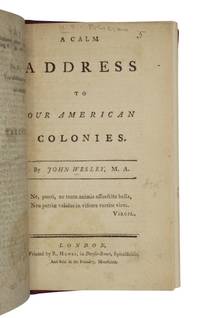
1775Best.-Nr. AQ35670London: Printed by R. Hawes.And Sold at the Foundry 1775. 23pp 1. ESTC T19839. Bound after: WILBERFORCE William. The debate on a motion for the abolition of the slave-trade in the house of commons on monday and tuesday april 18 and 19 1791 reported in detail. London. Printed by James Phillips 1792. Second edition. 4 133pp 3. With a terminal leaf of publisher's advertisements. ESTC N6876. And: WESLEYAN METHODIST CHURCH. The sunday service of the methodists in the united states of america. With other Occasional Services. London. s.n. 1790. Fourth edition. 24pp. Defective lacking the majority of text. ESTC T185256. And: WESLEY John. Some account of the late work of god in North-America in a sermon on Ezekiel i. 16. London. Printed by R. Hawes 1778. First edition. 23pp 1. ESTC T16608. And: FLETCHER John. A vindication of the Rev. Br. wesley's "calm address to our american colonies:" In some letters To Mr. caleb evans. London. Printed: and sold at the Foundry 1776. 70pp. Without half-title. ESTC T26110. Bound before: CHALMERS Thomas. Drop-head title: Christian union. Address of the rev. dr. chalmers at the bicentenary commemoration of the westminster assembly july 13 1843. London. Macintosh 1843. 12pp. And: An answer to the inquiry why are you a dissenter from the church of england In a letter to a friend. Harlow. Printed by B. Flower 1812. Fifth edition with additions. 28pp. And: WESLEY Rev. John. The character of a methodist. London. Printed at the Conference Office.by Thomas Cordeux 1817. 12pp. And: WESLEY John. Directions for renewing our covenant with god. London. Printed and sold at the New Chapel City Road; and at the rev. Mr. Wesley's Preaching-Houses in Town and Country 1787. Fourth edition. 23pp 1. ESTC T31873. 12mo. Modern red library cloth ruled and lettered in gilt. Library labels of the General Theological Seminary to pastedowns with their ink-stamp to title page of first mentioned work naive clear tape repairs to gutters of three terminal leaves of final mentioned work. A coherent sammelband of pamphlets concerning Wesleyan methodism including an early edition - printed in the same year as the first - of Anglican clergyman and founder of Methodism John Wesley's 1703-1791 vehement condemnation of America; an unacknowledged abridgement of Samuel Johnson's Taxation No Tyranny London 1775. The 1770s were turbulent years in the American colonies which were edging towards independence from Britain. John Wesley ventured squarely into American politics with publishing his A calm address to our American colonies. The booklet reversed his position of a year earlier on British oppression of the colonies and brought him down on the side of the British government and clergy arguing for the legitimacy of taxing the Americans. The pamphlet went through many editions immediately and over 100000 copies circulated within a year. Not surprisingly Wesley was vilified in America. It has been argued that the fact that America closed its ports to English ships - and books - on 20th July 1775 may have saved the cause of Methodism in America. The copies of the pamphlet which had entered already were largely destroyed and no further copies found their way into the country until after the conflict. . Printed by R. Hawes...And Sold at the Foundry hardcover
2009Best.-Nr. 834948Fondazione. New. Hardcover. FREE UPGRADE to Courier/Priority Shipping Upon Request - IN STOCK AND IMMEDIATELY AVAILABLE FOR SHIPMENT - Flawless copy brand new pristine never opened -- Text in English. 608 pages; over 1000 illustrations most in color. -- with a bonus offer; Over the course of 40 years New York-based Pop painter John Wesley has created a singular body of work with a cast of characters including Dagwood Bumstead birds and bears all rendered in the same flat sky blue flesh beige and candy pink palette. Employing a comic strip style and a compositional rigor Wesley makes warm sexy paintings with a frequent twist of the bizarre. "When post-global-warming anthropologists begin paddling through the streets of Manhattan in search of visible evidence that this republic was. the cosmopolitan democracy that it purported to be" writes Dave Hickey of this work "one can only hope that the earnest scientists will stumble across a trove of Wesley's paintings in some tenth-floor loft. If they do they will almost immediately begin to think better of us. They will think Hey! These weren't such bad dudes! How could they be They were cool generous and urbane; they encouraged high spirits and valued sex enough to make it elegant and funny." . 2009. 8887029431 . Fondazione hardcover
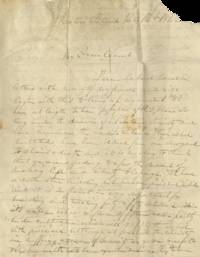
1842Best.-Nr. List3738Ship Saluda Bound for Monrovia 1842. Two autograph letters signed approximately seven manuscript pages total. 1839 letter measuring 8 x 12 ¾ inches foxed with small tears at folds very good; 1842 letter measuring 8 x 10 inches tears at folds with larger tear to top right some text missing very good minus. Overall very good. A pair of letters documenting the work of Dr. Wesley Johnson 1813-1844 physician educator and colonial official associated with Bassa Cove during Liberia's formative decades. Written three years apart the letters preserve Johnson's involvement in medicine colonial administration anti-slave trade efforts agricultural reform and the establishment of one of Liberia's earliest advanced educational institutions. Born in Hillsdale New York Johnson studied medicine at Jefferson Medical College in Philadelphia under Dr. Jacob Green receiving his degree in 1837 before departing almost immediately for West Africa.1 He entered service at Bassa Cove a settlement approximately seventy miles south of Monrovia supported jointly by the New York and Pennsylvania Colonization Societies. Established as part of the larger Liberian colonization project Bassa Cove existed under difficult conditions: high mortality limited resources dependence upon outside support and periodic violence associated both with local conflict and the wider Atlantic slave trade. Johnson's responsibilities expanded rapidly after his arrival. He worked closely with Governor Thomas Buchanan and within a year had served in command of local militia forces and assumed administrative authority at Bassa Cove. Following conflict involving Theodore Canot a trader in enslaved people and violence affecting nearby settlements Johnson was reportedly injured; he shifted increasingly toward educational work becoming central to the establishment of the Ladies Liberia High School at Factory Island an ambitious project intended to educate future leadership within the colony. The earlier letter written aboard the ship Saluda on October 2 1839 finds Johnson struggling with declining health; a "bilious attack" that "was succeeded by an enlargement of the spleen" and he travelled along the coast towards Sierra Leone and Cape Mount "for my health." Even while discussing illness however Johnson remained focused on institutional work and future responsibilities: "When I return to Bassa I shall take charge of a high school about to be established there and carried on by the Ladies of Philad'a." That brief reference points toward one of the more ambitious educational efforts connected to early Liberia. Organized in Philadelphia in 1832 the Ladies' Liberia School Association sought to support educational development in Liberia through funding schools teachers and educational infrastructure.2 By the late 1830s the organization had developed a broad network of support and had undertaken plans for a secondary school at Factory Island near Bassa Cove. Johnson would become central to its implementation. He writes: "As long as I have serviceable health it is doubtless my duty to remain here for why should new persons come here continually at the risk of their lives & unacquainted with the colony or country. It seems hardly credible that I have been here more than two years already. "10th. I have been today drawing a plan of the buildings for the high school on Factory Island but this evening the vessel rolls and I cannot make straight marks & will go on with my letter. My health is better & better. I drink wine occasionally & we have five courses at dinner. I stopped at Monrovia several days as we came along and found high life at the Govt. house. When we get back to Bassa a school will give my employment & as my agency for the Col. Soc. will be exchanged for that of the Ladies Soc. of Phil. for African Education. Of this change I am glad. It will relieve me of care trouble and vexation and business which I have no means of accomplishing to my mind. "The Colony was never more prospered. Gov. Buchanan drives hard at the Slavers and they cannot stand it. You will see by the . something of what has been going on here. O that I was worth a million. I would make a great jam in Liberia. As it is I take it extempore make the best moves that I can for the time." Three years later writing from Factory Island on July 14 1842 Johnson reports that the educational institution envisioned in the earlier letter had become reality. He writes: "We have at length taken possession of this place so long under the dominion of his Satanic Majesty and have commenced the Ladies Liberia High School. Multitudes have been doomed from our door-yard to chains & death and it is consoling to think that we are affording to a few the means of making life and liberty blessings. We have a noble stone building not however finished inside and it is sufficient in every department for boarding and teaching forty or fifty scholars within its walls. Also a farm of fifteen acres partly under cultivation which will supply the school with provisions. Although at present the colonists are suffering a season of scarcity we go on comfortably. My health has been excellent since my return paper loss indeed it received an important improvement immediately after my arrival. My objects are to get the School thoroughly established an improved system of agriculture in operation and some other person properly introduced to my place & then to return to America. I should not add the last item so readily at present not knowing what circumstances may indicate of my duty but I made a general promise to my friends to return in two years. We are introducing the improved and labor saving plans and means of farming which are from five to ten times as efficient as those in common use here and as novel to the colonists as theirs would be in the good state of New York. We are in want of funds for these purposes all having been exhausted which were appropriated to them by the Ladies and I am obliged to furnish means from my own funds. We have a kind of manual labour system - the pupils work from 6 to 8 & from 4 to 6 & study from 9 to 12 2 to 4 & 7 to 8. My mode of teaching is much improved on what it was in Cin. by invention reflection & teaching others to teach and no other employment is so agreeable to me. I am father mother preceptor & religious teacher to my scholars & universal agent & factotum to the School and would to Heaven that I were better prepared for the work and could show an influential example of the power of living holiness." The physical cost of such work proved severe. Tropical illness permanently damaged Johnson's health. By the time of the present letters he was already recording prolonged illness and enlargement of the spleen. He ultimately returned to Hillsdale in 1844 and died shortly afterward at only thirty-one years old. Contemporary memorials praised both his educational work and personal sacrifice describing Liberia as having lost "a devoted friend and martyr." Taken together the letters preserve the work of an unusually capable participant operating at multiple levels of early Liberian development-physician educator administrator agricultural reformer and institution builder-while documenting educational work colonial administration medicine anti-slave trade activity and daily life through firsthand observation during Liberia's formative decades. An important Liberia grouping. 1 Otteson Ron. Ron Otteson "Dr. Wesley Johnson of Hillsdale: A Gentleman of Talent and Liberal Education" Roeliff Jansen Historical Society accessed May 22 2026 https://www.roeliffjansenhs.org/about-6. 2 Karen Fisher Younger "Philadelphia's Ladies' Liberia School Association and the Rise and Decline of Northern Female Colonization Support" Pennsylvania Magazine of History and Biography 134 no. 3 2010: 235-260.
1963Best.-Nr. 53820A Geneva Book/Carlton Press 1963. Cloth. Very Good/Fair. Smaller sturdy book quality blue cloth gilt lettering near-bright on spine 190 stiff lightly browned pages. In neat green ink on half-title page: "To Nicholas & Leone Pedersen Please accept this book as a present from Eleanor with my sincere compliments: Richard Wesley Konter Chief Radioman US Navy Retired; 1897 to 1927." DJ beneath mylar and in archival plastic sleeve a photo of man in formal Navy uniform with guitar on front white and blue background photo at age 80 at top back. DJ has tiny chip at top front tip larger at spine top and top back edge next to spine slight surface wear at spine bottom edge very tiny tear at bottom back edge. Fair DJ/Very Good book. A Geneva Book/Carlton Press hardcover
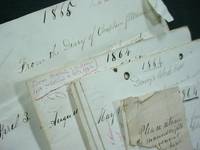
1864Best.-Nr. 0002339WITH THE 2ND NEW HAMPSHIRE REGIMENT. Good. 1864. On offer is a superb original historically significant manuscript diary and relic of the Civil War handwritten by noted Chaplain John Wesley Adams born in Townsend Massachusetts in 1832 the seventh generation ancestor of the Presidents Adams. On December 5 1863 Mr. Adams was commissioned chaplain of General Gilman Marston's original command "The Fighting Second". Devoting himself to social and moral welfare of his comrades Adams was renowned for the care of his men. Side by side he participated in the battles at Bermuda Hundred Point of Rocks the second engagement at Fair Oaks Swift Creek Proctor's Creek Drury's Bluff Cold Harbor Siege of Petersburg and entering Richmond under General Devens the day of his surrender. Mr. Adams preached before his regiment on the death of Abraham Lincoln Adams was discharged in 1865 in a testimonial on parchment. Joining the NH Conference Adams was successful with over a dozen notable pastorates. In 1876 he was chosen a delegate to the General Conference in Baltimore serving four years as secretary of his conference. The 42 page coverless diary is comprised of folio sized sheets are in 3 text blocks held by string and are titled as detailed 'excerpts' from the diaries of the renowned pastor. Retrospectively done but very very soon after the dates of the original writings Chaplain Adams provides a factual retelling of his vast service and in fact the writings include for example in one case a riveting word for word passages with a soldier condemned to die for desertion only to exalt in a reprieve to then be shot the next day. Overall G.; Manuscript; Folio - over 12" - 15" tall; KEYWORDS: HISTORY OF CHAPLAIN JOHN WESLEY ADAMS BATTLEFIELD DIARY CIVIL WAR BROTHER AGAINST BROTHER TOWNSEND MASSACHUSETTS GENERAL CONFERENCE IN BALTIMORE THE 2ND NEW HAMPSHIRE VOLUNTEERS GENERAL GILMAN MARSTON THE FIGHTING SECOND BATTLES AT BERMUDA HUNDRED POINT OF ROCKS SECOND ENGAGEMENT AT FAIR OAKS SWIFT CREEK PROCTOR'S CREEK DRURY'S BLUFF COLD HARBOR SIEGE OF PETERSBURG RICHMOND UNDER GENERAL DEVENS ABRAHAM LINCOLN HARRIET PATIENCE DAME AMERICANA HANDWRITTEN MANUSCRIPT AUTOGRAPHED AUTHORS DOCUMENT LETTER AUTOGRAPH KEEPSAKE WRITER HAND WRITTEN DOCUMENTS SIGNED LETTERS MANUSCRIPTS HISTORICAL HOLOGRAPH WRITERS AUTOGRAPHS PERSONAL MEMOIR MEMORIAL PERSONAL HISTORY ARCHIVE DIARY DIARIES JOURNAL LOG PRIMARY SOURCE FIRST HAND ACCOUNT SOCIAL HISTORY PERSONAL STORIES LIVING HISTORY ANTIQUITÉ CONTRAT VÉLIN DOCUMENT MANUSCRIT PAPIER ANTIKE BRIEF PERGAMENT DOKUMENT MANUSKRIPT PAPIER OGGETTO D'ANTIQUARIATO ATTO VELINA DOCUMENTO MANOSCRITTO CARTA ANTIGÜEDAD HECHO VITELA DOCUMENTO MANUSCRITO PAPELBIOGRAPHY BIOGRAPHICAL AUTOBIOGRAPHICAL AUTOBIOGRAPHY PERSONAL NARRATIVES . unknown
1908Best.-Nr. 856521908. DOW Arthur Wesley & Everett Stanley HUBBARD. BY SALT MARSHES: PICTURES AND POEMS OF OLD IPSWICH. Ipswich: Privately printed 1908. No. 103 of approximately 200. 32 pp. 8vo. Quarter brown cloth unmarked with color illustrated front cover only paper covered boards. Covers worn but still attractive; interior near fine small pencil numerals to front pastedown. Eight lovely color woodblock illustrations with other monochrome and two color designs/headpieces. "BY SALT MARSHES is Arthur Wesley Dow's tribute to the old North Shore town of Ipswich where he was born and spent most of his life and to his boyhood friend Everett Stanley Hubbard. It is a collaboration somewhat in the spirit of Meteyard Carman and Hovey in their Vagabondia books though Hubbard was undoubtedly a lesser poet and Dow a greater artist. BY SALT MARSHES is his masterpiece and it is evident from the numerous sketches and proofs in the Ipswich Historical Society and the Society for Preservation of New England Antiquities - some dating back as far as 1895 - that it was a labor of love. Infinite care and craftsmanship were expended on every detail. The illustrations are color woodblock prints such as Dow described in an article in MODERN ART 1896 entitled "Painting with Wooden Blocks." This was a technique Dow had discovered in the course of his study of Japanese art and he was a master of it using as many as four or five different blocks accurately registered thinly inked to show the grain of the wood and printed in subtle gradations of tone to achieve a luminosity that effectively evokes the quality of the light on the marshes. Although the text is printed from small gothic type the lettering on the cover and title page was also cut by hand in woodblocks after the manner of Meteyard and Dawson-Watson's lettering for the COURIER INNOCENT 1897." Finlay - Artists of the Book in Boston 1890-1910. unknown books
1908Best.-Nr. 856521908. DOW Arthur Wesley & Everett Stanley HUBBARD. BY SALT MARSHES: PICTURES AND POEMS OF OLD IPSWICH. Ipswich: Privately printed 1908. No. 103 of approximately 200. 32 pp. 8vo. Quarter brown cloth unmarked with color illustrated front cover only paper covered boards. Covers worn but still attractive; interior near fine small pencil numerals to front pastedown. Eight lovely color woodblock illustrations with other monochrome and two color designs/headpieces. "BY SALT MARSHES is Arthur Wesley Dow's tribute to the old North Shore town of Ipswich where he was born and spent most of his life and to his boyhood friend Everett Stanley Hubbard. It is a collaboration somewhat in the spirit of Meteyard Carman and Hovey in their Vagabondia books though Hubbard was undoubtedly a lesser poet and Dow a greater artist. BY SALT MARSHES is his masterpiece and it is evident from the numerous sketches and proofs in the Ipswich Historical Society and the Society for Preservation of New England Antiquities - some dating back as far as 1895 - that it was a labor of love. Infinite care and craftsmanship were expended on every detail. The illustrations are color woodblock prints such as Dow described in an article in MODERN ART 1896 entitled "Painting with Wooden Blocks." This was a technique Dow had discovered in the course of his study of Japanese art and he was a master of it using as many as four or five different blocks accurately registered thinly inked to show the grain of the wood and printed in subtle gradations of tone to achieve a luminosity that effectively evokes the quality of the light on the marshes. Although the text is printed from small gothic type the lettering on the cover and title page was also cut by hand in woodblocks after the manner of Meteyard and Dawson-Watson's lettering for the COURIER INNOCENT 1897." Finlay - Artists of the Book in Boston 1890-1910. unknown
1908Best.-Nr. JH1151589Privately printed. 1908. Limited Edition Number 36. . Hardcover. . Moderate wear to extremities pages and boards tanned. else very good condition. /No dust jacket as issued. No Box. Color Illustrations Book is as described - all defects and marks are noted. A very nice copy. Privately printed. hardcover
1958Best.-Nr. 0002131New York NY. Very Good. 1958. On offer is a super original relic of the Civil Rights era and the real bitterness and rage felt by some if not many on the front lines of the Civil Rights movement being the personal copy of the 128 page manifesto-autobiography 'Here I Stand' by Paul Robeson published in 1958 by Othello Associates New York owned annotated and underlined throughout by Wesley A. Williams 1897 - 1984. The target of lifelong racism as the third African-American man ever to join in 1919 the New York Fire Service Williams' ownership signature and despairing annotations fill the book from the front pastedown on: almost every page bears Williams' underlining but it is his commentary as it responds to Robeson's text which is revealing and intensely moving. The pages are stained with his holographic bitterness: he writes regarding the chapter 'Love will find out the way' in the aftermath of the assassination of President Kennedy Williams' comments: 'This Paul is your dream. Today I dream no more as I have lived my 66 years against this brutal white American who lives and dies on the blood of all people. A people who assassinate a good man like their President Kennedy - Kill coloured Sunday school children. Will stop at Nothing. They respect nothing but Force.' Underneath Robeson's suggestion that 'We must wait we are told until the hearts of those who persecute us have softened' Williams has jotted: 'That would be Never'. HISTORICAL NOTES: Wesley Williams joined the New York City Fire Department in 1919 and on the same day the Captain of the Engine Company retired and every other man requested reassignment. Williams persevered in the face of discrimination and became the prime mover in the creation of the Vulcan Society which exposed segregation within the Department. ; Manuscript; 8vo - over 7¾" - 9¾" tall; KEYWORDS: HISTORY OF CIVIL RIGHTS ERA WESLEY A. WILLIAMS NEW YORK FIRE SERVICE HERE I STAND PAUL ROBESON BLACK CULTURE RACISM RACE RELATIONS AFRICAN AMERICAN AFRO AMERICAN NEGRO STUDIES BLACK STUDIES BLACK CULTURE ICONIC BLACK MEN AMERICANA HANDWRITTEN MANUSCRIPT AUTOGRAPHED AUTHORS DOCUMENT LETTER AUTOGRAPH KEEPSAKE WRITER HAND WRITTEN DOCUMENTS SIGNED LETTERS MANUSCRIPTS HISTORICAL HOLOGRAPH WRITERS AUTOGRAPHS PERSONAL MEMOIR MEMORIAL PERSONAL HISTORY ARCHIVE DIARY DIARIES JOURNAL LOG PRIMARY SOURCE FIRST HAND ACCOUNT SOCIAL HISTORY PERSONAL STORIES LIVING HISTORY ANTIQUITÉ CONTRAT VÉLIN DOCUMENT MANUSCRIT PAPIER ANTIKE BRIEF PERGAMENT DOKUMENT MANUSKRIPT PAPIER OGGETTO D'ANTIQUARIATO ATTO VELINA DOCUMENTO MANOSCRITTO CARTA ANTIGÜEDAD HECHO VITELA DOCUMENTO MANUSCRITO PAPEL . unknown
1774Best.-Nr. 1283611774. First Edition. BENEZET Anthony WESLEY John. Thoughts upon Slavery. IN: A Collection of Religious Tracts. London Printed: Re-Printed in Philadelphia: Joseph Cruckshank 1774. Small octavo early full brown sheep. Housed in a custom chemise and clamshell box. $12000.First American edition preceded only by the same year's much shorter English edition of Wesley's influential and controversial early attack on slavery and the slave trade the first to contain abolitionist Anthony Benezet's expansive notes and afterword not in the English edition bound with a separate title page with four other works in publisher Joseph Crukshank's A Collection of Religous Tracts.Wesley a ""founder of Methodism was noted not only for outstanding powers of leadership but also for practical holiness social concern and immense courage"" Oxford Dictionary of World Religions 1037. He formulated a doctrine of perfection that led to the ""creation of the largest new family of churches to be thrown up by the revival in Britain and in the rest of the English-speaking world"" ODNB. While he was a colleague of leading abolitionists William Wilberforce and Anthony Benezet in Thoughts upon Slavery ""the ethical core of the argument is Wesley's own"" Field John Wesley as a Public Theologian 4. He first witnessed the horrors of slavery as a missionary in Georgia and South Carolina. ""By the time he published his Thoughts upon Slavery he clearly opposed the cruelties and violations of the slave trade It is striking that in this attack on slavery Wesley explicitly does not use the Bible as the basis for his position. Instead he argues that slavery cannot be reconciled with justice and mercy and derives his understanding of justice from natural law Jennings reports that Wesley went even further in moving from protest to transformation"" Sample Future of John Wesley's Theology 58-9. Wesley's work also stands out in that he was a political conservative who rejected democracy and ""strongly criticized mass action here however he legitimated slave resistance and rebellion as an expression of natural liberty in contradiction of biblical injunctions to slaves"" Field 6.This pivotal edition was issued at the urging of Benezet after reading the same year's much shorter English edition. He was especially moved by Wesley's ""exhortation to the ship captains merchants and planters involved in slaving urging them to 'give liberty to whom liberty is due that is to every child of man to every partaker of human nature.'"" Benezet quickly ""arranged with Philadelphia printer Joseph Cruikshank to reprint Wesley's pamphlet but not before he added five expansive footnotes and a lengthy afterword the general tenor of these additions was to clarify and amplify points Wesley had made"" Crosby ed. Complete Antislavery Writings of Anthony Benezet 197. In England ""the public response to Wesley's Thoughts upon Slavery would soon be so great that 229000 people signed petitions against the slave trade to be presented to Parliament"" Jackson Let This Voice Be Heard 126. Yet ""Wesley's attack on the profitable slave trade was risky his opinions were an affront to those who considered the Africans their inferiors. For the latter group Wesley had further unsettling words: 'The inhabitants of Africa are not inferior to the inhabitants of Europe; to some of them they are greatly superior'"" Yrigoyen John Wesley. ""Wesley's contribution to the struggle against slavery did not end with the publication of Thoughts upon Slavery Symbolically the last letter he wrote before his death was to Wilberforce supporting him in his struggle to have the slave trade abolished"" Field 6. Preceded by the same year's 53-page English edition published without Benezet's lengthy notes and afterword. Thoughts Upon Slavery was both published separately and included as ""the second title in: Benezet Anthony. The Potent Enemies of America Laid Open Philadelphia: Joseph Crukshank 1774 Evans 13146 and as part of some copies of: A Collection of Religious Tracts as here Philadelphia: Joseph Crukshank 1773-1778 Evans 13145"" ESTC W28091. The other titles in this collection each with a separate title page pagination and Crukshank's imprint are: The Plain Path to Christian Perfection by Johannes Tauler translated by Anthony Benezet; The Dreadful Visitation in a Short Account of the Progress of the Effects of the Plague 1774 an abridged version of Defoe's Journal of the Plague Year; Benezet's The Mighty Destroyer Displayed the mistaken Use as well as Abuse of Distilled Spiritous Liquors 1774 and Stephen Crisp's Sermons or Declarations 1773. Sabin 4671 102699. Evans 13145 13762. Hildeburn 3134. Early owner signature. Small early ink notation to the title page: ""Collected by Anthony Benezet.""Minor marginal dampstaining to last leaves of final title Sermons or Declarations; expected age-wear to early sheep binding. Very scarce. unknown
1914Best.-Nr. ST20137Hammersmith: Doves Press 1914. ONE OF 200 COPIES ON PAPER and 12 on vellum. 236 x 165 mm. 9 1/4 x 6 1/2". 203 pp. LOVELY DOVES BINDERY-STYLE DARK BLUE CRUSHED MOROCCO VERY INTRICATELY GILT AND INLAID BY WESLEY D. BAKER verso of front free endpaper stamped in ink: "Baker Bindery for James Cummins Bookseller"; rear turn-in stamp-signed in gilt: "20WDB08" covers with wide frame of inlaid pink morocco Tudor roses a total of 88 inlays on the covers the blossoms linked with sinuous gilt stems with delicate leaves all on a background stippled with tiny stars raised bands spine compartments similarly adorned with inlaid rose at center a trio of leaves at each corner and a background of stars gilt lettering gilt-framed turn-ins with cornerpieces featuring an inlaid rose gilt branches and stars white watered silk pastedowns and endleaves all edges gilt. Printed in red and black. Tidcombe DP-36; Tomkinson p. 58. A PRISTINE COPY. This is a refined book full of lovely love poetry offered as an object so gorgeous that its Doves Press imprint has to take an uncharacteristic second place in importance; this is especially true because the binding which clearly derives from Doves Bindery models is a convincing perpetuation of that firm's superb achievements. Ever the perfectionist Cobden-Sanderson personally selected and arranged the poems in the present anthology only after much considered effort. He noted in his journal on 31 July 1913: "I have put 'Bright Star' first for I wish the feeling of the last sonnet to accompany the reader throughout; and at the end revert to Keats' first sonnet and so leave the poet as it were on the peak in Darien." Our binding was done by Wesley Baker in 2008 using tools created by Roy Petit responsible for the roses and Stewart Fields who cut the leaf tools. Baker became interested in bookbinding while in college and attended workshops in the Northeast U.S. but is largely self-taught. From Alabama he has adapted the traditional techniques used in England to the climate of the Deep South where high temperatures and humidity require a different method of gold tooling than would be used in London. The present binding represents the latest attempt we know of to carry on in any thoroughgoing and convincing way the great tradition created by Cobden-Sanderson at the Doves Bindery at the center of the Arts & Crafts Movement. Doves Press unknown