CHAPLAIN JOHN WESLEY ADAMSBiblio.com
7409 risultati
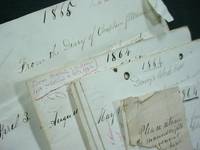
1864rif. 0002339WITH THE 2ND NEW HAMPSHIRE REGIMENT. Good. 1864. On offer is a superb original historically significant manuscript diary and relic of the Civil War handwritten by noted Chaplain John Wesley Adams born in Townsend Massachusetts in 1832 the seventh generation ancestor of the Presidents Adams. On December 5 1863 Mr. Adams was commissioned chaplain of General Gilman Marston's original command "The Fighting Second". Devoting himself to social and moral welfare of his comrades Adams was renowned for the care of his men. Side by side he participated in the battles at Bermuda Hundred Point of Rocks the second engagement at Fair Oaks Swift Creek Proctor's Creek Drury's Bluff Cold Harbor Siege of Petersburg and entering Richmond under General Devens the day of his surrender. Mr. Adams preached before his regiment on the death of Abraham Lincoln Adams was discharged in 1865 in a testimonial on parchment. Joining the NH Conference Adams was successful with over a dozen notable pastorates. In 1876 he was chosen a delegate to the General Conference in Baltimore serving four years as secretary of his conference. The 42 page coverless diary is comprised of folio sized sheets are in 3 text blocks held by string and are titled as detailed 'excerpts' from the diaries of the renowned pastor. Retrospectively done but very very soon after the dates of the original writings Chaplain Adams provides a factual retelling of his vast service and in fact the writings include for example in one case a riveting word for word passages with a soldier condemned to die for desertion only to exalt in a reprieve to then be shot the next day. Overall G.; Manuscript; Folio - over 12" - 15" tall; KEYWORDS: HISTORY OF CHAPLAIN JOHN WESLEY ADAMS BATTLEFIELD DIARY CIVIL WAR BROTHER AGAINST BROTHER TOWNSEND MASSACHUSETTS GENERAL CONFERENCE IN BALTIMORE THE 2ND NEW HAMPSHIRE VOLUNTEERS GENERAL GILMAN MARSTON THE FIGHTING SECOND BATTLES AT BERMUDA HUNDRED POINT OF ROCKS SECOND ENGAGEMENT AT FAIR OAKS SWIFT CREEK PROCTOR'S CREEK DRURY'S BLUFF COLD HARBOR SIEGE OF PETERSBURG RICHMOND UNDER GENERAL DEVENS ABRAHAM LINCOLN HARRIET PATIENCE DAME AMERICANA HANDWRITTEN MANUSCRIPT AUTOGRAPHED AUTHORS DOCUMENT LETTER AUTOGRAPH KEEPSAKE WRITER HAND WRITTEN DOCUMENTS SIGNED LETTERS MANUSCRIPTS HISTORICAL HOLOGRAPH WRITERS AUTOGRAPHS PERSONAL MEMOIR MEMORIAL PERSONAL HISTORY ARCHIVE DIARY DIARIES JOURNAL LOG PRIMARY SOURCE FIRST HAND ACCOUNT SOCIAL HISTORY PERSONAL STORIES LIVING HISTORY ANTIQUITÉ CONTRAT VÉLIN DOCUMENT MANUSCRIT PAPIER ANTIKE BRIEF PERGAMENT DOKUMENT MANUSKRIPT PAPIER OGGETTO D'ANTIQUARIATO ATTO VELINA DOCUMENTO MANOSCRITTO CARTA ANTIGÜEDAD HECHO VITELA DOCUMENTO MANUSCRITO PAPELBIOGRAPHY BIOGRAPHICAL AUTOBIOGRAPHICAL AUTOBIOGRAPHY PERSONAL NARRATIVES . unknown
1908rif. 856521908. DOW Arthur Wesley & Everett Stanley HUBBARD. BY SALT MARSHES: PICTURES AND POEMS OF OLD IPSWICH. Ipswich: Privately printed 1908. No. 103 of approximately 200. 32 pp. 8vo. Quarter brown cloth unmarked with color illustrated front cover only paper covered boards. Covers worn but still attractive; interior near fine small pencil numerals to front pastedown. Eight lovely color woodblock illustrations with other monochrome and two color designs/headpieces. "BY SALT MARSHES is Arthur Wesley Dow's tribute to the old North Shore town of Ipswich where he was born and spent most of his life and to his boyhood friend Everett Stanley Hubbard. It is a collaboration somewhat in the spirit of Meteyard Carman and Hovey in their Vagabondia books though Hubbard was undoubtedly a lesser poet and Dow a greater artist. BY SALT MARSHES is his masterpiece and it is evident from the numerous sketches and proofs in the Ipswich Historical Society and the Society for Preservation of New England Antiquities - some dating back as far as 1895 - that it was a labor of love. Infinite care and craftsmanship were expended on every detail. The illustrations are color woodblock prints such as Dow described in an article in MODERN ART 1896 entitled "Painting with Wooden Blocks." This was a technique Dow had discovered in the course of his study of Japanese art and he was a master of it using as many as four or five different blocks accurately registered thinly inked to show the grain of the wood and printed in subtle gradations of tone to achieve a luminosity that effectively evokes the quality of the light on the marshes. Although the text is printed from small gothic type the lettering on the cover and title page was also cut by hand in woodblocks after the manner of Meteyard and Dawson-Watson's lettering for the COURIER INNOCENT 1897." Finlay - Artists of the Book in Boston 1890-1910. unknown
1908rif. 856521908. DOW Arthur Wesley & Everett Stanley HUBBARD. BY SALT MARSHES: PICTURES AND POEMS OF OLD IPSWICH. Ipswich: Privately printed 1908. No. 103 of approximately 200. 32 pp. 8vo. Quarter brown cloth unmarked with color illustrated front cover only paper covered boards. Covers worn but still attractive; interior near fine small pencil numerals to front pastedown. Eight lovely color woodblock illustrations with other monochrome and two color designs/headpieces. "BY SALT MARSHES is Arthur Wesley Dow's tribute to the old North Shore town of Ipswich where he was born and spent most of his life and to his boyhood friend Everett Stanley Hubbard. It is a collaboration somewhat in the spirit of Meteyard Carman and Hovey in their Vagabondia books though Hubbard was undoubtedly a lesser poet and Dow a greater artist. BY SALT MARSHES is his masterpiece and it is evident from the numerous sketches and proofs in the Ipswich Historical Society and the Society for Preservation of New England Antiquities - some dating back as far as 1895 - that it was a labor of love. Infinite care and craftsmanship were expended on every detail. The illustrations are color woodblock prints such as Dow described in an article in MODERN ART 1896 entitled "Painting with Wooden Blocks." This was a technique Dow had discovered in the course of his study of Japanese art and he was a master of it using as many as four or five different blocks accurately registered thinly inked to show the grain of the wood and printed in subtle gradations of tone to achieve a luminosity that effectively evokes the quality of the light on the marshes. Although the text is printed from small gothic type the lettering on the cover and title page was also cut by hand in woodblocks after the manner of Meteyard and Dawson-Watson's lettering for the COURIER INNOCENT 1897." Finlay - Artists of the Book in Boston 1890-1910. unknown books
1908rif. JH1151589Privately printed. 1908. Limited Edition Number 36. . Hardcover. . Moderate wear to extremities pages and boards tanned. else very good condition. /No dust jacket as issued. No Box. Color Illustrations Book is as described - all defects and marks are noted. A very nice copy. Privately printed. hardcover
1958rif. 0002131New York NY. Very Good. 1958. On offer is a super original relic of the Civil Rights era and the real bitterness and rage felt by some if not many on the front lines of the Civil Rights movement being the personal copy of the 128 page manifesto-autobiography 'Here I Stand' by Paul Robeson published in 1958 by Othello Associates New York owned annotated and underlined throughout by Wesley A. Williams 1897 - 1984. The target of lifelong racism as the third African-American man ever to join in 1919 the New York Fire Service Williams' ownership signature and despairing annotations fill the book from the front pastedown on: almost every page bears Williams' underlining but it is his commentary as it responds to Robeson's text which is revealing and intensely moving. The pages are stained with his holographic bitterness: he writes regarding the chapter 'Love will find out the way' in the aftermath of the assassination of President Kennedy Williams' comments: 'This Paul is your dream. Today I dream no more as I have lived my 66 years against this brutal white American who lives and dies on the blood of all people. A people who assassinate a good man like their President Kennedy - Kill coloured Sunday school children. Will stop at Nothing. They respect nothing but Force.' Underneath Robeson's suggestion that 'We must wait we are told until the hearts of those who persecute us have softened' Williams has jotted: 'That would be Never'. HISTORICAL NOTES: Wesley Williams joined the New York City Fire Department in 1919 and on the same day the Captain of the Engine Company retired and every other man requested reassignment. Williams persevered in the face of discrimination and became the prime mover in the creation of the Vulcan Society which exposed segregation within the Department. ; Manuscript; 8vo - over 7¾" - 9¾" tall; KEYWORDS: HISTORY OF CIVIL RIGHTS ERA WESLEY A. WILLIAMS NEW YORK FIRE SERVICE HERE I STAND PAUL ROBESON BLACK CULTURE RACISM RACE RELATIONS AFRICAN AMERICAN AFRO AMERICAN NEGRO STUDIES BLACK STUDIES BLACK CULTURE ICONIC BLACK MEN AMERICANA HANDWRITTEN MANUSCRIPT AUTOGRAPHED AUTHORS DOCUMENT LETTER AUTOGRAPH KEEPSAKE WRITER HAND WRITTEN DOCUMENTS SIGNED LETTERS MANUSCRIPTS HISTORICAL HOLOGRAPH WRITERS AUTOGRAPHS PERSONAL MEMOIR MEMORIAL PERSONAL HISTORY ARCHIVE DIARY DIARIES JOURNAL LOG PRIMARY SOURCE FIRST HAND ACCOUNT SOCIAL HISTORY PERSONAL STORIES LIVING HISTORY ANTIQUITÉ CONTRAT VÉLIN DOCUMENT MANUSCRIT PAPIER ANTIKE BRIEF PERGAMENT DOKUMENT MANUSKRIPT PAPIER OGGETTO D'ANTIQUARIATO ATTO VELINA DOCUMENTO MANOSCRITTO CARTA ANTIGÜEDAD HECHO VITELA DOCUMENTO MANUSCRITO PAPEL . unknown
1774rif. 1283611774. First Edition. BENEZET Anthony WESLEY John. Thoughts upon Slavery. IN: A Collection of Religious Tracts. London Printed: Re-Printed in Philadelphia: Joseph Cruckshank 1774. Small octavo early full brown sheep. Housed in a custom chemise and clamshell box. $12000.First American edition preceded only by the same year's much shorter English edition of Wesley's influential and controversial early attack on slavery and the slave trade the first to contain abolitionist Anthony Benezet's expansive notes and afterword not in the English edition bound with a separate title page with four other works in publisher Joseph Crukshank's A Collection of Religous Tracts.Wesley a ""founder of MethodismÉwas noted not only for outstanding powers of leadership but also for practical holiness social concern and immense courage"" Oxford Dictionary of World Religions 1037. He formulated a doctrine of perfection that led to the ""creation of the largest new family of churches to be thrown up by the revival in Britain and in the rest of the English-speaking world"" ODNB. While he was a colleague of leading abolitionists William Wilberforce and Anthony Benezet in Thoughts upon Slavery ""the ethical core of the argument is Wesley's own"" Field John Wesley as a Public Theologian 4. He first witnessed the horrors of slavery as a missionary in Georgia and South Carolina. ""By the time he published his Thoughts upon Slavery he clearly opposed the cruelties and violations of the slave tradeÉ It is striking that in this attack on slavery Wesley explicitly does not use the Bible as the basis for his position. Instead he argues that slavery cannot be reconciled with justice and mercy and derives his understanding of justice from natural lawÉ Jennings reports that Wesley went even further in moving from protest to transformation"" Sample Future of John Wesley's Theology 58-9. Wesley's work also stands out in that he was a political conservative who rejected democracy and ""strongly criticized mass actionÉ here however he legitimated slave resistance and rebellion as an expression of natural liberty in contradiction of biblical injunctions to slaves"" Field 6.This pivotal edition was issued at the urging of Benezet after reading the same year's much shorter English edition. He was especially moved by Wesley's ""exhortation to the ship captains merchants and planters involved in slaving urging them to 'give liberty to whom liberty is due that is to every child of man to every partaker of human nature.'"" Benezet quickly ""arranged with Philadelphia printer Joseph Cruikshank to reprint Wesley's pamphlet but not before he added five expansive footnotes and a lengthy afterwordÉ the general tenor of these additions was to clarify and amplify points Wesley had made"" Crosby ed. Complete Antislavery Writings of Anthony Benezet 197. In England ""the public response to Wesley's Thoughts upon SlaveryÉ would soon be so great that 229000 people signed petitions against the slave trade to be presented to Parliament"" Jackson Let This Voice Be Heard 126. Yet ""Wesley's attack on the profitable slave trade was riskyÉ his opinions were an affront to those who considered the Africans their inferiors. For the latter group Wesley had further unsettling words: 'The inhabitants of AfricaÉ are not inferior to the inhabitants of Europe; to some of them they are greatly superior'"" Yrigoyen John Wesley. ""Wesley's contribution to the struggle against slavery did not end with the publication of Thoughts upon SlaveryÉ Symbolically the last letter he wrote before his death was to Wilberforce supporting him in his struggle to have the slave trade abolished"" Field 6. Preceded by the same year's 53-page English edition published without Benezet's lengthy notes and afterword. Thoughts Upon Slavery was both published separately and included as ""the second title in: Benezet Anthony. The Potent Enemies of America Laid Open Philadelphia: Joseph Crukshank 1774 Evans 13146 and as part of some copies of: A Collection of Religious Tracts as here Philadelphia: Joseph Crukshank 1773-1778 Evans 13145"" ESTC W28091. The other titles in this collection each with a separate title page pagination and Crukshank's imprint are: The Plain Path to Christian Perfection by Johannes Tauler translated by Anthony Benezet; The Dreadful Visitation in a Short Account of the Progress of the Effects of the Plague 1774 an abridged version of Defoe's Journal of the Plague Year; Benezet's The Mighty Destroyer DisplayedÉ the mistaken Use as well as Abuse of Distilled Spiritous Liquors 1774 and Stephen Crisp's Sermons or Declarations 1773. Sabin 4671 102699. Evans 13145 13762. Hildeburn 3134. Early owner signature. Small early ink notation to the title page: ""Collected by Anthony Benezet.""Minor marginal dampstaining to last leaves of final title Sermons or Declarations; expected age-wear to early sheep binding. Very scarce. unknown
1774rif. 1283611774. First Edition. BENEZET Anthony WESLEY John. Thoughts upon Slavery. IN: A Collection of Religious Tracts. London Printed: Re-Printed in Philadelphia: Joseph Cruckshank 1774. Small octavo early full brown sheep. Housed in a custom chemise and clamshell box. $12000.First American edition preceded only by the same year's much shorter English edition of Wesley's influential and controversial early attack on slavery and the slave trade the first to contain abolitionist Anthony Benezet's expansive notes and afterword not in the English edition bound with a separate title page with four other works in publisher Joseph Crukshank's A Collection of Religous Tracts.Wesley a ""founder of MethodismÉwas noted not only for outstanding powers of leadership but also for practical holiness social concern and immense courage"" Oxford Dictionary of World Religions 1037. He formulated a doctrine of perfection that led to the ""creation of the largest new family of churches to be thrown up by the revival in Britain and in the rest of the English-speaking world"" ODNB. While he was a colleague of leading abolitionists William Wilberforce and Anthony Benezet in Thoughts upon Slavery ""the ethical core of the argument is Wesley's own"" Field John Wesley as a Public Theologian 4. He first witnessed the horrors of slavery as a missionary in Georgia and South Carolina. ""By the time he published his Thoughts upon Slavery he clearly opposed the cruelties and violations of the slave tradeÉ It is striking that in this attack on slavery Wesley explicitly does not use the Bible as the basis for his position. Instead he argues that slavery cannot be reconciled with justice and mercy and derives his understanding of justice from natural lawÉ Jennings reports that Wesley went even further in moving from protest to transformation"" Sample Future of John Wesley's Theology 58-9. Wesley's work also stands out in that he was a political conservative who rejected democracy and ""strongly criticized mass actionÉ here however he legitimated slave resistance and rebellion as an expression of natural liberty in contradiction of biblical injunctions to slaves"" Field 6.This pivotal edition was issued at the urging of Benezet after reading the same year's much shorter English edition. He was especially moved by Wesley's ""exhortation to the ship captains merchants and planters involved in slaving urging them to 'give liberty to whom liberty is due that is to every child of man to every partaker of human nature.'"" Benezet quickly ""arranged with Philadelphia printer Joseph Cruikshank to reprint Wesley's pamphlet but not before he added five expansive footnotes and a lengthy afterwordÉ the general tenor of these additions was to clarify and amplify points Wesley had made"" Crosby ed. Complete Antislavery Writings of Anthony Benezet 197. In England ""the public response to Wesley's Thoughts upon SlaveryÉ would soon be so great that 229000 people signed petitions against the slave trade to be presented to Parliament"" Jackson Let This Voice Be Heard 126. Yet ""Wesley's attack on the profitable slave trade was riskyÉ his opinions were an affront to those who considered the Africans their inferiors. For the latter group Wesley had further unsettling words: 'The inhabitants of AfricaÉ are not inferior to the inhabitants of Europe; to some of them they are greatly superior'"" Yrigoyen John Wesley. ""Wesley's contribution to the struggle against slavery did not end with the publication of Thoughts upon SlaveryÉ Symbolically the last letter he wrote before his death was to Wilberforce supporting him in his struggle to have the slave trade abolished"" Field 6. Preceded by the same year's 53-page English edition published without Benezet's lengthy notes and afterword. Thoughts Upon Slavery was both published separately and included as ""the second title in: Benezet Anthony. The Potent Enemies of America Laid Open Philadelphia: Joseph Crukshank 1774 Evans 13146 and as part of some copies of: A Collection of Religious Tracts as here Philadelphia: Joseph Crukshank 1773-1778 Evans 13145"" ESTC W28091. The other titles in this collection each with a separate title page pagination and Crukshank's imprint are: The Plain Path to Christian Perfection by Johannes Tauler translated by Anthony Benezet; The Dreadful Visitation in a Short Account of the Progress of the Effects of the Plague 1774 an abridged version of Defoe's Journal of the Plague Year; Benezet's The Mighty Destroyer DisplayedÉ the mistaken Use as well as Abuse of Distilled Spiritous Liquors 1774 and Stephen Crisp's Sermons or Declarations 1773. Sabin 4671 102699. Evans 13145 13762. Hildeburn 3134. Early owner signature. Small early ink notation to the title page: ""Collected by Anthony Benezet.""Minor marginal dampstaining to last leaves of final title Sermons or Declarations; expected age-wear to early sheep binding. Very scarce. unknown books
1914rif. ST20137Hammersmith: Doves Press 1914. ONE OF 200 COPIES ON PAPER and 12 on vellum. 236 x 165 mm. 9 1/4 x 6 1/2". 203 pp. LOVELY DOVES BINDERY-STYLE DARK BLUE CRUSHED MOROCCO VERY INTRICATELY GILT AND INLAID BY WESLEY D. BAKER verso of front free endpaper stamped in ink: "Baker Bindery for James Cummins Bookseller"; rear turn-in stamp-signed in gilt: "20WDB08" covers with wide frame of inlaid pink morocco Tudor roses a total of 88 inlays on the covers the blossoms linked with sinuous gilt stems with delicate leaves all on a background stippled with tiny stars raised bands spine compartments similarly adorned with inlaid rose at center a trio of leaves at each corner and a background of stars gilt lettering gilt-framed turn-ins with cornerpieces featuring an inlaid rose gilt branches and stars white watered silk pastedowns and endleaves all edges gilt. Printed in red and black. Tidcombe DP-36; Tomkinson p. 58. A PRISTINE COPY. This is a refined book full of lovely love poetry offered as an object so gorgeous that its Doves Press imprint has to take an uncharacteristic second place in importance; this is especially true because the binding which clearly derives from Doves Bindery models is a convincing perpetuation of that firm's superb achievements. Ever the perfectionist Cobden-Sanderson personally selected and arranged the poems in the present anthology only after much considered effort. He noted in his journal on 31 July 1913: "I have put 'Bright Star' first for I wish the feeling of the last sonnet to accompany the reader throughout; and at the end revert to Keats' first sonnet and so leave the poet as it were on the peak in Darien." Our binding was done by Wesley Baker in 2008 using tools created by Roy Petit responsible for the roses and Stewart Fields who cut the leaf tools. Baker became interested in bookbinding while in college and attended workshops in the Northeast U.S. but is largely self-taught. From Alabama he has adapted the traditional techniques used in England to the climate of the Deep South where high temperatures and humidity require a different method of gold tooling than would be used in London. The present binding represents the latest attempt we know of to carry on in any thoroughgoing and convincing way the great tradition created by Cobden-Sanderson at the Doves Bindery at the center of the Arts & Crafts Movement. Doves Press unknown
1914rif. ST20137Hammersmith: Doves Press 1914. ONE OF 200 COPIES ON PAPER and 12 on vellum. 236 x 165 mm. 9 1/4 x 6 1/2". 203 pp. LOVELY DOVES BINDERY-STYLE DARK BLUE CRUSHED MOROCCO VERY INTRICATELY GILT AND INLAID BY WESLEY D. BAKER verso of front free endpaper stamped in ink: "Baker Bindery for James Cummins Bookseller"; rear turn-in stamp-signed in gilt: "20WDB08" covers with wide frame of inlaid pink morocco Tudor roses a total of 88 inlays on the covers the blossoms linked with sinuous gilt stems with delicate leaves all on a background stippled with tiny stars raised bands spine compartments similarly adorned with inlaid rose at center a trio of leaves at each corner and a background of stars gilt lettering gilt-framed turn-ins with cornerpieces featuring an inlaid rose gilt branches and stars white watered silk pastedowns and endleaves all edges gilt. Printed in red and black. Tidcombe DP-36; Tomkinson p. 58. A PRISTINE COPY. This is a refined book full of lovely love poetry offered as an object so gorgeous that its Doves Press imprint has to take an uncharacteristic second place in importance; this is especially true because the binding which clearly derives from Doves Bindery models is a convincing perpetuation of that firm's superb achievements. Ever the perfectionist Cobden-Sanderson personally selected and arranged the poems in the present anthology only after much considered effort. He noted in his journal on 31 July 1913: "I have put 'Bright Star' first for I wish the feeling of the last sonnet to accompany the reader throughout; and at the end revert to Keats' first sonnet and so leave the poet as it were on the peak in Darien." Our binding was done by Wesley Baker in 2008 using tools created by Roy Petit responsible for the roses and Stewart Fields who cut the leaf tools. Baker became interested in bookbinding while in college and attended workshops in the Northeast U.S. but is largely self-taught. From Alabama he has adapted the traditional techniques used in England to the climate of the Deep South where high temperatures and humidity require a different method of gold tooling than would be used in London. The present binding represents the latest attempt we know of to carry on in any thoroughgoing and convincing way the great tradition created by Cobden-Sanderson at the Doves Bindery at the center of the Arts & Crafts Movement. Doves Press unknown books