194 risultati
1813rif. 45481Philadelphia: Kimber & Richardson 1813. First Edition. Two volumes; octavo 21.5cm.; Vol. I bound in slightly later half calf over marbled boards black gilt spine label Vol. II in full contemporary sheep red gilt spine label; 4506; 6484pp.; engraved title pages 25 leaves of plates including eight folding. Evidence of previously removed library bookplates to Vol. 1 pastedowns some scuffing to boards more heavily so to Vol. II some light foxing one leaf trimmed close with slight loss of text a couple of closed tears to folding leaves else Very Good and sound overall. Attractive engraved pictorial bookseller ticket to rear pastedown of Vol. II. Complete first and second volumes of the New Series edited by the Anglo-American chemist Thomas Cooper. Though not a particularly brilliant scientist Cooper's "greatest service to science was undoubtedly the dissemination of information" Dictionary of Scientific Biography III p. 400. The present collection includes detailed articles on sugar from beets and grapes "Comparative Height of Mountains on the Earth the Moon and Venus" turnpike roads making "fine Cutlery" foreign and homemade wines criminals from 1805 to 1811 and "the uses of a dead horse by the editor." SHAW & SHOEMAKER 28226. Kimber & Richardson unknown books
1894rif. 010600London : Macmillan and Co 1894. Book. Very Good. Cloth. 1st Edition. 8vo - over 7¾ - 9¾" tall. First Edition. Green cloth with gilt lettering to the spine. Illustrated with over a hundred drawings and tables. Two pages of publisher's ads at the rear. xvi corrigenda 598 2 pp. Very Good Spine ends and corners are mildly rubbed. Both hinges just starting Prior owner name to top of front end paper. Bateson's foundational work in expanding Darwin's theory of evolution. This book introduced the term "genetics" argued for discontinuous sudden variation in evolution contrasting Darwin's gradualism and laid groundwork for modern genetics by linking variation heredity and evolution through detailed examples from nature influencing how scientists studied species origins. PMM 356. . Macmillan and Co, Hardcover books
1904rif. 004761Pittsburgh PA: Murdoch-Kerr Press 1904. Book. Very Good. Cloth. First Edition. 8vo - over 7¾" - 9¾" tall. First Edition 1904. Very Good in the original blue cloth gilt lettering at spine decorative end pages 267 pages including 6 pgs. of advertisements "confined to manufacturers who had exhibits in the hall at the place of meeting and are exclusively of apparatus included in such exhibits". Includes rosters of officers and members constitution by-laws minutes secretary and treasurer reports and program. Illustrated with photographs. While this was the 4th annual meeting reportedly only the 2nd year that the Transactions were published. Wilhelm Rontgen had made his discovery of the rays that he called X-rays only 9 years earlier in 1895. Very Good lettering at spine dulled yet legible light soiling and rubbing to cloth boards light soiling to page block. RARE. A handsome copy of this important early work of the development and history of x-rays. Murdoch-Kerr Press Hardcover books
1789rif. 472Freyburg & Annaberg: Craz 1789. First Edition. contemp. marbled wrappers. A very good copy; small inoffensive 19th cent. lib. stamp on the title. 8vo. There are 4 numbered plates on two sheets illus. the devices. This pamphlet is a description of an elaborate an innovative automatic recording device for rain wind direction and humidity. Each of the measurement systems devised by Herrmann were clock driven and appear to be the refinement of a similar system designed by Leupold in 1726. Herrmann's genius however is revealed in his design for the wind recorder. This device consisted of a wheel with 12 sector shaped compartments. Once and hour a clock driven hammer ejected a numbered cube from a magazine into the appropriate sector. After a fixed time cycle the observer would have a clear record of changing wind conditions. See Middleton Meteor. Instruments pp. 136 179-'80. Craz unknown books
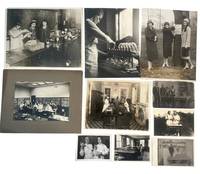
1900rif. 235831900. Women in laboratory sciences photo archive circa 1900 to 1946 documenting women's movement into chemistry bacteriology hospital medicine and classroom experiment at a time when scientific training and professional advancement remained largely organized around men with barriers of entry for women. The group begins with a pharmacological laboratory where one woman stands among men predating suffrage in the United States and continues through school laboratories hospital laboratories press photographs and postwar images of young women handling test tubes and glassware. World War I drew women chemists into schools universities analytical laboratories and war work while World War II accelerated laboratory demand again through bacteriology antibiotics and industrial drug production. Photo archive of 11 mixed phtoographic mediums including albumen silver gelatin and real photo postcard photographs various sizes ranging 5 x 4 inches to 8 x 10 inches United States and Europe early 20th century. The images show women and girls conducting experiments at benches lined with burners flasks pipettes test tubes reagent bottles and laboratory stands; a large pharmacological classroom with nearly all male staff and students and one woman present; high school girls in an early science classroom; two nuns or a nun and nurse working in a laboratory at Saint Anthony's Hospital Rockford Illinois identified on verso as early 1930s; and a bacteriological laboratory scene dated October 2 1923. A 1926 Acme press photograph identifies "Miss Virginia Trelease chemist student at Northwestern University Evanston Ill." using liquid oxygen from a Heylandt liquefier to fry an egg over "burning ice." Other images show two young women captioned "Resa Yusko and Bla Pesala" in 1946 smiling while handling laboratory equipment and a 1927 press photograph of Mrs. August Rus Oppenheim Mrs. Oswald Jimenis and Mrs. Arthur Bunker of the Southern Women's Educational Alliance posting a Metropolitan Opera benefit notice evidence of women's educational fundraising alongside the scientific scenes. The photographs trace women's scientific labor from gendered access to instruction into wartime necessity and postwar professional visibility. In the early twentieth century women who entered chemistry and medicine often worked through teaching nursing hospital laboratories and applied science fields that admitted them more readily than elite research posts while still relying on their technical skill. During World War II penicillin moved from laboratory microbiological study in 1940 to mass production by 1945 a shift that depended on fermentation work laboratory handling and industrial coordination rather than discovery alone. Light surface wear toning occasional creasing press stamps captions and handling marks; some images faded or rubbed. Overall good condition. A concentrated visual record of women learning demonstrating and performing laboratory science across the decades when modern medicine and chemistry increasingly required their work while still limiting their recognition. unknown books
1951rif. 12896New York: New York Council of the Arts Sciences and Professions 1951. Three items stapled together at top left corner together with a separate leaflet totaling seven pages. Minor edge wear one item with a short closed tear. Overall very good. A group of four printed items pertaining to an effort by New York arts professionals to encourage equality for African American arts professionals in midcentury United States where the lower half of the country was still mired in Jim Crow laws. The most notable of these items is a four-panel program detailing the conference with introductory text describing the ways in which racism limits the opportunities of Black artists and scientists and the failure to put recent anti-racist court decisions into actual practice. The program for the conference lists such themes as the effects of Jim Crow policy on the arts and representation of Black subjects the deleterious effects of racism on health and welfare and how cultural standards are lowered and violence encouraged by discrimination. According to the speakers list on the fourth page of the program participants in the conference included Oliver Harrington Jacob Lawrence Julian Mayfield Paul Robeson and other artists educators scientists and musicians. Attached to this program are two handbills; one is an invitation to an opening night event featuring new works of ballet chorus calypso and drama the night before the conference. This performance took place at the Pythian on November 9 1951. The other handbill announces the program for the Annual Convention of the New York Council which appears to have been a more general event on the day after the conference on equal rights. The text on this handbill notes the suppression of free speech under McCarthyism. The last item is an 8.5-x-14-inch handbill probably a press release of sorts announcing the conference also titled "A Call to a Conference on Equal Rights for Negroes in the Arts Sciences and Professions." The language of this handbill is the same as the second page of the four-page brochure but is dated a month before the conference in October 1951. Some of the language in the program introduction and handbill merit quoting here: "In the sciences and professions the majority of Negroes are deprived of equal educational opportunities by segregation and quota systems denied employment in the professions restricted to the most menial occupations confined to ghetto areas for their private practice and thus prevented from making a full contribution to the welfare of the nation. Blacklisting character assassination political inquisitions and other forms of censorship against white artists scientists and professionals cannot be ended - so long as discrimination against Negroes and other minority group members is maintained For those who violate the Constitution and foster a policy of discrimination against Negroes are the very same persons who are responsible for censorship blacklisting and the debasement of our science and culture. It is they who tolerate and promote the campaigns of violence and brutality against the Negro people as exhibited in Cicero in the bombing of the home of a world-renowned Negro chemist in the refusal of platforms to the most outstanding American Negro artists in the ‘legal lynchings’ of many young men guilty of nothing more than being Negroes. American culture Cannot live in the face of such terror against a large segment of our people. Standards of truth and humanism cannot be maintained in our cultural media so long as the truth of the Negro people's lives is denied expression. Nor can there be decent standards for white professionals in many fields so long as a reservoir of Negro unemployed is used to depress salaries and rates." Surprisingly OCLC is silent on any material from the conference though we doubt this group of ephemera is a unique survival. New York Council of the Arts, Sciences and Professions unknown books
1899rif. 246396Washington: The Academy. Very Good. 1899-1911. Complete in 13 volumes 1899-1911 some with several parts ; most in original wrappers with vols 4 5 6 & 7 bound in maroon cloth. In 1911 the name was changed to "Journal of the Washington Academy of Sciences" with a new vol. 1 no. 1 issued on July 19 1911. . The Academy hardcover books
1900rif. 007889Jena: Gustav Fischer 1900. Book. Very Good. Hardcover. First Edition. 4to - over 9¾" - 12" tall. 549 pp. 2 maps in text fold-out map at rear Near Fine small edge tears at folds 6 chromolithographs 8 heliogravures 32 full page plates and 390 plates in text. Bound in quarter black cloth over paper covered boards hand-written label at spine period handwriting title page small stamp "Konigl. Seminar Lobau" title page. Very Good a quite well-bound book and SCARCE in the 1900 First Edition. Carl Chun 1852-1914 was a German marine biologist a specialist on cephalopods and plankton. Chun's expedition on the "Valdivia" in 1898-99 was the first large-scale German expedition to explore the deep sea. Gustav Fischer Hardcover books
1926rif. 010202Philadelphia London and Chicago: J. B. Lippincott & Co. 1926. Book. Very Good. Cloth. First Edition. 8vo - over 7¾" - 9¾" tall. Very Good no jacket small scratches and rubs to cloth internally clean tight and unmarked. First Edition of Kinsey's First Book with no additional impressions stated. xiv 558 pages : 430 illustrations At head of title: "Edited by William F. Russell./ Includes index./ "Reference books": pages 537-542". SCARCE in the First Edition. J. B. Lippincott & Co. Hardcover books
1951rif. 004685Cambridge MA: Harvard University Press 1951. Book. Very Good. Cloth. SIGNED AND INSCRIBED BY AUTHORS. First Edition. 8vo - over 7¾" - 9¾" tall. Presentation Copy SIGNED AND INSCRIBED BY THE AUTHORS "Eleanor Maccoby with the sincere regards of Talcott Parsons Clyde Kluckhorn S.A. Stouffer Robert R. Sears Gordon W. Allport Harry Murray" A unique Association Copy Eleanor Maccoby was a noted psychologist best known for her contributions to developmental psychology and the psychology of sex differences. The signees were a Who's Who of eminent sociologists psychologists and anthropologists. Talcott Parsons career was entwined with the development of sociology as an academic discipline at Harvard and in this book he was refining his "general theory of action". In 1931 Parsons was one of the inaugural faculty members in the Dept. of Sociology at Harvard. Gordon W. Allport is known as one of the founding figures of personality psychology and along with Harry Murray were faculty in the Psychology Dept. at Harvard. Robert R. Sears was head of the Psychology Dept. at Stanford University Samuel Stouffer a Professor of Sociology at Harvard and Clyde Kluckhorn a Professor of Anthropology at Harvard. Book is Very Good no dustjacket corner crease bottom corners last 10 pages of book and top corners title page into contents page cloth a bit rubbed. The signatures of all 6 of these gentlemen are SCARCE individually and as a group along with the Association to Eleanor Maccoby this represents a RARE and unique opportunity in the academic collecting world !. Harvard University Press Hardcover books
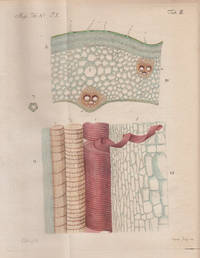
1782rif. 11020Leipzig: S L Crusius 1782. First Edition. Disbound. Very good with the plates beautifully colored and bright. 4to I - xxiv 1 - 112 pp.; II - xii 1 - 108 pp. 20 hand-colored plates. One of the handful of subscribers' color copies. Although this copy is disbound the interior of the book has remained in excellent condition. Hedwig was the founder of the modern botanical study of moss. The plates are exquisitely rendered in color to highlight the most delicate features of the plants and their miniature world. Hedwig himself was responsible for the drawings; coloring was accomplished by the Leipzig artist and engraver J S Capieux. A copy ready for a sympathetic binding and priced accordingly. Stafleu / Cowan #2525; DSB VI 218 - 220; Pritzel #3878; Nissen BBI #827. S L Crusius unknown books
1742rif. SS13441London:: Printed for John and Paul Knapton. . . 1742-53. 1742. 5 volumes. 8vo. Vol.1: 4 x 11-456 16; Vol.2: 2 407 15 10; Vol.3: 2 422 16; Vol.4: 2 410 14 11-26; Vol.5: 2 426 14 pp. The first 10 pages of the "Addenda" are bound at the end of vol.2 pp.11-26 are bound at the end of vol.4. 44 of 45 engraved plates mostly folding I: 17; II: 6; III: 6; IV: 6; V: 9 of 10 plates pl. 10 supplied in facs. see p. 422 TOTAL: 44 2 folding tables vol. I tables some folding addenda indexes; 2nd wasp plate vol. V with small scrape effecting some of the image. Original speckled calf; rebacked and with later endleaves vols. I III & V with joints gently mended with kozo. PROVENANCE: Bookplates of Henry and Carol Faul mounted on top of the following engraved bookplate for the American Academy of Arts & Sciences: "Sub libertate Florent" dated 1780 "The Gift of . . ." -- also with their gilt-stamp applied to the foot of the later spines "American Academy"; Rubber stamps discarded of the Linda Hall Library Kansas City MO. Very good. HENRY FAUL'S COPY -- WORKED FOR ENRICO FERMI & BIKINI ATOLL TEST. A collection of early scientific papers from leading figures all belonging to the Royal Academy of Sciences at Paris the French equivalent to the Royal Society of London. The abridged papers all appeared between 1699 and 1720 and include diverse topics such as anatomy apiculture astronomy incl. Moon chemistry electricity entomology gases geography geology herpetology invertebrates magnetism medicine meteorology mineralogy monsters music mollusks natural history optics physics scientific instruments including the barometer microscope zoology and more. / AMONG THE NUMEROUS CONTRIBUTORS OR NOTABLES MENTIONED: Agricola Amontons Baert Juan de Barros Bernoulli Bignon Borelli Bouvet Robert Boyle Carre Cassini Chazelles Chevalier Coronelli Dampier Descartes Dodart Fermat Fontenay Fontenelle Galileo Gandolphe Gassendi Gesner Gouye Halley Van Helmont de la Hire du Hamel Huygens Jeaugeon Kepler Kircher Leibnitz Lemery Leuwenhoek Malpighi de Marca Mariotte Mollard Gregory Nazianzen Isaac Newton de Nointel Ortelius Parent Picard Renau Riccioli Sanctorius Strabo Tournefort Varignon etc. PROVENANCE: 1 American Academy of Arts & Sciences bookplate: The Academy seal features Minerva the goddess of wisdom science and trade and the arts. Her temple on the Aventine Hill was a meeting place for skilled craftsman writers and actors. She is also depicted as a warrior a symbol appropriate for an organization created in the midst of the American Revolution. Around Minerva are representations of the new country—on her right a field of Indian corn a stand of oaks and the outline of a town; at her feet a hoe a plow and a sickle; on her left a quadrant and a telescope a ship heading for shore and the sun completely risen above the cloud. Over the whole is the motto SUB LIBERTATE FLORENT which suggests that arts and sciences flourish best in. -- 2 Rubber stamps discarded of the Linda Hall Library Kansas City MO. -- 3 Henry and Carol Faul. Henry Faul was a geologist working on Enrico Fermi's team at the University of Chicago. He was responsible for prospecting uranium ore in Colorado and Utah. He also travelled to Manhattan Project sites at Los Alamos and in Washington DC. Following the war Faul continued to work on nuclear projects and participated in the Bikini Atoll test. He received his M.S. from the University of Chicago during the war and went on to get his Ph.D. from the Massachusetts Institute of Technology. ESTC T131275. Printed for John and Paul Knapton. . . , 1742-53. unknown books
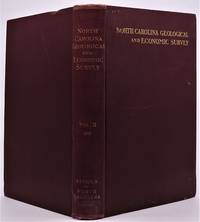
1907rif. 008929Raleigh NC: North Carolina Geological and Economic Survey 1907. Book. Very Good Plus. Cloth. First Edition. Small 4to. SCARCE in current commerce. xi 453 1 pages with 21 plates 16 of them color lithograph plates of fish and 188 figures in text. E.M. Uzzell and Co. Raleigh printers and binders. Very Good Plus no jacket bound in red cloth with gilt lettering. cloth a bit faded at bottom of spine light rubbing to boards interior clean bright and unmarked. North Carolina Geological and Economic Survey Hardcover books
1748rif. 1641Amsterdam: Chez l'honore et fils libraires 1748. First Edition. Hardcover. Very good. 2 vols. in one. 8vo. I: 10 cxix 7 208 pp. 1 f. "Errata" for Tom. 1. II: 2 231 pp. 1 f. "Addition" 1 f. "Errata" for Tom 1 sic. First title page with unobtrusive paper defect on lower margin not affecting text; this copy is lacking half-title and Errata leaf for Tom. 2. Very attractive 19th-century French red glazed boards red morocco spine lettered in gilt directly two insignificant worm-holes on lower hinge leading nowhere; trifle wear to binding extremities. Completely unsophisticated. First printing of "Telliamed" in every way a remarkable book. Disguised as an Oriental fantasy it contains perhaps the earliest appearance of one of the most important of all evolution speculations namely the so-called ultra-neptunian theory: that the entire Earth was and is a marine deposit and that all life on land originated from creatures of the sea. Maillet hypothesized that the earth was once entirely covered with water and that the water gradually evaporated into space causing land masses to appear. Maillet also created an ingenious methodology to calculate the age of the Earth: he concluded that the Earth is 2 billion years old evolutionists today consider this figure to be more like 4.5 billion. It is known that Buffon Lamark Cuvier and Darwin read this book and that they were very much influenced by Maillet's unorthodox "heretical" views. Well aware that such an immense figure would incur the wrath of the Church de Maillet presented his conclusions in the guise of a dialogue between a French missionary and an Eastern mystic named Telliamed an anagram for the author's last name i.e. de Maillet spelled backwards. The manuscript remained unpublished until a decade after Maillet's death. In order to present his radical conclusions in the guise of an Oriental tale Maillet interspersed monsters and mythological creatures into his text. Overtly anti-Christian "Telliamed" dismisses the Flood of the Old Testament as a fable because rainfall that lasted forty days would have been insignificant to submerge entire mountains. Maillet asserted that the Earth's history could not be read from the Bible but through the rocks themselves. ¶ With uncanny prescience Maillet describes how species have overlapping physical characteristics that suggested a common life origin namely the sea. Through a Oriental mystic we are told that: "The little Wings had under their Belly and which like their Fins helped them to walk in the Sea became Feet and served them to walk on Land." ¶ REFERENCES: Caillet No. 7009. Versins Utopie p. 640. LITERATURE: "Charles Darwin et ses Precurseurs francais Paris 1870 Chapter 1: "the moss-grown fragments from the ruins of another world." See also Albert Carozzi "De Maillet's 'Telliamed' 1748: An Ultra-Neptunian Theory of the Earth" in: Toward a History of Geology; Proceedings of the New Hampshire Inter-Disciplinary Conference on the History of Geology Sept. 7-12 1967. Mary Efrosini Gregory "Evolutionism in Eighteenth-century French Thought" Chapter 1. See also the article on Maillet in DSB IX pp. 26 et seq: "Maillet's ideas unquestionably influenced many leading naturalists for almost a century notably Buffon and Cuvier. Chez l'honore et fils, libraires hardcover books
1940rif. 006910Helsinki Finland: Suomalais-Ugrilainen Seura 1940. Book. Fine. Cloth. First Edition. Folio - over 12" - 15" tall. Two volumes in original dustjackets. Both volumes are Fine Vol.I dustjacket Very Good 1 1/2" triangular chip bottom edge at spine tears at spine folds and 2 tears horizontally at spine Vol. II jacket Near Fine small chips bottom edge of spine. List of donors laid in. One folding plate map index 15 folding maps at rear Vol. II. Numerous black and white photographs in text. A classic scholarly text ''In the spring of 1906 I received orders from the Russian General Staff to undertake a journey from Russian Turkestan through Chinese Turkestan and Western China and the provinces of Kan Su Shensi and Shansi to Peiping as the final goal. The object of this expedition was to study the conditions in the interior of Northern China collect statistical materials and perform various tasks of a military nature'' Preface. Mannerheim also collected archaeological and ethnographic materials and manuscripts and studied little-known peoples and tribes in Norther China. Mannerheim later became the 6th President of Finland after serving as Commander-in-Chief of the Finnish armed forces during WWII. Suomalais-Ugrilainen Seura Hardcover books
rif. 18077FIRST EDITIONS. Publisher’s cloth many covered in protective brown paper. From the library of Robert S. Mullikan 1896-1986 winner of the 1966 Nobel Prize for chemistry. He was primarily responsible for the early development of molecular orbital method of computing the structure of molecules. His signature appears in Volumes 29-39. First printings. The biographical memoirs include a photograph and short biography of recently-deceased members of the National Academy of Sciences. Columbia University Press printed the Memoirs on behalf of the Academy through 1974; thereafter the Academy’s own press in Washington began publishing the books. Biographies of all members that passed away are included; we find such luminaries as Enrico Fermi Thomas Hunt Morgan Robert Andrew Millikan Leo Loeb William Castle Arthur Compton Robert Yerkes Herbert Hoover Leo Szilard Edwin Hubble Ernest Lawrence Herbert Evans Herbert Spencer Jennings Harlow Shapley Vannevar Bush and even Albert Einstein. All were members of the Academy. unknown books
1959rif. 223131959. Journal of the Aerospace Sciences 1959 documents foundational research in American aerospace engineering during the early Cold War space race. Published the year after the establishment of NASA and amid intensified U.S. efforts to match Soviet rocket achievements following the 1957 launch of Sputnik these issues contain contemporary technical studies on hypersonic aerodynamics missile stability spacecraft propulsion and planetary trajectory design. Articles by scientists and engineers working at leading research institutions and government laboratories record the theoretical groundwork that would shape the next decade of American spaceflight including early analytical work on Mars trajectories reentry materials and competing propulsion systems for interplanetary travel. Journal of the Aerospace Sciences. Volume 26 numbers 1 2 4 5 6 7 8 9 10 11 and 12. New York: Institute of the Aeronautical Sciences 1959. Eleven issues from the journal's 1959 volume lacking only the March issue. The periodical served as the principal research forum of the Institute of the Aeronautical Sciences the professional organization that later became the American Institute of Aeronautics and Astronautics. Together these figures represent a cohort of scientists who would define American spaceflight theory and practice in the decade to come.Archive consists of 11 printed volumes in original wrappers approx. 50-80 pages per issue totaling over 800 pages. This archive includes: Volume 26 No. 1 January 1959: Features research on turbulent skin-friction drag at supersonic speeds jet nozzle structures nonlinear flutter problems and B-47 gust response. Includes Frank E. Goddard Jr. T.C. Adamson Jr. S.P. Shen. Vol. 26 No. 2 February 1959: Contains work on spiked bodies at hypersonic speeds reentry missile stability and panel flutter. Contributors include Seymour M. Bogdonoff E.V. Laitone and Frederick L. Ryder. Vol. 26 No. 4 April 1959: Publishes the Twenty-Second Wright Brothers Lecture by Maurice Roy of ONERA France. Other articles include thermal stresses hypersonic shock tunnels and boundary-layer transition. Vol. 26 No. 5 May 1959: Focuses on heat transfer at hypersonic speeds lift-drag ratios at supersonic speeds low-thrust spacecraft flight mechanics and chemically reacting boundary layers. Authors include A.J. Hanawalt Clinton E. Brown and Daniel E. Rosner. Vol. 26 No. 6 June 1959: Includes Hans Bethe's paper on the ablation of glassy materials structural matrix analysis and free-molecule flow dynamics. Vol. 26 No. 7 July 1959: Features M.A. Biot on thermomechanical reciprocity airplane turbulence responses and reentry motion. Also includes research on fatigue stress and laminar dissociated airflows. Vol. 26 No. 8 August 1959: Discusses transonic wing/body aerodynamics supersonic plate divergence mercury plasma tunnels and propellant burning models. Includes Hans U. Eckert. Vol. 26 No. 9 September 1959: Opens with Richard H. Battin's landmark article on planetary reconnaissance trajectories from MIT along with contributions on missile drag optimization rocket flight variational problems and real-gas flows. Vol. 26 No. 10 October 1959: Features George Paul Sutton's comprehensive comparison of interplanetary propulsion systems addressing ion rockets nuclear heating and solar sails. Also includes optimal aircraft climb paths and spherical cap snapping. Vol. 26 No. 11 November 1959: Includes studies on flutter energy equations jet-flap compressors porous-wall cooling and actuator disc dynamics in turbomachinery. Vol. 26 No. 12 December 1959: Closes the year with work on thermal buckling subsonic turbulence reattachment zoom climb optimization and hypersonic similitude. Contributors include Carl Gazley Jr. Wallace D. Hayes and George Gerard. In 1959 the Journal of the Aerospace Sciences served as the official scientific platform for cutting-edge American aerospace research marking the transition from aeronautical to astronautical engineering. That year saw sustained focus on hypersonics ballistic missile trajectories spacecraft propulsion and heat transfer under extreme atmospheric conditions as the U.S. sought to stabilize its strategic position after the 1957 Sputnik crisis and ahead of the 1960 Mercury program. Research in these volumes was underwritten by military contracts NASA collaboration established in 1958 and Cold War exigencies. Light foxing to several wrappers particularly July issue; some edge wear and surface abrasions. Two issues show sticker residue at spine or lower edge. Interiors uniformly clean bindings firm and covers largely bright and intact. Overall very good condition. The studies record the technical environment that produced early American satellite programs and later lunar navigation systems linking university laboratories defense contractors and federal research agencies. unknown books
1740rif. 14160Paris: de L’Imprimerie Royale 1740. Complete with errata’s and original blank leaves two of three finely engraved frontispieces chapter vignettes ornamental head and tail pieces and 82 folding plates. Full mottled calf rebacked the corners a bit worn. Interior is lightly toned with some browning on the preliminaries and last leaves. Generally this is an excellent set. First editions of these three volumes from a series published by the Academy of Sciences. It is a summary of the activities and inventions that have been made and contains the most important discoveries of the time. These periodicals which were at the forefront of scientific development during the Enlightenment contain works produced by an elite class of French scientist for the years 1722 1731 and 1740. Each volume provided an overview of advancements in math and science for each year and the writings therein shaped the world’s understanding of physics mathematics astronomy anatomy and other fields of science. They further provide invaluable historical data such as meteorological and astrological records for each year. The memoirs for 1722 include data recorded on both a lunar and solar eclipse as well as other astronomical observations by Jacques Cassini 1677-1756 best know for completing his fathers work on determining the meridian of Paris. The distinguished astronomer provided further research on lunar eclipses in the memoirs of 1731 where he is in great company alongside distinguished mathematicians Alexis-Claude Clairaut 1713-1765 Pierre Bouguer 1698-1758 known for his work in physics photometry and hydrography and the foremost proponent of the Newtonian movement in France Pierre de Maupertuis 1698-1759. Of special note in the 1731 memoirs is Maupertuis’s ballistic arithmetic which was used to try to better understand the movement of the earth and its gravity. Too an article by Clairaut on new formulas for finding the center of gravity. These articles contributed greatly to a better understanding of the earth’s shape and the mechanics of its rotation particularly Bouguer’s essay on the tendency of objects set in motion to move in a curvilinear fashion. The 1740 edition contains Cassini De Thury’s De la Maridienne de Paris. which was an important step in the process of mapping the shape of the earth. Cassini 1714-1784 representing the third generation of the distinguished family of astronomers was the first to question Picard’s measurements which had been used to map the Maridian of Paris. Clairaut’s essay on integral calculus in the same volume which established the existence of an integrating factor for linear differential equations was an important step in the history of mathematics and Mairan’s treatise on reflection and refraction of light and the human eye was essential to the advancement of optics. Mairan 1678-1771 would set the foundation for optical theory with this treatise. de L’Imprimerie Royale unknown books
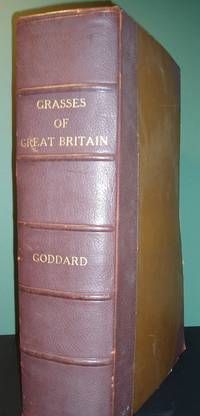
1936rif. 8081Salisbury UK: Not published 1936. Unique. Contemporary three-quarter gilt stamped leather. Fine; some rubbing to the binding. Folio measuring about 21 x 13 inches. There are 205 full page mounted specimens and mounted photographs etc. A massive folio volume of mounted specimens of British grasses representing a life-time of work. The botanist/collector was H Goddard who was a well known authority on British flora in general and grasses in particular. He was the staff botanist for the firm of Dunns Farm Seeds in Salisbury. In 1936 after 50 years of collecting he presented the collection to the firm. They had it bound with introductory letter press. This is the folio volume being offered here. The preliminaries of the volume contain photos and mounted press clippings from which is derived the following: ' A collection of British grasses believed to be without equal . It took most of his life to get it together and two years ago it was put into a bound volume . and presented to the firm. A preface to it was written by Prof. R G Stapleton director of the Welsh plant breeding station and one of the world's authorities on grasses who pays it and the author a high tribute. He says" . in Mr. Goddard's collection they have a valuable possession which will stand for all time . the specimens are beautifully set-up correctly named and well arranged. Indeed it is such that could have only been brought together by a botanist of long experience and by one with infinite patience and with a deep feeling for the beauties of nature." Apart from some minor scuffing the volume is in fine condition with impeccably preserved specimens in tact. Each specimen has the common name genus species place and date collected noted on the mount. A superb and fascinating monument to scholarship science and natural beauty. Not published hardcover books