194 results
1831ref. 54248Philadelphia: Stoddart and Atherton 1831. Second edition. Three octavo volumes 22cm. Contemporary marbled calf with leather spine labels; engraved extra-title present in each volume; xvi7-362;330;264pp; engraved frontispiece v.1 and 48 inserted leaves of plates; text illus. Faint scattered foxing to text but plates generally clean; bindings exhibit moderate external aging and wear with small losses to leather at spine ends and corners. A complete structurally sound Good or better set. Early ownership signature of a Benj. Webb Jr. on endpaper and extra-title of v.1. A quite presentable set of Godman's treatise on the mammals of North America including some ethnographic notes on Native Americans and a lengthy discussion of the fossil record with special attention given to the Giant Mastodon. Much of the third volume is devoted to a description of the American whale fishery. Godman 1794-1830 was trained as a physician and was for some time the director of the Philadelphia Anatomical Rooms a private medical college where he achieved considerable renown as an anatomist. American Natural History described as "the first systematic treatise on the subject" DAB was first published in Philadelphia from 1826-1828; two "Second Editions" appeared in 1831 this one under the Stoddart & Atherton imprint and another by Key & Mielkie. Sabin and Imprints Bruntjen & Bruntjen note only the latter but OCLC records suggest that the two editions are collected with equivalent frequency. Neither Sabin nor Imprints supply a plate count for the Second Edition but our copy conforms to that at the Smithsonian Institution the only OCLC member institution to provide a collation. SABIN 27663. B&B 7271. Stoddart and Atherton unknown books
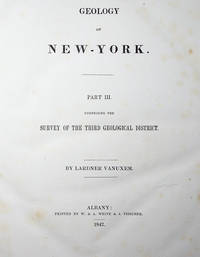
1842ref. 54245Albany: W. & A. White & J. Visscher 1842. First Edition. First printing. Quarto 30cm. In original publisher's cloth signed binding by Warner & Boynton of New York stamped in gold and blind with crinoid and trilobite ornaments in gilt to front board and base of spine; yellow coated endpapers; errata at rear; 2 1-5 6-306 2 pp; engraved series title page and 80 in-text wood engravings. One volume from a longer series. A sound and fresh copy with some gentle wear to joints head and tail; boards bumped and rubbed; heavy foxing to engraved series title and occasional light foxing throughout: Very Good. Vanuxem initiated certain practices adopted by other geological surveys including "anchoring rock units to specific type localities" and dating strata "on the basis of fossils" ANB. This volume was part of a larger geological survey which in turn was part of a series on the Natural History of New York. The Third Geological District here included the counties of Montgomery Fulton Otsego Herkimer Oneida Lewis Oswego Madison Onondaga Cayuga Cortland Chenango Broome Tioga and eastern Tompkins County. HAZEN & HAZEN 10589. SABIN 53782. W. & A. White & J. Visscher unknown books
1971ref. 154965Hollywood: Academy of Motion Picture Arts and Sciences 1971. Vintage four color brochure for the Academy Fall Film Series "Intercut: An Anthology of Unique Motion Pictures" held October 4 through November 22 1971 at the Academy Award Theatre for members of the Academy of Motion Picture Arts and Sciences. 6.25 x 8.75 inches which unfolds to 25 x 17.75 inches. 8 panels. Near Fine with light creasing and rubbing. Academy of Motion Picture Arts and Sciences unknown books
1840ref. 50127Boston: Charles C. Little & James Brown 1840. First Separate Edition. Octavo 21.5cm.; removed; 225pp.; illus. throughout. Stock a bit foxed else Very Good and sound albeit lacking orinal wrappers. Inscribed "From the Author" at head of title page. Article by the recording secretary of the American Academy of Arts and Sciences. Charles C. Little & James Brown unknown books
1850ref. 49285Amherst: J.S. & C. Adams 1850. First Edition. Octavo 23cm.; publisher's tan wrappers printed within decorative border; 85-100pp. Some chipping and a few small losses to wrapper extremities partly affecting author's inscription at head of upper cover else Very Good and sound. One of a series of fascicles on new species of seashells found in Jamaica. SABIN 176. J.S. & C. Adams unknown books
1848ref. 49981Philadelphia: John H. Gihon 1848. First Edition. Octavo 21.5cm.; removed; 1811adspp. Errata slip tipped to title page serving as upper cover slip starting to separate text uniformly foxed contemporary manuscript note at head of title page else Very Good and sound retaining leaf of publisher's advertisements on p. 20. Quite uncommon. John H. Gihon unknown books
1865ref. 48958Cambridge: American Journal of Science and Art 1865. Offprint. Octavo 24cm.; stitched self-wrappers; 9pp. Spine ends starting to split light chipping along extremities faint vertical fold else a Good or better unopened copy. Faint pencil inscription at head of upper cover: "With respects of the author." The second in a series of collected abstracts this first appearing in the "American Journal of Science and Art" Vol. XXXIX January 1865. Not separately catalogued in OCLC as of April 2020 though we find a copy of No. 1 at the Library of Congress. [American Journal of Science and Art unknown books
1896ref. 50094Lynn MA: Nichols Press 1896. First Separate Edition. Octavo 23.5cm.; publisher's cream stitched card printed wrappers; 12pp. Wrapper extremities rather toned and brittle with a few small chips to extremities else Good and internally sound. Obituary of the late astronomer Benjamin Apthorp Gould 1824-1896 first published in the "Boston Transcript" December 12 1896. Nichols Press unknown books
1855ref. 50253New York: Edward P. Allen 1855. First Edition. Octavo 23cm.; publisher's tan wrappers printed within decorative border; 24pp. Tiny chip at spine crown extremities slightly toned else Very Good and sound. Lecture dating early in Steiner's storied career delivered while professor at Columbian College now George Washington University and the National Medical College. Following the Civil War Steiner was elected president of the Frederick County School Board in Maryland focussing much of his energy on the education of Black children. Edward P. Allen unknown books
1867ref. 48943New Haven: Tuttle Morehouse & Taylor 1867. Offprint. Octavo 23cm.; publisher's peach printed wrappers; 19pp. Wrappers a bit brittle with a few chips along extremities not approaching text bottom fore-edge corner creased else Very Good internally sound. Offprint of a paper by the glass manufacturer first published in the "American Journal of Science and Arts" September/November 1867. Tuttle, Morehouse & Taylor unknown books
1833ref. 49821New York: G & C & H Carvill 1833. First Edition. Octavo. Original pebble-grained boards; paper spine title; 1-78-1582pp. Backstrip partially detached ; spine label faded barely legible; text fresh and unmarked - Good or better. Ex-U.S. Naval Lyceum with ink pressure stamp to endpapers and title page with de-accession dated 1927 on verso of title page. Pencil ownership inscription of a "Thos. J. Manning U.S. Navy" at head of title page. Verso of final text leaf prints a brief list of errata. G & C & H Carvill unknown books
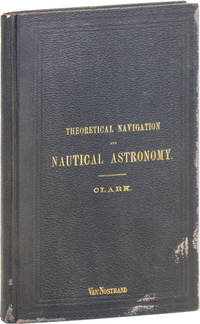
1872ref. 48012New York: D. Van Nostrand 1872. First Edition. Presentation copy inscribed "To Commander J.S. Skerrett with the regards of the author" undated but apparently contemporary. Octavo; publisher's pebbled cloth stamped in gilt and blind; 11416pp. Errata slip inserted folowing author's introduction; 16pp publisher's catalog of "Naval Books." Bit of discoloration at base of front cover; private library stamp to front endpaper and title page; Very Good. A basic treatise on astral navigation written as a textbook for students at the U.S. Naval Academy where the author was an assistant professor in the Department of Astronomy. Inscribed to J.S. Skerrett at this time commanding officer of the U.S.S. Portsmouth. A nice copy of what was according to a contemporary review in the journal Popular Science ".a harmful book being full of doubtful statements of confused mathematics and questionable precepts and one not likely to improve the art of navigation or the science of nautical astronomy in any way. D. Van Nostrand unknown books
1813ref. 45481Philadelphia: Kimber & Richardson 1813. First Edition. Two volumes; octavo 21.5cm.; Vol. I bound in slightly later half calf over marbled boards black gilt spine label Vol. II in full contemporary sheep red gilt spine label; 4506; 6484pp.; engraved title pages 25 leaves of plates including eight folding. Evidence of previously removed library bookplates to Vol. 1 pastedowns some scuffing to boards more heavily so to Vol. II some light foxing one leaf trimmed close with slight loss of text a couple of closed tears to folding leaves else Very Good and sound overall. Attractive engraved pictorial bookseller ticket to rear pastedown of Vol. II. Complete first and second volumes of the New Series edited by the Anglo-American chemist Thomas Cooper. Though not a particularly brilliant scientist Cooper's "greatest service to science was undoubtedly the dissemination of information" Dictionary of Scientific Biography III p. 400. The present collection includes detailed articles on sugar from beets and grapes "Comparative Height of Mountains on the Earth the Moon and Venus" turnpike roads making "fine Cutlery" foreign and homemade wines criminals from 1805 to 1811 and "the uses of a dead horse by the editor." SHAW & SHOEMAKER 28226. Kimber & Richardson unknown books
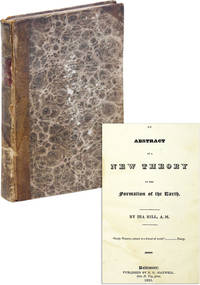
1823ref. 46664Baltimore: N.G. Maxwell 1823. First Edition. 12mo 18.5cm.; calf-backed marbled boards gilt-lettered spine; xv214-211pp. Boards a bit scuffed with brief exposure at corners leather somewhat dried and mottled endpapers toned faint dampstaining to first half of textblock else a Very Good sound copy. Theory on the formation of the earth dedicated to Andrew Jackson. Early chapters cover general natural phenomena such as "strata" and "The various colours of Marble" while the latter half of the text focuses on the North American continent describing "A Flood that was produced by the rise of northeast rise of North America" the formation of the Delaware Schuylkill and Susquehanna Rivers; the formation of the North American prairies; and the "Insects Vegetation &c. of America." The author later published another work titled "Antiquities of America Explained" 1831 arguing that a group of Tyrians and Jews crossed the Atlantic 3000 years ago creating a colony in Nova Scotia that eventually spread across the entire continent. This title missed by Sabin. SHOEMAKER 12827. N.G. Maxwell unknown books
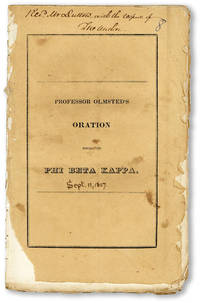
1827ref. 44516New Haven: Hezekiah Howe 1827. First Edition. Octavo 23.5cm.; publisher's peach wrappers printed within double rule; 24pp. Previously removed from larger volume coin-sized loss at bottom spine edge of upper cover not approaching text upper wrapper fore-edge rather chipped some soil and foxing later ink shelf number to upper cover and title page else Good to Very Good overall. Inscribed at head of front cover: "Revd. Mr. Duttow with the respect of the author." Address by the American physicist who would pioneer the study of meteor science in 1833 following the Leonid Meteor Shower over North America becoming the first American to observe Halley's Comet in 1835. SHOEMAKER 30115 misspelling author name "Olmstead". Hezekiah Howe unknown books
1964ref. acs247Springfield Illinois: Charles C. Thomas 1964. Octavo blue cloth hardcover gilt lettering xxvii 124 pp. Fine in a Fine mylar protected dust jacket with “American Lecture Series.” From dust jacket: It is only possible to understand life in all its forms by understanding it at its origin and in its development. by studying and reproducing the processes by which it arose. In this classic monograph Doctor Oparin describes in as great detail as achievements of contemporary science will allow the three stages in the evolution of organic substances which preceded the appearance of life on Earth. The emergence of the most primitive organic compounds the hydrocarbons and cyanides and their nearest oxygen nitrogen sulphur and phosphorus derivatives with comparatively low molecular weights. Further elaboration of these compounds associated with a progressive increaase in the size of their molecules owing to the polymerisation and condensation of organic substances in the waters of the primaeval seas and oceans the primaeval nutrient broth. Formation within the hydrosphere of multimolecular systems which arise by the association of different high-molecular organic substances into supra-molecular complexes marked off from their environment by a definite boundary of separation but capable of reacting with it as an open system Charles C. Thomas, 1964. hardcover books
1978ref. vas750Washington: United States Department of Agriculture in cooperation with University of Florida Institute of Food and Agricultural Sciences and Agricultural Experiment Stations Soil Science Department 1978. Quarto stiff pictorial wrappers stapled 113 pp. 34 double-sided fold-out maps. Good; cover somewhat wrinkled light soiling. United States Department of Agriculture in cooperation with University of Florida Institute of Food and Agricultural Sciences a unknown books
ref. qms374La Haye 1984. Text in English. Octavo black cloth hardcover paper labels 237 pp. Near-Fine with light rubbing to upper cover. hardcover books
1963ref. S11633San Francisco:: California Academy of Sciences 1963. 1963. Series: Occasional Papers of the California Academy of Sciences no. 44 Nov. 8 1963. 8vo. 154 pp. Frontis. 50 figs. Original printed wrappers. Very good. Contains 10 articles among them: Robert I. Bowman "Evolutionary Patters in Darwin's Finches." California Academy of Sciences, 1963. unknown books
1960ref. S10630Paris:: Hermann 1960. 1960. Series: Histoire de la Pensee II. 8vo. 344 pp. Printed wrappers; edges and corners rubbed. Ownership signature. Very good. Hermann, (1960). unknown books
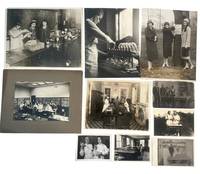
1900ref. 235831900. Women in laboratory sciences photo archive circa 1900 to 1946 documenting women's movement into chemistry bacteriology hospital medicine and classroom experiment at a time when scientific training and professional advancement remained largely organized around men with barriers of entry for women. The group begins with a pharmacological laboratory where one woman stands among men predating suffrage in the United States and continues through school laboratories hospital laboratories press photographs and postwar images of young women handling test tubes and glassware. World War I drew women chemists into schools universities analytical laboratories and war work while World War II accelerated laboratory demand again through bacteriology antibiotics and industrial drug production. Photo archive of 11 mixed phtoographic mediums including albumen silver gelatin and real photo postcard photographs various sizes ranging 5 x 4 inches to 8 x 10 inches United States and Europe early 20th century. The images show women and girls conducting experiments at benches lined with burners flasks pipettes test tubes reagent bottles and laboratory stands; a large pharmacological classroom with nearly all male staff and students and one woman present; high school girls in an early science classroom; two nuns or a nun and nurse working in a laboratory at Saint Anthony's Hospital Rockford Illinois identified on verso as early 1930s; and a bacteriological laboratory scene dated October 2 1923. A 1926 Acme press photograph identifies "Miss Virginia Trelease chemist student at Northwestern University Evanston Ill." using liquid oxygen from a Heylandt liquefier to fry an egg over "burning ice." Other images show two young women captioned "Resa Yusko and Bla Pesala" in 1946 smiling while handling laboratory equipment and a 1927 press photograph of Mrs. August Rus Oppenheim Mrs. Oswald Jimenis and Mrs. Arthur Bunker of the Southern Women's Educational Alliance posting a Metropolitan Opera benefit notice evidence of women's educational fundraising alongside the scientific scenes. The photographs trace women's scientific labor from gendered access to instruction into wartime necessity and postwar professional visibility. In the early twentieth century women who entered chemistry and medicine often worked through teaching nursing hospital laboratories and applied science fields that admitted them more readily than elite research posts while still relying on their technical skill. During World War II penicillin moved from laboratory microbiological study in 1940 to mass production by 1945 a shift that depended on fermentation work laboratory handling and industrial coordination rather than discovery alone. Light surface wear toning occasional creasing press stamps captions and handling marks; some images faded or rubbed. Overall good condition. A concentrated visual record of women learning demonstrating and performing laboratory science across the decades when modern medicine and chemistry increasingly required their work while still limiting their recognition. unknown books
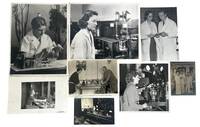
1910ref. 231321910. Women in STEM Women's scientific and technical employment photo archive documenting female laboratory labor from the early twentieth century through the 1940s historically significant for showing how women entered academic industrial and commercial research settings in roles that ranged from student and aide to biologist technician and physician at a period when scientific work remained overwhelmingly male and women's access to professional authority was still sharply constrained. The group includes five press photographs and three non press photographs with women pictured not as incidental clerical staff but as active operators of instruments handlers of test animals readers of charts and participants in experimental procedure establishing direct visual evidence of women's expanding place within the infrastructure of American science industrial testing and laboratory employment. Photo archive of 8 silver gelatin photographs ranging from 3.5 x 5.5 to 8 x 10 inches various U.S. locations circa 1910 to 1940s. The archive spans classroom laboratory and industrial interiors. One 1910 photograph shows two men and one woman standing in a laboratory identified as "three scientists or science students" an early image of mixed gender scientific training. A 1937 press photo titled "aviation biologist works with hatchlings" shows Dr. Manisera in a lab coat hand feeding two week old canaries with a third bird perched on her head turning animal handling and experimental care into a public image of female scientific expertise. Another press photo shows Sally Wulff identified on the verso as an engineering aide with a science degree from the University of Iowa seated at a control bench calibrating experimental instruments at Wright Field. A 1938 non press image shows Dr. Marie D'Amour and Fred D'Amour studying a chart before a blackboard covered with formulas and technical notations linking the photograph to mammalian physiology research. A Hoboken New Jersey press photo depicts a female technician in the chemical division of the United States Testing Company operating a Fisher titrimeter "for performing volumetric analyses by electronic means" while a 1939 press photo from Newton Massachusetts shows a laboratory worker testing newly developed Permatron tubes used in high frequency welding and power transmission. Another press image captioned "A 'noise machine' used in experiments in the Colgate laboratory" shows a woman and man positioned on either side of the apparatus and a separate 1940s laboratory group photograph places a single woman among five men before a long demonstration bench and blackboard diagrams underscoring both women's presence and their numerical isolation within technical settings. Several versos retain typed caption slips editorial markings and reference stamps consistent with press photo circulation. Across the first half of the twentieth century women entered scientific work through normal schools universities wartime research demand industrial laboratories and auxiliary technical appointments yet their advancement was often channeled into subordinate or specialized designations even when their work required substantial training. This archive makes that structure visible through named and captioned examples of women conducting measurement instrument calibration physiological research electronics testing and experimental animal work across corporate academic and applied research environments. Minor residue on versos from former press labels or caption attachments; otherwise clean and well preserved. Overall very good condition. As a record of women's early technical labor the archive supplies concrete visual evidence of the pathways limits and visibility of women's participation in American scientific work before the full opening of postwar professional opportunity. unknown books
1924ref. 560022Garden City New York: Doubleday Page & Co 1924. Hardcover. Very Good. First edition. Introduction by Blanche Colton Williams. Contemporary owner name on front fly sunned spine with light creases very good lacking the dust jacket. First publication of "Phantom Adventure" by Floyd Dell. Doubleday, Page & Co hardcover books
1961ref. 382136Washington: Government Printing Office 1961. Hardcover. Near Fine. First edition. Senate Document No. 26 87th Congress 1st Session. Thick octavo. xxii 1392pp. In the original publisher's cloth. Ex-library with two small ink stamps front pastedown else no other markings. Light soiling to the boards near fine. Prepared for the use of the Committee on Aeronautical and Space Sciences. A nice copy. Government Printing Office hardcover books
1748ref. 1641Amsterdam: Chez l'honore et fils libraires 1748. First Edition. Hardcover. Very good. 2 vols. in one. 8vo. I: 10 cxix 7 208 pp. 1 f. "Errata" for Tom. 1. II: 2 231 pp. 1 f. "Addition" 1 f. "Errata" for Tom 1 sic. First title page with unobtrusive paper defect on lower margin not affecting text; this copy is lacking half-title and Errata leaf for Tom. 2. Very attractive 19th-century French red glazed boards red morocco spine lettered in gilt directly two insignificant worm-holes on lower hinge leading nowhere; trifle wear to binding extremities. Completely unsophisticated. First printing of "Telliamed" in every way a remarkable book. Disguised as an Oriental fantasy it contains perhaps the earliest appearance of one of the most important of all evolution speculations namely the so-called ultra-neptunian theory: that the entire Earth was and is a marine deposit and that all life on land originated from creatures of the sea. Maillet hypothesized that the earth was once entirely covered with water and that the water gradually evaporated into space causing land masses to appear. Maillet also created an ingenious methodology to calculate the age of the Earth: he concluded that the Earth is 2 billion years old evolutionists today consider this figure to be more like 4.5 billion. It is known that Buffon Lamark Cuvier and Darwin read this book and that they were very much influenced by Maillet's unorthodox "heretical" views. Well aware that such an immense figure would incur the wrath of the Church de Maillet presented his conclusions in the guise of a dialogue between a French missionary and an Eastern mystic named Telliamed an anagram for the author's last name i.e. de Maillet spelled backwards. The manuscript remained unpublished until a decade after Maillet's death. In order to present his radical conclusions in the guise of an Oriental tale Maillet interspersed monsters and mythological creatures into his text. Overtly anti-Christian "Telliamed" dismisses the Flood of the Old Testament as a fable because rainfall that lasted forty days would have been insignificant to submerge entire mountains. Maillet asserted that the Earth's history could not be read from the Bible but through the rocks themselves. ¶ With uncanny prescience Maillet describes how species have overlapping physical characteristics that suggested a common life origin namely the sea. Through a Oriental mystic we are told that: "The little Wings had under their Belly and which like their Fins helped them to walk in the Sea became Feet and served them to walk on Land." ¶ REFERENCES: Caillet No. 7009. Versins Utopie p. 640. LITERATURE: "Charles Darwin et ses Precurseurs francais Paris 1870 Chapter 1: "the moss-grown fragments from the ruins of another world." See also Albert Carozzi "De Maillet's 'Telliamed' 1748: An Ultra-Neptunian Theory of the Earth" in: Toward a History of Geology; Proceedings of the New Hampshire Inter-Disciplinary Conference on the History of Geology Sept. 7-12 1967. Mary Efrosini Gregory "Evolutionism in Eighteenth-century French Thought" Chapter 1. See also the article on Maillet in DSB IX pp. 26 et seq: "Maillet's ideas unquestionably influenced many leading naturalists for almost a century notably Buffon and Cuvier. Chez l'honore et fils, libraires hardcover books