5 résultats
1975réf. 242862Berkeley: Psychic Times 1975. 1p. first page of the 12-page tabloid about 600 words with another 200 words recounting an astral visit to Ford and family in the Oval Office. Presswork on alkaline paperstock the once bright-white paper still substantial but now edged with sun-toning and soil slightly misfolded and has a small area of mouse-gnaw at top intersection of fold-lines. Legible and handleable a good copy. Pro-Ford not to say lickspittal: "a man of simple honesty and generosity. in a cosmic sense he is an honest apprentice. a living incarnation of the Average American." The inset box retails the astral visit of three psychics with Ford and Ford's daughter Susan; the president is advised to "make his body more real" also not to worry that psychic no.3 is screwing daughter Susan they remind him that it's all astral and to lighten up Sir. Psychic Times unknown books
2003réf. 21676San Diego: Thunder Bay Press. Fine in Fine dust jacket. 2003. Hardcover. 1571459952 . Illustrated. First printing. Fine in a fine dust jacket. . Thunder Bay Press hardcover books
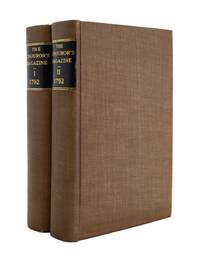
1792réf. 69260London: Printed for W. Locke 1792. ASTROLOGY. Including a superb Edition of Lavater's Physiognomy. London: Printed for W. Locke 1791-93. First edition of all issues of this scarce magazine; August 1791 to July 1793 after which time it was called The Astrologer's Magazine and continued for a further six months. Two octavo volumes 8 1/8 x 5 inches; 205 x 126 mm. 494 4 index 104; 104 2 99-520 4 index pp. Frontispiece at the beginning of each volume. Monthly titles to all issues. Numerous charts and diagrams throughout. Issues from August September and October 1792 Pages 1-104 are found in duplicate once at the end of volume I and also at the start of volume II. They each have the "George III" frontispiece accompanying them. Although it contained more occult information than legerdemain the Conjuror's Magazine is generally considered the first conjuring periodical. With much astrological interest. There were originally eighty Lavater plates issued with the magazine but these are always absent in bound runs. Bound in newer brown cloth. Black morocco spine labels lettered in gilt. Top edges dyed brown. Front inner hinge of volume I starting. Some scattered foxing and browning especially to first volume. Scratched out name on title page of one issue. Overall a very good copy of this legendary rarity. "The next publication of importance was The Conjuror's Magazine issued monthly by W. Locke and which was the first periodical to contain sections describing tricks abstracted from and credited to the works of Breslaw Dean and Pinetti. The magazine ran from August 1791 to July 1793 comprising two volumes. Bound volumes of The Conjuror's Magazine can still occasionally be found and are highly prized by collectors" Hall p. 158 Stott 179. Hall 70. HBS 69260. $3000. Printed for W. Locke unknown books
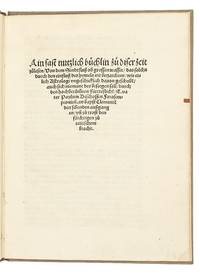
1524réf. 5256Augsburg: Simprecht Ruff 1524. FIRST GERMAN-LANGUAGE EDITION. Hardcover. Fine. Bound in modern boards. A fine copy. First German edition of a book written to quell the growing hysteria around the conjunction of Jupiter and Saturn in the sign of Pisces in February 1524 which was rumored to herald a catastrophic flood. Written by Paul of Middelburg renowned astrologer professor of astronomy at the University of Padua and personal physician to the Duke of Urbino the book "A most useful book to read at the present time concerning the Deluge or the Great Flood: That is that one will not be caused by the heavens as some astrologers have clumsily written and that no one should worry about it… Translated into German to bring consolation to the fearful." first appeared in Latin as "Prognosticon ostendens anno 1524 nullum diluvium futurum"1523. "The Jupiter-Saturn conjunction of February 1524 proved a stimulus to industry—about sixty Renaissance authors penned more than 160 pamphlets… Even a remove of nearly five-hundred years has done little to dampen scholarly interest in this signal episode of the intellectual history of the 1500s." "In a world view shaped by a natural philosophy much imbued with and indebted to astrology the theory of great conjunctions which was originally formulated by the Arab scholars Messehala Masha'allah and al-Kindi and more fully articulated thereafter by Albumasar Abu Ma'shar in his 'De magnis coniunctionibus' played a particularly important role… "The most important of these conjunctions involved the more slowly revolving planets—Jupiter and Saturn… Little wonder then that the attention of astrologers was drawn to the powerful planetary alignment even many years before it would supposedly take place in the watery house of Pisces in February 1524. But this time not only would Mars Jupiter and Saturn unite in celestial embrace they were also to be joined in a far more massive display by the Sun Mercury and Venus viz. six of the then seven known planets… "On 20 March 1523 a libel bearing the imperial seal was published in Vienna by the court astrologer Georg Tannstetter who noted that '…this rumour about the impending flood has already taken root everywhere in every sense creeping into everyone's mind: it has provoked the wise and the learned to heated debate and in some it has caused such consternation that they can no longer manage their affairs properly: they sell their lands fields and other properties or refuse to purchase those for sale because they believe it will be easier to convey money up to the mountains than castles and farms. Others still postpone weddings rescind contracts refuse holy orders listlessly tend to their crops while exclaiming if I understand rightly: what good are riches if in a few years no one will be able to enjoy them' "The Spanish astrologer and theologian Pedro Ciruelo a man of vast erudition who was widely acclaimed in his own time wrote an analysis in Spanish of the 1524 conjunction that was later translated into Latin Italian and German. He even advises his readers at a certain point about precautionary measures they might take: 'those of means should store provisions of flour oil wine firewood salted beef dried fish … so that if any watery event were to occur in the months hither everyone shall have their store and can go with it to a safer place.' For the poor who cannot afford such provisions Ciruelo recommends that their needs be seen to at public expense. He also suggests that peasants refrain from sowing lowland fields and that shepherds and cowherds drive their animals to highland pastures where forage is abundant… "A pre-eminent figure in the reform of the calendar taken up at the Lateran Council of 1512-1517 Paul of Middelburg who had long refrained from publishing any predictions was finally persuaded to a change of heart by the tightening grip of anxiety and fear throughout Italy and published in 1523 his 'Prognosticon' which was addressed to Pope Clement VII and refuted any possibility of either a universal deluge or a more local flash-flood."Barillà Drawing Nigh to February 1524: The Spate of Fear p. 2 ff. Simprecht Ruff hardcover books
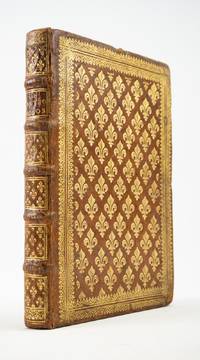
1615réf. ST20812Rome: Bartolomeo Zannetti 1615. Second Edition. 222 x 160 mm. 8 3/4 x 6 1/2". 12 p.l. 304 pp. 12 leaves. Very pleasing 17th century calf covers with a floral roll border surrounding a semis of fleurs-de-lys raised bands spine gilt in compartments with a double rule enclosing five fleurs-de-lys lettered in gilt marbled paper pastedowns all edges gilt old expert repairs at the top of joints. Attractive woodcut head- and tailpieces throughout historiated initials and two woodcut astrological charts in the text. Front pastedown with morocco book label of Stanislas de Guaita; rear flyleaf with his inked inscription: "Collationné. Complet - à Nancy. ce 27 Xbre 1895. - Guaita." "Stanislas de Guaita et sa bibliothèque occulte" 15 this copy; Caillet I 291; Graesse I 127; USTC 4022052. See also Thorndike VI pp. 202-04. A bit of rubbing at corners other light wear to the binding inconsequential foxing here and there isolated quires slightly darkened but an excellent copy--crisp and clean internally in a solid decorative binding still shining with gilt. In a lovely early binding this is a notorious 19th century occultist's copy of a scarce 17th century refutation of astrology. Our author Jesuit scholar Alessandro de Angelis 1559-1620 taught logic natural history metaphysics and theology at the Collegio Romano eventually serving as prefect of studies from 1611-17. De Angelis' only known publication the "Astologos" systematically picks apart common astrological beliefs on both metaphysical and theological grounds. First printed in Lyon the work appears here in a second edition issued the same year; both seem to be rare as we were able to trace only six copies at auction since 1966. Making our copy of an already absorbing book even more intriguing is its former owner the French poet and occultist Stanislas de Guaita 1861-97 whose short but colorful life was full of curious incident. He founded a chapter of the Rosicrucians published several works on magic and Kabbalah and had a defrocked priest declare a "magical war" against him which culminated in a decidedly unmagical though fortunately not fatal pistol duel. He is also responsible for the iconic symbol of a goat's head in an inverted pentagram now used to represent Satanism which he had originally used as an illustration for his 1897 work "La Clef de la Magie Noire" "The Key to Black Magic". In addition to these activities Guaita assembled an extensive library of books on various occult and related topics. His collection was sold by the Paris bookseller Dorbon whose 1899 catalog of the library includes 2227 volumes. Ours is #15 priced at the significant sum of 65 francs perhaps $1200 in today's buying power. Bartolomeo Zannetti unknown books