393 résultats
1630réf. 012312In Verlegung Lazari Zetzners S. Erben Strassburg 1630. Edition Unknown. Hardcover. Good Condition/No Dust Jacket. Size: Small Octavo. Text is in German. Text body is clean and free from previous owner annotation underlining and highlighting. Binding is tight covers and spine fully intact. Rebound gilt-stamped vellum and light blue paper over boards 30 282 pages illustrated with woodcuts. Covers and text block soiled corners and spine ends bumped and lightly worn pages toned staining scattered throughout still highly readable paper loss and tear on page 83 some minor wormholes in blank margins towards end of book. Quantity Available: 1. Shipped Weight: 1 lb 9 oz. Category: Astrology; German Language; Pictures of this item not already displayed here available upon request. Inventory No: 012312. . In Verlegung Lazari Zetzners S. Erben hardcover
1980réf. 058073ASI Publishers 1980. Book. Very Good. Hardcover. 2nd Edition. No dust jacket. Blue gilt-stamped cloth. 198pp. ASI Publishers Hardcover
1616réf. 6130London: Ex Officina Societatis Stationariorum printed by John Legat 1616. Small 8vo 4 294 66pp. Index. Woodcut device on title and initials. 18th century ruled calf spine lettered in gilt marbled page edges. Armorial bookplate of Adam Urquhart Esq. to front pastedown else clean internally and with minimal foxing. One of roughly half a dozen early English printings in the original Latin of the humanist poem by Neopolitan poet Marcello Stellato ca. 1500-1550. The work is divided into 12 books each for a sign of the Zodiac. Originally published in 1536 in Venice the poem was first translated into English by Barnaby Googe six books published in 1561 and then the complete Zodiake of Life in 1565. It was widely read and distributed in London and also taught in early English grammar school. Shakespeare almost certainly studied the work and it is thought to be the inspiration for his "All the world's a stage" monologue from As you Like It. Editions printed in London of this famous poem are markedly less common in the trade than other continental printings. Gardner 893. STC 19146. Ex Officina Societatis Stationariorum [printed by John Legat] unknown
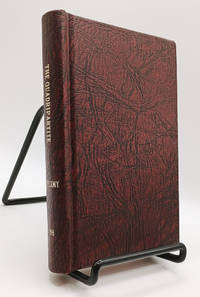
1786réf. 019210London UK: M. Sibley 1786. Second Edition. Hardcover. Very Good. 219pp; Handsomely rebound in textured maroon boards with gilt titling to spine boards square clean & bright previous owner's name to title page pages lightly age-toned text unmarked binding is tight VG condition. Scarce antique volume on astrology originally written in Greek by Claudius Ptolemy c. 100-170s AD a Greco-Roman mathematician astronomer astrologer geographer and music theorist. This edition translated by John Whalley 1653-1724 "professor of physic and astrology and others" but with a reputation as a notorious Irish quack. The original Greek title was Tetrabiblos the Latin title was Quadripartitum and the volume is also known as Apotelesmatika. M. Sibley hardcover
réf. DADAX1567183492New unknown
réf. DADAX0060808519New unknown
réf. DADAX0875428045New unknown
1608réf. 57593Argentorati Strassburg Conradus Scher 1608 - Strassburg Raab 1612. - Strassburg Raab 1612 Small 8vo. 3 works bound in one contemp. full vellum. Covers blindtooled in panels with floral cornerpieces. Old handwritten title on spine. Light wear. An: 1. 244497 pp. First edition. Thesaurus II338 - 2. 208 pp. - 3. 2426116 of 24 pp. Lacking the last leaves in the Index. 7 leaves with lower corners torn of which 2 have some loss of letters. Light browning an yellowing to leaves. "Bartholin’s fame is due not to his originality but to his learning and reputation as a teacher; as a strict Aristotelian he clarified the essential points in the doctrines of his time eliminating obsolete and superfluous theories. As a theologian his personal life was marked by piety and Lutheran orthodoxy. His anatomical manual Institutiones well arranged and handy but without illustrations was reprinted five times. It became still more famous when his son Thomas brought out an enlarged and illustrated edition."DSB. hardcover
réf. DADAX0875422977New unknown
réf. DADAX0875424414New unknown
réf. DADAX0140195122New unknown
réf. DADAX1572840676New unknown
1639réf. LL 69Copia de vna carta trayda de Costantinopla a Roma en la qual se cuentan grandes prodigiosos sic y espantables señales que aparecieron en la dicha ciudad de Costantinopla …. Contiene horribles visiones y apariciones de saetas vientos tempestades … con la interpretacion … hecha por algunos adiuinos estrologos sic de su Imperio …. In 4° A4. Upper margin trimmed not affecting text. First edition of this rare print about supernatural phenomena in Constantinople; this theme was treated later in several prints of the same tenor at the end of the 17th century. # WorldCat: no copies in US Libraries one copy elsewhere Bib Nacional Madrid. LL 69 Impressa en Micina, en Napoles, en Roma y aora en Barcelona: en casa de Gabriel Nogues
1730réf. 10266Madrid: Diego López de Haro 1730. First Seville edition. Quarto 20x14cm 4 18 2pp. Illustrated title showing the Columns of Fire. Modern Bradel-style binding of speckled paper-covered boards gilt-lettered spine label. Light wear and soiling to leaves; repaired wormtrack within the gutter margins. Very good. A wonderfully strange mixture of eyewitness astronomy judicial astrology folk medicine and personal melancholy by the Spanish writer physician mathematician and astrologer Diego de Torres Villarroel. On November 2 1730 a luminous globe accompanied by three columns of fire appeared over Spain and remained visible for four hours-an event now understood to have been an unusually southerly appearance of the aurora borealis. Torres relates the occurrence through an exchange of letters with his friend Don Juan Ventura who feared both its astrological significance and the bodily illnesses supposedly caused by its vapors. Torres then suffering from a severe bout of melancholy himself initially refuses either to prognosticate or prescribe a cure. At Ventura's insistence however he delivers both. Although he considers the apparition a natural rather than divine event he predicts that it will bring four years of misfortune-one for every hour it remained visible-and recommends an elaborate preventative regimen: moderate daily exercise raw garlic barley water goat's milk fresh meat and vegetables abstention from wine and the fumigation of the home with fragrant candles. An exceptionally appealing record of an early modern attempt to understand a terrifying celestial spectacle through a combination of observation astrology and domestic medicine. The final two pages advertise other books issued by López de Haro many of them by Torres himself. Jorge Luis Borges was an early admirer of Torres and devoted one of the opening essays in his first prose collection Inquisiciones 1925 to him. The dramatic title-page woodcut depicts the fiery globe and its three blazing columns above the horizon. . Diego López de Haro unknown
1792réf. 69260London: Printed for W. Locke 1792. ASTROLOGY. Including a superb Edition of Lavater's Physiognomy. London: Printed for W. Locke 1791-93. First edition of all issues of this scarce magazine; August 1791 to July 1793 after which time it was called The Astrologer's Magazine and continued for a further six months. Two octavo volumes 8 1/8 x 5 inches; 205 x 126 mm. 494 4 index 104; 104 2 99-520 4 index pp. Frontispiece at the beginning of each volume. Monthly titles to all issues. Numerous charts and diagrams throughout. Issues from August September and October 1792 Pages 1-104 are found in duplicate once at the end of volume I and also at the start of volume II. They each have the "George III" frontispiece accompanying them. Although it contained more occult information than legerdemain the Conjuror's Magazine is generally considered the first conjuring periodical. With much astrological interest. There were originally eighty Lavater plates issued with the magazine but these are always absent in bound runs. Bound in newer brown cloth. Black morocco spine labels lettered in gilt. Top edges dyed brown. Front inner hinge of volume I starting. Some scattered foxing and browning especially to first volume. Scratched out name on title page of one issue. Overall a very good copy of this legendary rarity. "The next publication of importance was The Conjuror's Magazine issued monthly by W. Locke and which was the first periodical to contain sections describing tricks abstracted from and credited to the works of Breslaw Dean and Pinetti. The magazine ran from August 1791 to July 1793 comprising two volumes. Bound volumes of The Conjuror's Magazine can still occasionally be found and are highly prized by collectors" Hall p. 158 Stott 179. Hall 70. HBS 69260. $3000. Printed for W. Locke unknown
1524réf. 5256Augsburg: Simprecht Ruff 1524. FIRST GERMAN-LANGUAGE EDITION. Hardcover. Fine. Bound in modern boards. A fine copy. First German edition of a book written to quell the growing hysteria around the conjunction of Jupiter and Saturn in the sign of Pisces in February 1524 which was rumored to herald a catastrophic flood. Written by Paul of Middelburg renowned astrologer professor of astronomy at the University of Padua and personal physician to the Duke of Urbino the book "A most useful book to read at the present time concerning the Deluge or the Great Flood: That is that one will not be caused by the heavens as some astrologers have clumsily written and that no one should worry about it… Translated into German to bring consolation to the fearful." first appeared in Latin as "Prognosticon ostendens anno 1524 nullum diluvium futurum"1523. "The Jupiter-Saturn conjunction of February 1524 proved a stimulus to industry—about sixty Renaissance authors penned more than 160 pamphlets… Even a remove of nearly five-hundred years has done little to dampen scholarly interest in this signal episode of the intellectual history of the 1500s." "In a world view shaped by a natural philosophy much imbued with and indebted to astrology the theory of great conjunctions which was originally formulated by the Arab scholars Messehala Masha'allah and al-Kindi and more fully articulated thereafter by Albumasar Abu Ma'shar in his 'De magnis coniunctionibus' played a particularly important role… "The most important of these conjunctions involved the more slowly revolving planets—Jupiter and Saturn… Little wonder then that the attention of astrologers was drawn to the powerful planetary alignment even many years before it would supposedly take place in the watery house of Pisces in February 1524. But this time not only would Mars Jupiter and Saturn unite in celestial embrace they were also to be joined in a far more massive display by the Sun Mercury and Venus viz. six of the then seven known planets… "On 20 March 1523 a libel bearing the imperial seal was published in Vienna by the court astrologer Georg Tannstetter who noted that '…this rumour about the impending flood has already taken root everywhere in every sense creeping into everyone's mind: it has provoked the wise and the learned to heated debate and in some it has caused such consternation that they can no longer manage their affairs properly: they sell their lands fields and other properties or refuse to purchase those for sale because they believe it will be easier to convey money up to the mountains than castles and farms. Others still postpone weddings rescind contracts refuse holy orders listlessly tend to their crops while exclaiming if I understand rightly: what good are riches if in a few years no one will be able to enjoy them' "The Spanish astrologer and theologian Pedro Ciruelo a man of vast erudition who was widely acclaimed in his own time wrote an analysis in Spanish of the 1524 conjunction that was later translated into Latin Italian and German. He even advises his readers at a certain point about precautionary measures they might take: 'those of means should store provisions of flour oil wine firewood salted beef dried fish … so that if any watery event were to occur in the months hither everyone shall have their store and can go with it to a safer place.' For the poor who cannot afford such provisions Ciruelo recommends that their needs be seen to at public expense. He also suggests that peasants refrain from sowing lowland fields and that shepherds and cowherds drive their animals to highland pastures where forage is abundant… "A pre-eminent figure in the reform of the calendar taken up at the Lateran Council of 1512-1517 Paul of Middelburg who had long refrained from publishing any predictions was finally persuaded to a change of heart by the tightening grip of anxiety and fear throughout Italy and published in 1523 his 'Prognosticon' which was addressed to Pope Clement VII and refuted any possibility of either a universal deluge or a more local flash-flood."Barillà Drawing Nigh to February 1524: The Spate of Fear p. 2 ff. Simprecht Ruff hardcover
1615réf. ST20812Rome: Bartolomeo Zannetti 1615. Second Edition. 222 x 160 mm. 8 3/4 x 6 1/2". 12 p.l. 304 pp. 12 leaves. Very pleasing 17th century calf covers with a floral roll border surrounding a semis of fleurs-de-lys raised bands spine gilt in compartments with a double rule enclosing five fleurs-de-lys lettered in gilt marbled paper pastedowns all edges gilt old expert repairs at the top of joints. Attractive woodcut head- and tailpieces throughout historiated initials and two woodcut astrological charts in the text. Front pastedown with morocco book label of Stanislas de Guaita; rear flyleaf with his inked inscription: "Collationné. Complet - à Nancy. ce 27 Xbre 1895. - Guaita." "Stanislas de Guaita et sa bibliothèque occulte" 15 this copy; Caillet I 291; Graesse I 127; USTC 4022052. See also Thorndike VI pp. 202-04. A bit of rubbing at corners other light wear to the binding inconsequential foxing here and there isolated quires slightly darkened but an excellent copy--crisp and clean internally in a solid decorative binding still shining with gilt. In a lovely early binding this is a notorious 19th century occultist's copy of a scarce 17th century refutation of astrology. Our author Jesuit scholar Alessandro de Angelis 1559-1620 taught logic natural history metaphysics and theology at the Collegio Romano eventually serving as prefect of studies from 1611-17. De Angelis' only known publication the "Astologos" systematically picks apart common astrological beliefs on both metaphysical and theological grounds. First printed in Lyon the work appears here in a second edition issued the same year; both seem to be rare as we were able to trace only six copies at auction since 1966. Making our copy of an already absorbing book even more intriguing is its former owner the French poet and occultist Stanislas de Guaita 1861-97 whose short but colorful life was full of curious incident. He founded a chapter of the Rosicrucians published several works on magic and Kabbalah and had a defrocked priest declare a "magical war" against him which culminated in a decidedly unmagical though fortunately not fatal pistol duel. He is also responsible for the iconic symbol of a goat's head in an inverted pentagram now used to represent Satanism which he had originally used as an illustration for his 1897 work "La Clef de la Magie Noire" "The Key to Black Magic". In addition to these activities Guaita assembled an extensive library of books on various occult and related topics. His collection was sold by the Paris bookseller Dorbon whose 1899 catalog of the library includes 2227 volumes. Ours is #15 priced at the significant sum of 65 francs perhaps $1200 in today's buying power. Bartolomeo Zannetti unknown
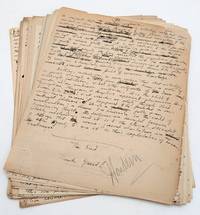
1926réf. 71978Providence RI: H. P. Lovecraft 1926. Manuscript. Very Good. Twenty-three letter-sized manuscript leaves approx. 8.5" x 11". Written in dark ink and hand-numbered by Lovecraft: page numbers 16 18 24 25 26 26b and 27-43. The manuscript pages feature heavy contemporary ink revisions cancellations interlinear additions and a data table. Lovecraft concludes on page 43 in ink: "The End / Thank Gawd!" and the manuscript is signed "Houdini" by Harry Houdini in pencil at the conclusion. The manuscript is written on the reverse sides of correspondence and constitutes a rich literary archive preserving original incoming letters to H.P. Lovecraft. Professional and personal correspondence typescript poetry submissions and editorial rejections sent to Lovecraft between 1922 and 1926 by associates editors and other contemporaries are represented here. Some horizontal folding creases sporadic edge wear and chipping age-toning. The Manuscript Rectos: A major autograph working draft of The Cancer of Superstition the ghostwritten treatise commissioned by Harry Houdini in 1926 to combat spiritualism and commercial fortune-telling. Writing entirely in his own hand Lovecraft systematically deconstructs astrology using modern astronomical scientific knowledge-citing the precession of the equinoxes light-speed delays and extragalactic nebulae-while refuting astrological claims through logic probability and history. Lovecraft mounts a rigorous scientific assault on astrology treating pseudoscience not merely as an intellectual failing but as a cosmic absurdity. On page 39 he constructs a detailed planetary data table tracking diameters solar distances and revolution periods arguing that when viewing these immense scales "we can no longer entertain the astrological illusion that our earth is a considerable object for whose benefit the rest of the universe is arranged." Turning his venom toward the commercial occult trade Lovecraft decries "how many dollars are snatched from the unwary by a device so ancient & so simple" warning that "many lives have been utterly wrecked through the random bombast & gibberish of some ignorant & unscrupulous soothsayer" page 26. Elsewhere he dismantles horoscopic predictions through celestial mechanics noting that zodiac signs "sprang partly from apparent conditions no longer existing" 35 and questions the clockwork of the planets reckoning with light-speed delays crossing vast distances of the cosmos: "If the planets rule the earth why are not the real times of their aspects calculated; instead of the apparent times as judged by their light as it reaches us" 38. Driving his argument to its climax Lovecraft brands astrology as "a legacy from primitive times; a sister of witchcraft fetichism . a shame & a nuisance in the world of broadening thought" and brings his draft to an exhausted close: "The End / Thank Gawd!" 43. The Correspondence Versos: Lovecraft reused the blank backs of incoming correspondence received between 1922 and 1926 to draft the text-a lifelong habit born of extreme poverty and his frequent inability to afford fresh writing paper. These versos contain letters poems and notes from key associates including W. Paul Cook James F. Morton Jr. Anne T. Renshaw Horace L. Lawson Leo Fritter Edward L. Sechrist and John Ravenor Bullen. Notably Leaf 26b preserves a typed rejection letter from Macfadden Publications Ghost Stories magazine dated September 13 1926 establishing the precise date of composition weeks prior to Houdini's death on October 31 1926. Beyond serving as draft paper these recycled letters capture vivid glimpses into Lovecraft's inner circle and literary network. James F. Morton Jr. bemoans his paid ghostwriting work lamenting "The more I work on this stuff the more I realize the hopeless inadequacy of the profanity division of the English language" while praising mutual associate Samuel Loveman as "a greater genius than both of us together" see letter on reverse of HPL's corresponding manuscript page 41. A remarkably interesting and macabre letter from entomologist Edward L. Sechrist is present. Inspired by Lovecraft's horror fiction Sechrist muses on having little "reverence for human meat than for any other kind of flesh and I believe I could contentedly pick a bone with the rest of a group of cannibals squatted beside a little fire. So I rather appreciate your Doctor's experiments. I have no shivers for anything." 28-29. Crucially anchoring the entire assembly is a formal rejection letter 26b from Macfadden Publications' Ghost Stories magazine "I regret that I am unable to use it" typed September 13 1926-providing the definitive date of this manuscript composition just weeks before Houdini's untimely death. Historical & Publication Context: Following their successful 1924 collaboration on "Imprisoned with the Pharaohs" Harry Houdini retained Lovecraft to spearhead a book-length crusade against spiritualism and pseudoscience. Lovecraft devised the work's master outline and drafted its core scientific arguments bringing in his Providence associate C. M. Eddy Jr. to expand prose chapters under his editorial direction. The project came to a sudden halt when Houdini unexpectedly died on Halloween 1926 prompting his widow Bess Houdini to discontinue the work. Long regarded as a legendary lost collaboration-represented in print for decades only by Lovecraft's outline in Arkham House's The Dark Brotherhood 1966 and a partial typescript discovery in 2016-the text remained unpublished for nearly a century until its debut release in March 2025 by 1878 Press Co. titled The Cancer of Superstition and credited to "Harry Houdini & C.M. Eddy Jr. Outline by H.P. Lovecraft." Here preserving twenty-three pages written entirely in Lovecraft's own hand this manuscript proves he penned far more than a mere outline for this famous lost work. H. P. Lovecraft unknown