4.206 resultados
1929ref. 82794Indianapolis IN: The Bobs-Merrill Company 1929. First edition first printing. Inscribed by the author on the front free endpaper "To Jean Hersholt a great artist from the author of this book Lorna Moon". With the bookplate of the Motion Picture Country House tipped-in above the inscription and two MPCH ink stamps to the front pastedown. The author Nora Low grew up in Aberdeenshire but eventually moved to the US and became a Hollywood screenwriter working on a number of hits in the 1920s including Mr. Wu starring Lon Chaney Don't Tell Everything 1921 starring Gloria Swanson and Her Husband's Trademark 1922 with Gloria Swanson and directed by Cecil B. DeMille Love 1927 and Anna Karenina starring Greta Garbo. She also wrote two semi-autobiographical literary works: the short story collection Doorways in Drumorty 1925 and the present novel Dark Star 1929 which was adapted as the film Min and Bill in 1930. Both were based on her childhood in a small inward looking town in Scotland and explore similar themes including "the particular codes and conventions created by such a closed community patterns of surveillance strictures of public morality evidence of private despair. They engage with the margins of this world presenting itinerants outcasts and misfits with a distinct lack of sentimentality. Low's work is also striking in its awareness of the position of women in the community: her stories deal with minutiae with networks of power which operate in apparently insignificant areas" ODNB. Though Hersholt one of the leading Hollywood actors of the early 20th century never appeared in a film written by Low the two may have been acquainted either socially or professionally. The bookplate records that this copy was donated by Hersholt to the Motion Picture Country House a retirement community for Hollywood figures that as president of the Motion Picture Relief Fund he was instrumental in founding in 1940. A lovely copy uncommon in such nice condition with an excellent association. Octavo. Original black cloth white cloth backstrip titles to spine in black and red red top-stain. With dust jacket. A little pale spotting to boards top stain faded. An excellent copy in the jacket with faded spine panel a few minor nicks and a short closed tear to the lower panel. hardcover
ref. 132884Brighton 1859. oblong 4to stiff paper covers 1 34pp. Very good. 35 stiff sheets stapled together and bound with a plain paper wrapper. The first sheet is the key to Moon's German Alphabet. The following 34 pages is the story of the birth of Christ taken from Luke Chapter 1 in the Moon Alphabet entitled "Geburt Christi". Moon invented his system of embossed reading in 1845. It was considered by many to be easier to learn than the Braille system. This is an early example of Moon's type. Book about. Text in German Language & Moon alphabet. Reference Bible in Moon Alphabet Braille Luke--New Testament Book. Paperback
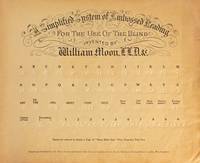
ref. 55674Moon Christmas Annual 1938 title taken from spine label: London: Moon Society a Branch of the National Institute for the Blind 1938. Large oblong folio 28.5 × 34.5 cm. Original blind brown stiff card boards with printed spine label; 85 pp. In lieu of a title page a leaf with transcribed raised alphabet is present: "A Simplified System of Embossed Reading for the Use of the Blind Invented by William Moon L.L.D &c.". Dedication signature to inside front wrapper and an inscription sticker "This book is a gift from the directors of the Moon Society a Branch of the National Institute for the Blind." Boards lightly scuffed and stained toned due to stock. Small chip to "alphabet" page not affecting text. Still about very good. WITH: The Gospel According to St. Mark title taken from spine label: London: Moon Society a Branch of the National Institute for the Blind 1938. Large oblong folio 28.5 × 34.5 cm. Original blind brown stiff card boards with printed spine label; 91 pp. In lieu of a title page a leaf with transcribed raised alphabet is present: "A Simplified System of Embossed Reading for the Use of the Blind Invented by William Moon L.L.D &c.". Sticker to inside front wrapper "Provided by the United States Government through the Library of Congress". Boards lightly scuffed and stained spine starting. Internally chipped and toned due to stock. Still about very good. Two volumes embossed in Moon type a form of raised type for the visually impaired based on the Latin alphabet developed in 1843-1845 by Dr. William Moon 1818-1894. The only non-Braille system that survives to this day Moon type is most popular among the elderly and readers who went blind later in life as was the case with Moon himself. Born in Kent Moon learned to read by sight first before losing his vision completely by the age of 21. With the loss of vision he also gave up his plans to join the clergy becoming instead a teacher for the blind and a philanthropist. As a teacher Moon focused on the development of the new raised type based on the simplified Latin characters which were easier to remember for those who knew letters by sight but were less spatially economical than the Braille system. The first Moon type book appeared in 1847. To promote the new system Moon founded and funded the Moon Society in Brighton Sussex publishing primarily devotional books during his lifetime. His ambitious project to release the entirety of the Bible in monthly instalments was completed in 1858 printed in 60 volumes. The present volume of the Gospel According to St. Mark appears to be a later edition of the original instalment. The volume is likely to be contemporaneous with the 1938 Christmas annual offered alongside it with the library rubber-stamps in the rear dating from 1939 and 1942. The two volumes also have similar binding and labelling differing only in the notation of the numerals on the title leaf. "When Dr. Moon died in 1894 books in his type were printed in 419 languages and dialects" See: Gabriel Farell The Story of Blindness p. 103. The geographic breadth of the use of the Moon type followed British colonial interests in India and China. In the United States the Moon system competed with and superseded the initially more popular embossed Boston Line Type developed in the 1830s and used extensively at the Perkins School for the Blind in Massachusetts which was similarly based on the Latin alphabet. Moon first promoted his system with a traveling tour he undertook in the US with his daughter Adelaide Moon in 1880s. His son the ophthalmologist Robert Moon emigrated to Philadelphia in the same period and continued to promote his father's system by publishing the Moon magazine starting in 1905 and helping to manage the Moon Society until his death 1914. The National Institute for the Blind would take over the Moon Society thereafter. J. Robert Atkinson would undertake the first printing of Moon books in the United States in 1933. The founder of the Braille Institute of America in Los Angeles Atkinson saw the project as an alternative for the few blind readers who preferred Moon type to Braille likely noting the need of immigrants to California from Asia. Despite this undertaking the present volumes were apparently imported to the US from London. As of May 2026 KVK OCLC show one copy of the Gospel According to St. Mark in North America and no copies of the 1938 Christmas Annual with two copies of the 1937 Christmas Annual held in North America. unknown
2019ref. 2081502111907756National Library Publishing Company 2019. Soft Cover. Fine. The book is in fine condition. National Library Publishing Company paperback
ref. 51-3047St. Albans London: F. Sander and J. French for Henry Sothern 1886-1888-1894. Folio 522 x 392. Housed in 4 elegant and massive slipcases of embossed lambskin over linen by the celebrated binder Sasha Mosalov.viii of x 110; viii 106; 8 iii 1 104; viii 24 27-114 pp. 2 Series in 4 volumes; with 192 chromolithograph plates after Henry George Moon W.H. Fitch & A.H. Loch wood-engravings throughout the text. Lacks first volume title page pp. 25/26 in final volume; plates with fresh tissue guards; some toning and edgewear occasional spots more so to verso dampstain in margins of some plates text with occasional foxing and toning some chips and damp staining wrappers with chips around extremities of the text pages which are on brittle pages.OCLC Number: 221762250FIRST EDITION of what Sitwell considers an "important and authoritative work for orchid growers." German-born Sander settled in St. Albans Hertfordshire where he ran a successful nursery specializing in orchids. The above work which was a collaboration with landscape painter Henry G. Moon was named in honor of the renowned German orchidologist Heinrich Gustav Reichenbach. The chromolithographs are among the best of its day with hand-cut blocks and use of up to 20 colors. Great Flower Books p 135.Very Heavy will cost extra for shipping. St. Albans, London: F. Sander and J. French for Henry Sothern, [1886]-1888-1894. unknown
1596ref. 39771Romae Rome: Apud Iacobum Lunam. Impensis Leonardi Parasoli & Sociorum 1596. First edition. Hardcover. poor to vg. Folio 15 1/4 x 10 3/4". 8 705 1pp. Contemporary gilt-stamped calf with gold lettering and tooling to spine. Raised bands. Dentelles. Striking floral design painting to paper edges with head of Christ on fore-edge. Engraved title by Francesco Villamena. Title page in red and black lettering and highlighted in gold. Decorative initials and tailpiece. Dedication to Pope Clement VIII by M. Vestrius Barbianus the Papal secretary. Printer's device on last page. Illustrated with no less than 156 magnificent hand-colored in-text engravings this monumental work is the official and complete liturgy of the Roman Catholic Church. It contains the offices for sacramental and other sacred acts and ceremonies such as baptism communion confirmation ordination matrimony dedication of churches altars bells benediction of crosses sacred vestures burials coronations etc. Also includes numerous liturgical motets in Latin for Masses Te Deum and other religious ceremonies. All the engravings as well as the decorative initials and the printer's device at rear have been splendidly handcolored by a contemporary previous owner. Binding rubbed along edges. Covers detached but present. Title page repaired and re-laid. The first 24 leaves are disbound. Pages 15 to 30 heavily sunned with sporadic holes thus partly affecting text and some illustrations. Minor to moderate age-toning along paper margin for the remaining pages. Text in Latin. Binding in overall poor pages 15-30 in poor to fair the remaining pages in good to very good condition. Apud Iacobum Lunam. Impensis Leonardi Parasoli & Sociorum hardcover