Alexandre de HumboldtLivre Rare Book
731 results
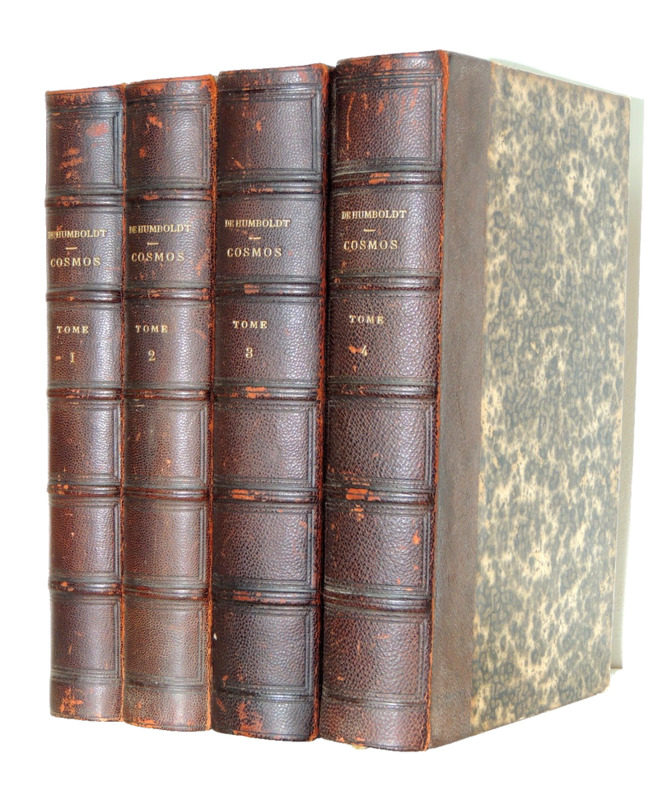
1855ref. CZC-13717Préface : "j'offre à mes compatriotes, au déclin de ma vie, un ouvrage dont les premiers aperçus ont occupé mon esprit depuis un demi-siècle . souvent je l'ai abandonné, doutant de la possibilité de réaliser une entreprise trop téméraire: toujours et imprudemment peut-être, j'y suis revenu et j'ai persisté dans mon premier dessein, j'offre le cosmos, qui est une description physique du monde. les unités de mesure, adoptées dans cet ouvrage sont les unités légales en France . volume spécialement destiné à compléter la partie uranologique du cosmos " Vol. I : Introduction. Le ciel. La Terre. Vie organique. Vol. II : 1re partie : Reflet du monde extérieur dans l'imagination de l'homme - 2e partie : Essai historique sur le développement progressif de l'idée de l'univers. Vol. III (en 2 tomes) : Partie uranologique de la description physique du Monde. Traduit par H. Faye, et Ch. Galusky ( IV), complet en 4 volumes fort in8, demi cuir, 22x14cm, frottements, bel état intérieur, qq rousseurs éparses, 580, 806, 764 et 801pp. Rare Paris, Gide et Baudry 1855-1859
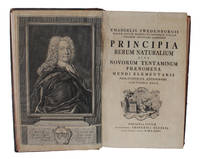
1734ref. 50434Dresden et Leipzig, Frederik Hekelius, 1734. Folio. Contemp. full mottled calf. Upper half of spine rebacked. Raised bands. Lower part of spine gilt. A crack to leather at lower part of fronthinge, cover not loose. Engraved portrait. (16),452 pp. and 28 engraved plates on 26 sheets. A dampstain in upper part of inner margins throughout, otherwise clean and wide-margined. The plates with some browning.
1734ref. 50434Dresden et Leipzig Frederik Hekelius 1734. Folio. Contemp. full mottled calf. Upper half of spine rebacked. Raised bands. Lower part of spine gilt. A crack to leather at lower part of fronthinge cover not loose. Engraved portrait. 16452 pp. and 28 engraved plates on 26 sheets. A dampstain in upper part of inner margins throughout otherwise clean and wide-margined. The plates with some browning. Scarce first edition of Swedenborg's main scientific work. The volume also form part one of his "Opera Philosophica et Mineralia"."In his Principia rerum naturalium Leipzig 1734 probably conceived as a counterpart to Newton’s Principia he sought a comprehensive physical explanation of the world based on mathematical and mechanical principles. While remaining faithful to the general principles of Cartesian natural philosophy which he had learned while studying at Uppsala Swedenborg elaborated upon them. According to his cosmogony the physical reality has developed from the mathematical point which was an entity between infinite and finite. Through a vortical movement implanted on the point a series of material particles developed the "first finiata "the second finita"and so on that eventually led to the cosmos in its present state. In contrast to Descartes Swedenborg believed that the planets had developed from the chaotic solar mass through expansion of its surrounding shell which finally joined to form a belt along the equatorial plane of the sun. It then exploded forming the planets and the satellites. Although the basic construction of Swedenborg’s thought heralded the later planetary theories of Buffon Kant and Laplace there is nothing to indicate that it exerted any direct influence on posterity." DSB.In 1738 Swedenborg's magnum opus was placed on the "Index Librorum Prohibitorum". hardcover
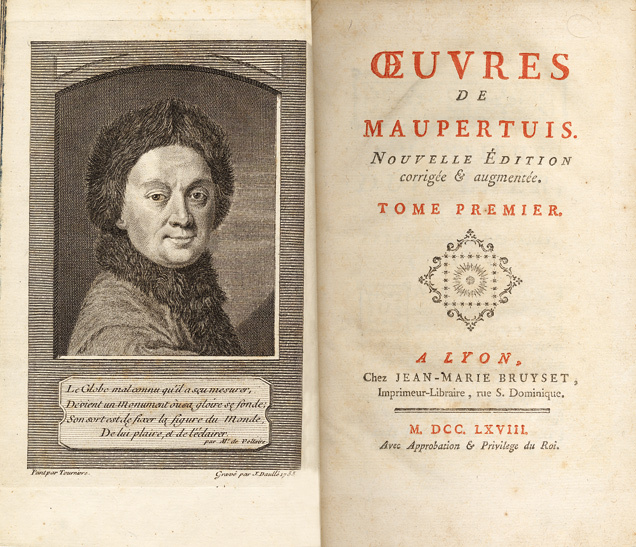
1768ref. 15501Lyon, Jean-Marie Bruyset, 1768 ; 4 tomes in-8 ; veau fauve marbré, dos à faux-nerfs, décorés et dorés, pièces de titre et de tomaison grenat, filet doré sur les coupes, tranches marbrées (rel. de l'époque) ; (4) faux-titre et titre en rouge et noir à chaque tome ; XXXVI, 309, (3) pp. ; IV, 431 pp., (1 bl.), (1) f. blanc ; IV, 468, (4) pp. ; VIII, (12), 346, (4) pp., nombreuses figures ; portrait en frontispice gravé par J. Daullé d'après Tournière et carte hors-texte de l'arc méridien mesuré au cercle polaire au Tome 3.
1532In -folio, due voll. legati assieme; pp. (68), 504, (4); (40), 334, (2). Legatura in piena pelle alle armi di Felipe Ramirez Nuñez de Guzmán de Medina, nervi e titolo al dorso. Questa di Basilea del ’32 è considerata l’ultima e migliore edizione nel Cinquecento in latino delle Genealogie [...] che si deve all’umanista strasburghese Jakob Moltzer. Notevoli le illustrazioni genealogiche a piena pagina in quest’opera che, in vita, diede fama a Boccaccio, i cui lavori in volgare erano considerati una produzione minore. Rilegato con i Saturnalia e il commentario al Somnium Scipionis, le due maggiori opere di Macrobio nell’edizione di Camerario. Numerose illustrazioni nel testo fra cui l’incisione del planisfero macrobiano, diviso in zone climatiche, che costituì per circa un millennio il modello geografico terrestre: nella prima riproduzione a stampa di questa mappa, del 1483, le linee climatiche erano dritte, qui per la prima volta sono curve e rimandano a un modello di terra sferica e non piatta. This Basilea 1532’s edition is considered the last and the best latin edition in XVI century of “Genealogie”: it’s due to austrian scholar Jakob Moltzer. The full page genealogic illustrations are remarkable; this work gave a reputation to Boccaccio while he was still alive, and whose works in volgare were then considered a less important production. Bound with the “Saturnalia” and commentary to “Somnium Scipionis”, the most important Macrobio’s works in Camerario edition. Many illustrations in text: between them the macrobian world map, divided in climatical areas, that was for about 1000 years the geografic Earth pattern: in the first printed reproduction of this map, from 1483, the climatical lines were straight, while here they are bent and they suggest a spheric Earth model.
16115 voll. Folio. viii pp. (incl. frontespizio inciso) + 596 + 607–638; + 252 (ultima carta bianca); + 244 + 84 + 184 (ultima carta bianca); + viii + 340 (ultima carta bianca) + 348 + xx (ultima carta bianca); + viii + 552 + xii + 60 + 244; + xii + 624 (ultima carta bianca) + 124 (ultima carta bianca) + 60 + 20 + 24 pp. Numerosi legni e diagrammi nel testo. Legatura in pelle coeva, dorso dorato. Bruniture omogenee della carta. The evidence of the attempts to leave the Aristotelianism for the modern method and an important proof of the Galileian revolution.Clavius's work includes in addition to commentary on arithmetic and algebra one on Euclid, Teodosio and Sacrobosco; his contribution to the study of trigonometry and astronomy; his work on the calendar. Clavius has been for mathematics in Renaissence a real turning point: “Probably the man who did the most of all the German scholars of the 16th century to extend the knowledge of mathematics… was Cristopher Clavius, a Jesuit, who passed the later years of his life in Rome. He was an excellent teacher… His Algebra appeared in 1608 and was one of the best textbooks on the subject that had been written up to that time… (he was) engaged in the reform of the calendar…” (Smith). Opera Mathematica in his third volume contains the Sphaera in his last editorial, to which Clavius worked during 1610 and which was printed in 1611. Shortly thereafter, in February 1612, Clavius was dying after a period of illness. In March 1610 following his comments on the telescope, Galileo published in Sidereus Nuncius his latest astronomical discoveries. These findings, perhaps only for a lucky snap of dates, are among the topics covered in the review of Sphaera, where Clavius shows to recognize the meaning. Clavius and the Jesuits in those years had to go back to seriously consider the observations of Galileo, and had to acquire the telescope also to repeat the observations and then verify their accuracy. Clavius led directly the observations (especially on the phases of Venus and the moons of Jupiter, but also on the lunar spots) along with a group of young Jesuit mathematicians and astronomers, first of all Grienberger, thus removing, towards the end of his life and following a long friendship with Galileo, his skepticism about the Copernican theory. Galileo himself in a letter to Madame Christina of Lorraine in 1615 wrote that “altri matematici, i quali mossi da gli ultimi miei scoprimenti, hanno confessato essere necessario mutare la già concepita costituzione del mondo, non potendo in conto alcuno più sussistere”. Galilei continues that one of them was just Clavius, and the reference is certainly to the pitch of the Opera Mathematica Tomo III, p. 75, where as the result of the list of Galileo's discoveries, the Jesuit ends “Quae cum ita sint, videant Astronomi quo pacto orbes coelestes constituendi sint ut haec phaenomena possint salvari”. It 's an extraordinary moment in the history of cosmology and Church, which has marked the highlight of the heliocentric theory, which no major scientists, mathematicians and astronomers of the Society of Jesus, thought no more be able to object. As D'Elia notes (pp. 14-15): "The confirmation from him on the discoveries of the astronomer from Pisa and on the copernican interpretation he deduced, had definitive influence and perhaps even dominate, to ensure the discoveries the almost universal acceptance in the intellectual world, even if the disappearance of the old professor and that of several of his closest disciples could not prevent the ecclesiastical Authority’s precept of 1616 and the condemnation of 1633 ". Clavius had even got that Galileo was received at the Roman College, and was himself to "explain" to Cardinal Bellarmine scientific discoveries of Galilei. So while the academic and obviously ecclesiastical circles did not leave officially by the Aristotelian position, a scientist of them, for evidence and intellectual honesty, was preparing the way for the acceptance of Galileo's discoveries, and could do so given the authority of his position, achieved mainly thanks to its capital contribution asked by Gregory XIII to reform the Julian calendar, which led to the drafting of the Gregorian Calendar. Christoph Clavius (Bamberg 1538-1612) Jesuit and mathematician, astronomer, he entered the Jesuit College in Rome in '55 and then went to Coimbra, where he studied mathematics and science; back to Rome to study theology, he remained as a professor for fortyfive years. He became a pivotal figure for the general mathematical and scientific renewal that had in the Compagnia di Gesù a driving force, entering into the main controversies of the time, from the squaring of the circle to the comparison between the Ptolemaic and Copernican theories. He was the master, among other things, of Matteo Ricci, who with the help of his students, translated many works of Clavius in China, including the six books of Euclid's Elements (1574), which had several editions and updates; a work who had an enormous influence, providing a compendium of knowledge on geometry. His other important works were the Commentaries on Sphaera di Sacrobosco, a treatise on spheres’ geometry and astronomy, and work on the astrolabe. He determined the subsequent development of algebra. De Backer & Sommervogel, 2, cols. 1222–3 (with details of contents). DSB, 3, pp. 311–2. D’Elia, Pasquale, Galileo in Cina, Roma, Università Gregoriana, 1947. Jardine, Nicholas. "The Forging of Modern Realism: Clavius and Kepler against the Sceptics." Studies in History and Philosophy of Science 10 (1979): 141-73. Lattis, James M. Between Copernicus and Galileo: Christoph Clavius and the Collapse of Ptolemaic Cosmology. Chicago: University of Chicago Press, 1994 Proceedings of the Symposium on Christoph Clavius (1538–1612), July 21, 2005, University of Notre Dame, Edited by Dennis Snow. D. E. Mungello, Curious land. Jesuit accomodation and the Origins of Sinology, 1985, p. 26. Eberhard Knobloch, Christoph Clavius – Ein astronom zwischen Antike und Kopernikus”, in Cvortrage des ersten Symposions des Bamberger Arbeitskreises Antike Naturwissenschaft und ihre Rezeption, 113-40, Wiesbaden, 1990.