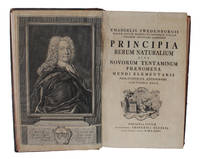
SWEDENBORG, EMANUEL - THE COSMOLOGYBiblio.com
Principia rerum naturalium sive Novorum tentaminum Phaenomena Mundi elementaris philosophice explcandi. Cum Figuris aeneis. 3 Parts.
1734ref. 50434Dresden et Leipzig Frederik Hekelius 1734. Folio. Contemp. full mottled calf. Upper half of spine rebacked. Raised bands. Lower part of spine gilt. A crack to leather at lower part of fronthinge cover not loose. Engraved portrait. 16452 pp. and 28 engraved plates on 26 sheets. A dampstain in upper part of inner margins throughout otherwise clean and wide-margined. The plates with some browning. Scarce first edition of Swedenborg's main scientific work. The volume also form part one of his "Opera Philosophica et Mineralia"."In his Principia rerum naturalium Leipzig 1734 probably conceived as a counterpart to Newton’s Principia he sought a comprehensive physical explanation of the world based on mathematical and mechanical principles. While remaining faithful to the general principles of Cartesian natural philosophy which he had learned while studying at Uppsala Swedenborg elaborated upon them. According to his cosmogony the physical reality has developed from the mathematical point which was an entity between infinite and finite. Through a vortical movement implanted on the point a series of material particles developed the "first finiata "the second finita"and so on that eventually led to the cosmos in its present state. In contrast to Descartes Swedenborg believed that the planets had developed from the chaotic solar mass through expansion of its surrounding shell which finally joined to form a belt along the equatorial plane of the sun. It then exploded forming the planets and the satellites. Although the basic construction of Swedenborg’s thought heralded the later planetary theories of Buffon Kant and Laplace there is nothing to indicate that it exerted any direct influence on posterity." DSB.In 1738 Swedenborg's magnum opus was placed on the "Index Librorum Prohibitorum". hardcover