1,735 results
ref. DADAX0415955548New unknown
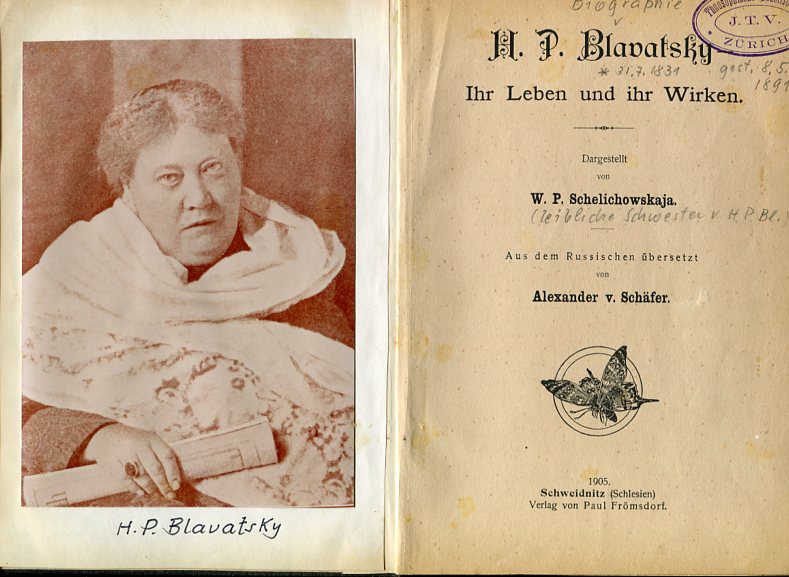
1905ref. SB2836Schweidnitz (Schlesien), Paul Frömsdorf, 1905. "8°, Frontispiz mit aufgeklebtem Foto der Blavatsky, IV, 78, (2 Verlagswerbung) S. und 6 gesonderte Bildtafeln, Textvignetten zwischen den Kapiteln, Rotschnitt, Gewebeeinband mit goldgeprägtem Deckel- und Rückentitel. Befriedigend erhaltene gebundene Ausgabe. Außen gut erhalten, lediglich die Ecken leicht bestoßen. Die Vorsatzpapiere mit Resten von Klebespuren von Tesafilm und Beschädigungen. Auf dem vorderen fliegenden Vorsatz sind die Leihbedingungen der Theosophischen Bibliothek der Züricher TG eingeklebt. Das Titelblatt mit Eintragungen und einem Stempel, vorderes Innengelenk angerissen aber fest, Papier gebräunt und stellenweise stockfleckig, einige Seiten mit kleinen Einrissen im Papier. Eine Seite mit Löchern im Papier aber ohne Textverlust. Im Text finden sich Anstreichungen und gelegentliche Anmerkungen mit Bleistift. Die Klammern sind stellenweise angerostet, eine weitere Bildtafel wurde wohl herausgeschnitten. Ab S. 59 enthält der Band den Aufsatz ""Meine Bücher"" von H.P. Blavtsky. Die Verfasserin dieser Biographie war die einzige leibliche Schwester von Helena Petrovna Blavatsky. Für dieses Werk wird Vorkasse erbeten."
1883ref. 75773Madras: C. Foster and Co. 1883. First edition. Small octavo. 47. 1 pp. Publisher's printed buff wrappers. Some dust-soiling to wrappers else and excellent copy. Only four copies located by OCLC.We in the West tend to think of the Theosophical Society as a new religion practiced almost entirely in Europe and America but in fact there was a very large contingent of Indian Theosophists. Row a Vice-president of the Madras Branch of the the Theosophical Society explains the importance of the movement to him an Indian practitioner and why he joined. C. Foster and Co. unknown
1939In 8, pp. 216. Bruniture al p. ant. Qualche alone alle cc. Br. ed. Pubblicazione di questo ciclo di conferenze di Steiner uscite per la casa editrice Edizioni di Religio fonadata da Ernesto Bonaiuti, prete eretico e filosofo i cui interessi principali erano la filosofia e il misticismo.
1914ref. 7950Adyar Madras: Printed by Annie Besant at the Vesanta Press 1914. First edition. 24x17cm 280pp. Modern Indian binding of full soft red leather ruled in gilt with brown spine label and gilt lettering speckled page edges metallic textured silk endpapers. Samuel Weiser ticket loose in front. Spine a touch sunned boards with a few bumps. Internally clean and near fine. Housed in an orange cloth slipcase. First edition of this translation of the ancient mystical Hindu texts which became foundational to Theosophy. This collection was printed by Annie Besant who was then president of the Theosophical Society in Adyar. Though this edition is fairly widely held by institutions it is seemingly quite scarce in the trade. From the library of Blanche DeVries and Pierre Bernard. Printed by Annie Besant at the Vesanta Press unknown
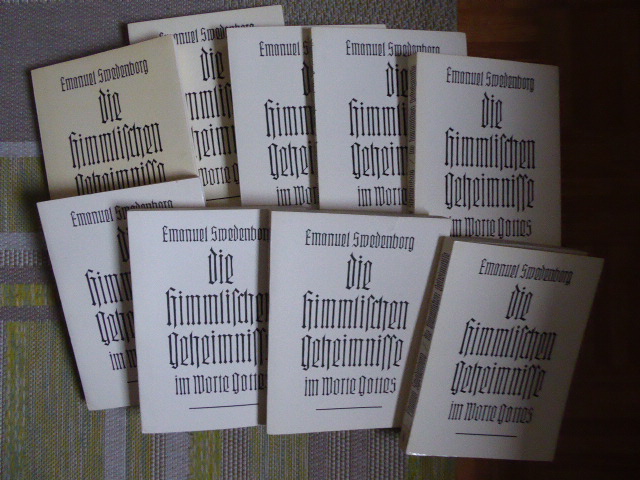
1967ref. 142551Zürich. Swedenborg Verlag. 1967 ff. Komplett selten. 9 Bände. IX, 351 Seiten; 228 Seiten; 359 Seiten; 315 Seiten; 268 Seiten; 353 Seiten; 374 Seiten; 404 Seiten u. 268 Seiten (zusammen 2958 Seiten). Weiße Originalbroschuren (Teils mit geringeren Gebrauchsspuren. Einbände etwas lichtverfärbt). 29x21x18 cm
1929ref. 76692Sydney: Theosophical Society in Australia 1929-30. Edited by C. W. Leadbeater. Monthly. Octavo. Vol. V Nos. 1 2 3 4 5 6 7 8 1929-29. Vol. VI Nos. 1 2 3 4 5 6 1929. Vol. VII Nos. 2 3 5 6 1929-1930. Vol. VIII Nos. 1 3 1930. 20 issues. Printed in blue ink. Each volume is separately paginated. Numerous photographic illustrations. Publisher’s peach wrappers with lettering and decorations in blue. Some abrasion to spines but sturdy and clean throughout.We cannot best Pat Delavaney’s description so we present it here in it’s entirety; “From mid-1928 C.W. Leadbeater was editor of the journal. This was a fairly typical sectional journal of the Adyar Theosophists but its bland contents tolerance child welfare Indian independence practical domestic economy the World Mother messages from Leadbeater Annie Besant C.J. Jinarajadasa etc. conceal and gloss over the bitter internecine strife that preceded it. Dissatisfaction with the direction the Theosophical Society had taken under the guidance of Besant and Leadbeater had begun with Leadbeater's temporary expulsion from the T.S. in 1906 growing out of the accusations of Helen Dennis of Chicago about his "immoral sexual practices" with her son and another boy. Similar charges against Leadbeater and his protege James Wedgwood were made in Australia after World War I principally by Thomas Hammond Martyn - d. 1924 the head of the Sydney Lodge of the Society. Martyn besides his outrage over Leadbeater's and Wedgwood's sexual conduct also played a role in the bitter discussions over whether Besant had or had not said Wedgwood was an initiate -- and over whether she herself was an initiate or merely the dupe of Leadbeater. The furor in Australia centered around the Sydney Lodge and its attacks on the roles of Co-Masonry Krishnamurti the E.S. pederasty ceremonialism the "Back to Blavatsky" movement and the "T.S. Loyalty League." The convention of the Australian Section of the Society in 1922 was split leading to the expulsion of the Sydney Lodge the next year -- though it continued for decades as the Independent Theosophical Society. George Sydney Arundale 1878-1945 who edited this journal was General Secretary of the Australian Section 1926-1928 and went on to become third president of the T.S. in 1934. He was an English Theosophist prominent Co-Mason and bishop in the Liberal Catholic Church and firmly brought Theosophy in Australia back into the Besant-Leadbeater fold.” Krishnamurti broke with Theosophy in early August of 1929 and in the August 15 1929 of this periodical we find the below article - “Krishnaji Dissolved the Order of the Star.” The Order of the Star was the movement within the Theosophical Society that proclaimed Krishnamurti to be the World-Teacher/Messiah. And even before that in the issue of October of 1928 the lead article written by Leadbeater again was “Our Chief and Krishnaji I.e. Krishnamurti and it discusses the growing disparity between the teachings of Krishnamurti and those given by Annie Besant. The Australian Branch of the Theosophical Society was a continuous torn in its side as Leadbeater was determined to co-mingle Theosophy with his new Liberal Catholic Church. A Church found to be sorely lacking by the vast majority of sincere Theosophists. Theosophical Society in Australia unknown
1919ref. 066056London: Theosophical Publishing House 1919. Book. Very Good. Hardcover. 497pp. Olive cloth with gilt spine lettering. Corners bumped mild rubbing to cloth owner notation on fly. Text clean contents remain tight. Theosophical Publishing House Hardcover
1609ref. 15559Ingolstadt, A. Angermeyer, 1609. 1 Bl., 30 Seiten. (Spät.) Umschlag.
1910ref. 512014The Dharma Press 1910. First Edition. Paperback. VERY GOOD. 4 5-55 1 pp. 5x6.5' Sewn binding in brown natural paper French-flap wraps with printed title label to front cover. '2101' inscribed to front cover and beneath author's name on the title page; wrapper spine perished 1' from tail a bit worn around the edges but still mainly intact--remarkable given its fragility. Text clean and sound. Leonard Bosman was a Jewish fellow of the Theosophical Society of London and a prominent writer on the Kaballah and other esoteric fields. Following his teacher Elias Gewurtz Bosman was a prominent voice contending for the Kaballistic roots of Theosophy and the essential compatibility of the two traditions. Mysteries of the Qabalah was the first of six 'Esoteric Studies' in a series projected by the publisher of which only four were published. It was revised and reissued in 1915 and either of these Dharma Press editions are quite scarce this first edition showing only 8 holdings in OCLC. The Dharma Press paperback
ref. 2971A Vienne, chez B. Ph. Bauer, 1813. Un volume relié (9 x 13 cm) d'un frontispice gravé et 219 pages. Reliure plein veau d'époque, dos lisse, plats et dos décorés de frises dorés, papiers de gardes dominotés. Reliure légèrement usée, traces de frottements, une charnière légèrement ouverte, quelques rousseurs. État moyen, mais agréable reliure.
1977ref. 040266India: Theosophical Publishing House 1977. Hardcover. Very Good/Good. 8vo - over 7¾" - 9¾" tall. Compilation of Theosophical Studies on the Angelic Kingdom. First Edition Theosophical Publishing House Adyar India 1977. illus errata xii 370 6pp hb dw pict white dw silver emerald cloth crinkled clear protective cover taped on leaving marks on dw & eps pages browned previous owner's signature vg Theosophical Publishing House hardcover
1869ref. 75650Cincinnati: Robert Clark and Company 1869. First edition. Octavo. 85 1 pp. Original wrappers expertly restored.J. Ralston Skinner was a man of tremendous and far-reaching learning. A denizen of Cincinnati he was deemed an expert on a great many matters. This book his first concerns Newtonian physics gone astray. The theory of Newton that every particle of matter attracts all other particles of matter in right lines joining their centers and in an inverse ratio to the squares of their distances b yvirtue of an inherent force called gravity accounted for the motions of the planets so satisfactorily that it has been almost universally adopted by subsequent physicists as a natural law. In this book he calls into doubt this firmly held theory/"The theory of Newton that every particle of matter attracts all other particles of matter in right lines joining their centers and in an inverse ratio to the squares of their distances bj"virtue of an inherent force called gravity accounted for the motions of the planets so satisfactorily that it has been almost universally adopted by subsequent physicists as a natural law. The latterof the essay in which it is attempted to sustainthe theory are as the author claims merely suggestive; the first part being devoted to the attempt to demonstrate mathematically that the theory of Newton is untenable" Scientific American 1869. J. Ralson Skinner was a die-hard mason and published numerous books of esoteric wisdom; Madame Blavatsky though very highly of him/ "H. P. Blavatsky’s hitherto unpublished letter to James Ralston Skinner is one of great consequence. Despite its relative obscurity evidence of its existence has been previously alluded to by J. D. Buck Modern World Movements and Boris de Zirkoff BCW VIII 220. Blavatsky herself mentioned the recipient of the letter on numerous occasions clearly revealing her admiration of his great learning as demonstrated in his ”wonderfully clever and erudite volume The Source of Measures” BCW XIII 258. Indeed it is no accident that Skinner is “constantly mentioned” in The Secret Doctrine. In his overview of letter’s recipient Assistant Editor Jerry Hejka-Ekins has observed that both the author and his Source of Measures are mentioned more often in The Secret Doctrine than any other author with the exception of Plato a remarkable observation given the relative obscurity of both Skinner and his work. It is no surprise that John Drais considered the book important enough to compile his Index of Hebrew and Numerical Terms contained in The Source of Measures by J. Ralston Skinner." Theosophical History January 2023. Robert Clark and Company unknown
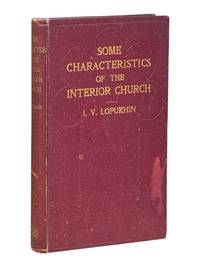
1912ref. 10203London: The Theosophical Publishing Society 1912. First edition in English. 8vo 135 1pp. Folding chart at front translation by D.H.S. Nicholson introduction by A.E. Waite. Publisher's maroon cloth lettered in gilt and decorated in blind. Few stains to boards neat ownership signature to ffep. Very good. Scarce English translation of this text by the Russian mystic and Freemason Ivan Lopukhin 1756-1816 originally published in 1798. Lopukhin's work sets out his conception of the invisible spiritual church that exists beyond outward religion. Self-denial purification surrender of will spiritual rebirth divine union etc. are all discussed as paths to this "interior Church." Waite's introduction draws connections between the mysticism of Lopukhin and Karl von Eckartshausen Kabbalah and other hermetic traditions. The Theosophical Publishing Society unknown
1886ref. 147868Rochester New York: Occult Word Press 1886. First and only edition of this theosophical short story. The Occult Word ran between 1884 and 1889 "for the dissemination of oriental knowledge and the new light from India". The journal was edited by Josephine Cables Aldrich 1843-1917 who founded the Rochester Brotherhood and the first US branch of the Theosophical Society and was the Hermetic Brotherhood of Luxor's eastern US representative. A friend of Susan B. Anthony she also co-founded the Woman's National University and School of Useful and Ornamental Arts. Although the pamphlet is undated it was advertised in volume seven of The Theosophist in 1886. "Written for The Occult Word" it likely first appeared in the journal but there are no extant copies from the year of its probable publication. WorldCat records only two copies of the pamphlet: Cincinnati and Hamilton County Public Library and the University of Alabama. Small octavo pp. 14. Original printed wrappers sewn at fold. Creased and lightly soiled front wrapper foxed: in very good condition. Gomes 1794. unknown
1950ref. 9014London U.K.: Various 1950. 30 publications journals monographs offprints generally 8x6" or smaller various paginations. Staple bound in wrappers occasional illustration or diagram. Several pamphlets with wrappers detached many chipped along edges few ownership signatures. All complete and good or better. Housed in a beat up open box labeled "T.R.C. Pamphlets. Very interesting collection of esoteric health and science pamphlets many of which deal with the Anti-Vivisectionist movement of the first half of the 20th century. The holistic view of health and belief in the spiritual evolution of all living things which were core tenets of Theosophy provided a natural link to the Anti-Vivisectionist movement as well as that of women's suffrage. Several prominent Theosophists of the time took up both of these causes including Anna Kingsford Mabel Collins Gertrude Baillie-Weaver and others. The Theosophical Research Centre was founded in the 1920s as a reorganization of the Theosophical World University. Its members included doctors psychiatrists and scientists who carried out research on scientific supernatural religious and philosophical subjects in relation to Theosophy and published their findings. This collection includes: Proteus: A Journal of the Science Philosophy and Therapy of Nature Nos. 1-4 and 6 1931-32 The Art of Breathing by F.E. Pearce League of Healing N.D. Health and Nervous Stability by William Watson League of Healing N.D. Slip signed by the author laid in. Unseen Aspects of the War and Super-Physical Science by A.P. Sinnett. Theosophical Pub. Soc. 1916 1917 Diet As A Basic Cause of Disease; The Problem of Antiseptics; Pernicious Anaemia; The Problem of Infection; The "Schick" Inoculation.2 copies; Some Little-Understood Effects of Serum Therapy; The Basic Principles of Health and Disease; The Futility of arguing.; Diet as a Basic Cause of Disease; Justice to the Sub-Human Kingdoms of Nature; Vivisection in the Light of Philosophy signed; Why Experiment on Animals; Influenza: A Criticism; and Acute Poliomyelitis all by M. Beddow Bayly. Generally 1930s offprints. Pathogenesis and Immunity by William F. Koch Offprint 1939 A Brief Survey of Medical History. by Heracles Offprint 1935 Cosmic Creation and Atomic Energy by V. Wallace Slater. Theosophical Pub. House 1950 An Intro. to the Study of Analytical Psychology by Laurence J. Bendit and Phoebe Bendit. TRC 1947 De Beweging voor een Theosofische Wereld-Universtiteit by J.J. Poortman. 1927. Crookes Digest September 1948-December 1948 No. 12 The Regulation Between Thought and Action by Emile Boutroux. Oxford 1918. In all an interesting assemblage containing several quite scarce Theosophical publications with ties to the TRC. . Various unknown
1884ref. 76074Madras: Madras Christian College Magazine 1884. First edition of this infamous report. Extracted from the November 1884 issue of the Madras Christian College Magazine one suspects that this article comprised the entirety of the issue. Octavo. 112 pp. entirely devoted to this report by Emma Coulomb which severely damaged the Theosophical movement. Contemporary ersatz binding of plain brown wrappers with lighter brown taped for spine front cover with a paper label bearing the title in manuscript. Hinges reinforced. With the bookplate of noted 20th century magician Stanley Collins.A very good copy of the exceedingly rare publication.Blavatsky met Emma and Alexis in 1871 in Cairo. They founded the short-lived Societe Spirite. In August 1879 Emma and Alexis contacted Blavatsky because they had financial problems. They were stranded in Sri Lanka and Blavatsky helped them to get to Bombay and tried to find a job for them. As she could not find a job for them she provided them with a position in the Theosophical Society where they did various chores such as cooking and gardening. In February 1884 Blavatsky and H. S. Olcott travelled to Europe. Prior to their departure Emma had occasion to see what she considered to be fraud on the part of Blavatsky. Blavatsky was rightly famous for introducing the concept of Hidden Masters and their importance in Mankind's crawl toward apotheosis. Traditionally celebrants would seek the advice of a revered Ascended Master through Blavatsky. When Blavatsky asked a question the illuminati would send an answer down apparently originating in midair. Emma claimed to have gone to the room above where Blavatsky was hosting a seeker and she said she saw Blavatsky's assistant in that room dropping little slips of paper through a crack in the ceiling. After their departure a conflict between the Coulombs and the Theosophical Society escalated. The Coulombs tried to blackmail and threaten Blavatsky whereupon Blavatsky dismissed them.After the Coulombs were dismissed they went to their Christian missionary friends of the Free Church of Scotland and gave them letters that were allegedly written by Blavatsky to Emma. These letters suggested that Blavatsky was a fraud. The chaplain George Patterson published extracts from these letters in the Madras Christian College Magazine presented here The incident became well known all over India and also in America and Europe. Blavatsky immediately published a reply in several newspapers. Blavatsky and Olcott then traveled back to India at the end of 1884. Soon afterwards the Hodgson Report was published which further damaged Blavatsky's reputation. The Hodgson Report was an 1885 report by the Society for Psychical Research SPR on Helena Blavatsky and purportedly fraudulent Mahatma Letters. According to OCLC there is not record for the copy here presented. After wading throuh a miasma of red tape we think that there was a report issued in London in 1885 with a title page reading "Some account of my Intercourse with Madam Blavatsky" that followed the original report issued by the Madras Christian College Magazine in 1884 an obvious extract with the title page reading "Some Account of My Association with Madame Blavatsky. In either case it is exceeding rare with no copy ever ever having come up at auction and none ever offered in the trade that we could find. Madras Christian College Magazine unknown
1929ref. 76701Point Loma: The Theosophical Society 1929-35. Edited by G. de Purucker. Monthly. Small octavo. Vol. I Nos. 1-12; Vol. II Nos. 1 2 5 8 9 10 11 12: Vol. III. Nos. 1 2 3 4 7 8 9 10 11 12; Vol. IV. Nos. 1 2 3 4 6 7 10 11; Vol. V Nos. 3 4 5 8 10 11 12: Vol. VI. Nos. 1 2 4 6 7 8 9 10 11 12; Vol. VII Only 1 2 & 4 are present. Fifty-seven issues. Each volume is separately paginated. The wood pulp paper used in the first two years is truly execrable-About half of these issues have problems e.g. on Vol. I No. 1 the last two pages have broken in half a few with wrappers loose edges chipped. They upgraded the paper stock for the later years. A very good and early assemblage.Katherine Tingley founded the Theosophical Society's main U.S. branch at Point Loma California in 1900. After her death in 1929 Gottfried de Purucker took over as leader of that community. He was a much more dedicated researcher and writer and he is still highly thought of in theosophical circles. He authored many works including The Esoteric Tradition and Studies in Occult Philosophy. He sold the Lomaland estate in 1942 and moved the branch’s headquarters to Covina but died within months of the move. The Theosophical Society unknown
1931ref. 76697Los Angeles: The Theosophy Company 1931-1942. Edited by John Garrigues. Monthly. Octavo. Vol. XX; Nos. 1 2 3 4 7 8 9 10 11 12 1931-1932; Vol. XXI. Nos. 1-12 1932-1933; Vol. XXII Nos. 3 4 5 6 7 8 9 10 11 12 1934-1935; VOL. XXVI Nos. 8 10 1928; Vol. XXVII Nos. 1-12 1938-1939; 52 issues plus 9 odd issues from 1940-1946. 6 issues with their covers off but present and 3 with stains to the front cover. Very good overall. This was the mouthpiece of the United Lodge of Theosophists formed by Robert Crosbie in 1909. Crosbie was a student of William Judge who headed the American Division of the Theosophical Society. With the death of Blavatsky the leadership was thrown into disarray with Annie Besant heading the International Society and Katherine Tingley the American Society. In 1900 Crosbie threw his lot in with Tingley and moved to Lomaland but by 1904 he had grown disillusioned with her increasing theatricality and moved to South Pasadena and 5 years later founded the ULT. The United Lodge adhered tightly to the teachings of Blavatsky and paid no attention to either Tingley’s Kingdom in San Diego nor to the Maitreya of Annie Besant. In every issue they state “This Magazine is an independent journal unconnected with any theosophical society or other organization.” The ULT is likely the most active remaining theosophical group in the world. The Theosophy Company unknown
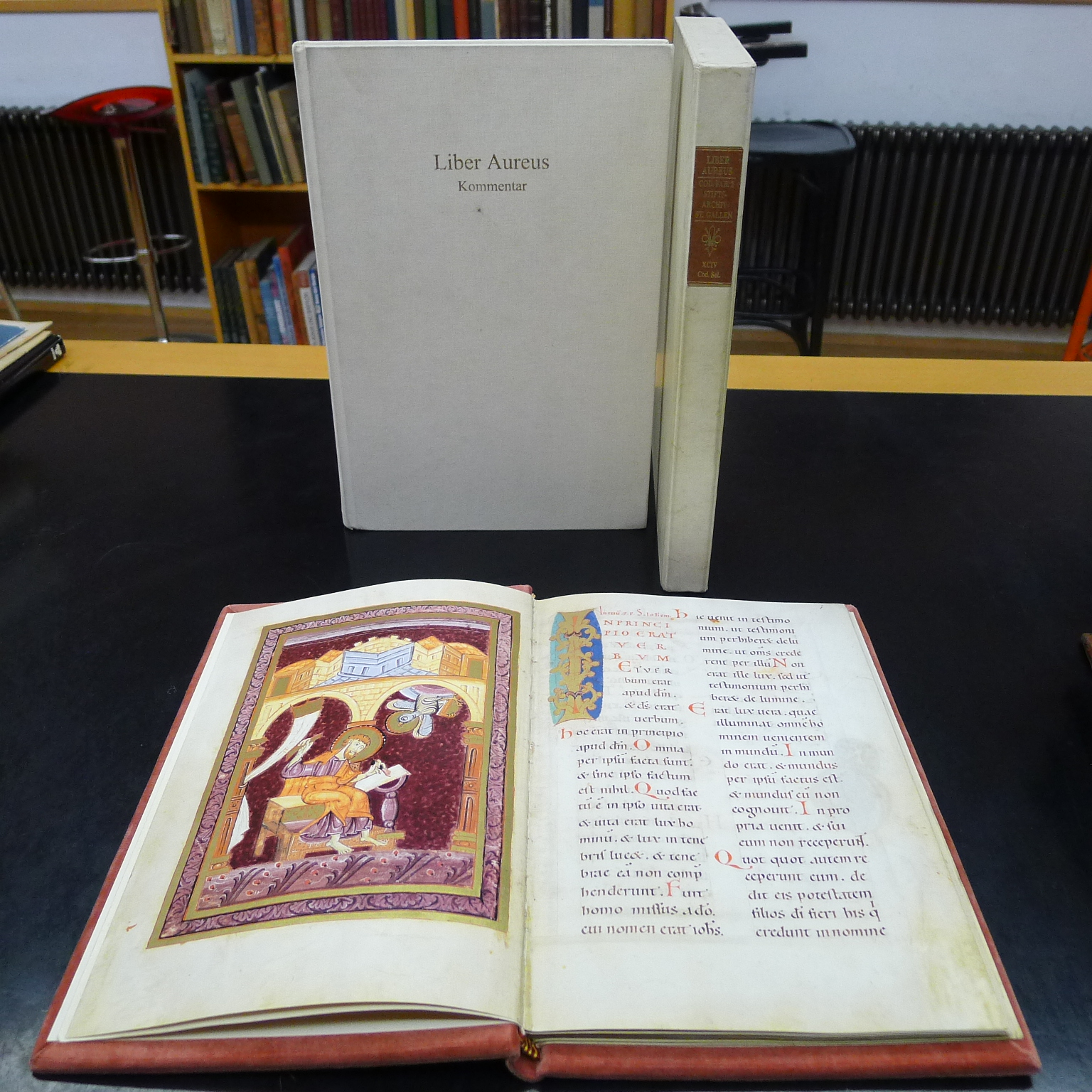
1993ref. 19855ABGraz, Akademische Druck- und Verlagsanstalt, 1993. Folio 52 Bl.+ 219 S. Original Samteinband und Original Leineneinband mit Original Schuber, Einband Zwei Bände Minimalen Gbrsp. Codices selecti, 94.
1720ref. 10778(Ohne Ort und Drucker), 1720. 390 S. Kl.-8°. Ldr. des 18. Jahrhunderts (etw. beschabt und bestoßen).
1782A Edimbourd (Lyon), 1782. In-8 relié plein veau de l'époque, dos lisse très ornés de filets et fleurons dorés, pièce de titre rouge. Divisé en deux parties : 276 + 244 pages + avis des éditeurs + errata + table. Reliure légèrement frottée, coins émoussés, petit manque en coiffe, mors du 1er plat légèrement fendu en partie supérieure sur 4 centimètres. Louis Claude de SAINT-MARTIN, dit LE PHILOSOPHE INCONNU, écrivain , théosophe et philosophe de l'école dite ILLUMINEE, né à AMBOISE (Loir et Cher). Sa rencontre avec Martinez PASQUALIS, juif converti au christianisme, l'entraina vers l'initiation aux mystères de la secte des illuminés. Il s'intéressa particulièrement aux sciences occultes et à la philosophie transcendante. Dans l'ouvrage que nous proposons ici, l'auteur se réfère constamment aux symbolisme du Tarot. Son livre est d'ailleurs divisé en 22 chapitres, comme le nombre des cartes du Tarot. Cf. LAROUSSE XIXme qui lui consacre une très importante et intéressante notice. Malgré les défauts signalés bel exemplaire, grand de marges. Rare.
1838ref. 111383Paris, Ab. Cherbuliez, Libraire, Alex. Johanneau, impr. H. Fournier et Comp., à Paris 1838 In-8 22 x 13,5 cm. Broché, couverture bleue, titre en noir sur le dos et le premier plat, XVI-569 pp., bibliographie. Exemplaire bien complet du frontispice, un diagramme colorié expliquant le temps et l’éternité, et p. 331, d’une reproduction d’une curieuse médaille en or à l'effigie du Christ, qui passe pour avoir été frappée l'année même de sa mort par un de ses disciples pour les douze apôtres. Bon exemplaire, pages non coupées, de la première édition française d’un ouvrage d’une relative rareté, véritable traité de théosophie transcendante, à la lumière duquel l'auteur a pu élucider d'une façon pénétrante la doctrine essentielle des évangiles.
ref. 052781Paris Ab. Cherbuliez, Libraire, Alex. Johanneau, imprimerie de H. Fournier et Comp. 1838 in 8 (24,5x16) 1 volume broché, couverture de papier illustrée d'un diagramme, frontispice et page de titre illustrés d'un diagramme colorié à l'aquarelle, XVI et 569 pages, les pages 429 à 432 coloriées en 2 colonnes jaune et bleue, la page 331 est illustrée d'une reproduction d'une curieuse médaille en or à l'effigie du Christ, non coupé, non rogné. Bel exemplaire, tel que paru ( Photographies sur demande / We can send pictures of this book on simple request )