1979Scholar's bookplate to ffep (Philippa Goold). DJ spine a bit sunned. ; This book brings together a wealth of out-of-the-way information both on the national peculiarities of the Romans and on their views of the peculiarities of others; the topics range from food and sex habits to astrology and the seven day week, from slavery, snobbery and the problems of exile to ritual murder, euthanasia and suicide. ; 10.25 x 1.25 x 6.5 Inches; 310 pages
1979Book has very light shelfwear. Dustjacket has light shelfwear. DJ spine a bit sunned. ; This book brings together a wealth of out-of-the-way information both on the national peculiarities of the Romans and on their views of the peculiarities of others; the topics range from food and sex habits to astrology and the seven day week, from slavery, snobbery and the problems of exile to ritual murder, euthanasia and suicide. ; 10.25 x 1.25 x 6.5 Inches; 310 pages
1979Book has very light shelfwear. ; This book brings together a wealth of out-of-the-way information both on the national peculiarities of the Romans and on their views of the peculiarities of others; the topics range from food and sex habits to astrology and the seven day week, from slavery, snobbery and the problems of exile to ritual murder, euthanasia and suicide. ; 10.25 x 1.25 x 6.5 Inches; 310 pages
2015New Turkish Paperback. Roy. 8vo. (21 x 14 cm). In Turkish. 352 p. Emevîler'in sonuna kadar Islam cografyasinda Mecusîler. The Mazdaism in the Islamic geography until fall of the Umayyads.
1988Still wrapped in plastic. ; 340 pages; Part I: Responses from Within HInduism: 1. Gandhi and Religious Pluralism; 2. The Responses of the Brahmo Samaj; 3. The Response of the Arya Samaj; 4. The Response of the Ramakrishna Mission; 5. The Response of Sri Aurobindo and the Mother; 6. The Response of Swami Bhaktivedanta; 7. The Response of Modern Vaisnavism; 8. Saiva Siddhanta and Religious Pluralsm; 9. India's Philosophical Response to Religious Pluralism; Part II: Responses from Other Religious Within India: 10. Parsi Attitudes to Religious Pluralism; 11. Modern Indian Muslim Responses; 12. The Sikh Response; 13. A Modern Indian Christian Response; 14. The Response of the Dalai Lama and the Tibetan Community in the Indian Exile;
1910Former owner's name on ffep. Pencil notes to back endpaper. Light foxing throughout text. Pencil underlining on a few pages. Edgewear to extremities. ; Excellent treatise on Paganism and its decline and the rise of early Christianity. ; 359 pages
1999Zeus and the other gods of shining Olympus were in reality divine only by popular consent. Over the course of time Olympian luster diminished in favor of religious experiences more immediate to the concerns of people living in an increasingly cosmopolitan ancient world. These experiences were provided by the mysteries, religions that flourished particularly during the Hellenistic period and were secretly practiced by groups of adherents who decided, through personal choice, to be initiated into the profound realities of one deity or another. Unlike the official state religions, in which people were expected to make an outward show of allegiance to the local gods, the mysteries emphasized an inwardness and privacy of worship within a closed band of initiates. In this book, Marvin W. Meyer explores the sacrifices and prayers, the public celebrations and secret ceremonies, the theatrical performances and literary works, the gods and goddesses that were a part of the mystery religions of Greece in the seventh century B. C. To the Judaism and Christianity of the Roman world of the seventh century A. D.; 9.0 X 6.1 X 0.7 inches; 280 pages
1999Minor creasing to front wrap. A few pages have pencil underlining. ; This is a book about the religious life of the Greeks from archaic times to the fifth century AD, looked at in the context of a variety of different cities and periods. Simon Price examines local practices and concepts in the light of general Greek ideas, relating them to such issues as gender roles, political life, and the trial of Socrates. He lays emphasis on the reactions to Greek religions of ancient thinkers--Greek, Roman and Christian. The evidence drawn on is of all kinds: literary, inscriptional and archaeological. ; Key Themes in Ancient History; 230 pages
1967Light dampstaining in outer margin and to front wrap, not affecting the text, else VG; 85pp, illustrated. ; Transactions of the American Philological Association Vol. 57, Part 5, 1985; 4to - over 9¾" - 12" tall; 85 pages
1901Ownership name to ffep. Wraps tattered, browned and smudged, a few pencil notes. ; Diss. Wisconsin, 1900. Pp 221-329, a few plates. A study of religious beliefs in ancient Rome and the genesis of the Great Mother goddess cult during the reign of Lucius Tarquinius Superbus (535-496 BC. ) ; Diss. Bulletin of the University of Wisconsin No. 43. Philology and Literature Series, Vol. 1, No. 3, 1901; 108 pages
1983Minor shelfwear to book. Scholar's blindstamp and name to half-title (Robert Brown). DJ has minor edgewear. ; Illustrated with 126 photographs, 40 being in colour, map of Ancient greece. ; 4to 11" - 13" tall; 216 pages
1983Light underlining and marginalia (lines) in black ink. DJ has small piece missing at bottom front corner of DJ and small tear to top corner of DJ.. Large tear to top back corner of DJ. ; Illustrated with 126 photographs, 40 being in colour, map of Ancient greece. ; 4to 11" - 13" tall; 216 pages
1991Abhandlungen Der Heidelberger Akademie Der Wissenschaften. Philosophisch-Historische Klasse Jahrang 1991 - 3 Abhandlung; 45 pages
1946réf. 986051946 Numéro 14 - Novembre 1946 - Rédaction de la Revue d'Information : Cabinet du Général Commandant Supérieur des T.O.A. - revue illustrée - broché - 64 pages
1936réf. 10472ÉDITIONS SPES PARIS 1936 303 pages in8. 1936. broché. 303 pages. Ouvrage religieux de l'auteur jésuite Albert Bessières publié par les Éditions Spes en 1935 qui aborde le thème du paganisme à travers les figures bibliques de Jean-Baptiste et Hérodiade. Le livre présente une reliure en cuir et provient d'une bibliothèque religieuse
2016New English Paperback. Pbo. Demy 8vo. (21 x 14 cm). In Turkish. 272 p. Saman gözü: Yaratanin teni dogadir. A study on shamanic rituals.
1976Pages tanned. Minor shelfwear. ; Petite Bibliothèque Payot; 343 pages
1989Minor shelfwear. Scholar's name to ffep (Robert Brown). Edgewear to wraps with a bit of Chipping. Ffep creased. ; 411 pages
1976DJ spine a bit sunned. Some creasing to DJ. Signed by author to copyright page. Colour loss along spine. ; 159 pages; Signed by Author
1973Very light shelfwear to book. Dustjacket has minor shelfwear and rubbing. DJ spine sunned. DJ is price-clipped. ; More perhaps than any other single writer, Plutarch has been responsible for transmitting to Europe the central historical and moral traditions of classical antiquity. His books have been a formative influence in western civilisation; they retain a direct appeal to which it is easy to respond. Mestrius Plutarchus (ca. 46- 127) was a Greek historian, biographer, and essayist. Born in the small town of Chaeronea, in the Greek region known as Boeotia, probably during the reign of the Roman Emperor Claudius, Plutarch travelled widely in the Mediterranean world, including twice to Rome. Due to his parents' wealth, after 67, Plutarchus was able to study philosophy, rhetoric, and mathematics at the Academy of Athens. He had a number of influential friends, including Soscius Senecio and Fundanus, both important Senators, to whom some of his later writings were dedicated. He lived most of his life at Chaeronea, and was initiated into the mysteries of the Greek god Apollo. However, his duties as the senior of the two priests of Apollo at the Oracle of Delphi (where he was responsible for interpreting the auguries of the Pythia or priestess/oracle) apparently occupied little of his time - he led an active social and civic life and produced an incredible body of writing, much of which is still extant. ; Classical Life and Letters; 183 pages
1980Minor shelfwear. Former owner's name to half-title. ; University Paperbacks 775; 242 pages
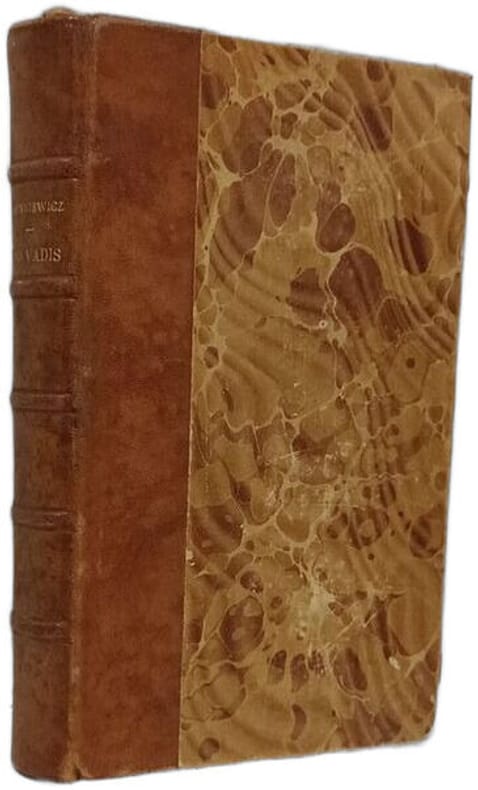
1901réf. 100149040P. Lethielleux Libraire-Éditeur 1901 in12. 1901. Cartonné. Quo Vadis est un roman historique de Henryk Sienkiewicz publié en 1895 qui raconte l'histoire d'amour entre le patricien romain Marcus Vinicius et la jeune chrétienne Lygie sur fond de persécutions des chrétiens sous le règne de l'empereur Néron à Rome au Ier siècle. L'œuvre dépeint la vie quotidienne l'organisation sociale et les excès de la Rome antique des jeux du cirque aux fêtes des puissants
1972réf. 145565Mainz: Akademie der Wissenschaften und der Literatur & Wiesbaden: In Kommission bei Franz Steiner Verlag GmbH 1972. 20 Seiten. Gr. 8° (22,5-25 cm). Orig.-Broschur. [Softcover / Paperback].
1995Light wear to corners. Pencil marginalia to a few pages. ; Interest in goddess worship is growing in contemporary society, as women seek models for feminine spirituality and wholeness. New cults are developing around ancient goddesses from many cultures, although their modern adherents often envision and interpret the goddesses very differently than their original worshippers did. In this thematic study of the Roman goddess Ceres, Barbette Spaeth explores the rich complexity of meanings and functions that grew up around the goddess from the prehistoric period to the Late Roman Empire. In particular, she examines two major concepts, fertility and liminality, and two social categories, the plebs and women, which were inextricably linked with Ceres in the Roman mind. Spaeth then analyzes an image of the goddess in a relief of the Ara Pacis, an important state monument of the Augustan period, showing how it incorporates all these varied roles and associations of Ceres. This interpretation represents a new contribution to art history. With its use of literary, epigraphical, numismatic, artistic, and archaeological evidence, The Roman Goddess Ceres presents a more encompassing view of the goddess than was previously available. It will be important reading for all students of Classics, as well as for a general audience interested in New Age, feminist, or pagan spirituality. ; 308 pages
1897réf. 96BlAbbeville Paillart 1897 In12 374 pages - broché - couvertures defraichies sans gravité - dos non d'origine - etat satisfaisant