Debray, (Régis ) Langlois (Claude), Delumeau (Jean ), Menasseyre (Christiane), CollectifLivre Rare Book
755 Ergebnisse
Best.-Nr. 17056Canopé - Crdp De Versailles, 2003. Broché, couverture souple au format 241 x 160 mm, 375 pages, très bon état
1934Best.-Nr. 1258451934 L'Artisan du Livre, Paris - MCMXXXIV (1934) - In-8 broché - 519 pages
1987Best.-Nr. 3995Paris Presses de la Sorbonne 1987 In-8 (h. 24 cm.) 222 pp. couverture souple.
1942Best.-Nr. LFA-126721125Revue de 56 pages, format 140 x 215 mm, reliée cartonnage, bon état, rare
1998Best.-Nr. GITe206Paris Picard 1998. In-8 broché couverture illustrée 207pp. Nombreuses illustrations dans le texte et 18 hors texte en couleurs. Bel exemplaire frais et bien complet.
1889Best.-Nr. GITk425Paris Hachette 1889. In-8 3 feuillets non chiffrés 4-376pp 2 feuillets non chiffrés (épilogue, table). Demi chagrin vert, dos à 4 nerfs orné d'un triple cadre de filets dorés dans les entrenerfs, plats de papier chagriné vers avec encadrements de ilets à froid, tranches dorées, reliure de l'époque. Orné d'un beau frontispice par Tony Johannot, gravé sur acier. Quelques pâles rousseurs. Bel exemplaire complet dans une reliure en bon état et décorative. (5128)
in-8 broché, 374 pp. Bibliographie, index. Très bel exemplaire. [MI-17]
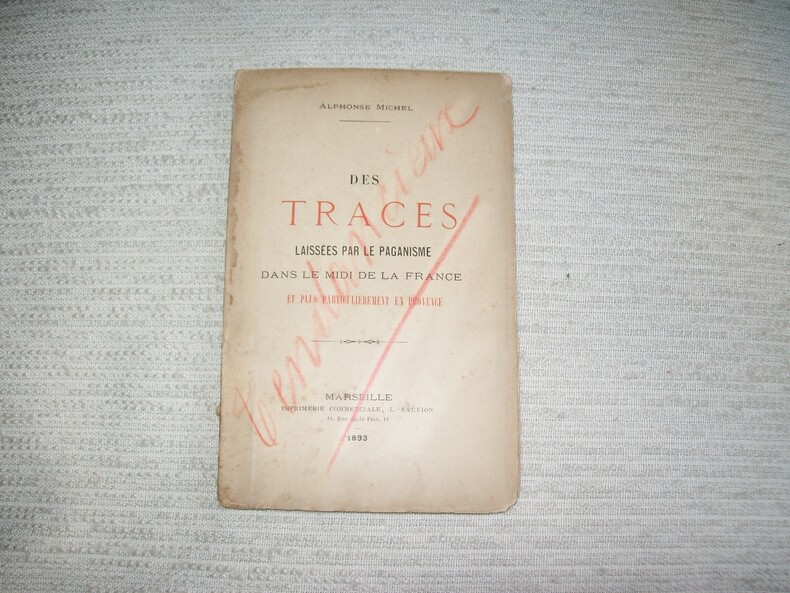
1893Best.-Nr. GITk255Marseille Imprimerie Commerciale Sauvion 1893. In-12 broché titre imprimé en rouge et noir 2 feuillets non chiffrés 112pp. Inscription au crayon rouge en travers du 1er plat de la couverture, auréole ancienne en marge des pages 71 à 76, puis mouillure importante de la page 92 à la page 112.
1937Tears to wraps at spine ends. Browning to wraps. Light tanning to pages. ; Contents: Egyptian Cults in Athens- Sterling Dow; apology of Aristides- a Re-Examination - Robert Lee Wolff; the 'Plain Meaning' of Isaiah 42.1-4. Index of Volumes I (1908) - XXX (1937).
1979Spine sunned. Foxing/dustsoiling to top of textblock. ; SR Supplements 7; 274 pages
1998Publications D'Histoire De L'Art Et D'Archeologie De L'Universite Catholique to Louvain XCVII / Archaeolgia Transatlantica XV; 10.8 X 8.4 X 0.1 inches; 114 pages
2008Minor indents to upper edges of wraps. Else minor shelfwear. ; What do Greek myths mean and how was meaning created for the ancient viewer? In Art, Myth and Ritual in Classical Greece, Judith Barringer considers the use of myth on monuments at several key sites – Olympia, Athens, Delphi, Bassai, and Trysa – showing that myth was neither randomly selected nor purely decorative. The mythic scenes on these monuments had meaning, the interpretation of which depends on context. Barringer explains how the same myth can possess different meanings and how, in a monumental context, the mythological image relates to the site and often to other monuments surrounding it, which redouble, resonate, or create variation on a theme. The architectural sculpture examined here is discussed in a series of five case studies, which are chronologically arranged and offer a range of physical settings, historical and social circumstances, and interpretive problems. Providing new interpretations of familiar monuments, this volume also offers a comprehensive way of seeing and understanding Greek art and culture as an integrated whole. ; 8vo 8" - 9" tall; 284 pages
1898Best.-Nr. R48510Paris, Auteuil 1898 v + 127 + iii pp., br.orig., 19cm.
1987Originally published in 1912. Contents: The Amazons in Greek Legend; The Great Mother; Ephesian Artemis; Artemis Astrateia and Apollo Amazonius; Ares; conclusion; Bibliography ; 84 pages
1963Scholar's blindstamp to ffep and bookplate to inner cover (Robert Brown). Staining to top of spine. Some tears to wraps especially at base of spine. Some creasing to wraps. Light pencil marginalia. ; Les Grands Penseurs; 348 pages
1982General shelfwear. ; Thesis in Dutch. ; 293 pages
1972Book has minor shelfwear and rubbing. ; Reprint of 1911. Chapters Include: Rome and the Etruscans; Rome and Greece: The Religion Of Superstition And The Decline Of Faith; Religion Of The Early Empire; Constantine And Christianity; Julian called the Apostate: Twilight of the Gods; Augustine And The City Of God; Benedict And The Ostrogoths; Gregory And The Lombards: The Preparation For The Holy Roman Empire. ; 270 pages
1994Foxing to top of textblock. ; Rich with implications for the history of sexuality, gender issues, and patterns of Hellenic literary imagining, Marcel Detienne's landmark book recasts long-standing ideas about the fertility myth of Adonis. The author challenges Sir James Frazer's thesis that the vegetation god Adonis-- whose premature death was mourned by women and whose resurrection marked a joyous occasion--represented the annual cycle of growth and decay in agriculture. Using the analytic tools of structuralism, Detienne shows instead that the festivals of Adonis depict a seductive but impotent and fruitless deity--whose physical ineptitude led to his death in a boar hunt, after which his body was found in a lettuce patch. Contrasting the festivals of Adonis with the solemn ones dedicated to Demeter, the goddess of grain, he reveals the former as a parody and negation of the institution of marriage. Detienne considers the short-lived gardens that Athenian women planted in mockery for Adonis's festival, and explores the function of such vegetal matter as spices, mint, myrrh, cereal, and wet plants in religious practice and in a wide selection of myths. His inquiry exposes, among many things, attitudes toward sexual activities ranging from "perverse" acts to marital relations. ; Mythos: the Princeton/ Bollingen Series in World Mythology; 256 pages
2006Very light shelfwear. ; The first book to capture a complete picture of the most important of Greek gods in one reliable volume for almost seventy years, this masterly and comprehensive study brings a new-millennium examination of the fascinating god Zeus. Broad in scope, the book looks at myth, art, cult, philosophy, drama, theology and European painting amongst much more, and allows us to take seriously what it was to worship and respect the greatest of Greek gods, and to live through the aftershock of the Middle Ages and modern times. Showing the evidence along the way, Zeus is student-friendly and includes: a range of illustrations and maps translated passages from ancient authors a chronology and excellent indexing. Looking at the ancient Greeks their predecessor and their successors – the Romans and beyond – the book is engagingly written and speaks to a modern audience: this is Zeus from our remote ancestors to Wagner, and into the computer age. ; Gods and Heroes of the Ancient World; 192 pages
1996Very light shelfwear else fine; Vol. 2; 1.5 x 8.9 x 5.98 Inches; 424 pages; Early Greek Myth is a much-needed handbook for scholars and others interested in the literary and artistic sources of archaic Greek myths -- and the only one of its kind available in English. Timothy Gantz traces the development of each myth in narrative form and summarizes the written and visual evidence in which the specific details of the story appear.
2005New Persian Paperback. Roy. 8vo. (24 x 17 cm). In Persian, with a bilingual title in English and Persian on cover. [xi], 291 p., ills., maps. Short history of ancient and primitive religions.= Târîkh-i adyân-i ibtidâ'î va qadîm.
1980Scholars' bookplate to inner cover (Slater & Dunbabin). Foxing to textblock. Some foxing. ; Unchanged Reprint of 1918 ed. ; 8.5 X 5.8 X 0.4 inches; 136 pages
1980Scholars' bookplate to inner cover (Slater & Dunbabin). Foxing to textblock. Some foxing. ; 8.4 X 5.8 X 0.2 inches; 83 pages
1993Book is fine. DJ has minor edgewear. ; In private and in public life, the ancient Greeks danced to express divine adoration and human festivity. They danced at feasts and choral competitions, at weddings and funerals, in observance of the cycles of both nature and human existence. Formal and informal dances marked the rhythms of life and death. In Dance and Ritual Play in Greek Religion, Steven Lonsdale looks at how the Greeks themselves regarded the act of dance, and how dance and related forms of ritual play in Greek religious festivals served a wide variety of functions in Greek society. The act of worship, he explains, often implied engaging in collective rites regulated by playful behavior, the most common forms of which were group hymns and choral dances. ; Ancient Society and History; 384 pages