755 résultats
1939Dustjacket is protected in mylar. DJ is missing a small piece at spine. Bookplates of former owner; According to Riffert, the Great Pyramid was built by the biblical king Enoch, as 'God's Bible in stone'. As such, its measurements and construction are supposed to represent various messages about the nature of god and to prophesy key occurrences in the history of the world. I present a few of the events supposedly foretold (by an arcane and contrived method of taking dates from measurements of the turnings in the internal passageways of the pyramid) : * 4000 BC. The year of man's creation. Any evidence of man before this date must obviously be wrong, as unbiblical. * 2344 BC. The Great Flood. * Saturday October 6, 4 BC. Birth of Christ. * Friday April 7, AD 30. Death of Christ. * AD 1558. Start of the reign of Queen Elizabeth I. * 25 January, 1844. Amongst other items, the passing of the Bank Charter Act. * August 2, 1909. Czar of Russia met King Edward and inspected the Great Fleet at Clowes. * December 2, 1924. 'On this date the new English Parliament met for the first time, after the Labour Party Parliament, which resigned, had been in power only 286 days'. You would be entitled to think it a little odd that good King Enoch went to all that trouble to forecast a relatively minor date in British political history, but in Riffert's loopy worldview this is perfectly natural. For Riffert was one of the British-Israelites, who believed that the British were in fact the ten lost tribes of Israel, and hence God's Chosen People. Contents include: Great Pyramid and Modern Thought; World's Greatest Wonder; God's Bible in Stone; Modern Science of the Great Pyramid; Christ and Salvation of the Great Pyramid; Astronomical Timing of Man's Creation; Great Pyramid Versus Evolution; Great Pyramid and the Ten Lost Tribes of Israel; What the Great Pyramid Proves etc.. ; 233 pages
1961Former owner's name to titlepage. Rubbing has effaced most of lettering on spine. Else Fine. ; Reprint of 1898 Edition. ; 769 pages
1902Ex-library stamp to titlepage but no other markings. Endpaper has creasing and minor tears. Else VG. ; 463 pages
1996Curling to foredges of wraps. Else minor shelfwear. ; American Schools of Oriental Research; 193 pages
1956Ex-library copy with usual stamps, call numbers. Adhesive remains on cover. Ugly adhesive stains on inner covers. Webbing is showing on inner covers. Binding is still tight. ; Contents include (list is not exhaustive) : Virgil's Fourth Eclogue and the Sidus Iulium; Ludus poeticus; Princeps; Horace and Virgil; "Rebirth" in profane antique Literature; Crime of Fratricide; Origin of the Ludi Saeculares; Virgil's eclogues I and IX; Isles of the Blessed and Insula Tiberina; Parentatio in honour of Romulus. ; 316 pages
1961Faint edgewear to wraps. Pages unopened. ; Collection D'Études Anciennes; 329 pages
1891Ensemble de deux forts volumes brochés de format in 8° de 464, 520 pp. Couverture un peu maniées; dos légèrement bruni; pâle trace de mouillure sur quelques pp. au début du tome premier. Bon état malgré tout. Voir photos.
1945Very Good English Original dark red cloth. Demy 8vo. (22 x 15 cm). In English. [xiv], 752 p. I Volume Abridged Edition. The Golden Bough: A study in magic and religion.
2009Large closed tear to back panel of DJ (8cm). Now protected in mylar sleeve. Bottom corners slightly bumped. ; The Robson Classical Lectures; 256 pages; Based on Elaine Fantham's 2004 Robson lectures, Latin Poets and Italian Gods reconstructs the response of Roman poets in the late republic and Augustan age to the rural cults of central Italy. Study of Roman gods is often limited to the grand equivalents of the Olympian Greek deities such as Jupiter, Mars, and Juno. However, real-life Italians gave a lot of their affection and loyalty to humbler gods with no Greek equivalent: local nymphs who supplied healing waters, the great Tiber river and other lesser rivers, the lusty garden god Priapus, and more. Latin Poets and Italian Gods surveys the representation of these old country gods in poets from Plautus to Statius. Fantham offers historical and epigraphic evidence of worship offered to these colourful lesser spirits and reveals the emotional importance of local Italian deities to the sophisticated poets of the Augustan age.
2001Gift inscription from author to Jenifer [Neils] on titlepage. ; Xii, 288pp. The elaborate and inventive slaughter of humans and animals in the arena fed an insatiable desire for violent spectacle among the Roman people. Donald G. Kyle combines the words of ancient authors with current scholarly research and cross-cultural perspectives, as he explores* the origins and historical development of the games* who the victims were and why they were chosen* how the Romans disposed of the thousands of resulting corpses* the complex religious and ritual aspects of institutionalised violence* the particularly savage treatment given to defiant Christians. This lively and original work provides compelling, sometimes controversial, perspectives on the bloody entertainments of ancient Rome, which continue to fascinate us to this day. ; 288 pages; Signed by Author
2006Very light shelfwear. ; 11.8 X 8.1 X 0.6 inches; 176 pages
1968Dust-soiling to top of textblock. ; Unchanged Reprint of 1943 edition. ; 403 pages
1944réf. 19214Aristide Quillet 1944 . Bon état d’occasion.
1979Book has minor shelfwear. Old price sticker residue on ffep else unmarked. Dustjacket is a bit tatty with chipping and some small tears. ; Martin Classical Lectures 25; 157 pages
1742réf. GITg394A Paris chez la Veuve Estienne 1742. Fort in-12 XXXVII 1 feuillet non chiffré exeplication des planches 518pp 1 feuillet non chiffré approbation. Pleine basane brune, dos à nerfs orné de cadres de filets et pastilles dorés, pièces de titre et de tomaison grenat et de tranches brique, reliure de l'époque. Orné de 24 planches hors texte (l'une étant numérotée 7 bis) sur 25. Reliure défraîchie avec manques de cuir et 1 mors fendu sur 4cm, quelques rousseurs et auréoles claires anciennes, texte complet mais sans le frontispice allégorique et sans la planche numéro 17.
2009réf. GITc390Paris Dualpha 2009. In-8 broché couverture illustrée 508pp. Bel exemplaire.
réf. 530174Turin, Fratelli Boca, 1923 In-8, broché, XVI, 251 p.
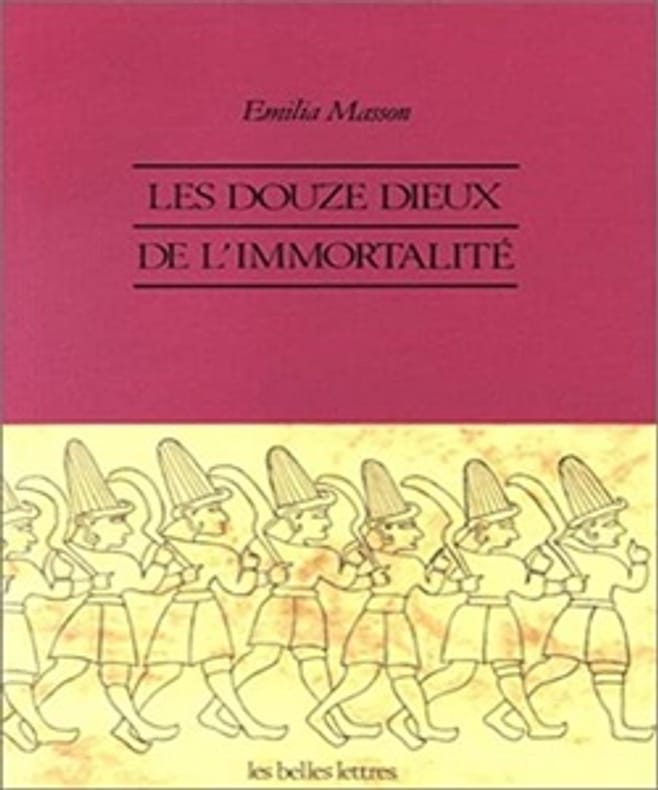
réf. 604088Paris, Les Belles Lettres, 1989. In-8 broché, couv. rempliée avec bandeau ill., X-231 pp., 20 pl. de reprod. photogr. en n/b, qq. cartes, fig. et plans en n/b. in-t., bibliographie, index.
1989réf. 606417Paris Les Belles Lettres 1989 In-8 broché, couv. rempliée avec bandeau ill., X-231 pp., 20 pl. de reprod. photogr. en n/b, qq. cartes, fig. et plans en n/b. in-t., bibliographie, index. Envoi autographe de l'auteur.
1866réf. GITh272Tours Alfred Mame et Fils 1866. 2 volumes in-8 452pp, 421pp. Demi chagrin noir, dos à nerfs, reliure de l'époque. Beau portraits de Saint Augustin et de sa mère en frontispice. Exemplaire très frais, complet du texte et de la gravure, reliure sobre de bonne qualité, en très bon état.
1883réf. GITc733Paris Auguste Ghio 1883. In-12 broché XXXIV 294pp. Petit manque au bas du dos.
1994Pen check marks to bibliography. Underlining in pen to 2 pages. Gift inscription from author to Jenifer [Neils] on half title. ; Greek Studies: Interdisciplinary Approaches; 9.0 X 6.0 X 0.7 inches; 315 pages; Signed by Author
1976Minor shelfwear; Reprint of 1932 Edition in German: Inhalt: Das larenproblem in der modernen Forschung; Mater Larum im Ritual der fratres Arvales; Dea Mania Mater Larum; Acca Larenti(n)a; Dea Tacita; Mater Larum, Mond und Geburt; Genita Mana; Register. ; Ancient Religion and Mythology; 0.5 x 8.7 x 5.5 Inches; 103 pages
2013Book is fine. DJ has 1 small tear (1 cm) to lower rear corner and very light shelfwear. ; This edited collection addresses the role of ritual representations and religion in the epic poems of the Flavian period (69-96 CE) : Valerius Flaccus' Argonautica, Silius Italicus' Punica, Statius' Thebaid, and the unfinished Achilleid. Drawing on various modern studies on religion and ritual, and the relationship between literature and religion in the Greco-Roman world, it explores how we can interpret the poets' use of the relationship between gods and humans, cults and rituals, religious activities, and the role of the seer / prophet and his identification with poetry. Divided into three major sections, the volume includes essays on the most important religious activities (prophecy or augury, prayers and hymns) and the relationship between religion and political power under the Flavian emperors. It also addresses specific episodes in Flavian epic which focus on religious activities associated with the dead and the Underworld, such as purification, necromancy, katabasis, suicide, and burial. It finally explores the role of gender in ritual and religion. ; 432 pages
1974Studien Der Skulpturhalle Basel, Heft 1; 86 pages