755 résultats
1852xxviii + 512pp., édition originale de 1852, 23cm., brochure originale, 2 cachets, texte frais et sans rousseurs, bon état, rare, R94590
2002Light bump to base of spine. Minor crease to upper part of book (book does not lay flat). Sticky note with author's dedication to ffep. ; This study questions the traditional view of sacrifices in hero-cults during the Archaic to the early Hellenistic periods. The analysis of the epigraphical and literary evidence for sacrifices to heroes in these periods shows, contrary to the traditional notion, that the main ritual in hero-cults was a thysia at which the worshippers consumed the meat from the animal victim. A particular handling of the animal’s blood or a holocaust, rituals previously taken to be typical for heroes, can rarely be documented and must be considered as marginal features in hero-cults. The terms eschara, escharon, bothros, enagizein, enagisma, enagismos and enagisterion, believed to be characteristic for hero-cults, are seldom used in hero-contexts before the Roman period and occur mainly in the Byzantine lexicographers and in the scholia. Since the main kind of sacrifice in hero-cults was a thysia, a ritual intimately connected with the social structure of society, the heroes must have fulfilled the same role as the gods within the Greek religious system. The fact that the heroes were dead seems to have been of little significance for the sacrificial rituals and it is questionable whether the rituals of hero-cults are to be considered as originating in the cult of the dead. ; Kernos Supplément 12; 429 pages
1963Minor shelfwear to all volumes. V1: slight bump to head of spine. 1 corner lightly bumped. V2: lower corners and top edge of front board lightly bumped. V3: faint bump to base of spine. ; Reprint of the 1926 ed. Complete in 3 volumes. Vol. I (1963) 307 pp; Vol. II (1963) 319 pp; Vol. III (1963) 352 pp; 3 Volume Set COMPLETE; Vol. 1/3/2022; 978 pages
1996Faint creasing to wraps. Minor shelfwear. ; Heavy book ; 302 pages
1990Dustjacket has minor shelfwear and rubbing. Book has minor shelfwear. ; Barbarians and Bishops is concerned with two fundamental themes of Late Antiquity: the barbarization of the Roman army, and the interrelation of Church and secular government. The conspicuous role played by barbarian, particularly German, soldiers in the Late Roman state has always been recognized. It still has not been satisfactorily explained. This is not surprising since the development which compelled the Empire to call on foreigners for its defence is a complex one, related to changes in basic structures and attitudes of Roman society. One of these was the triumph of Christianity which required the abandonment of a civic religion closely integrated with secular government. ; 336 pages; Gift inscription from author: "To Andrew, With best wishes --Wolf" ; Signed by Author
2006Small library stamp to bibliography page. No other ex-lib markings. Creasing to corners of wraps and some edgewear. Else VG. ; F. Marcattili: Un tempio di Esculapio a Pompei: 1. La scoperta e gli studi; 2. L' edificio di culto; 3. Il culto; 4. La Casa dello Scultore e la domus viii 7, 26 27; Appendice; Bibliografia; L. Romizzi: La casa dei Dioscuri di Pompei (vi 9, 6.7) : una nuova lettura: Premessa; Introduzione; 1. Inquadramento topografico e analisi planimetrica; 2. L' allestimento decorativo; 3. I materiali; 4. Catalogo: I quadri parietali a soggetto mitologico e teatrale; 5. Il programma figurativo della domus: un percorso per immagini; 6. Per l' identificazione della committenza: una nuova ipotesi; 7. Il rapporto con il Macellum ed il ruolo di Alleia Maia; Tabella comparativa delle decorazioni parietali e pavimentali della Casa dei Dioscuri; Abbreviazioni bibliografiche; M. -O. Laforge-Charles: Le complexe des rites magiques et le culte de Sabazios à Pompéi; La Maison ii, i, 12 ou complesso dei riti magici; Les mains panthees; Le culte de Sabazios; Les vases magiques; Comment interpréter le complexe des rites magiques ?; Le complexe des rites magiques: un lieu de culte Sabaziaque ?; Le complexe des rites magiques: un lieu de culte privé; Bibliographie; W. Van Andringa: Sacrifices et marché de la viande à Pompéi; Bibliographie. ; Studi Della Soprintendenza Archeologica Di Pompei 18; 202 pages
2007Bumping to corners. Else very light shelfwear. ; Weiner Forschungen Zur Archäologie Band 10; 259 pages
1923Gift inscription from author to ffep: "C. Bailey Balliol College from the author 1923". Includes card from author tipped in. Includes newpaper obituary of author tipped in. Former owner's name in ink to inner cover (Charles Babcock). Includes American Academy in Rome - Newletter (December 1969) tipped in (with memoriam of author). Possibly rebound in brown boards with gilt lettering to spine. Corners a bit edgeworn and spine ends. Pages tanned. ; Papers and Monographs of the American Academy in Rome Volume II; 258 pages; Signed by Author
réf. 3757Nancy, Vagner, 1863 - 1864 ; trois tomes in-12 ; demie-basane havane, dos à nerfs ornés de fleurons dorés, titre et tomaison dorés (relire de l'époque) ; 439 pp. ; 448 pp. ; 447 pp., (1) p. d'errata.
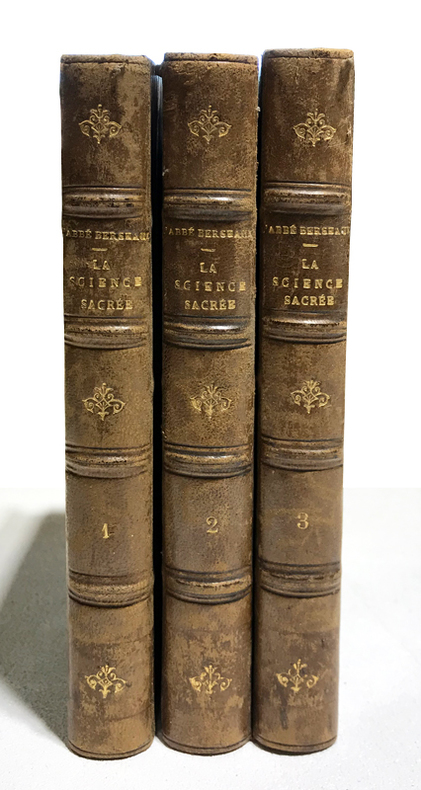
1829réf. GITc181Paris Goeury 1829. In-8 VIII (table) XLVIII (introduction) 423pp. Demi basane havane à petits coins de vélin ivoire, dos lisse orné de filets dorés, tranches jonquille, reliure de l'époque. Quelques pâles rousseurs par endroits. Bel exemplaire.
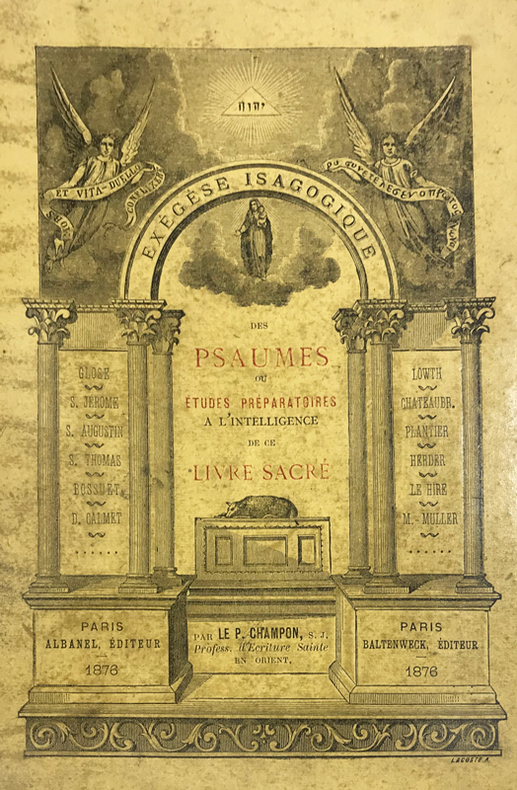
1876réf. 3786Paris, Albanel et Baltenweck (Le Puy en Velay, Imp. Freydier), 1876 ; in-8, broché ; XXXIV pp., 491 pp., (1) f. d'errata et couverture jaune illustrée.
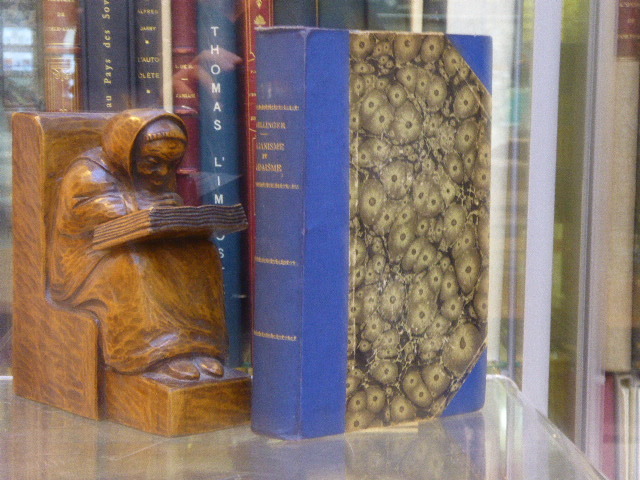
réf. 636136J. Meyers, Editeur - H. Casterman - Verhoeven Frères Liège - Paris - Bois-le-Duc S.D. (1857) 4 parties en 2 tomes reliés en 1 volume in-8 ( 220 X 140 mm ) de III-IV-457 et XVI-XII-407 pages, demi-percaline bleue à coins, dos lisse orné de filets dorés. Edition originale. Bel exemplaire.Etude des Religions.Paganisme et Judaïsme.
1990Scholar's name to ffep (Jenifer Neils). Very light pencilling to a couple of pages. Minor creasing along upper edge of DJ. ; The supreme god of the ancient Athenian pantheon, Zeus was often the subject of Athenian art, especially in vase painting and sculpture, as well as a dominant figure in Greek myths and legends. This book presents a detailed study of the depiction of Zeus in one particular classical Athenian art for--the red-figured vase. Offering a close comparison of the artistic and literary versions of the myths surrounding Zeus, including the Gigantomachy, births of the other gods, libations and offerings to the gods, and the Judgement of Paris, Arafat here examines the narrative technique of allusion against the artistic portrayals of Zeus in a contemporary religious and political context. Juxtaposing vase painting with other art forms, Arafat distinguishes the function of the different social contexts in which Zeus appears, exploring the role that the study of vase painting plays in the reconstruction of lost sculpture. ; Oxford Monographs On Classical Archaeology; 9.3 X 6.3 X 1.0 inches; 286 pages
18932 vols Rebound in 1/4 leather boards with green boards and gitl lettering. Spine cover has pieces missing along lower section and some tears and chipping to leather spine. Scholars' bookplate to inner cover (Slater & Dunbabin) along with additional bookplate. A few tears along joints of spine cover. ; 2 books bound in 1 volume. Bruchmann (1893) 226 pp; Carter (1902) 154 pp ; Ausführliches Lexikon Der Griechischen Und Römischen Mythologie: Supplement; 226 pages
1964Rebound in maroon boards with gilt spine. ; Probleme Der Ägyptologie, IV; 174 pages
1990Minor rubbing to DJ. Top corners lightly bumped else Book is Fine. ; A collection of 38 papers by Lloyd-Jones covering his interest in fields of Greek Comedy, Hellenistic literature, Greek religion, and Greek culture. ; 424 pages
2003Very minor shelfwear to book and DJ. Scholars' bookplate to inner cover (Slater & Dunbabin). ; Oxford Classical Monographs; 8.5 X 5.6 X 1.3 inches; 384 pages
1988Ex-library copy with minimal stamps, circulation page. ; Revision of thesis. ; Monographs in Classical Studies; 259 pages
1973Ex-library copy with usual stamps, call numbers and pocket. Traces of circulation page to ffep. Else book is Very Good. ; Indice: I culti egizi: Esame dei documenti, Conclusioni; I culti dell'Asia Minore: Cibele e Attis, Sabazio; Il culto di Mithra; Il Culto della Dea Syria. ...; Études Préliminaires Aux Religions Orientales Dans L'Empire Romain; 338 pages
1911Ex-library copy with usual stamps, call numbers and pocket. Light foxing. Corners bumped. Edgewear along bottom edge; Published by the British School of Archaeology in Egypt and Bernard Quaritch. Contents: Egyptian Festivals and Nile Shrines; Heliacal rising of Sirius; Application of the Kalendar to History; Length of egyptian History; Nomes of Egypt; Island of Besa; The Roman Coinage of Alexandria; Roman Glazing Kilns; Linen of the Third Dynasty; An egyptian Hippocampus; Figure-Vases in Egypt. ; British School of Archaeology in Egypt Studies. Vol. II; Folio 13" - 23" tall
1955Scholar's name to ffep (E Badian) . Pages uncut. Front wraps have Creasing to top corner along with a first pages. Wraps have edgewear with chipping and small tears. Spine is slightly browned. ; American Academy in Rome: Papers & Monographs XVI; 186 pages
1990Minor rubbing to DJ. ; A collection of 38 papers by Lloyd-Jones covering his interest in fields of Greek Comedy, Hellenistic literature, Greek religion, and Greek culture. ; 424 pages
1978Stamp from ffep has been rubbed off leaving ghost image else Fine. ; Of the oriental religions that swept across the Roman empire as forerunners of Christianity, the cult of Iuppiter Dolichenus was, together with Mithraism, the most successful in the Roman army. It may thus reveal something of the spirit of an army that was as multinational and multicultural as it was loyal, disciplined and efficient. The hope of gaining spirit of such an army and the spell of a powerful, mysterious religion prompted this study. ; Études Préliminaires Aux Religions Orientales Dans L'Empire Romain; 103 pages
1978Of the oriental religions that swept across the Roman empire as forerunners of Christianity, the cult of Iuppiter Dolichenus was, together with Mithraism, the most successful in the Roman army. It may thus reveal something of the spirit of an army that was as multinational and multicultural as it was loyal, disciplined and efficient. The hope of gaining spirit of such an army and the spell of a powerful, mysterious religion prompted this study. ; Études Préliminaires Aux Religions Orientales Dans L'Empire Romain; 103 pages
1988Scholars' bookplate to inner cover (Slater & Dunbabin). DJ is tattered and torn with tears and chipping. ; Vestigia; 268 pages