2,275 results
1913ref. S87968Dresden, Stengel & co. 1913 72pp.with some illustrations + 38 plates out-of-text (of which two in colour), loose in editor's map in green cloth (as issued), 34cm., good condition, very rare, S87968
1932ref. 44440E. Leroux, 1932 1932 Porte-folio in-4, cartonné à rabats in-4, contenant un fascicule broché 36 pp. et une suite de 50 planches de dessins codifiés en noir de motifs de tissage du Djebel Amour, certaines dépliantes, imp. sur papier libre, précédée d'une légende explicative des couleurs. Parmi les planches, 4 reproductions en couleurs de tapis et des photos en noir. Cartonnage très lég. passé, un coin émoussé. Très bon exemplaire.
1882ref. 5606Paris, Reims, A. Quentin, F. Michaud, 1882. In-folio (450 x 320 mm), (1) f. blanc, (4) ff., 164 pp., (2) ff., 16 planches d'ill. n/b. Reliure demi-percaline à coins, tirage à 500 ex. numérotés, plats frottés, coiffe inf. détériorée au mors, claires rousseurs sur titre, justificatif de tirage, première planche et page d'introduction, traces de lacets.
Prachtvoll ausgestattetes Werk über die gewirkten oberrheinischen, insbesondere baslerischen Bildteppiche. Die großformatigen Lichtdrucktafeln vermitteln ein getreues Abbild von der Wirkung der Teppiche.
ref. 3382Dourdan, E. Thézard, s.d. in-folio en feuilles sous portefeuille de l’édit. (25 planches + 12 planches de patrons).
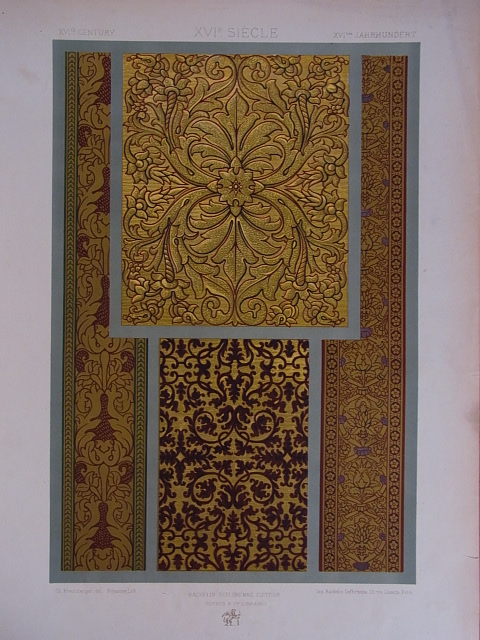
1888ref. 1233Liège, Paris, Librairie Spéciale des Arts Industriels et Décoratifs Ch. Claesen, Imprimeur-Editeur, Sans date (circa 1888). In-folio - 32,5x44cm. Reliure de l'époque en demi-basane rouge, dos lisse orné de pointillés et filets dorés et à froid, tranches mouchetées. 2ff, 25 planches, 1ff. Ouvrage destiné aux professionnels de l'art et de l'industrie. Ensemble de 25 lithographies représentant différents styles de tentures (rideaux, lit à baldaquin) décoratives. Très rare ouvrage complet de ses 25 planches chromolithographiées, protégées par des serpentes (certaines manquantes). Page de titre également chromolithographiée.
1877ref. 116767Paris, Ducher & Cie (Librairie generale de L'architecture et des travaux publics), 1877. 29,5 x 28 cm ;
1900ref. 6274AGDourdan, Emile Thezard, ca. 1900. Pochoir-colorierte Tafeln. Titelblatt, 6 Seiten Beschreibung zu den verschiedenen Tafeln, 29 lose Tafeln 32 x 44 cm. Blätter minim.fleckig, wenige m.kl . Rändläsuren bzw. gekn. Ecken. eine Tafel gebräunt mit Einriss,sonst insgesamt gut erh.
1993ref. 1871A Lausanne, Editions Acatos, 1993. In-4 - 31,5 x 25,5 cm. Reliure de l’éditeur en pleine toile, jaquette illustrée en couleurs, insérée dans un grand étui-coffret en pleine toile bleue orné d’une œuvre originale de Claude Loewer sur le premier plat, rail de maintien de la reliure en plexiglas. 312 p. Edition originale, un des 25 exemplaires du tirage de luxe, enrichi de 2 œuvres originales signées (un « collage en cuir » sur le premier plat du coffret et une gouache).Ouvrage orné de nombreuses photographies en couleurs et en noir et blanc.Rarissime exemplaire de luxe bien complet de ses 2 œuvres originales signées par l’artiste.
Seltene, prachtvolle Veröffentlichung über die Franz. Tapisserie. Jede Tafel ausführlich nach Manufaktur u. historischen Personnen und Darstellungen bestimmt.
ref. SONG1441326774Used: Good unknown
1983ref. 227921983. Transgender and cross-dressing periodical archive documents grassroots publishing community formation and evolving discourse on gender nonconformity in the United States and Europe between 1983 and 1996 a period marked by limited mainstream recognition and expanding internal advocacy networks. Produced by organizations independent publishers and media distributors these materials capture the development of trans and cross-dressing identities within both activist and subcultural frameworks. The archive includes publications associated with the International Foundation for Gender Education alongside commercial and semi-underground print reflecting a range of perspectives from political organizing to personal narrative and visual culture. It supports research in transgender history LGBTQ print networks and late 20th-century identity formation. Archive of seven items including five magazines one illustrated paper doll book and one German-language film program most in quarto format and saddle-stapled. Includes: 1 Metra Issue 107 Detroit ca. 1983 featuring "Cross-Dressing: A Legitimate Lifestyle" and coverage of a Detroit gay and lesbian health fair; 2 The TV-TS Tapestry Issue 54 Wayland Massachusetts: IFGE 1989 with content on crossdressing in Indigenous cultures and tributes to figures such as Christine Jorgensen and Karen Ulane alongside editorial work by Merissa Sherrill Lynn; 3 The World of Transvestism Vol. 19 No. 10 London: Tranz Publications ca. 1990s combining reader narratives photographs and listings for organizations including the Beaumont Society; 4 Crossdresser's Quarterly Vol. 1 No. 1 Burbank California 1990 inaugural issue featuring instructional and community-oriented content tied to national conferences; 5 Just Like a Woman film program Germany: Filmprogramm Verlagsgesellschaft 1992 documenting cinematic representation of cross-dressing; 6 Transgender Tapestry Issue 78 Wayland Massachusetts: IFGE 1996 addressing topics including family life military service and media representation; 7 Tierney Tom. Danny's Boys: A Female Impersonator Paper Doll 1997 presenting drag performance aesthetics through illustrated costume play inspired by Hollywood film imagery. These materials emerge from a period of increasing visibility and organization within transgender communities shaped in part by earlier medicalized narratives of "transsexualism" and evolving into broader identity-based advocacy by the late 20th century. Publications such as Transgender Tapestry and TV-TS Tapestry functioned as central forums for information exchange political strategy and community support while commercial and cultural items reflect parallel developments in representation and self-expression. The archive also intersects with the broader context of the HIV/AIDS Crisis during which LGBTQ publications often served as critical channels for health information and mutual aid. Light creasing rubbing and edge wear to several issues with minor tears and surface wear to select wrappers; overall very good condition. A cohesive archive illustrating the diversity of transgender and cross-dressing print culture in the late 20th century. unknown
1983ref. 227921983. Transgender and cross-dressing periodical archive documents grassroots publishing community formation and evolving discourse on gender nonconformity in the United States and Europe between 1983 and 1996 a period marked by limited mainstream recognition and expanding internal advocacy networks. Produced by organizations independent publishers and media distributors these materials capture the development of trans and cross-dressing identities within both activist and subcultural frameworks. The archive includes publications associated with the International Foundation for Gender Education alongside commercial and semi-underground print reflecting a range of perspectives from political organizing to personal narrative and visual culture. It supports research in transgender history LGBTQ print networks and late 20th-century identity formation. Archive of seven items including five magazines one illustrated paper doll book and one German-language film program most in quarto format and saddle-stapled. Includes: 1 Metra Issue 107 Detroit ca. 1983 featuring "Cross-Dressing: A Legitimate Lifestyle" and coverage of a Detroit gay and lesbian health fair; 2 The TV-TS Tapestry Issue 54 Wayland Massachusetts: IFGE 1989 with content on crossdressing in Indigenous cultures and tributes to figures such as Christine Jorgensen and Karen Ulane alongside editorial work by Merissa Sherrill Lynn; 3 The World of Transvestism Vol. 19 No. 10 London: Tranz Publications ca. 1990s combining reader narratives photographs and listings for organizations including the Beaumont Society; 4 Crossdresser's Quarterly Vol. 1 No. 1 Burbank California 1990 inaugural issue featuring instructional and community-oriented content tied to national conferences; 5 Just Like a Woman film program Germany: Filmprogramm Verlagsgesellschaft 1992 documenting cinematic representation of cross-dressing; 6 Transgender Tapestry Issue 78 Wayland Massachusetts: IFGE 1996 addressing topics including family life military service and media representation; 7 Tierney Tom. Danny's Boys: A Female Impersonator Paper Doll 1997 presenting drag performance aesthetics through illustrated costume play inspired by Hollywood film imagery. These materials emerge from a period of increasing visibility and organization within transgender communities shaped in part by earlier medicalized narratives of "transsexualism" and evolving into broader identity-based advocacy by the late 20th century. Publications such as Transgender Tapestry and TV-TS Tapestry functioned as central forums for information exchange political strategy and community support while commercial and cultural items reflect parallel developments in representation and self-expression. The archive also intersects with the broader context of the HIV/AIDS Crisis during which LGBTQ publications often served as critical channels for health information and mutual aid. Light creasing rubbing and edge wear to several issues with minor tears and surface wear to select wrappers; overall very good condition. A cohesive archive illustrating the diversity of transgender and cross-dressing print culture in the late 20th century. unknown books
1945ref. 91708CBAubusson, (1945). Jeweils 20 x 18 cm. Blattgr. 23,5 x 18 cm.
Nicht weniger als 68 hervorragende Werke der Fränkischen Bildwirkerei des 15. u. 16. Jahrhunderts sind beschrieben. Der größte Teil der Gegenstände ist in vorzüglichen Lichtdrucken reproduziert.
ref. 232851983. Transgender Tapestry a run of 13 magazines spanning 1983 to 2002 trace the editorial and political development of a major U.S. transgender periodical from the Tiffany Club era of "the magazine for persons interested in transvestism & transsexualism" to the later IFGE-era language of "Celebrating the Diversity of Gender Expression." Issue 40 1983 grounds the early publication in community infrastructure through "A HOUSE What it means" "Special Report: Provincetown Outing 1983" and "NO NAME: Coping with the use and mis-use of labels" while Issue 74 Winter 1995 announces the title shift to Transgender Tapestry and pairs that change with cover lines on Rachael Pollack "The SRS Surgeon Crisis" and "Hunks in Frocks: The New Drag Films." The later issues in this run extend that documentary range into debates over Stonewall memory spouses' and wives' rights intersex politics hate crimes Sylvia Rivera and anti-violence discourse all within the publication history of a magazine founded by Merissa Sherrill Lynn and renamed beginning with Issue 74 in Winter 1995. Tapestry / Transgender Tapestry. Massachusetts: Tiffany Club and International Foundation for Gender Education 1983-2002. Archive of 13 issues. The run preserves multiple title states including The TV-TS Tapestry Tapestry Journal and Transgender Tapestry and several issues retain strong cover copy and interior editorial matter that show the magazine's changing terminology subject matter and intended readership across two decades. 1 Lynn Merissa Sherrill and Delores Carter eds. The TV-TS Tapestry. Wayland Massachusetts: Tiffany Club 1983. Issue 40. 2 Lynn Merissa Sherrill ed. The TV-TS Tapestry. Massachusetts: Tiffany Club 1991. Issue 59. 3 Lynn Merissa Sherrill and Vivian D. Allen eds. The TV-TS Tapestry Journal. Massachusetts Fall 1994. Issue 69. 4 Allen Vivian D. ed. The TV-TS Tapestry Journal. Massachusetts Winter 1995. Issue 70. 5 Lynn Merissa Sherrill ed. The TV-TS Tapestry Journal. Massachusetts Summer 1995. Issue 72. 6 Allen Vivian D. ed. The TV-TS Tapestry Journal. Massachusetts Fall 1995. Issue 73. 7 Lynn Merissa Sherrill ed. Transgender Tapestry. Massachusetts: International Foundation for Gender Education Winter 1995. Issue 74. 8 Transgender Tapestry. Massachusetts: International Foundation for Gender Education Summer 1997. Issue 79. 9 Transgender Tapestry. Massachusetts: International Foundation for Gender Education Fall 1997. Issue 80. 10 Transgender Tapestry. Massachusetts: International Foundation for Gender Education Summer 1999. Issue 87. 11 Transgender Tapestry. Massachusetts: International Foundation for Gender Education Fall 1999. Issue 88. 12 Transgender Tapestry. Massachusetts: International Foundation for Gender Education Winter 2000. Issue 92. 13 Transgender Tapestry. Massachusetts: International Foundation for Gender Education Summer 2002. Issue 98. These 13 issues span transgender community debates across two decades of change: early issues address naming labels and community formation through pieces such as "A HOUSE What it means" and "NO NAME: Coping with the use and mis-use of labels" while the renamed Transgender Tapestry moves into explicitly political and institutional subjects including "The SRS Surgeon Crisis" "The First National Gender Lobby Day" "From Stonewall the Rebellion to Stonewall the Movie" "The GID Controversy" "Disposable People" "Remembering Our Dead" "Focus: Intersex" "GenderPAC in Washington" "Intersex Advocacy" "Jennifer Levi Attorney for Gender Justice" and "The Transgender Civil Rights Project." Across these issues the magazine records the shift from the Tiffany Club's earlier "tv-ts" and "transsexualism" framework to the broader transgender politics formalized by the title change at Issue 74 in Winter 1995. The later numbers coincide with the consolidation of transgender rights organizing in the 1990s and early 2000s: GenderPAC lobbying public argument over Gender Identity Disorder the emergence of Transgender Day of Remembrance-era anti-violence discourse expanded intersex advocacy and national legal work around gender identity discrimination all appear here in contemporaneous print rather than retrospective summary. Light creasing and minor handling wear across the run; interiors generally clean and complete. Overall good condition. This run preserves issue by issue the magazine's own record of changing transgender language political priorities and community print culture from the early 1980s through the early 2000s. unknown
ref. 232851983. Transgender Tapestry a run of 13 magazines spanning 1983 to 2002 trace the editorial and political development of a major U.S. transgender periodical from the Tiffany Club era of "the magazine for persons interested in transvestism & transsexualism" to the later IFGE-era language of "Celebrating the Diversity of Gender Expression." Issue 40 1983 grounds the early publication in community infrastructure through "A HOUSE What it means" "Special Report: Provincetown Outing 1983" and "NO NAME: Coping with the use and mis-use of labels" while Issue 74 Winter 1995 announces the title shift to Transgender Tapestry and pairs that change with cover lines on Rachael Pollack "The SRS Surgeon Crisis" and "Hunks in Frocks: The New Drag Films." The later issues in this run extend that documentary range into debates over Stonewall memory spouses' and wives' rights intersex politics hate crimes Sylvia Rivera and anti-violence discourse all within the publication history of a magazine founded by Merissa Sherrill Lynn and renamed beginning with Issue 74 in Winter 1995. Tapestry / Transgender Tapestry. Massachusetts: Tiffany Club and International Foundation for Gender Education 1983-2002. Archive of 13 issues. The run preserves multiple title states including The TV-TS Tapestry Tapestry Journal and Transgender Tapestry and several issues retain strong cover copy and interior editorial matter that show the magazine's changing terminology subject matter and intended readership across two decades. 1 Lynn Merissa Sherrill and Delores Carter eds. The TV-TS Tapestry. Wayland Massachusetts: Tiffany Club 1983. Issue 40. 2 Lynn Merissa Sherrill ed. The TV-TS Tapestry. Massachusetts: Tiffany Club 1991. Issue 59. 3 Lynn Merissa Sherrill and Vivian D. Allen eds. The TV-TS Tapestry Journal. Massachusetts Fall 1994. Issue 69. 4 Allen Vivian D. ed. The TV-TS Tapestry Journal. Massachusetts Winter 1995. Issue 70. 5 Lynn Merissa Sherrill ed. The TV-TS Tapestry Journal. Massachusetts Summer 1995. Issue 72. 6 Allen Vivian D. ed. The TV-TS Tapestry Journal. Massachusetts Fall 1995. Issue 73. 7 Lynn Merissa Sherrill ed. Transgender Tapestry. Massachusetts: International Foundation for Gender Education Winter 1995. Issue 74. 8 Transgender Tapestry. Massachusetts: International Foundation for Gender Education Summer 1997. Issue 79. 9 Transgender Tapestry. Massachusetts: International Foundation for Gender Education Fall 1997. Issue 80. 10 Transgender Tapestry. Massachusetts: International Foundation for Gender Education Summer 1999. Issue 87. 11 Transgender Tapestry. Massachusetts: International Foundation for Gender Education Fall 1999. Issue 88. 12 Transgender Tapestry. Massachusetts: International Foundation for Gender Education Winter 2000. Issue 92. 13 Transgender Tapestry. Massachusetts: International Foundation for Gender Education Summer 2002. Issue 98. These 13 issues span transgender community debates across two decades of change: early issues address naming labels and community formation through pieces such as "A HOUSE What it means" and "NO NAME: Coping with the use and mis-use of labels" while the renamed Transgender Tapestry moves into explicitly political and institutional subjects including "The SRS Surgeon Crisis" "The First National Gender Lobby Day" "From Stonewall the Rebellion to Stonewall the Movie" "The GID Controversy" "Disposable People" "Remembering Our Dead" "Focus: Intersex" "GenderPAC in Washington" "Intersex Advocacy" "Jennifer Levi Attorney for Gender Justice" and "The Transgender Civil Rights Project." Across these issues the magazine records the shift from the Tiffany Club's earlier "tv-ts" and "transsexualism" framework to the broader transgender politics formalized by the title change at Issue 74 in Winter 1995. The later numbers coincide with the consolidation of transgender rights organizing in the 1990s and early 2000s: GenderPAC lobbying public argument over Gender Identity Disorder the emergence of Transgender Day of Remembrance-era anti-violence discourse expanded intersex advocacy and national legal work around gender identity discrimination all appear here in contemporaneous print rather than retrospective summary. Light creasing and minor handling wear across the run; interiors generally clean and complete. Overall good condition. This run preserves issue by issue the magazine's own record of changing transgender language political priorities and community print culture from the early 1980s through the early 2000s. unknown books
Beschreibender Katalog einer der bedeutendsten Wandteppichsammlungen der Welt. Sehr selten, nur in 350 numerierten Exemplaren erschienen.
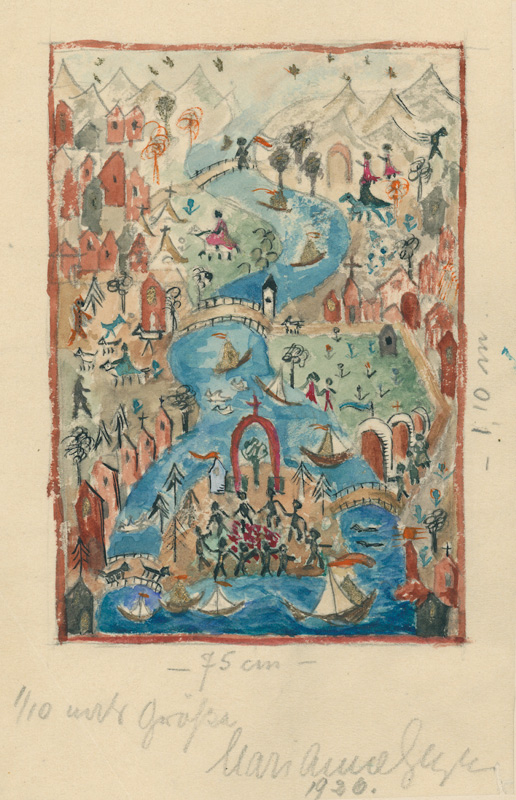
ref. 044-Wo.J. Aquarell und Deckfarben, ein wenig Goldbronze, über Bleistift, mit roter Deckfarbe gerahmt, auf dünnem chamoisfarbenem Velin, unten signiert und datiert ?Marianne Geyer 1926? und mit Maßangaben für das Webstück versehen. 16,1:9,4 cm. In den Rändern ungleich beschnitten, in der Ecke rechts unten kleiner Einriß, Ecke links unten Knickfalte.
1991ref. 55479Thonon-les-bains France: Editions De L'Albaron. New. Paperback. FREE UPGRADE to Courier/Priority Shipping Upon Request – – IN STOCK AND IMMEDIATELY AVAILABLE FOR SHIPMENT - -- with a bonus offer-- . 1991. 2908528258 . Editions De L'Albaron paperback
ref. 10340Paris, Imprimerie Nationale, 1923, 1903, 1904, 1907, 1912, 1923. 6 tomes in-folio reliés en 5 volumes, XII-386, IX-(3)-432, IX-(3)-365-(1), IX-(3)-421-(1) et XII-466-(6)-77-(1) pp., reliure demi-maroquin à coins, têtes dorées. Ex-libris : Comte Chandon de Briailles.
First edition, 5 vols., folio (390 x 280 mm), [12], 432; [12], 365, [1]; [12], 421, [1]; xii, 466; xii, 386pp., limited edition of 325 numbered sets on papier velin, of which this is, No. 144, decorative titles printed in red and black, extensively illustrated with full-page photogravure plates of the most famous Gobelin tapestries, after Charles Le Brun, Dulin, Christophe, N. Poussin, Noel Coypel, Raphael, Jules Remain, and others, occasional light damp stains to fore-edge of several leaves, bookplates removed from front paste-downs, fine contemporary terracotta brown morocco by Hatchards, covers with central gilt ruled panel containing decorative motifs and title, spines with raised bands and gilt panelled compartments, occasional light scratches and scuffs, all edges gilt, a handsome set. A most extensive and sumptuous publication. This work gives the history and pedigree of all the Tapestries woven in the National Factory of Gobelin. The edition was entirely subscribed by mostly public institutions before it was published and seldom appears in commerce.
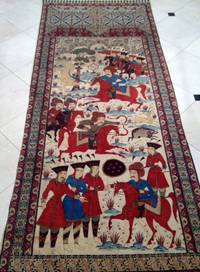
1890ref. 146641890. Hand painted Persian textile depicting Shah Abbas I nineteenth century a monumental example of Qajar period revivalist visual culture that reinterprets Safavid imperial iconography to articulate Persian kingship martial virtue and historical memory. Centered on one of the most mythologized rulers in Iranian history the composition presents a continuous figural narrative in which Shah Abbas I appears mounted on horseback in a royal hunt sword drawn as he confronts a lion while turbaned cavalry attendants bearing spears observe. A secondary vignette shows the Shah pursuing a wild boar reinforcing long standing Persian associations between sovereignty mastery over nature and military prowess. Rendered in a frontal highly legible style with flattened perspective and rhythmic repetition the imagery translates the visual language of Persian manuscript illustration into large scale textile form reflecting nineteenth century Qajar engagement with earlier Safavid models of centralized authority and dynastic legitimacy. Hand painted Persian figural textile. Qajar period nineteenth century. Approximately 117.5 x 51 inches 9.8 x 4.25 feet. The upper register introduces a martial tableau of Persian warriors confronting Indian soldiers mounted on elephants imagery that evokes enduring visual memory of imperial expansion and recalls narratives associated with Nader Shah's eighteenth century campaigns against the Mughal Empire. In the Qajar period particularly in the later nineteenth century Safavid rulers such as Shah Abbas were repeatedly invoked across painting lacquer and textile production as symbols of national continuity and restored sovereignty. This textile operates within that historicist framework layering Safavid royal imagery with later martial memory to construct a composite vision of Persian power across centuries. Minor edge tears including one approximately 1 inch and three approximately 3 inches within the border and along the edge not affecting the central figural imagery; colors remain bold and composition visually strong. Overall condition: very good. unknown
1890ref. 146641890. Hand painted Persian textile depicting Shah Abbas I nineteenth century a monumental example of Qajar period revivalist visual culture that reinterprets Safavid imperial iconography to articulate Persian kingship martial virtue and historical memory. Centered on one of the most mythologized rulers in Iranian history the composition presents a continuous figural narrative in which Shah Abbas I appears mounted on horseback in a royal hunt sword drawn as he confronts a lion while turbaned cavalry attendants bearing spears observe. A secondary vignette shows the Shah pursuing a wild boar reinforcing long standing Persian associations between sovereignty mastery over nature and military prowess. Rendered in a frontal highly legible style with flattened perspective and rhythmic repetition the imagery translates the visual language of Persian manuscript illustration into large scale textile form reflecting nineteenth century Qajar engagement with earlier Safavid models of centralized authority and dynastic legitimacy. Hand painted Persian figural textile. Qajar period nineteenth century. Approximately 117.5 x 51 inches 9.8 x 4.25 feet. The upper register introduces a martial tableau of Persian warriors confronting Indian soldiers mounted on elephants imagery that evokes enduring visual memory of imperial expansion and recalls narratives associated with Nader Shah's eighteenth century campaigns against the Mughal Empire. In the Qajar period particularly in the later nineteenth century Safavid rulers such as Shah Abbas were repeatedly invoked across painting lacquer and textile production as symbols of national continuity and restored sovereignty. This textile operates within that historicist framework layering Safavid royal imagery with later martial memory to construct a composite vision of Persian power across centuries. Minor edge tears including one approximately 1 inch and three approximately 3 inches within the border and along the edge not affecting the central figural imagery; colors remain bold and composition visually strong. Overall condition: very good. unknown books
ref. LCS-580Exemplaire relié en maroquin rouge aux armes et au chiffre du roi. A Paris, de l’Imprimerie Royale, 1670.Grand in-folio de (4) ff., 43 pp., (1) f.bl., (1) f., 47 pp., (1) p., 8 planches sur double page. Relié en plein maroquin rouge de l’époque, large roulette dorée encadrant les plats, armes frappées or au centre, dos à nerfs orné de chiffres couronnés, double filet doré sur les coupes, roulette intérieure dorée, tranches dorées.560 x 405 mm.